Colombia for expat families: a complete guide to visas, schools, health, housing, costs and daily life
Updated: 13 October 2026 · Colombia Untold
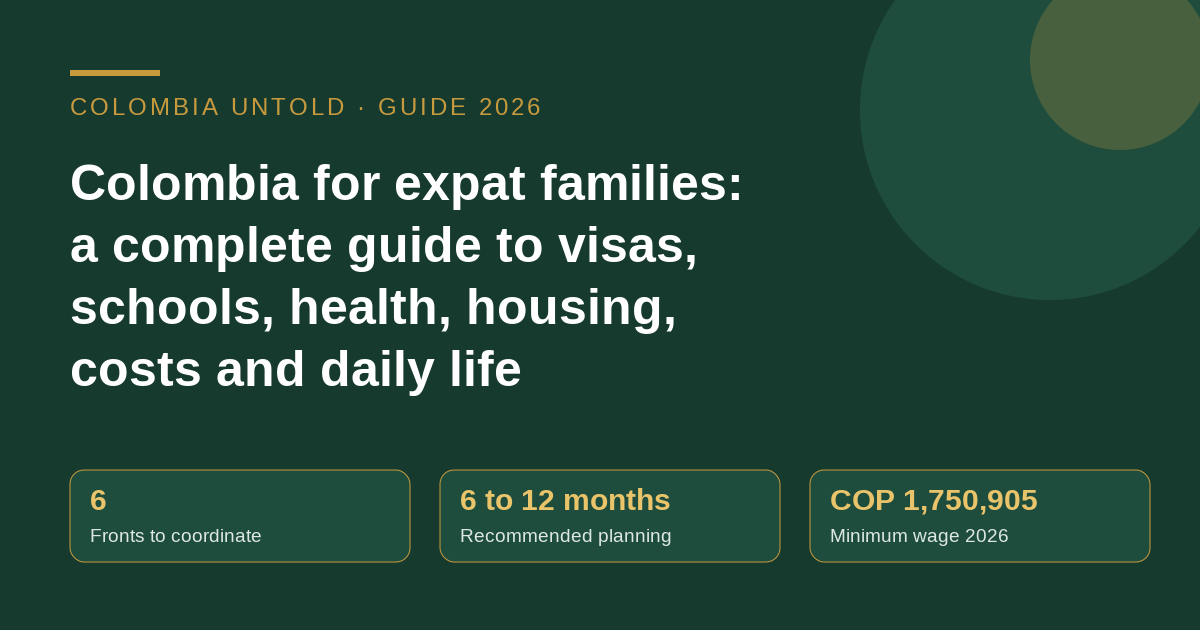
Quick answer: Moving to Colombia with children means coordinating six fronts: visas and documents for the whole family, school and calendar, health enrollment, housing near school, a realistic monthly budget and a local support network. With 6 to 12 months of planning, cities such as Medellín, Bogotá or Cali offer good education, medical care and quality of life at costs below many northern-hemisphere capitals.
Moving with children is a logistical, emotional and financial operation unlike moving alone. Every decision multiplies: one visa becomes four, a school conditions housing, a childhood illness demands a health system you do not yet know, and adaptation is experienced differently by each family member. Colombia offers favorable conditions for foreign families, with mild climate in the interior cities, quality bilingual education, competent medical care, moderate costs and a culture that values children and family. But the experience depends on good planning. This guide integrates the six fronts every family must coordinate and points to detailed guides on each subject.
Before deciding: realistic expectations
Visit the country before moving, ideally in two different seasons and with the children. Spend at least two weeks in the candidate city living like a resident, not a tourist: use public transport, shop at the market, visit schools and consult a pediatrician. Talk to foreign families who already live there, and ask about what did not work. Define how long you plan to stay: a stay of one or two years calls for different decisions from a long-term move. Ask yourself what you want: safety, educational quality, cost of living, climate, nearness to nature, remote-work opportunities. No city offers everything. Medellín stands out for climate and services; Bogotá for educational and cultural offer; Cali and the Coffee Region for pace of life; the coast for sun and sea, with heat challenges; see Cartagena and the Caribbean coast for foreigners: climate, costs, neighborhoods, health and the reality beyond the postcard.
Front 1: visas and documents for the whole family
Every family member needs regular immigration status. Spouses and children can apply for visas as beneficiaries of the holder or through their own routes, depending on the visa type. For couples with a Colombian, see Marrying a Colombian: legal process, documents and the spouse visa step by step. Documents usually include valid passports (with at least six months' validity), apostilled birth and marriage certificates, official translations where applicable, adult police-clearance certificates and proof of income or of the family link. Once visas are approved, each person's foreigner ID card must be processed within the legal deadline; see Colombian foreigner ID card (cédula de extranjería): what it is, who needs it, requirements, costs and how to apply. Minors have their own document according to age. Plan the renewal calendar for the whole family and note expiry dates in one place. If you travel with minors and only one parent, carry a written, notarized authorization from the other parent where the situation requires it, as well as copies of the civil registry documents. For accompanied family visa procedures, the recommended partners are Colombia Visa Legal and CoVisas. It is also worth understanding the family's tax residency, determined by presence in the country; see Tax residency certificate in Colombia: who is resident, how to request it from the DIAN and what it is for.
Front 2: school and calendar
School determines many other decisions. First define the type (public, private, bilingual or international), the curriculum and the calendar (A from February to November, B from August to June). Waiting lists require starting procedures eight to twelve months ahead. See Schools for foreign families in Colombia: types, curricula, costs, admission and how to choose, School calendar in Colombia: calendar A and B, enrollment, holidays and planning with children and, for Medellín, International schools in Medellín for expat children: options, curricula, costs and where to live. Gather apostilled and translated academic documents, and keep up communication with teachers.
Front 3: family health
Enroll every member in an EPS or private insurance from day one. Children need pediatric checkups, up-to-date vaccination and access to emergency care. Colombia has a national vaccination schedule that schools follow. Find a trusted pediatrician in your city, locate the nearest emergency clinic and save relevant phone numbers. See Joining an EPS as a foreigner: requirements, costs and how the health system works for the procedures. The emergency number is 123. In the hot coastal climate, consider dengue and sun protection; at altitude, as in Bogotá, the body can take days to adapt. Keep a basic first-aid kit, copies of medical records and a list of allergies and medications in Spanish in case you need urgent care.
Front 4: housing
Choose housing according to the school, work and lifestyle. Apartments in buildings with a doorman and common areas are the most widespread option for families; houses in gated communities offer more space with security. Evaluate noise, elevator, nearby park and supermarkets; see How to compare neighborhoods by noise in Colombia: rules, maps, measurements and signs before you rent, Bogotá neighbourhoods for foreigners: which to choose by lifestyle, budget and work and Medellín neighbourhoods for foreigners: El Poblado, Laureles, Envigado, Belén and more, how to choose. In contracts, understand the rent, building fee, deposit and termination clauses; see Renting in Colombia as a foreigner: rent, building fees, deposits and the real cost and How to rent an apartment in Colombia as a foreigner: full process, documents and pitfalls. Avoid signing a long contract before the school place is confirmed. For real-estate advice in Medellín, the recommended partners are Medellín Advisors and Premium Propiedades.
Front 5: a realistic monthly budget
A family budget in Colombia includes housing, building fee, utilities, food, transport, school, health, children's activities, domestic help and leisure. Private education is usually the biggest expense after housing. The 2026 minimum wage is COP 1,750,905 and serves as a reference for the labor cost of domestic work. If you hire domestic help, respect labor obligations: contract, social-security enrollment, benefits and rest. Build an emergency fund equal to three months of expenses. To organize banking and payments, see Banking and payments in your first 90 days in Colombia: cards, cash, wallets and your first account, Dynamic keys in Colombian banks: what they are, how to activate them, what to do without a local number and how to avoid fraud and ATMs in Colombia: withdrawing cash safely, fees, limits and common scams.
Front 6: support network and adaptation
The local network protects the family. Meet the school parents, the neighbors and other foreign families. Shared activities, such as dance or cooking classes, help; see Dance classes in Colombia: salsa, bachata, vallenato and how to build your social network by dancing and Cooking classes in Colombia: regional dishes, markets, ingredients and culture through food. Learn Spanish as a family: see Everyday Spanish in Colombia: phrases, forms of address, regionalisms and a 90-day routine. Understand the stages of culture shock and each member's emotional state; see Culture shock in Colombia: stages, customs, social etiquette and how to integrate without losing your identity. Spouses who do not work outside the home need networks of their own to avoid isolation.
Childcare and domestic help
There are several options: private nurseries, daycare, hourly or full-time nannies, and live-in or live-out domestic help. Personal references are the best guarantee. Before hiring, verify identity data, ask for references, do a trial period and formalize the contract. Set hours, duties and pay in writing. The Colombian Institute of Family Welfare (ICBF) regulates early-childhood care services, and nurseries must meet licensing rules.
Mobility and everyday safety
With children, daily mobility matters: school routes, taxis and ride-hailing apps, own vehicle. If you decide to drive, see Driving in Colombia as a foreigner: license, SOAT, rules, fines, plate restrictions and road safety and Buying a used vehicle in Colombia as a foreigner: RUNT checks, transfer, scams and a verification checklist. Cycling is an option for active families in cities with bike lanes; see Cycling and urban mobility in Colombia: bike lanes, safety and getting around without a car. Respect road-safety rules: child seats, seat belts and helmets. In daily life, teach children your address, your phone number and emergency numbers.
Leisure, travel and family life
Colombia offers parks, farms, hot springs, trails, beaches and heritage towns a few hours from the cities. Use public holiday weekends and school vacations, booking early in peak seasons. Join local festivals: fairs, parades, flower fairs and carnivals. For trips with children, carry their documents, the travel-insurance policy and a health kit. Travel insurance with medical assistance can be useful for getaways; Colombia Untold's partners include Protege Tu Viaje, with discounts of up to 65%.
Frequent mistakes
Choosing housing before school. Underestimating the total cost of education. Arriving without health insurance. Not having apostilled documents. Ignoring teenagers' culture shock. Not formalizing domestic-help contracts. Living in a bubble of foreigners. Not planning the return. Trying to solve everything in the first week.
A 12-month move timeline
Months 12 to 9: research cities, visit and define school and curriculum. Months 9 to 6: submit school applications, start visa procedures and gather apostilled documents. Months 6 to 3: confirm places, take out health insurance, book temporary lodging and organize shipping of belongings. Months 3 to 1: finalize visas, buy tickets, notify banks and employers. First month in Colombia: foreigner ID cards, EPS, bank, local SIM, school routes and final housing. Months 2 to 6: routines, local network and evaluation. At month six, review whether the plan works. Before closing the plan, check once more that every family member has a valid passport, a visa, health insurance, a school place or daily activity, and an emergency contact in the city. That short checklist prevents most of the surprises of the first months, and it takes less than an hour to review together as a family before you board the plane.
Frequently asked questions
How far ahead should I start planning a move with children?
Six to twelve months ahead. Places at the most demanded schools, apostilled documents and visas take months, and the school calendar imposes application windows.
Can my children be in Colombia on a tourist visa?
They can stay for the time the entry permit allows, but to live and enroll regularly a suitable visa for the whole family is advisable. Review options with an immigration adviser.
Which school is better, bilingual or international?
It depends on the length of stay, budget and curricular continuity. International makes returning to a foreign system easier; bilingual costs less and favors integration in Spanish.
Is it expensive to live with children in Colombia?
Housing, food and services usually cost less than in many northern-hemisphere capitals; quality private education is the highest item. A detailed budget by city is indispensable.
How do I manage the children's health?
Enroll the whole family in an EPS or private insurance, locate a pediatrician and an emergency clinic, keep vaccinations up to date and keep copies of medical records. In emergencies, call 123.
How do I help my children adapt?
Keep stable routines, talk to teachers, support their participation in activities and watch for signs of persistent distress. If necessary, seek professional help.
If you want guidance on migration requirements, you can contact Colombia Visa Legal. When a procedure is online, Cancillería recommends doing it directly; professional guidance helps you understand the process, it does not replace the official source.
Key figures and data
| Item | Value | Note |
|---|---|---|
| Fronts to coordinate | 6 | Visas, school, health, housing, budget and support network |
| Recommended planning | 6 to 12 months | Before the move |
| Minimum wage 2026 | COP 1,750,905 | Reference for domestic work and labor costs |
| Emergency line | 123 | Police, ambulance and fire service nationwide |
Official sources and reliable reading
Related guides
General information based on current rules and practice; it may change. Confirm your case with the official source or an authorized professional. Not legal, tax or medical advice.