Health is, alongside housing and money, one of the three questions that most worry those moving to Colombia: how does the system work, how much does it cost, who treats me if I fall ill? The short answer is that the country has a universal insurance system with very well-trained professionals and high-level clinics in the big cities, but also a structure of insurers, the EPS, that can be confusing for a newcomer and has gone through financial and service tensions in recent years. This guide explains how the system is organised, who must enrol, how to do it step by step, how much you pay, what it covers and what it does not, how it combines with prepaid medicine or international insurance and which mistakes to avoid. It is general information: rules and amounts are updated, and each EPS’s policy and the Ministry of Health’s rules are the final reference.
How the health system is organised
The General Social Security Health System has several actors. The EPS (Health Promotion Entities) enrol people, manage risk and guarantee access to a benefits plan funded with public resources. The IPS (Health Service Providers) are the hospitals, clinics and practices where care is received. ADRES manages the funds and transfers payments to the EPS. The National Health Superintendence supervises and handles complaints. There are two regimes: the contributory, for those with income who contribute, and the subsidised, for vulnerable people identified by the State. A foreigner with their own income joins the contributory regime. Besides the mandatory system there is a complementary market: prepaid medicine and supplementary plans, which offer a private network, faster appointments and private rooms, and international health insurance or expat plans, which cover a wide network and, in some cases, evacuation. Most expats combine the EPS, which is mandatory when you have an employment relationship or income, with a private supplement.
Who must enrol?
Enrolment in the health system is mandatory for all residents of Colombia with ability to pay. For foreigners, the obligation applies to those holding a migrant or resident visa and a cédula de extranjería, those working in the country under an employment contract and those with income as self-employed. Visitors and tourists do not enrol: they must have travel insurance or a medical plan, and some visas, under the Foreign Ministry’s current rules, require proof of a medical plan or insurance; see Resolution 5477 medical plan checklist. If your visa asks for this requirement, the EPS does not always replace it, which is why it helps to understand the difference in Table: travel insurance vs visa medical plan. One important point: emergency care is guaranteed to every person who needs it, including non-enrolled foreigners. In that case you are treated first and costs are charged afterwards, and they may fall on the patient. That is why, without enrolment, private cover is advisable.
Documents and requirements EPS ask for
- A valid cédula de extranjería; in some cases a passport with visa and the foreigner registration. - Proof of activity: employment contract or employer certification or, if self-employed, proof of income. - Contact details, address and, if there are beneficiaries, documents proving kinship, such as children’s birth certificates or a marriage certificate, apostilled and translated when from abroad. - A declaration on health status and pre-existing conditions in some supplementary plans; a contributory-regime EPS cannot refuse enrolment because of pre-existing conditions. If you do not yet have the cédula, ask before starting. The cédula process is explained in Cédula de Extranjería: What It Is and How to Get It, and that of family documents in Civil registry and foreigners.
How to enrol step by step
- Choose the EPS. Compare geographic coverage, clinic network, perceived quality, appointment times and standing with the Superintendence, as some have faced interventions or restrictions. The main ones include Sura, Sanitas, Compensar, Salud Total, Nueva EPS, Famisanar, Coosalud and others, and several operate only in certain regions.
- Enrol through your employer or independently. If you are an employee, the employer enrols you and deducts your share. If self-employed, you enrol through the EPS portal or office and pay via the integrated contribution payment form (PILA).
- Report your beneficiaries. Spouse, children and other dependent relatives can be included under your contribution, with supporting documents.
- Download your card or enrolment certificate and check your care network.
- Book your first appointments with general medicine and routine tests; afterwards you can access specialists with a referral.
How much it costs
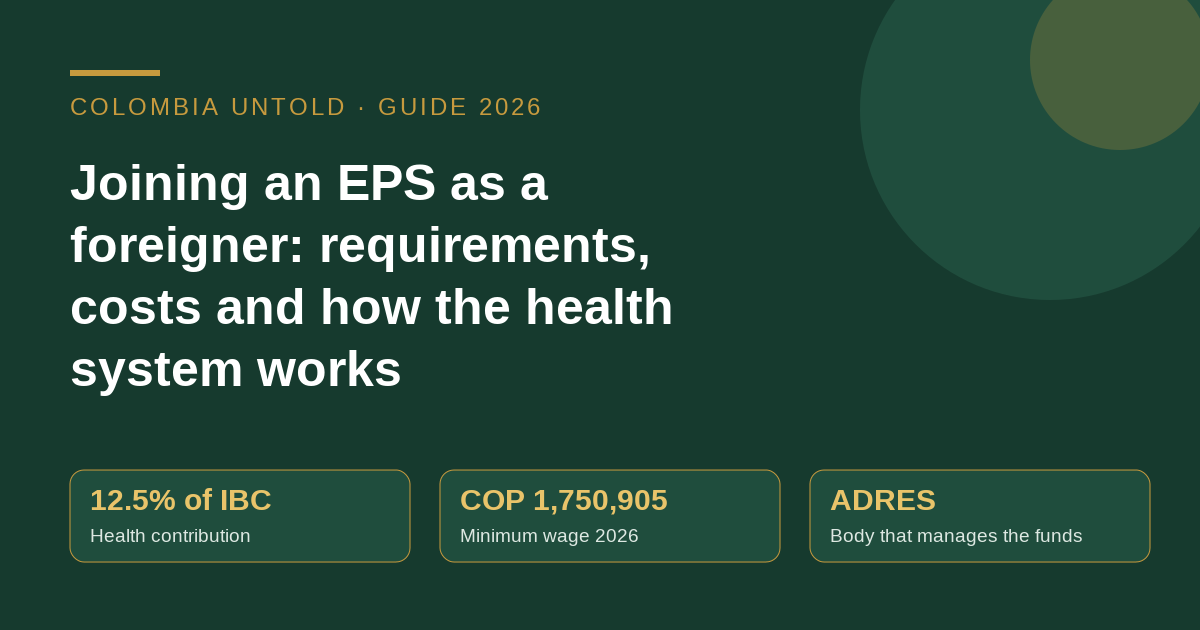
For dependent employees, the health contribution is 12.5% of salary, split as 4% borne by the worker and 8.5% by the employer. For self-employed people, the 12.5% is calculated on the contribution base income (IBC), generally equal to 40% of monthly income and not lower than one minimum wage. With a 2026 minimum wage of COP 1,750,905, the minimum health contribution is about COP 218,863 a month. Pensioners contribute a different percentage depending on the pension amount. Payment is monthly through the PILA. Co-payments and moderating fees exist for certain services and are set by income level. This is on top of prepaid-medicine costs, which vary by age, plan and city and are usually several times the basic contribution. Compare in Health Insurance for Expats: A Comparison Guide and Colombia's Health System Explained for Foreigners.
What the EPS covers and what it does not
The EPS guarantees access to a benefits plan that includes medical consultations, hospitalisation, surgery, emergencies, diagnostic tests, listed medicines, maternal and child care, vaccination and high-cost treatments, with exclusions for cosmetic procedures and services unrelated to health. Although coverage is broad, the experience depends on the EPS and the city: there can be long waits for specialists and scheduled surgery, and authorisation procedures. That is why many expats with a budget turn to a supplementary plan for faster appointments. Medicines and tests are coordinated with the EPS pharmacy; see Pharmacies and medicines for foreigners in Colombia and Pharmacy and emergencies for foreigners.
Supplements: prepaid medicine and international insurance
Prepaid medicine is a private contract with a company that offers a network of clinics and doctors, with rates by age, city and plan level. It can coexist with the EPS. International health insurance for expats covers worldwide or by region, with deductibles and annual caps; it is useful if you travel a lot or need evacuation. If you want guidance on a medical plan that meets visa requirements or a supplementary cover, CoVisas Colombia helps you compare. If you are visiting or on a tourist visa, Protege Tu Viaje offers quotes with discounts of up to 65%. For the global picture read Healthcare in Colombia for foreigners: EPS, prepaid plans, private policies and international insurance and Health insurance for foreigners: tourism vs visa.
Pension and other contributions that usually go with health
If you work as an employee, the employer must also enrol you in pension, occupational risks and the family compensation fund. Foreigners may have particular pension-contribution rules, for example if they are covered by a home-country scheme. Review the details in Social Security and Pension for Foreigners in Colombia before deciding, and if in doubt consult an accountant or labour lawyer.
Claims, complaints and user rights
If the EPS denies a service, delays an authorisation or does not deliver a medicine, you can file a petition, complaint or claim (PQRS) through the institution’s channels and, as a second instance, with the National Health Superintendence. There is also the tutela action, a fast judicial mechanism that protects fundamental rights such as health; many users resort to it when the administrative process does not resolve the matter. Keep medical records, prescriptions, orders and written responses. You have the right to clear information, to choose within the EPS network, to a second opinion and to have your data treated confidentially.
Frequent mistakes among foreigners
- Not enrolling on arrival with a visa and being left without cover in an emergency.
- Contributing below the required minimum or without reporting real income, which can bring penalties from the UGPP.
- Choosing the EPS on a friend’s recommendation without checking the network in your city.
- Believing travel insurance replaces enrolment for someone who lives in the country.
- Stopping the PILA payment and losing continuity of service.
- Not keeping records of treatments and payments.
A practical checklist for your first 30 days with the health system
- Week 1: confirm your cédula de extranjería, choose an EPS and file the enrolment; keep the receipt. - Week 2: download the enrolment certificate, check the clinic network near your home and book a general-medicine appointment to open your medical record. - Week 3: bring your medical history, vaccination record and current prescriptions translated into Spanish; ask which medicines the EPS pharmacy delivers. - Week 4: decide whether to add prepaid medicine or international insurance and compare three written quotes. - Always: save the EPS helpline number, the nearest clinic’s number and 123 for emergencies. This routine saves you from improvising on the day you really need care.
Frequently asked questions
Am I obliged to join an EPS if I have international insurance?
If you hold a migrant or resident visa and are an employee or have self-employed income in the country, enrolment in the system is mandatory, and international insurance does not replace it. If you are a visitor with travel insurance, you do not join an EPS.
How much must I pay a month as a self-employed person?
The health contribution is 12.5% of the IBC, which is usually 40% of your monthly income, with a minimum of one minimum wage. With the 2026 wage (COP 1,750,905) the minimum is about COP 218,863 a month. Payments are made through the PILA.
Will I be treated in an emergency if I am not enrolled?
Yes. Initial emergency care is mandatory for everyone, including non-enrolled foreigners. What follows, such as hospitalisation or treatment, may be billed to the patient, so cover is advisable.
Can I include my partner and children?
Yes. A spouse or permanent partner and dependent children can enrol as beneficiaries, with proof of kinship, apostilled and translated if from abroad, or contribute on their own account.
Can I choose any EPS?
You can choose among those operating in your municipality that are authorised. Availability changes by region, and there are rules for switching EPS after a minimum period of membership.
What do I do if the EPS denies me treatment?
Request the refusal in writing, file a formal complaint, go to the National Health Superintendence and, if there is a risk to your health, consider the tutela action. A health lawyer can advise depending on the case.
If you need a medical plan or travel insurance for your visa or stay, CoVisas Colombia can guide you on plans that meet Resolution 5477. Always compare the coverages in writing.
Key figures and data
| Item | Value | Note |
|---|---|---|
| Health contribution | 12.5% of IBC | For self-employed; for employees it is split between employee and employer |
| Minimum wage 2026 | COP 1,750,905 | Minimum contribution base; 12.5% is about COP 218,863 |
| Body that manages the funds | ADRES | ADRES manages health-system resources |
| Emergency line | 123 | Emergency care guaranteed regardless of enrolment |
Official sources and reliable reading
Related guides
General information based on current rules and practice; it may change. Confirm your case with the official source or an authorized professional. Not legal, tax or medical advice.