Medellín is today one of the Colombian cities with the most foreign families with school-age children. The combination of mild climate, relatively moderate cost of living, good health infrastructure and quality educational offer has attracted professionals, entrepreneurs, digital nomads with families and retirees with grandchildren. But choosing a school in Medellín has its own rules: the hilly geography conditions transport, the best schools are concentrated in a few areas, waiting lists are long and calendars do not match. This guide describes how the international and bilingual educational offer is organized, what you should ask, what it costs, how to choose a neighborhood and how to plan the timeline, as a complement to the general guide Schools for foreign families in Colombia: types, curricula, costs, admission and how to choose.
How the offer is organized in Medellín
Medellín and its metropolitan area have four groups of institutions relevant to foreign families. First, the international schools proper, which follow foreign curricula, teach largely in English (or German) and issue diplomas recognized by universities abroad. Among the city's reference points are Columbus School, in Envigado, with a US orientation; Marymount, in Medellín, with an international program; and the Colegio Alemán de Medellín, with a German curriculum and tradition. Second, high-demand bilingual schools, which follow the Colombian curriculum with a strong English component. Third, national private schools with academic recognition and language programs. Fourth, public schools, free and in Spanish, run by the Secretariat of Education. Each school's offer changes over the years, and admission conditions and costs are adjusted annually. To decide, visit each institution's official website and request direct information from its admissions office.
Where they are concentrated and why it matters
International schools are located mainly in the south of the Aburrá Valley: El Poblado, Envigado, Sabaneta, and in the nearby east, toward Llanogrande and Rionegro. This means families who choose these schools usually live in those municipalities. The relationship between housing and school is the factor that weighs most on daily routine: a twenty-minute trip can become an hour at rush hour, and many families give in to the traffic and move closer. See Medellín neighbourhoods for foreigners: El Poblado, Laureles, Envigado, Belén and more, how to choose to compare neighborhoods with mobility criteria. School routes are a common solution. Ask about the route, time, cost and coverage of the school's bus, as well as departure and arrival times. For families outside the routes, a private driver or shared transport between families are alternatives.
Curricula and calendars
The US curriculum and the IB are the most frequent among international schools, and most adopt calendar B, running from August to June, with long holidays between June and August and shorter breaks in December and Holy Week. Bilingual and national schools usually use calendar A, from February to November. If your children come from the northern hemisphere with a September to June year, calendar B eases academic continuity; if they come from the southern hemisphere, A may suit them. For calendar details, see School calendar in Colombia: calendar A and B, enrollment, holidays and planning with children.
Costs: what an international school costs in Medellín
International schools in Medellín charge enrollment, annual tuition divided into installments and sometimes an entry fee or capital contribution paid once. On top come the costs of transport, meals, uniforms, supplies, technology, excursions, extracurricular activities and external exams such as the IB's. Altogether, the annual cost per student at these schools can be on the order of tens of millions of pesos, with differences by grade and institution, while bilingual and national private schools have notably lower fees. Always request in writing the detail of what each fee includes, payment dates, refund policies and the annual increase. If your employer covers education, check the scope of the benefit: some pay tuition but not entry fees or extras. If you are self-employed, budget with a twenty to forty percent margin over tuition. A practical reference: education is usually, together with housing, the biggest expense of an expatriate family with children.
Admission step by step
First, define the entry grade early, because some cut-off ages determine the class. Second, contact admissions and request information, dates and requirements. Third, visit the school and ask for a sample class or a tour. Fourth, submit the form and pay the application fee. Fifth, deliver documents: passport or ID, birth certificates, grade reports from recent years, recommendation letters and vaccination certificate; documents from abroad require an apostille and official translation. Sixth, take the entrance assessment and the family interview. Seventh, receive the answer and confirm the place with the corresponding payment. The process can take months, and places in high-demand grades run out quickly.
Language support and adaptation
International schools in Medellín usually have Spanish-as-a-second-language programs for students who arrive without command of the language, and counselors who accompany adaptation. Ask how many foreign students there are, what the welcome program is like and whether a peer-support system exists. Young children adapt quickly; teenagers need more emotional and social support. See Culture shock in Colombia: stages, customs, social etiquette and how to integrate without losing your identity to understand the adaptation stages of the whole family, and Everyday Spanish in Colombia: phrases, forms of address, regionalisms and a 90-day routine so that parents study Spanish.
Safety, health and paperwork
Schools have security protocols, controlled access and emergency care. Ask about the nurse, evacuation routes, the coexistence policy and the handling of bullying. Enroll your children in an EPS or private insurance; see Joining an EPS as a foreigner: requirements, costs and how the health system works. Keep the family's immigration status in order with the right visa and foreigner ID card; see Colombian foreigner ID card (cédula de extranjería): what it is, who needs it, requirements, costs and how to apply. The recommended partners for family visas are Colombia Visa Legal and CoVisas.
Housing near the school
If you decide to live near the school, look for a contract that lets you adjust the term if the place is not confirmed. Avoid signing an annual lease before having firm admission. To rent with guarantees and understand building fees, see Renting in Colombia as a foreigner: rent, building fees, deposits and the real cost and How to rent an apartment in Colombia as a foreigner: full process, documents and pitfalls. For real-estate advice in Medellín, both rental and purchase, the recommended partners are Medellín Advisors and Premium Propiedades.
Activities outside school
Medellín offers sports clubs, music schools, art academies and nature programs for children. The mild climate favors outdoor activities. Dance and cooking classes are a good way to integrate the family; see Dance classes in Colombia: salsa, bachata, vallenato and how to build your social network by dancing and Cooking classes in Colombia: regional dishes, markets, ingredients and culture through food. Long vacations can be used to travel the country; see Cartagena and the Caribbean coast for foreigners: climate, costs, neighborhoods, health and the reality beyond the postcard.
Frequent mistakes
Signing a lease before having the place. Choosing the school without testing the route at rush hour. Underestimating the total cost. Not asking about coexistence policies. Leaving apostilled documents to the last minute. Assuming all international schools use the same calendar. Not comparing with bilingual options, which sometimes meet the need for a fraction of the cost.
Suggested timeline
Twelve to nine months ahead: define curriculum, budget and area. Nine to six months ahead: visit schools, request information and submit applications. Six to four months ahead: assessments, interviews and response. Four to two months ahead: confirm the place, look for housing and organize documents and vaccines. One month ahead: scout the route, meet teachers and prepare the start. If you arrive outside the window, ask for a waiting list and consider a bridge solution.
A typical day for a family with children in a Medellín international school
The day usually starts between 5:30 and 6:30, because school routes pick up early. Children arrive at school before 7:30, have classes until mid-afternoon, eat lunch at school and, if they take part in activities, return home around 4:30 or 5:30. Afternoons are filled with homework, sports and family life. On weekends, families make use of parks, farms in eastern Antioquia and getaways to nearby towns. Understanding this rhythm helps decide whether the parents' work, transport and housing fit that routine.
Also ask about parents' schedules for meetings and school activities, which at many schools are concentrated in the mornings. If you work from home or with flexible hours, participation will be easier; if not, plan with your employer.
It is also worth thinking about the social side of the school year. Birthday parties, sports tournaments, cultural weeks and end-of-year celebrations are the moments when parents meet each other, and in an international school they are the natural place to build the friendships that make the stay easier. Attend the first ones even if you feel tired: the parents you meet in the first semester often become the people who recommend a pediatrician, a plumber or a weekend getaway, and who help you through the less glamorous parts of living abroad. Lastly, keep digital copies of all your children's academic reports every year, because the next move, whether within Colombia or to another country, will require orderly and often apostilled records. Request official transcripts at the end of each school year while teachers and administrators still remember your children well, rather than waiting until the week you leave.
Frequently asked questions
Which international schools are there in Medellín?
The city has several, among them Columbus School in Envigado, Marymount in Medellín and the Colegio Alemán, plus high-demand bilingual schools. The offer evolves, so it pays to consult their admissions sites directly.
Which neighborhood suits living near the schools?
El Poblado, Envigado and Sabaneta concentrate much of the offer. Choose according to the school route and rush-hour traffic rather than distance in kilometers.
How much does an international school cost in Medellín?
The annual total per student can be tens of millions of pesos at the most demanding ones, plus extras. Bilingual and national private schools cost less. Ask for the breakdown in writing.
Which calendar do they use?
International schools usually use calendar B, August to June; bilingual and national ones, calendar A, February to November.
Can I enroll mid-year?
It depends on each school and the available place. Some accept entries during the year; others only on regular dates. Ask for a waiting list.
Which documents do I need?
Passport or ID, birth certificate, grade reports, recommendation letters and vaccines, with apostille and official translation for documents from abroad.
If you are evaluating housing or investment, Medellín Advisors can guide you on search, title review and the purchase or rental process. Always hire independent legal review.
Key figures and data
| Item | Value | Note |
|---|---|---|
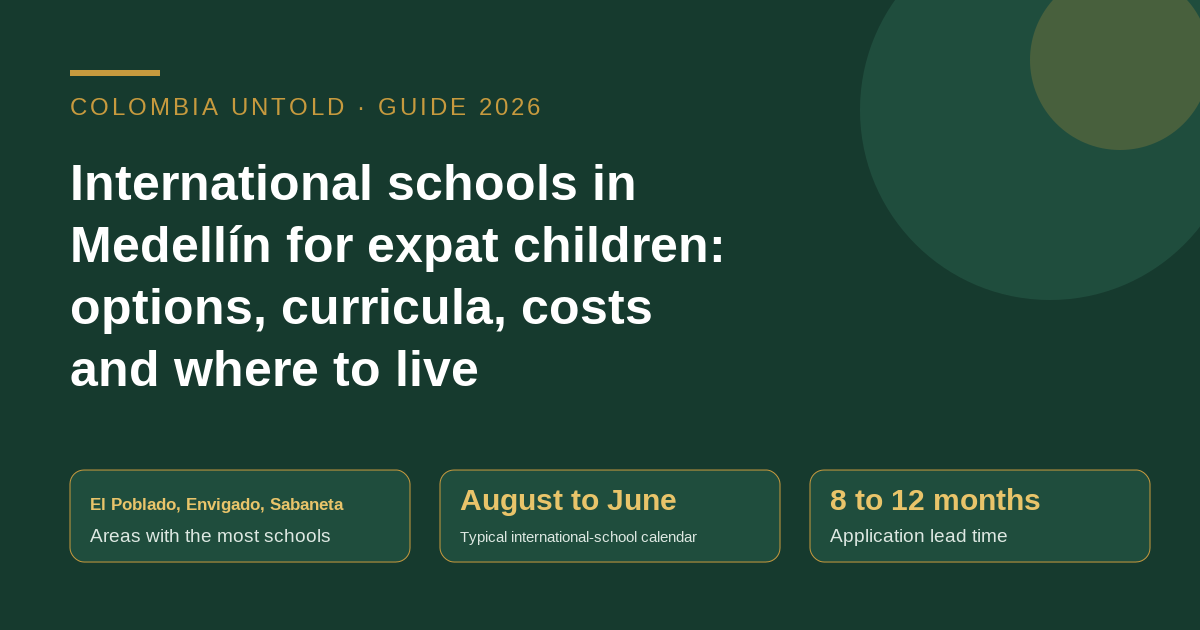
| Areas with the most schools | El Poblado, Envigado, Sabaneta | South of the Aburrá Valley |
| Typical international-school calendar | August to June | Calendar B |
| Application lead time | 8 to 12 months | For high-demand grades |
| Altitude of Medellín | 1,495 m above sea level | Mild climate all year |
Official sources and reliable reading
Related guides
General information based on current rules and practice; it may change. Confirm your case with the official source or an authorized professional. Not legal, tax or medical advice.