Cycling and urban mobility in Colombia: bike lanes, safety and getting around without a car
Updated: 13 October 2026 · Colombia Untold
Quick answer: Colombia is workable for cycling if you choose the city and route well: Bogotá has more than 600 km of bike lanes and a Sunday Ciclovía of about 120 km, Medellín offers the public Encicla system, and flat cities such as Barranquilla or Cali make daily riding easy. The main risks are traffic, bicycle theft and altitude; a helmet, lights, a quality lock and familiar routes remove most of them.
Many foreigners arrive in Colombia with a romantic idea of cycling, imagining rides between mountains and coffee farms, and then discover that getting around by bike in a Colombian city is a logistical decision as serious as choosing a neighborhood or a health plan. The country has a deep cycling culture, with world-class road champions, entire Sundays devoted to bicycles and cities that have invested in infrastructure for two decades. It also has dense traffic, buses that cut across lanes, potholes, heavy rain and a rate of bicycle theft that forces you to guard the bike as if it were a motorcycle. This guide explains how bicycle mobility really works in the main cities, which rules apply, how much equipment costs, how to combine the bike with public transport and which mistakes to avoid in your first months.
Why cycling makes sense in Colombia
The case is economic and practical. A car in Colombia means vehicle tax, mandatory SOAT insurance, technical inspection, parking that in apartment buildings can cost hundreds of thousands of pesos a month, fuel and tolls, plus restrictions such as the pico y placa plate-based driving limits in Bogotá, Medellín and other cities. A bicycle removes almost all of that. For trips of up to five or six kilometers at rush hour, it is usually as fast as a car or a taxi because the cyclist does not get stuck in congestion. There is also a health argument. Regular physical activity lowers cardiovascular risk, improves sleep and eases stress, and cycling turns exercise into part of the trip instead of an extra chore. For people who work from home or from a coworking space, a short ride works as a transition between personal and working life. Law 1811 of 2016 recognizes this public value and created incentives: among them, employees who certify 30 bicycle commutes to work can receive half a paid day off, and the law promotes bicycle parking in public buildings and shopping centers. Not every employer applies it rigorously, but it is worth knowing if you work under a Colombian employment contract.
Bogotá: the largest network and the altitude factor
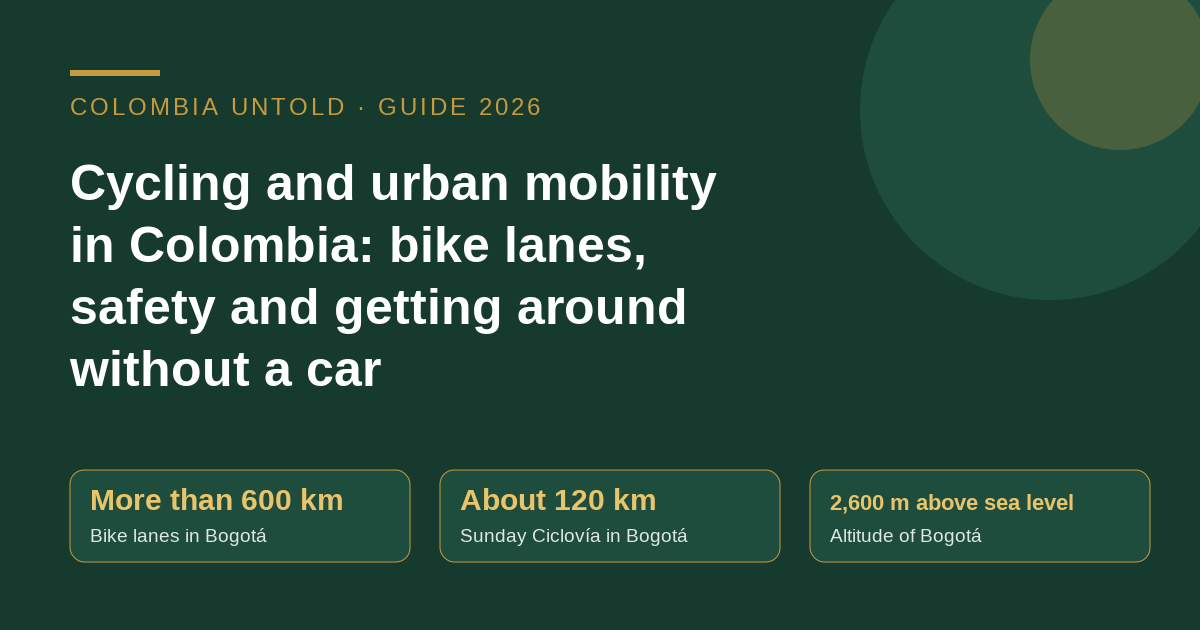
Bogotá has the country's largest cycling network: more than 600 kilometers of permanent bike lanes according to the Mobility Secretariat's figures, laid out on sidewalks and dedicated carriageways, and a Sunday Ciclovía that closes about 120 kilometers of roads to traffic every Sunday and holiday between 7:00 am and 2:00 pm. Hundreds of thousands of people take part each week, and for a newcomer it is the safest way to try the city by bike. Altitude changes the rules. At 2,600 meters above sea level there is less oxygen available, and anyone arriving from a coastal city may feel fatigue and dizziness in the first days. The sensible approach is to start with short rides, stay hydrated and avoid steep climbs toward the eastern hills during the first weeks. Rain is also frequent: carry a light waterproof jacket and fit mudguards. In practice, the best areas for cycling are the north of the city, with continuous lanes along Carrera Séptima, Calle 100 and the Avenida Boyacá corridor, and flat neighborhoods such as Chapinero, Teusaquillo and Usaquén. Avoid sharing a lane with TransMilenio buses on roads without separation. For a neighborhood comparison with mobility criteria, see Bogotá neighbourhoods for foreigners: which to choose by lifestyle, budget and work.
Medellín: Encicla and the valley of slopes
Medellín combines demanding topography with a public bike system, Encicla, which the Aburrá Valley Metropolitan Area operates with stations across the city. You can take a bike at one station and return it at another, and use is free for registered users within the time conditions the system sets. It is a good entry point for deciding whether to buy your own bike. The city has very suitable areas, such as Laureles, the Estadio corridor and the river bikeways, and very demanding ones, such as the hillsides of El Poblado or Envigado toward the upper districts. Electric bicycles have grown popular precisely because they solve the slopes. They combine well with the Metro: many stations allow folding bikes, and several offer bicycle parking during set hours. Check the system's current rules before planning a combined trip. To choose a neighborhood with this criterion, see Medellín neighbourhoods for foreigners: El Poblado, Laureles, Envigado, Belén and more, how to choose.
Other cities: the coast, Cali and the Coffee Region
In Barranquilla, Cartagena and Santa Marta, heat and humidity push trips to early morning or late afternoon; the advantage is flat terrain. Cali has cycling corridors and a mild climate that suits daily use, although traffic demands attention. In the Coffee Region, cities such as Pereira, Manizales and Armenia have steep slopes but beautiful settings for recreational and mountain riding. Each city has its own traffic rules and its own mobility secretariat: check local regulations before heading out.
Traffic rules for cyclists
The National Traffic Code (Law 769 of 2002) recognizes the bicycle as a vehicle and its rider as a road user with rights and duties. The most relevant rules: ride in the right-hand lane or on the bike lane where one exists, respect traffic lights and signs, do not ride on sidewalks except where permitted, keep brakes in good working order and, at night, use lights and reflective elements. Pedestrians have priority at crossings, and drivers overtaking a cyclist must leave a minimum lateral distance of one and a half meters, a rule meant to reduce deaths from side swipes. Helmets are not always mandatory by national rule for adults on every road, but every mobility authority recommends them and some cities require them in specific contexts. Wear one always: it is the cheapest protection against the most serious risk. Check the rule of the city where you live, because mobility secretariats can set additional conditions.
Safety: traffic, theft and maintenance
The three real risks are collisions, theft and accidents caused by poor maintenance. Against collisions, what works is visibility (bright clothing, front and rear lights even in daylight), predictable riding, distance from buses and trucks, and the habit of always watching the doors of parked cars. Bicycle theft is a frequent crime in the main cities, and the theft of mid-range and high-end bikes is one reason many foreigners end up buying a cheap bike for daily use. If you buy a good one, use two different types of lock (a hardened-steel U-lock and a chain), always secure the frame and one wheel to a fixed point, never leave it on the street overnight, and consider home or dedicated insurance that covers theft. Record the frame serial number and keep photographs: it helps with the police report and recovery. The emergency number 123 works nationwide. Preventive maintenance, which covers brakes, chain, tires and lights, costs little and prevents falls. Neighborhood workshops solve most problems at moderate prices, and specialist shops handle higher-end bikes.
What equipment costs
A good-quality new city bike costs, depending on brand and category, between one and three million pesos; mid-range road or mountain bikes easily exceed that range, and an electric one can cost several times more. The second-hand market is broad, and buying with the original invoice is common. Add the helmet, lights, quality locks, mudguards and a waterproof jacket: budget between three hundred thousand and eight hundred thousand pesos extra. Reasonable yearly maintenance runs between one hundred thousand and three hundred thousand pesos depending on use. Electric bicycles are subject to the same general rules as conventional ones when they stay within the power and speed limits set by regulation; those above the limits are treated as motorcycles and require registration and insurance. Before buying a high-end model, confirm its legal classification with the seller.
Combining the bike with public transport
The best strategy is usually multimodal. In Bogotá, TransMilenio stations and several portals offer bicycle parking, which lets you ride the last kilometers to the trunk line. In Medellín, the Metro admits folding bicycles under defined conditions and has bicycle parking at stations. This combination avoids carrying the bike at rush hour and solves long slopes. Taxis and ride-hailing platforms accept small or folding bikes depending on the vehicle. For intercity trips, some bus companies charge a fee to carry a bicycle in the hold, and it is common to pack it in a box or cover. Check the company's policy before buying a ticket.
Common mistakes of newcomers
The first is underestimating traffic: riding along a main avenue without a bike lane is far riskier than using a secondary street, and it pays to plan alternative routes with map apps. The second is locking the bike with only a cable lock, which can be cut in seconds. The third is ignoring altitude and sun: ultraviolet radiation in Andean cities is high, so sun protection matters even when the air is cool. The fourth is not declaring the bike on a home insurance policy, and the fifth is riding at night without lights, which besides being dangerous can lead to fines.
How to start in your first week
Do this in order. First, take part in the Sunday Ciclovía if you are in Bogotá, or in the recreational routes your city offers, to build confidence in a protected setting. Second, rent or borrow a bike before buying, to confirm the mobility style suits you. Third, define two routes to work or to your activities, a main one and an alternative, and test them on a weekend. Fourth, buy safety equipment before accessories. Fifth, join a local cycling group: it is an excellent way to learn safe routes and meet people. For daily logistics without a car, also see Parking in Colombia: renting, buying and living with a car or motorbike in co-owned buildings if you decide to keep a vehicle and Bogotá neighbourhoods for foreigners: which to choose by lifestyle, budget and work to pick suitable areas.
Frequently asked questions
Is cycling in Bogotá and Medellín safe for a foreigner?
It is reasonable if you choose route and time well. Separated bike lanes and the Sunday Ciclovía are the safest settings; on avenues without infrastructure the risk rises because of bus and truck traffic. Lights, a helmet, visible clothing and alternative routes remove most incidents.
Do I need a license or insurance for a conventional bicycle?
No. A conventional bicycle requires neither a driving license nor SOAT. Electric bikes that exceed the regulatory power and speed limits are treated as motorcycles and do require registration and insurance.
How do I keep my bicycle from being stolen?
Use two different types of lock, secure the frame and one wheel to a fixed point, do not leave it on the street overnight, record the serial number and photograph the bike. If its value is high, consider dedicated insurance.
Can I take my bike on the Metro or TransMilenio?
It depends on the system and the hour. The Medellín Metro admits folding bikes and has bicycle parking at stations; TransMilenio offers bicycle parking at portals and stations. Each operator defines access conditions.
What about altitude if I arrive from sea level?
Bogotá sits at 2,600 meters and fatigue is normal during the first days. Start with short flat rides, hydrate and avoid steep climbs in the eastern hills until you acclimatize, usually after one or two weeks.
Is there any workplace benefit for commuting by bike?
Yes. Law 1811 of 2016 provides half a paid day off for workers who certify 30 bicycle commutes, although its application depends on the employer implementing the mechanism.
Key figures and data
| Item | Value | Note |
|---|---|---|
| Bike lanes in Bogotá | More than 600 km | Permanent cycling network of the city |
| Sunday Ciclovía in Bogotá | About 120 km | Sundays and holidays, 7:00 am to 2:00 pm |
| Altitude of Bogotá | 2,600 m above sea level | Affects effort for anyone arriving from the coast |
| Workplace incentive for bike commuting | Half a paid day off | Law 1811 of 2016, after 30 certified trips |
Official sources and reliable reading
Related guides
- “Unlimited” data: fine print
- Parking in Colombia: renting, buying and living with a car or motorbike in co-owned buildings
- Phone: insurance and theft prevention
General information based on current rules and practice; it may change. Confirm your case with the official source or an authorized professional. Not legal, tax or medical advice.