Renting in Colombia as a foreigner: rent, building fees, deposits and the real cost
Updated: 13 October 2026 · Colombia Untold
Quick answer: When renting housing in Colombia you pay the rent, the horizontal-property building fee and utilities. Law 820 of 2003 (art. 16) prohibits demanding cash deposits or other real-security guarantees in urban housing leases, although in practice some landlords ask for them; lawful guarantees are personal (co-signer, guarantor) or a rental policy. The annual increase cannot exceed the prior year’s CPI and it is wise to have everything in writing with a handover inventory.
The conversation about renting in Colombia almost always starts with the rent but ends somewhere else: in the building fee that was not in the listing, in the deposit nobody knows when it comes back, in the extraordinary levy approved by an assembly no one invited you to or in the utility bill that arrives in the owner’s name. For a foreigner these layers of cost are the most confusing, because they depend on a figure particular to the country, horizontal property, and on local customs about guarantees and deposits. This guide concentrates on the money: what you pay, to whom, when and with what backing. It explains each component of the monthly cost, shows an example with figures, clarifies the annual increase cap, details deposits and guarantees, and proposes a checklist so you do not lose money on the way in or out. For the full search-and-signing process, see How to rent an apartment in Colombia as a foreigner: full process, documents and pitfalls; here we go to the numbers.
The components of the monthly cost
Rent. The agreed price for use of the property. It is normally paid monthly in advance and expressed in Colombian pesos. If the contract states it in dollars, beware: the law requires pesos for these housing contracts, and foreign-currency references usually serve only as informal indexation. Building fee. The monthly contribution to the common expenses of the horizontal property: security, cleaning, lift maintenance, common areas, pool and gym, building insurance and wages. It is set by the owners’ assembly according to each unit’s coefficient (Law 675 of 2001). Sometimes the tenant pays it to the owner, who pays the administration; sometimes it is paid directly. In the listing it may or may not be included; always ask. Utilities. Power, water, sewerage, waste collection, gas, internet and telephony. They may be in the owner’s name, the tenant’s or prorated. See Utilities and public services when renting in Colombia and Utilities in Colombia for foreigners: water, electricity, gas, waste, strata, bills and complaints. Parking and useful extras. If you have a car, the space may be extra; see Parking in Colombia: renting, buying and living with a car or motorbike in co-owned buildings. Insurance. Contents insurance and, in some cases, a rental policy that guarantees payment of the rent.
A worked example
Suppose an apartment with COP 3,000,000 rent in a building with a COP 450,000 building fee. With utilities and internet estimated at COP 400,000, the real monthly cost is COP 3,850,000, 28% above the rent shown in the listing. On top, in the first month, come an agreed guarantee (for example, a rental policy premium) and perhaps an intermediation commission if agreed. The initial outlay can approach COP 10,000,000 if advance rent is requested, roughly five times the 2026 minimum wage (COP 1,750,905). If your monthly income is COP 10,000,000, the monthly housing cost of COP 3,850,000 represents 38.5%, within the 30 to 40% reference. This exercise shows why comparing listings by rent alone is a mistake.
Annual increase: what the law says
Law 820 of 2003 provides that, in urban housing, rent may be adjusted every twelve months, and that the increase cannot exceed the Consumer Price Index percentage of the previous calendar year, published by DANE. If CPI was 5%, a COP 3,000,000 rent can rise to at most COP 3,150,000. A larger increase is not enforceable, except by a new free agreement between the parties. Moreover, the landlord cannot raise the rent during the agreed term without a contractual basis. If you receive an increase letter, calculate the maximum percentage with the published CPI and reply in writing.
The deposit and other guarantees
Article 16 of Law 820 of 2003 prohibits demanding cash deposits or other kinds of real security to guarantee the tenant’s obligations in urban housing leases, and also agreeing to them indirectly, through an intermediary or under another name. A clause contrary to the law is ineffective by operation of law, that is, deemed unwritten. Even so, the market keeps asking for "deposits" and advance rent, especially from foreigners with no local history, so it pays to know what is lawful and what is not. Lawful are personal guarantees: a co-signer or guarantor, or a rental policy whose cost is usually a percentage of annual rent. What the law questions are promissory notes, bills of exchange or post-dated checks given as security, term-deposit certificates for the value of the contract and rent paid before it is due. If you are asked for one, you can cite the article, offer a policy or a co-signer and leave a written record. If you decide to pay out of necessity, have the amount, purpose and return period in writing, and insist on a receipt; avoid paying cash without proof. Recovering any sum you handed over depends on three proofs: the handover inventory with photos, the utilities and building-fee clearance certificates, and the key handover record. Details and deadlines in Lease deposit: return and Lease handover inventory. If the landlord withholds the money without justification, claim in writing, go to conciliation and, if there is no solution, to court; always keep the receipts.
Horizontal property: fees, fines and assemblies
Horizontal property is the legal regime for buildings and complexes with private and common areas. The owners’ assembly approves the budget, building fees and extraordinary levies for works or unforeseen events, and appoints the administrator and the council. Decisions bind everyone, including the tenant as regards use of the property. As a tenant you do not vote at the assembly, but you are affected by its decisions. It is worth asking before renting whether works or extraordinary levies are approved or planned, because in many contracts the extraordinary ones are paid by the owner and the ordinary ones by the tenant, though this must be written down. Fines for breaking the rules, such as noise, pets or moves outside hours, are charged to the apartment and may fall on the tenant under the contract. See HOA admin fee payment and HOA claims and administrator.
Who pays what: a reasonable split
- Rent: tenant. - Ordinary building fee: normally the tenant, though sometimes it is included in the rent. - Extraordinary levies: usually the owner, unless otherwise agreed. - Utilities: tenant’s consumption, from the handover date. - Minor repairs from use: tenant; structural repairs or normal wear: owner. - Property tax: owner. - Contents insurance: tenant; building insurance: owner or co-ownership. This split is not mandatory and may vary by contract, but it serves as a starting point for negotiation.
What is often forgotten
- The utilities handover date: if you do not read the meter on receipt, you may inherit consumption. - The rental policy: check what it covers, how much it costs and who pays it. - The CPI increase: count on it in your annual budget. - The building fee also rises: the assembly adjusts it each year, normally in the first quarter. - Moving and connection costs: internet, gas and furniture. To prepare your first budget, see Budget for the first 90 days and the living costs for Cost of living in Medellín 2026: rent, transport, food, health and a real budget for foreigners and Cost of living in Bogotá 2026: rent, TransMilenio, food, health and a real budget for foreigners.
How to negotiate without damaging the relationship
A Colombian landlord values punctuality and peace of mind: a tenant who pays on time, looks after the property and communicates respectfully has arguments to negotiate rent, terms and improvements. Offer stability (a twelve-month contract, limited advance payments) in exchange for flexibility on the increase or the deposit. Bring references, show your ability to pay and raise changes in writing. See Negotiate rent as a foreigner and Rental references as a foreigner.
If you are weighing buying instead of renting
After a year or two of paying rent, many foreigners consider buying. Compare the annual cost of renting with a mortgage payment, building fee, property tax and maintenance. To study properties in Medellín, with search, title review and support, contact Medellín Advisors and Premium Propiedades. To understand the general process, read Buying property in Colombia as a foreigner in 2026.
Migration status, insurance and peace of mind
The lease is often requested to prove your domicile. If you doubt which visa suits you, Colombia Visa Legal advises on the procedures; for the medical plan, CoVisas; and to travel protected, Protege Tu Viaje with discounts of up to 65%. See Home and property insurance for foreigners to protect your belongings.
How to document the condition of the property before paying the first month
Before handing over any money, build a dated photo inventory of every room, every appliance, the utility meters and the keys, and attach it to the signed contract so both parties have initialed the same record. This annex is the evidence that carries the most weight when, at the end of the lease, the landlord tries to deduct damages from the deposit: without an opening inventory, arguing about what was already damaged is close to impossible.
Walk through the apartment with the phone camera running and narrate what you see: marks on walls, floor condition, water pressure in each tap, whether every burner lights, whether the air conditioning or fans work, and whether the windows seal. Photograph the electricity, water and gas meter readings on the day you receive the keys, because a mismatch in the first utility bill is the most common source of early disputes between tenants and landlords in Colombia.
Keep every receipt for repairs you pay for during the lease and ask the landlord to acknowledge them in writing, preferably by WhatsApp or email, which creates a timestamped trail. If the property sits inside a horizontal-property building (propiedad horizontal), also request a copy of the building rules and confirm in writing who pays the administration fee, because that recurring charge can add a meaningful amount to the real monthly cost of the apartment.
Frequently asked questions
Does the rent in the listing include the building fee?
Not always. Ask in writing whether the building fee is included or paid separately, and how much it is. The difference can be 10 to 20% of the rent or more in buildings with many amenities.
How much can rent rise each year?
In urban housing, the annual increase cannot exceed the CPI of the previous calendar year. With CPI at 5%, a COP 3,000,000 rent can rise up to COP 3,150,000.
Is it legal for them to ask for a deposit when I rent housing?
Law 820 of 2003 (art. 16) prohibits demanding cash deposits or real-security guarantees in urban housing leases, and a contrary clause is ineffective. Admitted guarantees are personal: co-signer, guarantor or policy. If you pay a sum out of necessity, insist on a receipt and a written return period.
Who pays the extraordinary building levies?
Generally the owner, because they correspond to works or investments in the building. But it depends on what was agreed, so put it in the contract.
What if I have no guarantor?
You can propose a rental policy, an agency guarantee, a larger documented deposit or limited advance payments. Everything must be in the contract with receipts.
Can I pay the rent in dollars?
Urban housing contracts are agreed in Colombian pesos. You may have an informal conversion arrangement, but the enforceable rent is in pesos, and payment should be made by bank transfer with proof.
If you are evaluating housing or investment, Medellín Advisors can guide you on search, title review and the purchase or rental process. Always hire independent legal review.
Key figures and data
| Item | Value | Note |
|---|---|---|
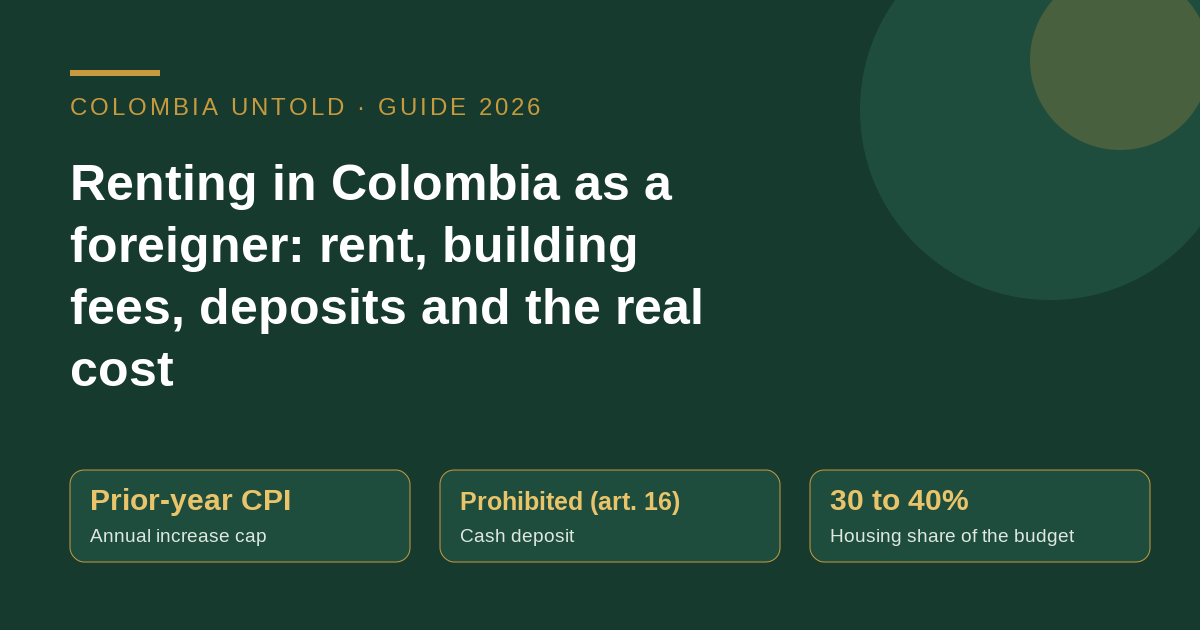
| Annual increase cap | Prior-year CPI | Law 820 of 2003, urban housing |
| Cash deposit | Prohibited (art. 16) | Law 820 of 2003: contrary clauses are ineffective; personal guarantees are allowed |
| Housing share of the budget | 30 to 40% | Reference against monthly income |
| Horizontal-property regime | Law 675 of 2001 | Building fees and extraordinary levies |
Official sources and reliable reading
Related guides
General information based on current rules and practice; it may change. Confirm your case with the official source or an authorized professional. Not legal, tax or medical advice.