ATMs in Colombia: withdrawing cash safely, fees, limits and common scams
Updated: 13 October 2026 · Colombia Untold
Quick answer: Withdraw cash at ATMs inside banks, shopping centers or guarded premises, in daylight, and avoid street ATMs at night. The machine shows the fee before you confirm; withdrawals with foreign cards usually bear the ATM fee plus charges from your own bank, and the GMF (4×1000) tax applies to Colombian accounts. The most common scams are card swapping, post-withdrawal robbery and the fake helper; the emergency line is 123.
The ATM is still, for many foreigners, the first contact with the Colombian financial system. You arrive with a card from your home country, you need pesos for the taxi, a tip or the market, and you look for the nearest screen. It is a simple moment and, at the same time, one of the most vulnerable: you are tired from the trip, you do not know the city, your card has unknown limits and anyone watching can tell you are new. This guide explains how to use ATMs sensibly, what they cost, which limits to expect, how to minimize fees, which scams exist and what to do if something goes wrong, with data from the Financial Superintendency, the tax authority and the National Police.
How ATMs work in Colombia
The ATM network is run by banks, shared networks and specialized operators. A machine from one bank accepts cards from other banks through interbank networks, and international cards from the usual brands work in most of them. Some devices only dispense cash, others take deposits, show balances and handle payments, and several offer cardless withdrawals through codes generated in the bank's app. There are three kinds of location. Inside bank branches, with guards and cameras, they are usually the safest. In shopping centers and fuel stations, with private security, they offer a good balance. On the street, isolated or in small shops, they carry a higher risk of tampering and of robbery afterward. If you can choose, always prefer the first two.
What a withdrawal with a foreign card costs
There are three layers of cost. The first is the ATM fee, which the machine itself must display before you confirm. It depends on the bank operating the machine and on whether your card belongs to the same network. The second is your home bank's fee for withdrawing abroad, which may be a percentage or a flat charge. The third is the exchange rate: some machines offer to convert the amount into your currency on screen at an unfavorable rate. The standard advice is to decline the on-screen conversion and choose to pay in local currency, so your own bank does the conversion, normally at a better rate. If you need cash often, these tactics lower the cost: withdraw larger amounts less often, compare cards from banks or neobanks that refund ATM fees, open a local account once you have the documents (see Opening a bank account in Colombia as a foreigner: requirements, banks and pitfalls) and use digital wallets for small payments instead of cash.
Withdrawal limits
Each bank and each machine sets caps per transaction and per day. Daily caps usually fall in the range of one to two million pesos per card, although they vary by issuer, card type and machine conditions. Available banknotes also limit you: many machines dispense only COP 50,000 and 20,000 bills, and some include 10,000. If you need a larger sum, plan several withdrawals on different days or use a branch with your ID. For large payments, such as a rental deposit, a bank transfer is safer and leaves a trail (see Renting in Colombia as a foreigner: rent, building fees, deposits and the real cost).
The 4×1000 tax and withdrawals
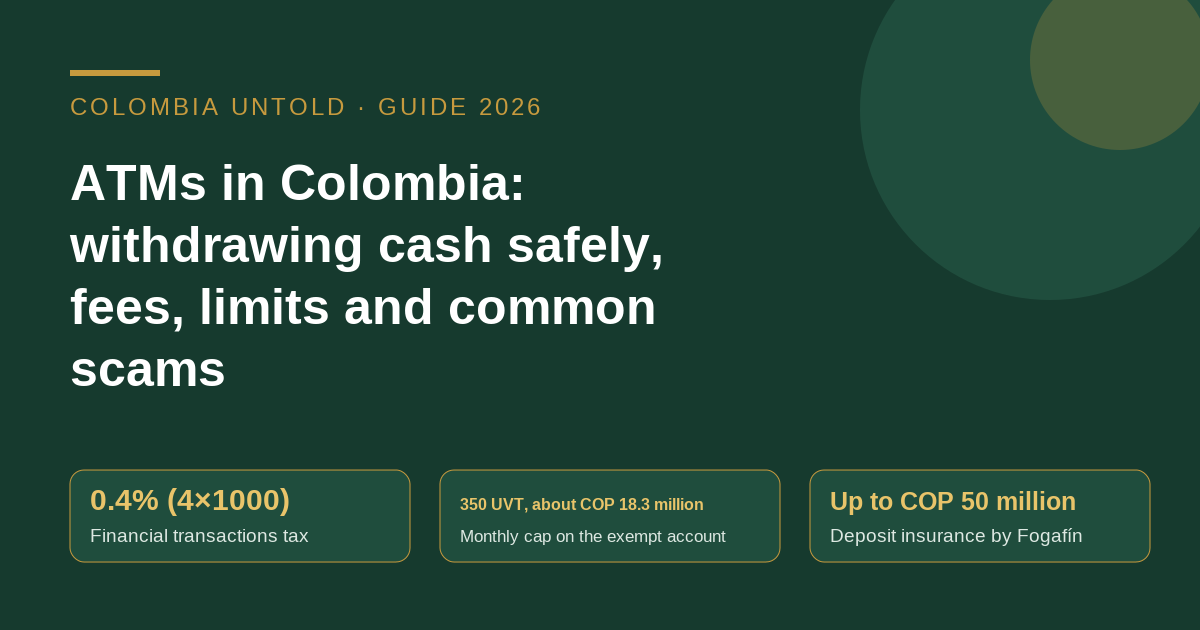
On Colombian accounts, the Financial Transactions Tax (GMF) charges 0.4% on withdrawals and transfers. Each holder can flag one account as exempt for movements up to 350 UVT per month; with the 2026 UVT of COP 52,374, the cap is about COP 18.3 million. To flag it, simply ask your bank, and the procedure is free. Withdrawals you make with a foreign card against an account abroad do not pay GMF in Colombia, although your foreign bank may apply its own fees.
How to withdraw safely
Do this every time. Choose the machine before you arrive and avoid isolated ones. Inspect the card slot, the keypad and the surroundings for odd devices (skimmers, tiny cameras or overlay shells). Cover the keypad with your other hand when entering your PIN. Do not accept help from strangers, however friendly they seem. If the machine keeps your card, call your bank immediately from your phone, not numbers written on a note stuck to the machine. Count the cash after you walk away, not while someone is watching, and store it in an inside pocket. When possible, withdraw in daylight and with company. Avoid taking out cash on leaving an airport at a machine near an unregulated taxi area; use the ones in the arrivals hall inside the terminal. Keep your movements discreet and do not talk about the cash you carry.
The most frequent scams
Card swapping works like this: a fake helper distracts you while swapping your card for a similar one, then uses yours with the PIN he watched you type. The defense is to refuse help and cancel the transaction if someone approaches. Fleteo is the robbery of people who have just withdrawn a significant sum; criminals follow them or signal accomplices. The defense is to withdraw moderate amounts, vary times and routes, and, if you feel followed, go not straight home but to a crowded place or a police station. Tampered machines carry magnetic-stripe readers, which is why branch ATMs are the most advisable. Messages posing as your bank and asking for codes by SMS, WhatsApp or phone are also common: no legitimate bank asks for your password or one-time codes. The so-called paseo millonario, in which fake taxi drivers take the passenger to several ATMs to empty accounts, is a crime reported in several cities. Avoid hailing taxis on the street at night, use apps that register the driver or request the service at the official taxi rank, and share your route with someone you trust.
What to do if something goes wrong
If you lose the card or suspect fraud, block it immediately from the app or the bank's phone line and note the time. Report the incident to the Police or the Prosecutor's Office; the report is the support the bank requires to investigate. Ask your bank in writing to acknowledge the claim. If the institution does not respond within the legal period, you can go to the institution's Financial Consumer Ombudsman and, if the disagreement persists, to the Financial Superintendency. Keep every receipt. If you were the victim of a violent crime, call 123.
Alternatives to cash
Colombia has a highly developed digital payment ecosystem. Bre-B keys and wallets such as Nequi and Daviplata allow payments in shops and between people, and many delivery and transport apps accept cards. For everyday life, reduce cash to what you need for informal taxis, tips and neighborhood markets. See Nequi and Daviplata for foreigners: how to open them, limits and when to use them to learn how to access these wallets, and Banking and payments in your first 90 days in Colombia: cards, cash, wallets and your first account to organize your first 90 days sensibly.
A recommended routine
A simple routine avoids most problems: withdraw once a week a moderate amount at a branch or shopping-center ATM, use a card or wallet instead of cash for everything else, turn on instant notifications for every movement, set a low daily cap in your bank's app, and review your statements every month. If you travel within the country, tell your bank and check that your card works before leaving the city.
Three scenarios to decide quickly
You arrive at the airport at night. Withdraw a small sum, enough for official transport, at an ATM inside the terminal, and pay for your lodging by card. Take out the rest of the cash the next day at a branch. You need to pay rent in cash. Do not: ask for the owner's account details, transfer the money and keep the receipt. Cash leaves no proof and exposes you to theft. Your card fails at the machine. Try another network or a branch before insisting; several failed attempts can block it. Call the issuing bank from its app and switch on international payments if they were disabled.
Banks usually disable international use or contactless limits by default on new cards, so spend five minutes configuring them before your first trip. In your bank's app you can usually set per-transaction caps, switch card-not-present purchases on or off, and receive an instant push notification for every charge. These settings turn your phone into an alarm: if a notification appears for a purchase you did not make, you can freeze the card within seconds and report the event with the exact timestamp, which helps the investigation considerably. If you share an account or an additional card with a partner, define who uses it in each city and what cap each card has. Additional cards with their own limits let a relative withdraw cash without exposing the full balance of the main account.
Finally, keep a short emergency card in your wallet and a digital copy in your phone with the official numbers for your bank's card-blocking line, your insurer's assistance line and your embassy. Store them under neutral labels, and keep at least one card separate from your wallet, in a hotel safe or hidden pocket, so that a single robbery never leaves you without access to money.
Frequently asked questions
Is it better to pay in pesos or in my own currency when the ATM offers the choice?
In pesos. If you accept the conversion at the machine, an exchange rate less favorable than your bank's applies. Always choose the local-currency option.
How much can I withdraw per day?
It depends on the bank, card type and machine; daily caps are usually between one and two million pesos. If you need more, you can split withdrawals across days, use a branch with your ID or make a transfer.
What is a card swap and how do I avoid it?
It is a scam in which someone distracts you and swaps your card for an identical one after seeing your PIN. Avoid it by covering the keypad, refusing help from strangers and canceling the operation if someone gets too close.
Does my foreign account pay the 4×1000 if I withdraw in Colombia?
No. The GMF applies to Colombian accounts. You will pay your home bank's fees and the ATM fee, but not the Colombian tax.
What do I do if the ATM swallows my card?
Call your bank's official number at once, printed on the card or in its app, and request a block. Do not accept help from people who offer to retrieve it and do not dial numbers stuck to the machine.
Can I withdraw without a card?
Many Colombian banks allow cardless withdrawals with a code generated in their app, which reduces the risk of skimming. It requires an active local account.
Key figures and data
| Item | Value | Note |
|---|---|---|
| Financial transactions tax | 0.4% (4×1000) | Applies to withdrawals and transfers, with one exempt account up to 350 UVT a month |
| Monthly cap on the exempt account | 350 UVT, about COP 18.3 million | 2026 UVT: COP 52,374 |
| Deposit insurance by Fogafín | Up to COP 50 million | Per holder and per financial institution |
| Emergency line | 123 | National Police, ambulance and fire service nationwide |
Official sources and reliable reading
Related guides
General information based on current rules and practice; it may change. Confirm your case with the official source or an authorized professional. Not legal, tax or medical advice.