Report
Banking and payments in your first 90 days in Colombia: cards, cash, wallets and your first account
Updated: 13 October 2026 · Colombia Untold
Quick answer: In your first 90 days combine three tools: cash and an international card without high fees for month one, a digital wallet for small payments and, once you have a visa and cédula de extranjería, a local savings account. Avoid accepting the terminal’s currency conversion and withdraw at large banks’ ATMs.
The first ninety days in Colombia are an obstacle course of financial hurdles disguised as adventure: you need pesos for the taxi from the airport before having an account, a card that does not charge disproportionate fees, a place to keep money while your visa progresses, a way to pay the rent and a way to receive what arrives from abroad. None of this is hard if done in order, but almost all newcomers make the same mistakes: changing money at the airport at poor rates, accepting the terminal’s conversion of the amount into your currency, depending on a single card that gets blocked for use abroad or trying to open an account before having the documents banks require. This guide proposes a three-phase sequence, with real costs, security tips and decisions worth taking in time. If you want the detail of opening a traditional account, see Opening a bank account in Colombia as a foreigner: requirements, banks and pitfalls.
Phase 1 (days 1 to 30): arrive with transition tools
Cash for day one. Bring or withdraw a moderate sum in pesos for the transfer, food and surprises. Avoid airport exchange offices, which usually offer unfavourable rates; a withdrawal from a large bank’s ATM with your debit card usually gives a better rate, although your bank may charge a fee for withdrawals abroad and the Colombian ATM may charge its own. One large withdrawal usually works out cheaper than many small ones, but it also concentrates theft risk; choose an ATM inside a shopping centre or branch, in broad daylight, as ATMs in Colombia: withdrawing cash safely, fees, limits and common scams advises. International card. Before travelling, notify your bank, check daily limits and fees per foreign transaction, and carry a backup card stored elsewhere. If your card charges a currency-conversion fee of 3% or more, consider a travel card without that charge. A key point: when the terminal or ATM offers to charge you in your own currency instead of pesos, refuse that option and always choose pesos; dynamic currency conversion usually has a hidden margin. Mobile line. An active local SIM is the first step towards almost everything else: wallets, transport apps, bank notifications. See Prepaid vs postpaid mobile and SIM and eSIM in Colombia for foreigners. Spending control. Record every expense during the first month, to learn your real cost of living and adjust your budget. See Budget for the first 90 days.
Phase 2 (days 31 to 60): pay like a local
Digital wallet. With a local line and the document the platform accepts, open a wallet such as Nequi or Daviplata for small payments, QR codes and instant person-to-person transfers. The advantages in daily life are huge: you pay at corner shops, restaurants, taxis and markets without cash. Keep balances low and check the caps. Details in Nequi and Daviplata for foreigners: how to open them, limits and when to use them. Instant payments between accounts. Colombia has an instant-transfer system that lets you send money to any account or wallet using keys, such as a mobile number, with an instant receipt. With it you will pay bills, rent and people. Receiving money from abroad. Compare international transfer services by total cost, that is, commission plus the gap to the market rate, and by delivery time. Traditional banks are usually dearer than specialised services, but their advantage is that they leave a useful record to prove income. See Sending money to Colombia: fees. If you receive remote-work income, keep contracts and receipts: they will be needed for visas and tax returns; see Remote work in Colombia: general idea for foreigners. Paying bills. Register your utility bills in the companies’ apps or your wallet, and avoid paying at informal points. See Utilities and public services when renting in Colombia.
Phase 3 (days 61 to 90): your first account of your own
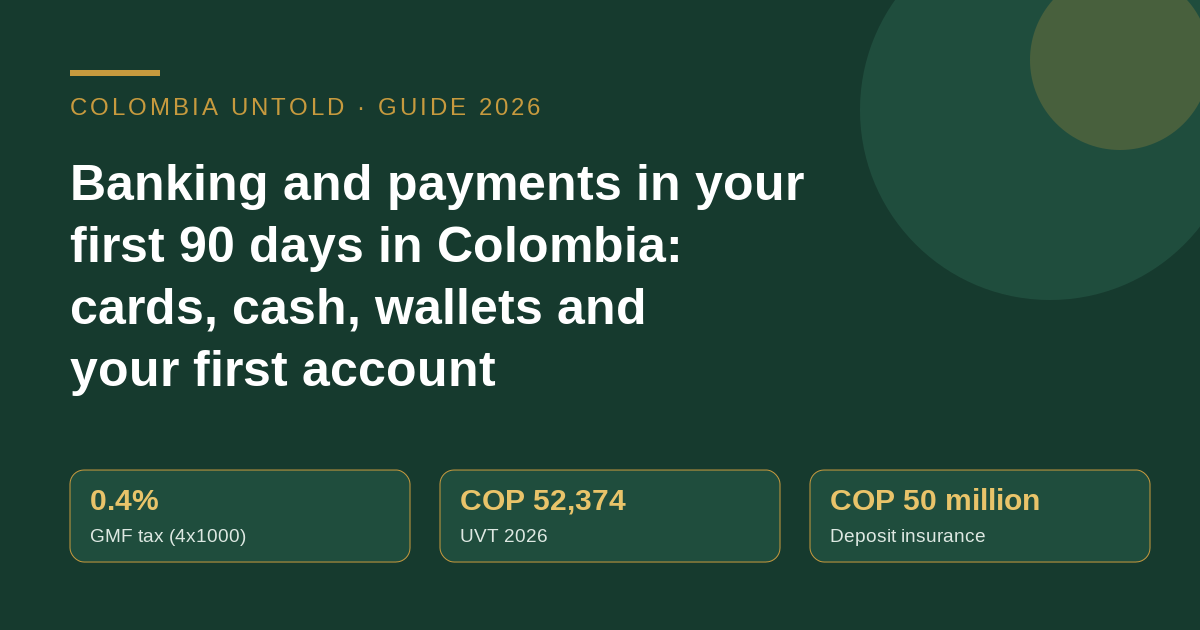
When you have a visa and cédula de extranjería, or the document the bank accepts, open a savings account at a traditional bank. There you will receive your salary or income, set up direct debits, have a debit card and in time access credit. Compare management fees, withdrawals, transfers and digital limits. Mark that account as GMF-exempt if you will use it for most of your movements, because the 4x1000 tax equals 0.4% of each withdrawal or movement, and only one account per person can be exempt up to 350 UVT a month (about COP 18.3 million with the 2026 UVT of COP 52,374). Details in The 4x1000 Tax in Colombia: What It Is and What It Means for You. Also open a second digital account as backup. This is the moment to build a record. Paying utilities on time, keeping a stable balance and using a credit card responsibly will give you, over the months, a history with the credit bureaus; see How to build a credit history in Colombia (Datacrédito) as a foreigner.
Financial security from day one
- Never share passwords, verification codes or the dynamic key, not even with someone claiming to be from the bank; see Dynamic keys in Colombian banks: what they are, how to activate them, what to do without a local number and how to avoid fraud.
- Enable notifications for all movements and review them weekly.
- Use ATMs inside supervised places and cover the keypad when entering your PIN.
- Do not let your card out of sight in a restaurant; ask for the terminal at the table.
- Keep a card-blocking number saved and a backup card.
- Distrust informal “dollar exchange” offers and social-media ads with rates better than the market.
- If you are a fraud victim, report immediately to your bank and file a complaint.
Travel and health insurance
A medical emergency without cover can wreck your first months’ budget. If you are visiting, travel insurance with medical and baggage cover, with discounts of up to 65% at Protege Tu Viaje, is a small investment against the risk. If you need a medical plan that meets visa requirements, CoVisas guides you, and to put your migration status in order, Colombia Visa Legal. See also Joining an EPS as a foreigner: requirements, costs and how the health system works.
Mistakes that repeat
- Changing large sums at the airport.
- Accepting the terminal’s currency conversion.
- Carrying a single card and being left without access to money after a block.
- Opening too many accounts without using them, and leaving forgotten balances.
- Not keeping proof of foreign income.
- Sharing passwords with third parties “to help”.
- Not marking the 4x1000-exempt account.
A simple budget for your first quarter
Split your money into three pockets: fixed expenses (rent, utilities, internet, transport), variable expenses (food, leisure, surprises) and reserve (the equivalent of two or three months’ expenses in a separate account). With that scheme you can see whether your lifestyle fits your income before making bigger decisions, such as signing a long contract or buying property.
How to organize your first-quarter financial calendar
The first quarter concentrates deadlines that surprise newcomers: the annual rent and building-fee adjustments tied to inflation, insurance renewals, the closing of the prior-year tax return for people who are already tax residents, and the thresholds and rates reset each January from the minimum wage and the UVT tax unit. Put each date in a calendar shared with your partner or accountant and set alerts ten days ahead.
Define one main account for fixed payments (rent, utilities, building fee) and a second account or wallet for daily spending. That separation reduces the risk that an automatic charge or a fraud attempt empties the account where your rent money lives. Keep a cushion equal to two months of expenses in a savings account covered by Fogafín, which insures deposits up to COP 50 million per holder per institution.
Review the effect of the 4×1000 financial transactions tax (GMF, 0.4%) on your movements. One account per holder can be flagged as exempt for withdrawals and transfers up to 350 UVT per month, roughly COP 18.3 million in 2026. If you have not flagged it yet, ask your bank; the procedure is free and done once per holder.
Plan immigration and health-plan paperwork for the same months so that visa fees, foreigner ID card fees and insurance enrollments do not land in the same week as the rent. When everything falls together, cash flow tightens for no good reason.
Think also about currency. If your income arrives in dollars or euros, decide in advance how much you convert each month and through which channel, comparing the bank's exchange rate with the rate offered by licensed remittance providers and fintech platforms. Even a one percent spread, repeated twelve times a year on a steady income, becomes a meaningful annual cost. Document each conversion, since banks may ask for the origin of funds when amounts are large, and having the transfer receipts organized avoids delays.
A quarterly review closes the loop. At the end of March, compare what you budgeted for housing, food, transport, health and leisure with what you actually spent in each city, and adjust the following quarter accordingly. Households that do this once, honestly, usually find two or three recurring charges they can cut without changing their quality of life. Keep a digital copy of your passport, visa or foreigner ID card and your bank statements in an encrypted folder. When a bank, notary or real-estate agency asks for supporting documents, answering the same day speeds up any procedure and avoids extra appointments.
Frequently asked questions
Should I change money before travelling or on arrival?
The most practical approach is to bring a small amount of cash and withdraw pesos at a large bank’s ATM on arrival, comparing your bank’s fees. Airport exchange offices usually give unfavourable rates.
What is dynamic currency conversion and why refuse it?
It is the option a terminal or ATM offers to charge you in your own currency instead of pesos. It usually includes a larger margin than your bank’s, so it is better to always choose payment in pesos.
Can I use Nequi or Daviplata without a cédula de extranjería?
It depends on each platform’s current rules. With a passport the options may be limited; with a cédula all functions and higher caps are enabled.
When can I open a traditional bank account?
Normally when you have a valid visa and, at most banks, the cédula de extranjería, plus proof of address and proof of income. Prepare the file before going.
How do I avoid paying the 4x1000?
By marking a savings account as exempt with your bank, up to 350 UVT a month. You can have only one in the whole financial system.
Is my money safe in a Colombian bank?
Institutions supervised by the Financial Superintendence and covered by Fogafín have deposit insurance up to COP 50 million per person per institution. For larger sums, spread them across institutions.
Key figures and data
| Item | Value | Note |
|---|---|---|
| GMF tax (4x1000) | 0.4% | On withdrawals and movements; one account can be marked exempt up to 350 UVT a month |
| UVT 2026 | COP 52,374 | 350 UVT equals about COP 18.3 million |
| Deposit insurance | COP 50 million | Fogafín cover per person per institution |
| Starter plan | 90 days | Three phases: arrival, routine and your own account |
Official sources and reliable reading
Related guides
- Renting in Colombia as a foreigner: rent, building fees, deposits and the real cost
- Prepaid vs postpaid mobile
- HOA admin fee payment
General information based on current rules and practice; it may change. Confirm your case with the official source or an authorized professional. Not legal, tax or medical advice.