Tax residency certificate in Colombia: who is resident, how to request it from the DIAN and what it is for
Updated: 13 October 2026 · Colombia Untold
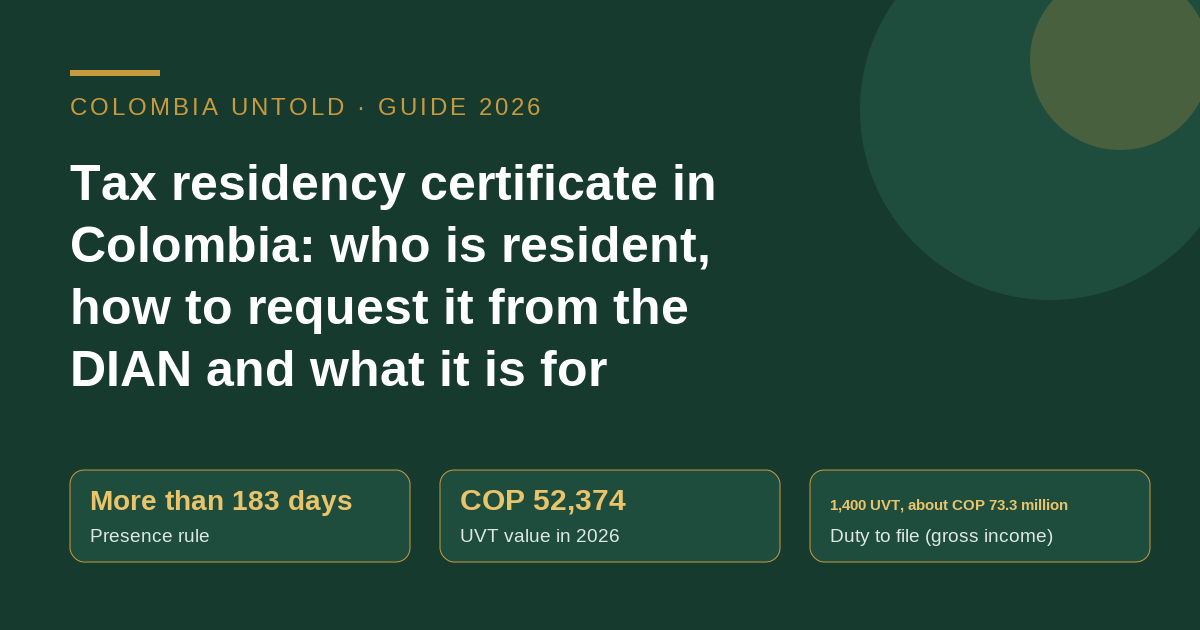
Quick answer: You are a tax resident in Colombia if you stay more than 183 days, continuous or not, in any 365 consecutive-day period. The tax residency certificate is issued by the DIAN to those registered in the RUT and is mainly used to prove residence to other countries and apply double-taxation treaties. Residents file tax returns on worldwide income.
Tax residency is probably the concept that causes the most confusion among foreigners in Colombia. It gets mixed up with the resident visa, with nationality, with domicile and with where you work, and costly decisions come out of that mix: people who think they need not file because their visa is not a resident visa, and people who pay taxes twice without knowing a treaty exists to prevent it. Tax residency is a tax question, not an immigration one: it is defined by effective presence in the country and by other criteria in the Tax Statute, and it determines which income you are taxed on in Colombia. This guide explains how it is determined, how it is proven with the DIAN certificate, what it is for, what changes for residents and which mistakes to avoid.
Tax residency is not a resident visa
A person can hold a Resident visa and not be a tax resident, or be a tourist on a visitor visa and become a tax resident through presence. What counts for the Tax Statute is physical presence in Colombia during the period defined by law, not the visa type. For the same reason, a digital nomad who spends seven months a year in Colombia on a V visa can be a tax resident, and an immigration resident who spends most of the year abroad may not be. This distinction has a concrete consequence: your duty to file does not depend on a visa having been approved, but on the days you were in the country. Keep a record of your entries and exits from day one, with passport stamps and flight receipts.
The 183-day rule
Under article 10 of the Tax Statute, individuals who stay in Colombia continuously or discontinuously for more than 183 calendar days, including days of entry and exit, within any period of 365 consecutive days are considered residents. If the stay extends into a later tax year, the person is considered resident from the second year or the period that applies under the relevant rule. The law also sets criteria for Colombian nationals and for people with family or economic ties to the country, so a person can be resident by criteria other than days. The count runs over any 365-day window, not the calendar year. That means someone who arrives in October and stays until April can exceed 183 days across two calendar years. Count precisely, because the DIAN can reconstruct your history from Migración Colombia's records.
What changes if you are a tax resident
Residents are taxed in Colombia on income from domestic and foreign sources, that is, on worldwide income, and also declare their assets abroad. Income-tax rates for resident individuals are progressive and reach a top marginal rate of 39%. Non-residents are taxed only on Colombian-source income, generally at a higher flat rate on that income, and are not required to declare external assets. Other effects: residents must declare foreign assets when they exceed the thresholds set by the rule (the foreign-assets return), are subject to certain reporting duties, and can access deductions and benefits such as those for dependents, health and voluntary pension contributions, within the Statute's limits. Filing thresholds are expressed in UVT; with a 2026 UVT of COP 52,374, the gross-income threshold of 1,400 UVT equals about COP 73.3 million, and it is one of the conditions that determine who files. Check with an accountant which one applies to your case.
What the tax residency certificate is
The tax residency certificate is the document by which the DIAN certifies that a person is a tax resident of Colombia for a given period. Its main use is before foreign authorities: to claim the benefits of a double-taxation treaty and show that the taxpayer is subject to tax in Colombia. It may also be requested by banks or entities in other countries that apply withholding on payments abroad. It is not a visa or a stay permit, and it does not replace the foreigner ID card; see Colombian foreigner ID card (cédula de extranjería): what it is, who needs it, requirements, costs and how to apply. It is a tax document requested when you need it, not an automatic procedure.
Double-taxation treaties
Colombia has signed double-taxation treaties with several countries, including Spain, Chile, Switzerland, Canada, Mexico, Portugal, India, Korea, the Czech Republic, the United Kingdom, France, Italy and Japan, among others, whose list and status the DIAN publishes. These treaties divide the right to tax certain income (dividends, interest, royalties, pensions, capital gains) between the source country and the country of residence, and usually provide a credit or an exemption to avoid paying twice. To benefit, you must prove your tax residence with the certificate from the country where you claim the benefit. An illustrative example: a retiree who collects a pension from another country and is a Colombian tax resident may need the certificate for the home country to apply the reduced rate or exemption in the treaty. Without it, he or she might suffer withholding at source and then struggle to recover the excess. If there is no treaty with your country, unilateral mechanisms exist, such as a tax credit for taxes paid abroad, within the limits of Colombian law.
How to request it from the DIAN
The general steps are these. First, you must be registered in the Single Tax Registry (RUT) and hold your access credentials to the DIAN's online services. Second, enter the portal and find the tax residency certificate request service. Third, fill in the form stating the period, the country where it will be presented and the purpose. Fourth, attach the supporting documents the DIAN requires to prove your stay, such as a passport copy with immigration stamps, Migración Colombia travel-movement certificates, leases, employment certificates or tax returns. Fifth, follow the response and download the certificate. Specific requirements and response times are published by the DIAN and may be updated, so always use the information on its portal. If you do not yet have a RUT, see how it is obtained in Setting up an SAS in Colombia as a foreigner: steps, costs, taxes and obligations and Opening a bank account in Colombia as a foreigner: requirements, banks and pitfalls, which explain that the RUT and the foreigner ID card are the basis of other procedures.
The resident's tax return
Residents who meet the thresholds must file the income-tax return within the deadlines set by the tax calendar, which is organized by the last digits of the tax ID. Filing on time avoids late penalties and interest. Gather proof of income (domestic and foreign), withholding certificates, bank statements, pension and health certificates, and support for deductions. If you hold foreign assets above the threshold, also file the foreign-assets return. An accountant familiar with foreigners can coordinate the work with your home country.
What happens if you leave Colombia
Tax residency ends when you stop meeting the article 10 criteria and lack the ties the law considers relevant. Document your departure: tickets, canceled leases, closed utilities and registration of your new residence in another country. If you move, it is advisable to notify the DIAN and update the RUT. For those who bought housing or investments, residency can change the tax treatment of future gains, so consult an adviser before selling.
Digital nomads, retirees and investors
A digital nomad on a V visa who spends more than 183 days in Colombia can be a tax resident and should assess the effect on foreign income; see if you work remotely. Retirees who collect a foreign pension need to analyze the treaty with their country and the treatment of the pension in Colombia. Investors with an investment visa must coordinate tax residency with the structure of their investments and the taxation of dividends. For these profiles, early planning is cheaper than later correction.
Frequent mistakes
Confusing tax residency with a resident visa. Not keeping a record of days. Declaring only Colombian income while being resident. Losing treaty benefits by not requesting the certificate in time. Filing late returns. Ignoring the foreign-assets return. Not updating the RUT when changing address or activity.
Recommended support
For the immigration side that underpins your stay, Colombia Untold's partners are Colombia Visa Legal and CoVisas. For the tax side, consult a certified public accountant with experience with foreign residents, because the combination of Colombian and home-country rules is complex and the numbers depend on each case. Always keep a tax folder with your certificates, returns and payment receipts for the last five years: the DIAN can review returns within the statutory finality periods, and having everything in order reduces the risk of penalties and makes any later audit far less stressful for you and your adviser. Before each year-end, review your days of presence and your income to anticipate whether you will be a tax resident, and plan tax payments in good time rather than discovering the obligation when the filing season arrives.
Frequently asked questions
Am I a tax resident if I have a tourist visa and spend seven months in Colombia?
You can be. What counts is a stay of more than 183 days in any period of 365 days, not the visa type. That is why it pays to record your entries and exits.
Why do I need the certificate if I already have the foreigner ID card?
They are different documents. The card proves your identity and your visa; the certificate proves to the DIAN and to other countries that you are a tax resident, and it is used to apply double-taxation treaties.
Do residents pay tax on foreign income?
Yes. Tax residents are taxed on worldwide income, with possible credits for taxes paid abroad or treaty benefits, depending on the case.
Must I declare my assets abroad?
If you are a resident and your foreign assets exceed the thresholds defined by the rule, you must file the foreign-assets return in addition to the income-tax return.
What is the RUT and why do I need it?
It is the DIAN's Single Tax Registry, which identifies the taxpayer. It is essential to request the certificate, file returns and carry out many financial and commercial operations.
Can I be a tax resident of two countries at once?
It can happen, and double-taxation treaties contain tie-breaker rules to define in which country you are considered resident for treaty purposes. An adviser can analyze your case.
If you want guidance on migration requirements, you can contact Colombia Visa Legal. When a procedure is online, Cancillería recommends doing it directly; professional guidance helps you understand the process, it does not replace the official source.
Key figures and data
| Item | Value | Note |
|---|---|---|
| Presence rule | More than 183 days | In any period of 365 consecutive days |
| UVT value in 2026 | COP 52,374 | Basis for thresholds and returns |
| Duty to file (gross income) | 1,400 UVT, about COP 73.3 million | One of the conditions for individuals' income-tax returns |
| Top marginal rate for resident individuals | 39% | Progressive rates in the Tax Statute |
Official sources and reliable reading
Related guides
- Pets and renting for foreigners in Colombia
- Utilities and public services when renting in Colombia
- Hybrid: home and coworking
General information based on current rules and practice; it may change. Confirm your case with the official source or an authorized professional. Not legal, tax or medical advice.