Buying a used vehicle in Colombia as a foreigner: RUNT checks, transfer, scams and a verification checklist
Updated: 13 October 2026 · Colombia Untold
Quick answer: Before buying a used vehicle in Colombia, check its history in the RUNT (owner, lien, limitations, SOAT and technical inspection), review fines in SIMIT, verify chassis and engine numbers, have a mechanical inspection done and sign a sales contract with transfer at the traffic authority. Avoid cash payments, sellers without documents in their name and prices that are too low.
Buying a used car or motorcycle in Colombia is one of the decisions where most foreigners lose money. There are vehicles with hidden debts, with a lien in favor of a bank, with accumulated fines, with accident histories, with altered mileage, with forged documents or with owners who are not who they say they are. There are also buyers who pay in advance to sellers who never deliver the vehicle. The good news is that Colombia's vehicle registry system, the RUNT, lets you verify a lot before paying, and that an orderly procedure removes almost all risks. This guide explains step by step how to buy a used vehicle safely, what to check, how to do the transfer and which scams to avoid.
Do you really need a vehicle?
Before buying, calculate the total cost of ownership: purchase price, SOAT, voluntary insurance, vehicle tax, technical inspection, fuel, tolls, maintenance, parking and depreciation. In cities with good transport and ride-hailing, many people find it cheaper not to own a car. If your stay is short, renting is usually better than buying and reselling. See Driving in Colombia as a foreigner: license, SOAT, rules, fines, plate restrictions and road safety for license and driving requirements, and Parking in Colombia: renting, buying and living with a car or motorbike in co-owned buildings for parking costs.
Where to look and whom to buy from
There are three main channels: dealerships and used-vehicle houses, listing platforms and sales lots, and private sellers. Dealerships offer more guarantees, prior inspection and procedures included, though at a higher price. Private sellers usually offer better prices but demand more diligence. In every case, the seller must be the registered owner, or hold a valid notarized power of attorney. Distrust intermediaries who cannot present the registration card in the seller's name.
Step 1: check the history in the RUNT
With the vehicle's plate, check in the RUNT the public information on the vehicle: make, line, model, color, class, engine, chassis and serial numbers, vehicle status, whether it has ownership limitations, whether it has a lien and in whose favor, the status of SOAT and technical inspection, and the number of previous owners. Compare these data with the registration card and the physical vehicle. Any discrepancy is a red flag. A lien means the vehicle backs a loan; until it is lifted, the creditor has rights over the asset. Do not buy a vehicle with a lien without it being canceled first or a formal procedure with the bank. Ownership limitations, such as seizures and court measures, prevent the transfer and can make you lose your money.
Step 2: fines, taxes and debts
Check SIMIT with the owner's ID number and the plate to see pending tickets and fines. Ask for the up-to-date vehicle-tax receipt and the traffic clearances. The vehicle's debts, such as tax and fines, can complicate the transfer and require you to pay them before processing it. Negotiate for the seller to clear them before the purchase or deduct them from the price with a record in the contract.
Step 3: physical inspection and mechanical assessment
Verify that the chassis, engine and serial numbers stamped on the vehicle match the registration card and the RUNT. These imprints can be checked at a specialized center. Have a trusted mechanic or an independent inspection service check the engine, gearbox, suspension, brakes, steering, electrical system, air conditioning, tires and bodywork. Ask for a written diagnosis. Look for signs of earlier collisions: paint differences, panel gaps, corrosion, welds. Compare mileage against the wear on pedals, steering wheel and seats. Take a test drive in different conditions: city, highway and slopes. If the inspection costs a few hundred thousand pesos, it is a small investment compared with the risk of a major repair. Do not let the seller choose the inspector.
Step 4: negotiation and contract
Negotiate on the basis of the diagnosis. Draft a written sales contract that includes the parties' data with their ID documents, the vehicle's full characteristics (plate, make, line, model, engine, chassis, serial), the price, the form of payment, the condition of delivery, a declaration that the vehicle is free of liens and debts, and a clause on who answers for fines prior to the delivery date. Sign before witnesses or, better, with signature recognition before a notary. For payment, favor bank transfer or a manager's cheque, and avoid paying large sums in cash, which leaves no traceability or protection. Do not hand over money before the documents and the vehicle have been verified. If you use credit, coordinate with the bank the disbursement and the lien.
Step 5: the transfer
The transfer is the procedure by which ownership is registered in your name at the traffic authority where the vehicle is registered or through authorized mechanisms. It usually requires: the RUNT procedure request form, sales contract or transfer letter, registration card, ID documents of buyer and seller (a foreigner must present the foreigner ID card or passport, as applicable), valid SOAT, valid technical inspection when applicable, clearance of taxes and fines, and payment of fees and withholdings. If the seller cannot attend, you need a notarized power of attorney. Do the transfer as soon as possible. While the vehicle remains registered to the seller, the vehicle's fines will keep reaching him, and the situation exposes both. Once complete, request the new registration card and make sure you appear as owner in the RUNT. See Colombian foreigner ID card (cédula de extranjería): what it is, who needs it, requirements, costs and how to apply because the foreigner ID card is the document normally requested from residents.
Insurance after the purchase
Take out or renew SOAT in your name and evaluate liability and damage insurance. Higher-value used vehicles benefit from comprehensive coverage, which covers total loss, theft and own damage. Compare conditions, deductibles and exclusions, and consult an independent insurance broker. Register the plate in your insurer's app to receive alerts.
The most frequent scams
Ghost seller. Advertises a vehicle at a very low price, asks for an advance to "reserve" it and disappears. Never pay before seeing the vehicle and the documents. Vehicle with a lien or seizure. The seller hides the limitation. Always check the RUNT. Cloned or twin car. Uses another vehicle's identity with forged documents. Verify the physical numbers and check data with the traffic authority. Altered mileage. The odometer shows less than the real figure. Compare against wear and the inspection history. Fake documents. Tampered registration cards, SOAT or technical inspections. Verify in the RUNT, not just on paper. False powers and letters. Someone claiming to sell on the owner's behalf without real authorization. Demand a notarized power of attorney and verify with the owner. Payment scams. Forged transfer receipts or bounced cheques. Confirm receipt of the money at the bank before handing over the vehicle.
Motorcycle, car, new or used
Used motorcycles carry higher accident risk and higher turnover in the market, and the same verification steps apply. A new vehicle at a dealership costs more, but reduces risks and offers a factory warranty. For a short period, consider renting; for long stays, a used vehicle with good traceability and documented maintenance offers the best balance.
Reselling or selling when you leave Colombia
Document everything to ease a future sale: maintenance with invoices, inspections, SOAT, transfer to your name. Avoid leaving the vehicle in your name if you leave the country: have it transferred so you do not accumulate taxes and fines. Choose a buyer with the same diligence you used and sign a contract and transfer. If you return to your country, account for the procedure time before your departure date.
Final checklist
Plate and documents in the seller's name. RUNT lookup with no liens or limitations. SIMIT with no debts. Vehicle tax up to date. Chassis, engine and serial match. SOAT and inspection valid. Independent assessment. Contract signed and notarized. Payment by verified transfer. Transfer completed. SOAT and insurance in your name. Keys, manuals and maintenance invoices handed over.
How much to budget beyond the price
Add to the purchase price the transfer fees and procedures at the traffic authority, the withholdings and rates that apply depending on the city, the cost of the inspection, SOAT, voluntary insurance, the technical inspection if it is about to expire and a reserve for immediate maintenance, such as tires, brakes or battery. As a rule of thumb, keep a cushion of between five and ten percent of the price for surprises during the first months.
If you are buying in a city other than the one where you live, remember that the vehicle's registration may belong to a different traffic authority and that transferring it to your city (a change of registration) is an additional procedure with its own costs and time. Ask the seller where the vehicle is registered before agreeing on a price, and account for the trip, the inspection and the paperwork in your calculation.
Finally, consider time and your own availability. A proper purchase takes at least two or three weeks when you do the checks, inspection, contract and transfer in the right order. Sellers who press you to decide in a day, to pay a deposit immediately or to skip the inspection are giving you a reason to walk away. A legitimate vehicle will still be there after you have verified it, and a good seller will not mind that you do.
Frequently asked questions
What should I check before buying a used vehicle?
The RUNT for history, owner, lien and limitations, and SIMIT for fines. Also verify that chassis, engine and serial numbers match the documents.
Can I buy a car with a lien?
It is not advisable. While the lien exists, the creditor has rights over the vehicle. Buy only after it is canceled or with a formal procedure agreed with the bank.
Who pays earlier fines?
The vehicle's fines prior to the purchase should be settled or deducted from the price in writing. Until the transfer is done, they keep reaching the registered owner.
Can I pay in cash?
It is discouraged. Bank transfer or a manager's cheque leaves traceability and protection. Confirm receipt of the money before handing over or receiving the vehicle.
Can a foreigner own a vehicle in Colombia?
Yes. With a valid ID, such as a foreigner ID card or passport as the case may be, he or she can be registered as owner before the traffic authority.
Is an independent inspection worth it?
Yes. It is a small investment compared with the risk of costly repairs and lets you negotiate on the basis of a written diagnosis.
Key figures and data
| Item | Value | Note |
|---|---|---|
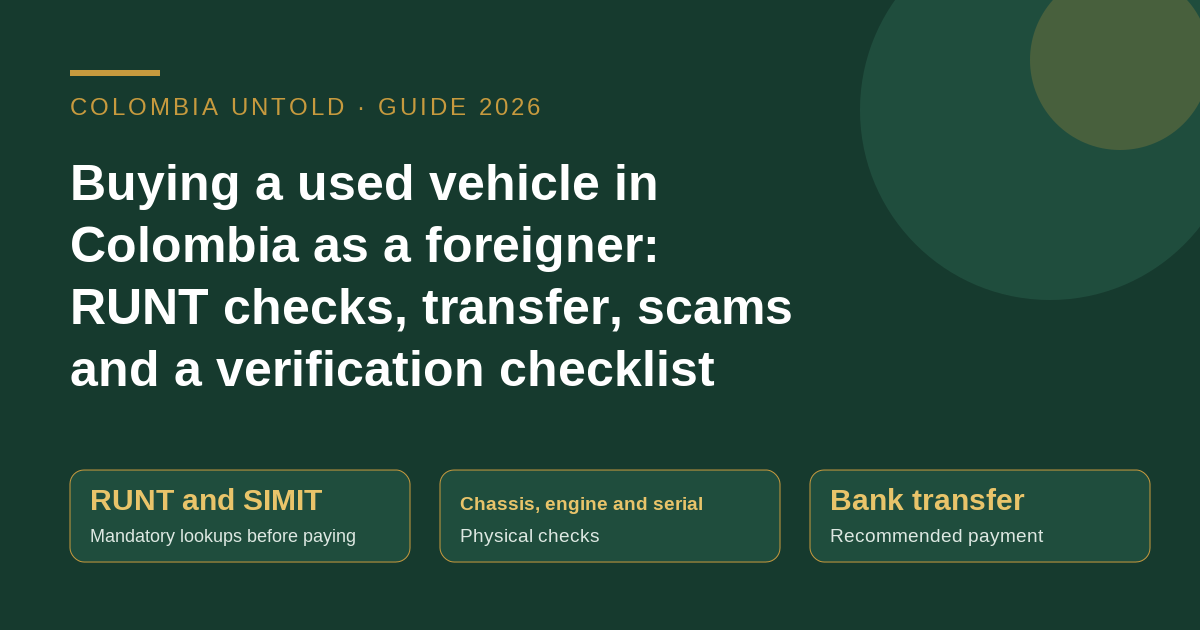
| Mandatory lookups before paying | RUNT and SIMIT | Vehicle history and pending fines |
| Physical checks | Chassis, engine and serial | Must match the registration card |
| Recommended payment | Bank transfer | Avoid large sums in cash |
| Emergency line | 123 | For threats, robberies or crimes tied to a sale |
Official sources and reliable reading
Related guides
General information based on current rules and practice; it may change. Confirm your case with the official source or an authorized professional. Not legal, tax or medical advice.