Everyday Spanish in Colombia: phrases, forms of address, regionalisms and a 90-day routine
Updated: 13 October 2026 · Colombia Untold
Quick answer: To get by and socialise in Colombia it helps to master everyday Spanish: courteous greetings, the use of “usted”, phrases for the bank, the market and renting, and basic regionalisms. A 90-day routine with daily practice, exchanges and neighbourhood life produces visible progress.
There is an enormous difference between studying Spanish and living in Spanish. In class you learn verbs, tenses and vocabulary; on the street you learn to ask for a tinto without sounding abrupt, to say no to a vendor politely, to understand what “ahorita” means and why a “ya voy” can take twenty minutes. For the expat who already has some basics, or is just starting, the challenge is to build a Spanish of real use: the one that works at the bank, the market, the neighbourhood, the office and social gatherings, and that also conveys respect and warmth in a culture where manners matter a great deal. This guide gathers courtesy formulas, phrases by situation, the logic of usted, basic regionalisms, typical mistakes and a 90-day routine to progress without relying only on the classroom. If you are looking for schools and formal levels, see Learning Spanish in Colombia: schools, universities, methods and how long it takes.
Courtesy as part of the language
In Colombia, how you ask matters as much as what you ask. A conversation almost always begins with a greeting and a question about the person’s wellbeing: “Buenos días, ¿cómo está?”. Going straight to the point without greeting can sound curt. Some formulas that make everything easier: - “Con gusto”: a kind reply to thanks, equivalent to “you are welcome” or “my pleasure”. - “A la orden”: a service formula from shopkeepers and vendors; it means “I am at your disposal”. - “Mil gracias” and “muy amable”: usual thanks, which are never too many. - “Regálame” or “me regala”: a polite way to ask for something in a shop, such as “¿me regala un café?”; it does not mean it is free. - “Permiso”: said when passing between people, entering a home or a space. - “Qué pena”: an expression of apology and also courtesy before a request or refusal, such as “qué pena, no puedo”. Learning these formulas has more impact than mastering the subjunctive, because they transform the impression you make.
Usted, tú and vos: which to use
“Usted” is the respectful form, and in Colombia it is used far more than in other Spanish-speaking countries: with strangers, older people, officials, clients, and also, in some regions, among relatives or partners as a sign of closeness. “Tú” is used in informal contexts and with young people, especially in Bogotá and the interior, and “vos” appears in Medellín, the Coffee Region and Cali, with its own conjugations (“vos sos”, “vos tenés”). A safe rule for a foreigner: start with “usted”; if the other person invites you with “tutéame” or starts addressing you as “tú”, you can switch. “Usted” never offends; “tú” too early can seem overly familiar. For employees, taxi drivers, officials and landlords, “usted” is correct.
Phrases by situation
At the bank or with paperwork. “Quisiera abrir una cuenta de ahorros”, “¿Qué documentos necesito?”, “¿Me puede dar un comprobante?”, “No entiendo bien, ¿me lo puede repetir más despacio?”. See how to prepare in Opening a bank account in Colombia as a foreigner: requirements, banks and pitfalls and Bank account checklist for foreigners. When renting. “¿El valor incluye la administración?”, “¿Quién paga los servicios?”, “¿Cuál es el depósito?”, “¿Puedo ver el contrato antes de firmar?”, “¿El apartamento tiene inventario?”. See How to rent an apartment in Colombia as a foreigner: full process, documents and pitfalls and Checklist before signing a lease. At the market and supermarket. “¿A cómo está el kilo?”, “Me regala dos aguacates”, “¿Tiene cambio?”, “¿Me lo puede empacar?”. Prices at markets are usually given in pesos in a short style, such as “tres mil” instead of “tres mil pesos”. In a taxi or with apps. “Voy a la carrera siete con calle setenta”, “¿Me puede dejar en la esquina?”, “Aquí está bien, gracias”. Learn the numbering system: in Bogotá, carreras and calles are perpendicular; see Transport in Colombia for foreigners: apps and metro. At the doctor or pharmacy. “Tengo dolor de cabeza desde hace dos días”, “Soy alérgico a la penicilina”, “¿Necesito fórmula médica?”. See Pharmacy and emergencies for foreigners. At a social gathering. “Mucho gusto”, “¿De dónde es usted?”, “Yo vivo en Laureles”, “¿Y usted a qué se dedica?”. Talking about family, food and football almost always works.
Basic regionalisms
The country’s informal vocabulary is rich and varies by region, and it helps to know some terms to understand without misunderstanding. - “Parce” or “parcero”: friend, widely used in Medellín, and increasingly across the country. - “Chévere”: great, very good; general and safe to use. - “Ahorita”: can mean in a moment, in a while or even never; interpret by context. - “Tinto”: a small black coffee; “perico” is coffee with milk in some regions. - “Vaina”: thing, matter; a catch-all word on the coast. - “Qué pena con usted”: polite apology. - “Rumba”: party; “rumbear” is to go out partying. - “Lucas”: thousands of pesos, as in “veinte lucas”. Beware of strong words: some colloquial expressions can be vulgar or offensive out of context. Before using a word you hear on the street, ask a friend whether it can be said in any situation. For a guide to culture and coexistence, see Culture Shock and Integration in Colombia.
Typical mistakes of English speakers
- False friends: “embarazada” is not “embarrassed” (that would be “avergonzado”); “constipado” is not “constipated”; “actualmente” means “at this moment”, not “actually”.
- Ser and estar: “soy aburrido” (I am a boring person) versus “estoy aburrido” (I feel bored).
- Asking with “quiero”: it sounds abrupt; prefer “quisiera” or “me regala”.
- Omitting the greeting at the start of a conversation.
- Confusing “carro” and “coche”: in Colombia “carro” is the automobile, and “coche” is the baby stroller.
- Translating literally: “hacer sentido” is not natural; say “tener sentido”.
A 90-day routine
Days 1 to 30: survival. Learn 150 words and phrases from the situations above, practise the greeting and “usted”, use Spanish in every purchase and every errand even with mistakes, and take two or three classes a week. Add 20 minutes a day of active listening with simple content. Days 31 to 60: routine. Find a weekly language exchange, record three voice notes a week telling your day and ask a teacher or friend to correct them. Chat with the usual vendor, the doorman, the person at the bakery. Start watching series in Spanish with Spanish subtitles. Days 61 to 90: conversation. Raise the difficulty: hold fifteen-minute conversations, join a group activity such as dance, cooking or volunteering classes, and prepare topics about your work and city. See Dance classes and social network, Cooking classes and culture and Volunteering and visa for ideas. At the end of the period, repeat a level test to measure progress and set the next goal.
Useful tools without relying only on apps
The Royal Spanish Academy dictionary is the reference for meaning doubts; language-exchange groups and expat communities offer free practice; and neighbourhood activities, such as community action boards, dance classes or volunteering, give real exposure. Avoid spending time only with bilingual Spanish speakers who switch to English: ask them to speak Spanish to you, even if you lose pace.
Spanish at work and in business
If you work or start a business, learn the vocabulary of your sector and of paperwork: contracts, invoices, taxes, meetings. Formal emails use formulas such as “Cordial saludo” and “Quedo atento”, and meetings usually begin with brief small talk before getting to the point. For legal procedures, check terminology with a lawyer or agent, and if you need help with your migration status, Colombia Visa Legal advises you. To protect your trips and health while you settle in, quote at Protege Tu Viaje with discounts of up to 65%.
When you get tired: sustaining the habit
Learning a language is a long-distance race, and moments of frustration are normal, especially between months three and six. Break the goal into small targets, celebrate concrete achievements such as “today I asked at the bank without help”, change method when one stalls and surround yourself with people who correct you kindly. The best practice is the one you repeat.
How to practise in your neighbourhood without feeling awkward
Many expats avoid speaking for fear of mistakes. A useful trick is to choose three fixed places: a bakery, a greengrocer and a café. Always go to the same ones, greet in the same tone and add one new phrase each week. Within a month those people know who you are and help you: they correct with a smile, repeat more slowly, teach you new words. Repetition in a friendly setting is worth more than an hour of grammar, and it builds something no app offers: belonging to the neighbourhood. Keep a small notebook, or a notes file on your phone, where you jot down every new word you hear and every correction you receive. Review it on Sunday and try to use five of those words during the week. Hearing a word in context, from a real person, and then using it yourself a few days later is the fastest route from passive understanding to confident speech, and it turns everyday errands into a low-pressure classroom. Finally, be generous with yourself about accent. Nobody expects a perfect pronunciation, and a visible effort to speak Spanish is received warmly almost everywhere in Colombia. People tend to respond to the attempt, not the grammar, and that goodwill is the most valuable resource you have as a learner.
Frequently asked questions
Should I use “usted” with everyone?
As a foreigner, starting with “usted” is the safe choice with strangers, older people, officials and suppliers. Move to “tú” or “vos” when the other person does or suggests it.
What does “ahorita” mean and how long does it take?
It can mean “right now”, “in a while” or “later”, depending on context and region. If you need precision, ask “¿ahorita cuánto es? ¿diez minutos?”.
Can I use “parce” with anyone?
It is an informal word of friendship; use it with friends and in relaxed contexts, not with officials, clients or older people you have just met.
What do I do if I cannot understand a Colombian who speaks fast?
Politely say “Qué pena, ¿me lo puede repetir más despacio?”. Most people make an effort to help. With practice, your ear adjusts in weeks.
Is it better to learn Colombian Spanish or a neutral Spanish?
Learn a standard Spanish and expose yourself to the Colombian one. Differences in vocabulary and intonation are absorbed by living here, and the accent of the interior is usually clear for beginners.
How much Spanish do I need to handle paperwork?
An A2 to B1 level allows most basic procedures, always with documents ready and the help of apps or a companion in complex cases. For legal matters, professional advice is wise.
Key figures and data
| Item | Value | Note |
|---|---|---|
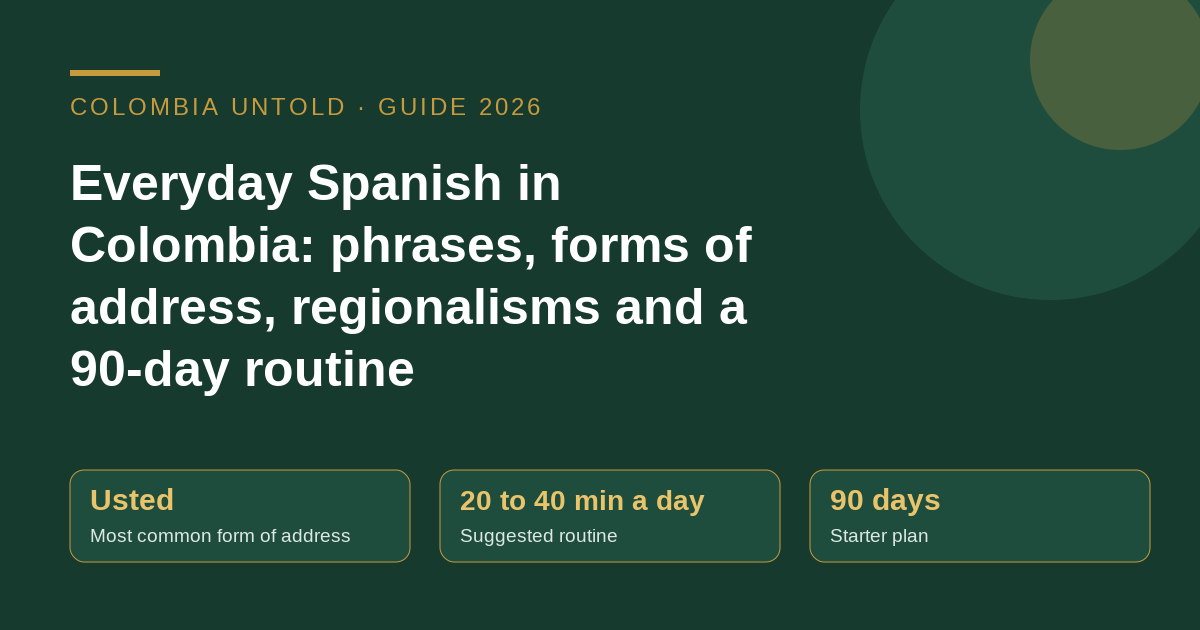
| Most common form of address | Usted | Common even among acquaintances; tú and vos vary by region |
| Suggested routine | 20 to 40 min a day | Plus 2 or 3 conversation sessions a week |
| Starter plan | 90 days | Three blocks: survival, routine and conversation |
| Practical level | A2 to B1 | Enough for daily life and basic paperwork |
Official sources and reliable reading
Related guides
General information based on current rules and practice; it may change. Confirm your case with the official source or an authorized professional. Not legal, tax or medical advice.