Schools for foreign families in Colombia: types, curricula, costs, admission and how to choose
Updated: 13 October 2026 · Colombia Untold
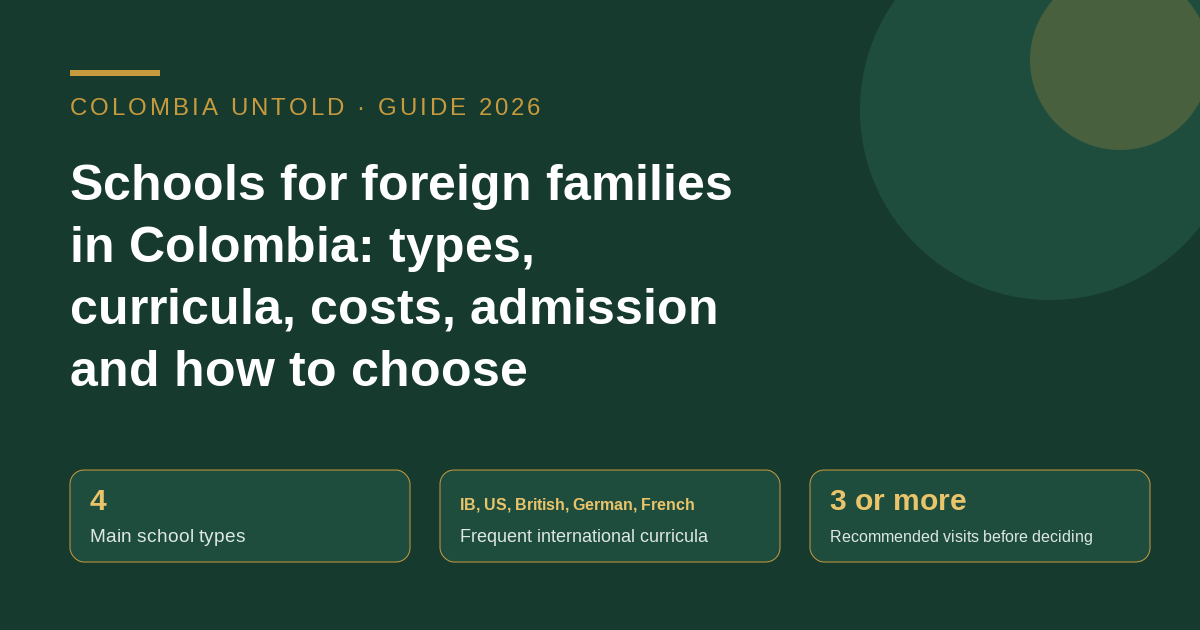
Quick answer: Foreign families in Colombia choose among public schools (free, in Spanish), bilingual private schools and international schools with US, UK, German, French or International Baccalaureate curricula. The decision depends on language, budget, city, expected length of stay and academic continuity. Visit at least three schools, ask about Spanish-as-a-second-language support and confirm accreditations and calendar.
Choosing a school is the decision that weighs most in the life of an expatriate family. It determines the neighborhood where you will live, the monthly budget, the morning routine, your children's friendships and, in many cases, how long you can stay in the country. In Colombia the range is wide: from excellent public schools in Spanish to international institutions with foreign curricula and student communities of dozens of nationalities. This guide describes the types of schools, the curricula, the costs, the admission process, the criteria for comparing and the mistakes to avoid, and complements the information on calendars and enrollment in School calendar in Colombia: calendar A and B, enrollment, holidays and planning with children.
The four types of school
Public schools. They are free in preschool, primary and secondary levels. They teach in Spanish under the Ministry of National Education's guidelines. Quality varies widely by institution and area, and places are assigned by availability and proximity through the enrollment system. They are a real option for families with good Spanish or those seeking total immersion, but they demand patience and language support. National private schools. They operate with the Colombian curriculum, in Spanish, and charge enrollment and tuition. Many have enhanced English programs. They offer smaller groups than public schools and variable infrastructure. Bilingual schools. They teach an important part of the subjects in English (sometimes with a third language), following the Colombian curriculum with language reinforcement. They are an intermediate option in cost and adaptation. International schools. They follow foreign curricula, such as the US, British, German, French or the International Baccalaureate (IB), with teachers from several countries and diplomas recognized by universities abroad. The main cities, above all Bogotá and Medellín, have several options. They usually use calendar B, from August or September to June, and are the natural choice for families who move between countries.
The curricula and what they mean
The US curriculum uses a grade structure (kindergarten to grade 12), a flexible approach and high-school diplomas accepted by US and other universities. The British curriculum organizes learning in stages and prepares for IGCSE and A-Level exams. The International Baccalaureate offers three programs, primary, middle years and diploma, with emphasis on critical thinking, research and service. German and French schools provide education in their language with recognition for their national systems and, in many cases, a Spanish component. For families on a short stay, the practical criterion is continuity: choose the curriculum your child can resume at the next destination. For families staying long term, the language of instruction and the university goal weigh more. Every decision should consider that a foreign diploma may require an apostille or validation to be used in other systems.
The real costs
International schools charge enrollment, capital or entry fees in some cases, annual tuition and additional costs for transport, meals, uniforms, technology, activities and external exams. In total, annual fees can reach tens of millions of pesos per student at the most demanding schools, and the amount varies by city and grade. Bilingual and national private schools cost considerably less. Ask about sibling discounts, installment payments and the annual tuition increase; the Ministry of Education regulates private-school increases through a classification system. A realistic budget includes the total annual cost, not just monthly tuition, and a twenty to forty percent margin for extras. If your employer covers your children's education, negotiate direct payment to the school, coverage of enrollment and entry costs, and the possibility of adjusting the amount for inflation. See International schools in Medellín for expat children: options, curricula, costs and where to live for the specific case of Medellín.
Admission: documents, assessments and timing
The schools with the most demand open applications eight to twelve months before the school year starts. The process usually includes a form, an application fee, academic reports from recent years, recommendation letters, an entrance assessment (language and mathematics, depending on the grade), an interview with the family and the vaccination certificate. Documents from abroad usually require an apostille and official translation. Some schools also ask for a report on educational support needs. Admission of children with special needs depends on the school's capacity to support them. Ask frankly what services exist, who provides them and whether they carry an additional cost. Schools that serve inclusively usually explain their model clearly.
Language: the decisive question
If your children do not speak Spanish, how will the transition be managed? International schools teach in English or another language, with Spanish as a second language classes. National schools require a sufficient level to follow classes, and offer variable support. Ask about the welcome program, the number of foreign students and the expected pace of adaptation. Young children usually acquire the language in months; teenagers need more time and support. See Everyday Spanish in Colombia: phrases, forms of address, regionalisms and a 90-day routine if the family will also study Spanish.
How to compare schools: a checklist
Review the school's accreditation and authorization by the Ministry of Education and by relevant international bodies. Visit the campus and look at the condition of classrooms, labs, libraries and sports areas. Ask about the student-teacher ratio, teacher turnover, teacher training and the share of foreign teachers. Review the coexistence policy and handling of bullying, access security and transport. Find out academic results and where graduates go. Evaluate the offer of arts, sports and extracurricular activities. Talk to current families, preferably foreign, and to families who left the school. Attend a sample class, if offered, and observe how teachers and students interact. A school's atmosphere is sensed in the corridors, in how teachers treat children and in the kids who greet visitors.
Location, transport and daily life
The school conditions your housing. In Bogotá, traffic can turn distance into hours; that is why many families choose to live near the school or hire school transport. In Medellín, slopes and traffic jams influence the choice of neighborhood; see Medellín neighbourhoods for foreigners: El Poblado, Laureles, Envigado, Belén and more, how to choose and Bogotá neighbourhoods for foreigners: which to choose by lifestyle, budget and work. Ask whether the school offers bus routes and how long the trip takes. For alternative urban mobility, see Cycling and urban mobility in Colombia: bike lanes, safety and getting around without a car.
Health, insurance and paperwork
Schools usually ask for an up-to-date vaccination schedule and may require medical insurance. Enroll your children in an EPS or private insurance; see Joining an EPS as a foreigner: requirements, costs and how the health system works. Keep the family's immigration status in order: minors with a visa of more than three months have their own document under the rules; see Colombian foreigner ID card (cédula de extranjería): what it is, who needs it, requirements, costs and how to apply. For family visa procedures, our recommended partners are Colombia Visa Legal and CoVisas.
Supporting your children's adaptation
Talking to them before the move, visiting the school together, keeping stable routines and establishing communication with teachers eases adaptation. Encourage them to take part in extracurricular activities and to invite classmates home. Watch for signs of persistent distress, such as changes in sleep, appetite or mood, and seek support from the school counselor or a professional. For culture shock in the family, see Culture shock in Colombia: stages, customs, social etiquette and how to integrate without losing your identity.
Frequent mistakes
Choosing a school without visiting. Deciding only on prestige and not on fit to the child's needs. Not asking about total cost. Ignoring the calendar and arriving mid-year without a plan. Not processing apostilled documents in time. Living far from the school and underestimating traffic. Underestimating the emotional support teenagers need. Not planning the return or the next destination.
A decision timeline
Twelve months ahead: define budget, city and curriculum. Ten months ahead: visit schools and ask for information. Eight months ahead: submit applications and registration payments. Six months ahead: complete assessments and interviews. Four months ahead: confirm the place, process documents and look for nearby housing. Two months ahead: final enrollment, uniforms and vaccines. One month ahead: visit the route and meet teachers. If you arrive outside this calendar, ask schools for a waiting list and consider a temporary solution.
Questions worth asking at the admission interview
Arrive with a written list. Ask how each student's progress is measured and how often families are informed. Ask how many students per class are accepted and what happens if the group fills up. Ask how communication is handled with parents who do not speak Spanish, which digital platforms are used and how conflicts between students are resolved. Ask about the homework policy, the daily hours and the relationship with universities. These answers reveal the school's real culture much better than a brochure.
Also ask about the school's community. How large is the parent association, and does it organize events for new families? Is there a mentoring or buddy program for newcomers? What proportion of the student body is foreign, and how long do foreign families usually stay? A school where most families rotate every two or three years has a different social rhythm from one with a stable local community, and neither is better in absolute terms: what matters is whether it fits what your children need during your stay.
Finally, ask about continuity and exit: how the school documents academic records for transfers, how long it takes to issue transcripts, and what support it offers if you must leave mid-year for a new posting. Families who plan the departure before arriving avoid last-minute surprises.
Frequently asked questions
Can my children study in a public school as foreigners?
Yes. Foreign children can register in public schools with their ID, and places are assigned by availability and proximity. Teaching is in Spanish.
What is the difference between a bilingual and an international school?
A bilingual school follows the Colombian curriculum with English reinforcement; an international school follows a foreign curriculum (US, British, German, French or IB) with teachers from several countries and diplomas recognized abroad.
How much should I budget for an international school?
It can be tens of millions of pesos a year per student at the most demanding ones, plus extras for transport, meals and activities. Always compare the total annual cost.
How far ahead should I request a place?
Eight to twelve months ahead at highly demanded international schools. At public schools, during the enrollment windows of each education secretariat.
Will my children struggle if they do not speak Spanish?
International schools teach in English or another language with Spanish classes. At national schools a sufficient level and support will be needed. Young children usually adapt in a few months.
Does an international school diploma work in another country?
In general yes, because foreign curricula and the IB are recognized by universities in many countries. Some procedures may require an apostille or validation depending on the destination.
If you want guidance on migration requirements, you can contact Colombia Visa Legal. When a procedure is online, Cancillería recommends doing it directly; professional guidance helps you understand the process, it does not replace the official source.
Key figures and data
| Item | Value | Note |
|---|---|---|
| Main school types | 4 | Public, national private, bilingual and international |
| Frequent international curricula | IB, US, British, German, French | Depending on the school and city |
| Recommended visits before deciding | 3 or more | With tour, sample class and interview |
| Lead time to request a place | 8 to 12 months | At highly demanded international schools |
Official sources and reliable reading
Related guides
- Compare neighbourhoods by noise
- Medellín vs Bogotá for foreigners 2026
- Renting an office or desk in Colombia: coworking, private office and commercial premises
General information based on current rules and practice; it may change. Confirm your case with the official source or an authorized professional. Not legal, tax or medical advice.