Dance classes in Colombia: salsa, bachata, vallenato and how to build your social network by dancing
Updated: 13 October 2026 · Colombia Untold
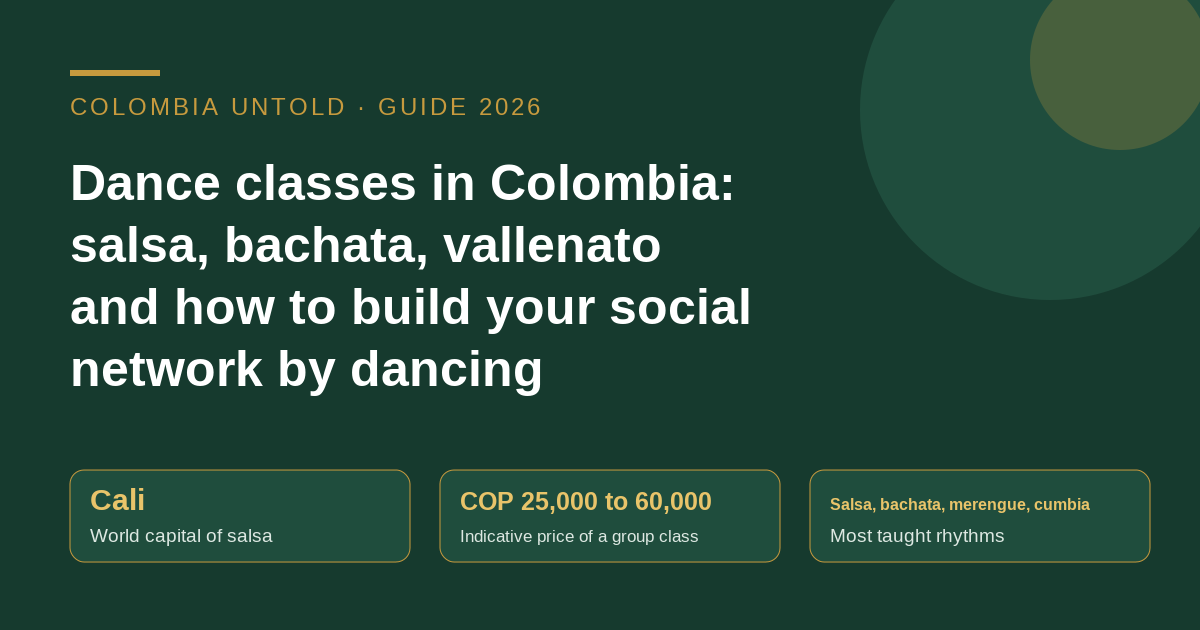
Quick answer: Dance classes are one of the quickest ways to make Colombian friends: Cali is the world capital of salsa, Medellín has a strong salsa, bachata and tango scene, and the coast lives on cumbia, vallenato and champeta. A group class usually costs between COP 25,000 and 60,000, monthly packages exist, and the essentials are choosing academies with level-based groups, qualified instructors and a safe atmosphere.
There is a truth almost every foreigner who has lived in Colombia for more than a year repeats: their most solid friends were made outside work, and many met them dancing. The reason is no mystery. Dancing demands contact, laughter, shared mistakes and weekly repetition, which are exactly the ingredients of friendship, and it does so without needing perfect language. A salsa class forces you to talk to strangers, change partners and laugh at your own steps. This guide explains which rhythms are worth learning, what the scene is like in the main cities, what it costs, how to choose an academy, what etiquette to follow on the floor and how to turn classes into a lasting social network.
Why dance works as a social network
When you arrive in a new city, traditional social networks are closed: your office colleagues have families and plans, foreigner groups fill with conversations about paperwork and sporadic events create no bonds. Dance solves three problems at once. It gives you a fixed weekly appointment, a shared purpose other than conversation and a setting where people are already relaxed and ready to enjoy themselves. Group classes rotate partners, so in a single evening you interact with ten or fifteen people. Visible progress also creates shared pride. There is another, less obvious effect: understanding the music and dance is understanding a central part of Colombian culture. When you know what a cumbia means at a coastal party or a hard-hitting salsa brava at a Cali street party, you stop being a spectator and enter the conversation. This complements the adaptation process described in Culture shock in Colombia: stages, customs, social etiquette and how to integrate without losing your identity.
Rhythms and where to learn them
Salsa. Cali is recognized as the world capital of salsa, with academies, high-performance schools, shows and the World Salsa Festival. The Cali style is danced with fast, very agile footwork and little travel. If you are serious about salsa, a season in Cali is an investment. In Medellín and Bogotá there are good salsa schools in several styles, including on-line salsa and casino. Bachata and merengue. They are the most accessible rhythms for beginners, with simple steps and strong partner connection. They are taught in practically all academies and at social nights in bars and clubs. Vallenato and cumbia. Caribbean-coast rhythms with Indigenous, African and European roots. Vallenato is danced as a couple with a softer step, and cumbia in a group with simpler movements. They are learned on the coast and in specialized schools in the big cities. Champeta. Born in Cartagena and Afro-Caribbean communities, it is a dance of marked rhythm and high energy, increasingly popular. Learning it in its place of origin gives you a unique cultural immersion. Tango. Medellín has a historic relationship with tango, remembered above all because Carlos Gardel died in the city in 1935. There are milongas and academies, especially in the Manrique neighborhood. Folk dances. Bambuco, mapalé, joropo and other traditions are taught in cultural centers and public programs, often at minimal cost.
The scene by city
In Cali the offer is the most intense in the country: classes every day, salsa venues, taverns and events. In Medellín, the Laureles, El Poblado and downtown areas concentrate academies, and on weekends there are salsa, bachata and reggaeton nights. In Bogotá, Chapinero, Teusaquillo and La Candelaria offer classes and themed nights, with a very diverse public. In Cartagena and Santa Marta, champeta, cumbia and Cuban son mix in bars and schools of the Center and Getsemaní; see Cartagena and the Caribbean coast for foreigners: climate, costs, neighborhoods, health and the reality beyond the postcard for the coastal context. Municipal cultural centers and culture secretariats offer low-cost folk-dance courses.
What it costs
A one-hour group class usually costs, as a guide, between COP 25,000 and 60,000, with discounts when buying packages of eight or twelve classes. Monthly packages with two or three classes a week range from COP 150,000 to 400,000, depending on the city and academy. Private lessons are much pricier, and high-end academies or those in tourist areas charge more. Public and community courses can be free or very inexpensive. Always ask for trial classes, which many academies offer free or at a discount.
How to choose an academy
Visit at least two academies before paying. Observe whether groups are organized by level, whether instructors have training and experience, whether the rooms are ventilated and have mirrors, and whether the atmosphere is respectful. Ask about the number of students per group: ten to twenty is reasonable, and more than twenty-five hampers learning. Check that partners rotate, that both leader and follower roles are taught, and that the style is the one you want. Read reviews and talk to students. Be wary of long contracts with large advance payments: prefer short, renewable packages. Ask also about the language. Many academies in big cities offer explanations in English, but Spanish immersion is an advantage. If you are learning Spanish, the dance class is an opportunity for real practice; see Everyday Spanish in Colombia: phrases, forms of address, regionalisms and a 90-day routine.
Etiquette on the floor
Dance social etiquette is simple. Invite politely and accept a no without insisting. Keep up personal hygiene, because dancing involves close contact. Respect your partner's space: the hold should be comfortable for both. If you make a mistake, laugh and carry on. Rotate with different people and do not stay with the same partner all night. Avoid giving unsolicited corrections to other dancers. In bars and social clubs, watch your belongings and your drink, do not accept drinks from strangers and arrange safe transport home. The emergency number is 123.
How to turn classes into a social network
A class does not create friendships by itself; repetition and initiative do. Choose a fixed schedule and attend twice a week for at least three months. Arrive ten minutes early and stay ten minutes after, which is when conversations arise. Suggest a coffee, a lunch or an extra practice. Join the academy's messaging group and attend social nights. Invite classmates to other activities, such as a hike or a match. Over time, the dance group becomes your first local network. Combine dancing with other activities to widen your circle; see Cooking classes in Colombia: regional dishes, markets, ingredients and culture through food and Cycling and urban mobility in Colombia: bike lanes, safety and getting around without a car for further ideas. If you work from home, a fixed class schedule also structures your week.
Health benefits
Dancing is moderate-intensity cardiovascular exercise, improves coordination and balance, reduces stress and lifts mood. For someone coming from a sedentary life, it is a gentle way to start moving. If you have injuries, heart problems or are pregnant, consult your doctor before starting. Warm up before class, wear suitable footwear and hydrate, especially in hot climates. Confirm that your health insurance covers sports or recreational injuries; see Joining an EPS as a foreigner: requirements, costs and how the health system works.
Common beginner mistakes
Starting at too advanced a level and getting frustrated. Paying for a long package without trying. Talking only to other foreigners and not to the Colombians in the group. Relying on alcohol to loosen up. Missing classes and losing the rhythm. Not communicating boundaries on the floor. Expecting to dance like a local in a month: fluency comes with months of regular practice.
A 12-week plan
Weeks 1 to 2: try three academies and choose one. Weeks 3 to 6: attend twice a week and learn the basic salsa and bachata steps. Weeks 7 to 10: go to one social night a week and practice with different partners. Weeks 11 to 12: assess your progress, enroll in a higher level and propose a social activity with your group. At the end of that cycle, you will have rhythm, friends and a deeper understanding of the culture.
If you are shy or arrive alone
Many foreigners avoid classes for fear of looking ridiculous. Pick an absolute-beginner group, go to the first class committed to attending three times before deciding, and tell the instructor you are new; he or she will almost always assign you a patient partner. The first twenty minutes are the most awkward and then the music does the work. Remember that in Colombia dance is a common language and nobody is surprised when a newcomer stumbles.
It also helps to understand how a class is structured. Most sessions start with a warm-up and a review of the previous week, move on to a new step or figure taught in small pieces, and then practice the figure with rotating partners to music, usually closing with a short social dance. If you miss a class, ask a classmate to show you the step rather than skipping the following session, because skills build on each other and falling behind is the main reason beginners quit. Record short videos of the choreography if the instructor allows it, and practice for ten minutes at home between classes.
Finally, set small, measurable goals: learn the basic step in the first week, a simple turn by the end of the first month and a full song with a partner by the third month. Celebrate each of them with the group. Progress that you can see and share is what keeps people attending until the friendships have taken root.
Frequently asked questions
Do I need to know how to dance to start?
No. Academies have levels for absolute beginners, and most students start with no experience. What matters is going regularly and being willing to laugh at mistakes.
Which rhythm is best to start with?
Bachata and merengue are the simplest, and salsa is the most popular. If you want cultural immersion, begin with salsa and cumbia.
Can I go without a partner?
Yes. Group classes rotate partners and almost all students attend alone. It is one of the reasons they work as a social network.
How long should I invest to feel comfortable?
With two classes a week, two to four months to move with confidence at a social night. Advanced mastery takes years.
What should I bring to class?
Comfortable clothes, shoes that slide well on the floor, a bottle of water and a small towel. Some styles recommend smooth-soled shoes.
Is it safe to attend dance nights?
With precautions, yes: arrive and return by safe transport, watch your drink and belongings, and do not accept drinks from strangers. Choose reputable venues and share your location with someone you trust.
Key figures and data
| Item | Value | Note |
|---|---|---|
| World capital of salsa | Cali | Home of the World Salsa Festival |
| Indicative price of a group class | COP 25,000 to 60,000 | Varies by city, academy and level |
| Most taught rhythms | Salsa, bachata, merengue, cumbia, vallenato | With champeta on the coast |
| Time to feel comfortable on the floor | 2 to 4 months | With two classes a week |
Official sources and reliable reading
Related guides
- Laundry and dry cleaning for expats
- Banking and payments in your first 90 days in Colombia: cards, cash, wallets and your first account
- Renting in Colombia as a foreigner: rent, building fees, deposits and the real cost
General information based on current rules and practice; it may change. Confirm your case with the official source or an authorized professional. Not legal, tax or medical advice.