Savings vs checking account in Colombia: which to open as a foreigner, GMF tax, deposit insurance, fees and requirements
Updated: 13 October 2026 · Colombia Untold
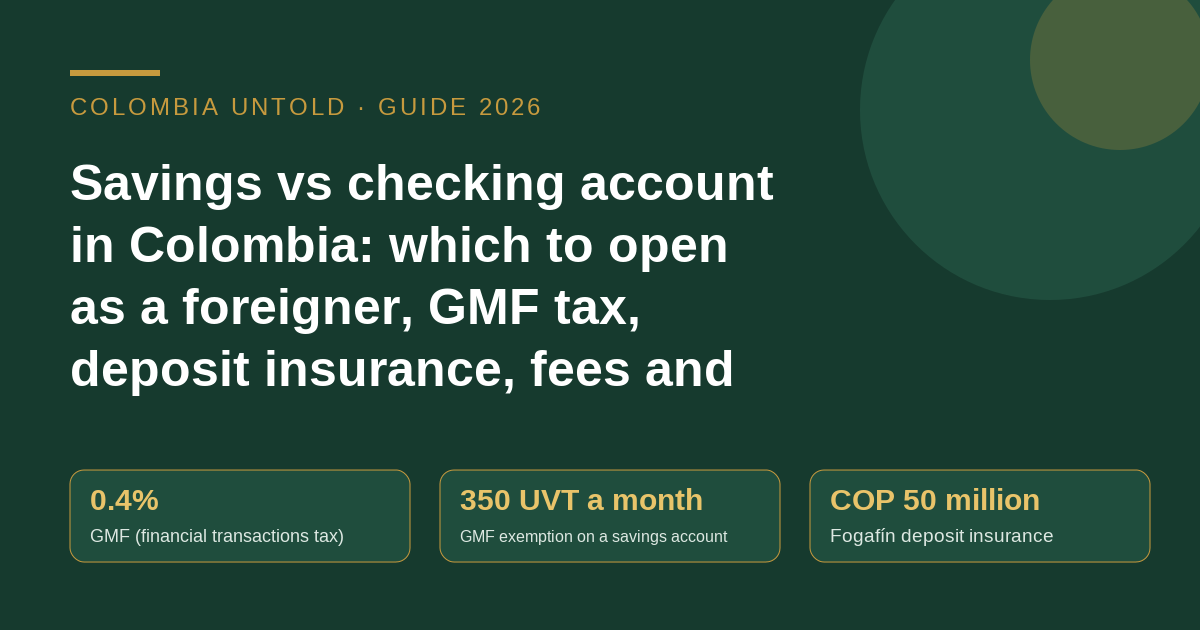
Quick answer: For almost all foreigners, the savings account is the best option: it pays interest, can be designated as exempt from the GMF (4 per thousand) up to 350 UVT a month (about COP 18.3 million in 2026) and usually has lower costs. The checking account mainly serves for checks and overdrafts for businesses or professionals with high turnover. Deposits are insured by Fogafín up to COP 50 million per person and institution.
Opening a bank account is the first procedure that changes a foreigner's life in Colombia. Without an account you pay rent in cash, deposit at correspondents, lose time on transfers and cannot receive a salary or invoice without friction. When you get to the bank, they ask something that sounds technical: savings or checking? The answer is less a preference than a consequence of what you will do with the money. This guide explains what each account is, what each costs, how the 4-per-thousand tax and its exemption work, what protects your money if the bank fails, what requirements are asked of foreigners and which one suits your profile.
What each account is
A savings account is a demand deposit whose purpose is to hold money and earn a return. It comes with a debit card and allows transfers, PSE payments, ATM withdrawals and use of the bank's app. It pays interest on the balance, with rates that vary by institution, amount and type of account. It is the personal-use account par excellence. A checking account is a demand deposit aimed at high turnover and payments by check. It allows writing checks and, with prior authorization, overdrafts or linked revolving credit lines. It usually pays no interest on the balance, or very little, and has higher costs. It is designed for companies, merchants and professionals with heavy flow. The practical difference is not in day-to-day functions but in purpose. If your need is to receive money, pay bills, transfer and save, a savings account covers everything. If you need to write checks regularly, have an authorized overdraft or manage a business's treasury, a checking account makes sense. Today check use has fallen markedly compared with transfers and instant payments, and the checking account loses appeal for the individual user.
The 4-per-thousand tax (GMF)
The Financial Transactions Tax, GMF, is a 0.4% tax —the famous "4 per thousand"— on withdrawals, transfers and other outflows from accounts. The DIAN collects it and the bank withholds it on each operation. It is not paid on deposit, but on withdrawing or moving money. For anyone moving large amounts, it is a real cost: 4 pesos for every 1,000 that leave. The key for individuals is that there is an exemption. A person can designate a single savings account as exempt, and in that account withdrawals and transfers up to 350 UVT a month do not pay GMF. With the 2026 UVT of COP 52,374, the cap equals about COP 18,330,900 a month. Above that amount, 4 per thousand is charged on the excess. The exemption is requested from the bank and applies to a single savings account per person across the financial system; if you designate several, the rule forces you to choose one. The checking account has no such exemption. Everything that leaves it pays GMF, which makes it costlier for personal use. This is the strongest argument in favor of the savings account for foreigners. An example: if you pay COP 2,000,000 rent and move COP 8,000,000 a month in total, in an exempt savings account you pay nothing, while in a checking account you would pay COP 32,000 a month, or COP 384,000 a year, in GMF alone. Keep in mind that if you receive and move money at more than one institution, the exemption is lost at the others.
Protection of your money: Fogafín
Deposits in savings accounts, checking accounts and CDs are covered by the deposit insurance of Fogafín, the Financial Institutions Guarantee Fund. If a supervised institution enters liquidation, Fogafín reimburses up to COP 50 million per depositor and per institution. Coverage applies per person and per institution, not per account; if you have COP 80 million in three accounts of the same bank, protection covers up to COP 50 million in total. That does not mean you should fragment your money without reason. It means that, if you hold large sums, it is worth spreading them across institutions or understanding the exposure. It also means verifying that the institution is supervised by the Financial Superintendence. Savings and credit cooperatives not supervised by the Superfinanciera have another deposit insurance, with other caps. Check the information on Fogafín's website.
Requirements for a foreigner
Banks must know their customer. In Colombia they apply the money-laundering and terrorism-financing risk management system, SARLAFT, which explains the questionnaire you are given. Requirements vary by institution, but the usual list for a foreigner includes the following. Identity document. The foreigner ID card is the ideal document. Some banks open accounts with a valid passport and visa while you process the card; others require the card. See Colombian foreigner ID card (cédula de extranjería): what it is, who needs it, requirements, costs and how to apply. Visa or stay permit. Proving your current immigration status. Proof of address. Lease, utility bill or certification. Source of funds. A declaration and, sometimes, supporting documents: employment contract, invoices, statements from your country or tax return. References or history. Some banks ask for statements from your home bank. Colombian email and mobile number. For digital banking and sending passcodes. If a bank rejects your application, try another: internal policies differ, and each institution has its own risk appetite regarding customers with no local history. For a business account or one meant to receive recurring payments from abroad, the bank may ask for additional documentation.
Costs: maintenance fees and commissions
An account's costs are the maintenance fee, commissions on transfers, withdrawals at other institutions' ATMs, inquiries, checkbooks and cards. Many banks offer savings accounts with no maintenance fee if you hold a minimum average balance, use the card frequently or receive payroll. Neobanks and digital wallets usually have lower or zero costs, but with amount limits and fewer services. Before opening, ask for the full fee schedule in writing. Ask what happens if the balance falls below the minimum, how many transfers are free per month, how much it costs to withdraw at other networks' ATMs and whether they charge for card use abroad. Banks are obliged to disclose their fees, and the Financial Consumer Ombudsman handles complaints that are not resolved.
Low-amount deposits, neobanks and wallets
Besides traditional accounts, Colombia has electronic deposits and low-amount accounts, opened by app with simplified procedures. They have balance and movement caps defined by regulation. They are useful for starting to operate while you finish the ID-card procedure, for small payments and for separating a budget. In general they do not replace a full savings account, but they are a bridge. The Banco de la República's instant payment system, Bre-B, allows sending and receiving money between banks and wallets using "keys" linked to a mobile number, email or ID. It makes it easier to pay for services, rent and purchases without typing account numbers. Find out whether your institution and counterparties support it. The guide Banking and payments in your first 90 days in Colombia: cards, cash, wallets and your first account explains how to operate without your own account in the first months.
Receiving money from abroad
If you are paid by clients or employers in another country, there is a foreign-exchange consideration: foreign currency entering Colombia is channeled through the exchange market, and the bank will ask you to declare the purpose of the operation with a code identifying the nature of the inflow (for example, services, remittances or investment). It is normal for them to ask for supporting documents. Stating the right concept avoids delays and later problems. Compare rates: the difference between the TRM and the rate applied to you can cost more than any maintenance fee. For reference, the TRM was COP 3,307.73 on 2 October 2026. If you stay more than 183 days in a 365-day period in Colombia, you become a tax resident, and your foreign income may be taxed here. Check Tax residency certificate in Colombia: who is resident, how to request it from the DIAN and what it is for before reaching that threshold, because your bank movements will be part of the evidence.
Which suits your profile
Resident foreigner with personal income or payroll. A savings account, designated as GMF-exempt, with debit card and digital banking. Digital nomad or remote worker. A savings account for daily life; check the cost of receiving transfers from abroad and converting currency, and compare banks and platforms. Independent professional who invoices. A savings account for personal expenses and, if volume or the need for checks justifies it, a separate checking account for the business. See how a services contract is structured in Local employment contracts in Colombia for foreigners: visa, contract types, benefits and limits. Entrepreneur or company partner. The company will open a checking or savings account in its name; it meets legal-entity requirements. Retiree. A savings account with good in-person support and no maintenance fee for low balances. Student. A savings account or low-amount deposit with minimal costs.
Frequent mistakes
Opening a checking account out of habit from other countries. Not designating the savings account as GMF-exempt. Designating more than one. Not asking for the fee schedule in writing. Accepting poor exchange rates in a hurry. Not correctly declaring the concept of an incoming transfer. Keeping large sums at a single institution without knowing Fogafín's cap. And not reviewing statements every month.
A practical example: a remote worker arriving on a visa
A remote worker arrives on a visa and rents an apartment. In the first month he receives a payment from abroad, converts it to pesos and transfers it to his savings account. He designates that account as GMF-exempt and pays rent and utilities from it. With a monthly volume below 350 UVT, he does not pay the 4 per thousand. He compares two transfer platforms before sending and chooses the one giving a rate closest to the TRM. When he receives his foreigner ID card, he updates the data at the bank. If you are organizing your whole stay and want someone to accompany you with visa and paperwork, Colombia Visa Legal at colombiavisalegal.com and CoVisas at covisascolombia.com handle the immigration side. If you also look for housing in Medellín, Medellín Advisors at medellinadvisors.com and Premium Propiedades at premiumpropiedades.com can guide you; see Cost of living in Medellín 2026: rent, transport, food, health and a real budget for foreigners to understand your fixed expenses.
Security: how to protect your account
Turn on notifications for every transaction. Do not share passwords or one-time codes, not even with someone who says they are from the bank. Use digital banking from trusted networks, not public wifi. Review daily transfer limits and adjust them. If you lose your card, block it immediately from the app. In Dynamic keys in Colombian banks: what they are, how to activate them, what to do without a local number and how to avoid fraud and ATMs in Colombia: withdrawing cash safely, fees, limits and common scams we explain the controls and the most common risks.
Frequently asked questions
Which account suits me better as a foreigner, savings or checking?
Savings, in almost all cases. It pays interest, has lower costs and lets you designate one GMF-exempt account. Checking is justified by the use of checks or overdrafts, which is uncommon for individuals.
How do I avoid the 4 per thousand?
You designate a single savings account as exempt with your bank. In it, withdrawals and transfers up to 350 UVT a month, about COP 18.3 million with the 2026 UVT, do not pay GMF. Above that cap, 0.4% is charged on the excess.
What happens to my money if the bank fails?
Fogafín guarantees deposits up to COP 50 million per depositor and per supervised institution. If you hold more, it is worth spreading it or knowing your exposure.
Can I open an account without a foreigner ID card?
Some banks open accounts with a valid passport and visa; others require the card. If one rejects your application, try another institution or open a low-amount deposit as a bridge.
How much does a savings account cost?
It depends on the bank. Many waive the maintenance fee with a minimum balance, card use or payroll. Ask for the fee schedule in writing, including transfers, withdrawals and card charges.
How do I receive payments from abroad?
Through the bank, which channels foreign currency through the exchange market and asks you to declare the concept of the operation. Compare the applied rate with the TRM before accepting.
Key figures and data
| Item | Value | Note |
|---|---|---|
| GMF (financial transactions tax) | 0.4% | 4 per thousand on each withdrawal or transfer |
| GMF exemption on a savings account | 350 UVT a month | About COP 18.3 million with the 2026 UVT of COP 52,374 |
| Fogafín deposit insurance | COP 50 million | Per depositor and per financial institution |
| UVT 2026 | COP 52,374 | Tax Value Unit |
Official sources and reliable reading
Related guides
General information based on current rules and practice; it may change. Confirm your case with the official source or an authorized professional. Not legal, tax or medical advice.