School calendar in Colombia: calendar A and B, enrollment, holidays and planning with children
Updated: 13 October 2026 · Colombia Untold
Quick answer: Colombia runs two school calendars: A, from February to November, used by almost all public schools and many private ones, and B, from August or September to June, typical of bilingual and international schools. Enrollment is arranged months ahead, foreign children can register in public schools with their ID, and studies completed abroad are validated before the Secretariat of Education.
Moving to Colombia with children brings a complication that single adults never face: the school calendar. Registration dates, available places, holidays and exams do not match what many families know from the northern hemisphere, and arriving at the wrong moment can mean months of waiting or an academic year split awkwardly. This guide explains how the two calendars work, when to enroll, which documents are requested, how studies completed abroad are validated, what a private school costs and how to plan vacations, based on the rules of the Ministry of National Education.
The two calendars: A and B
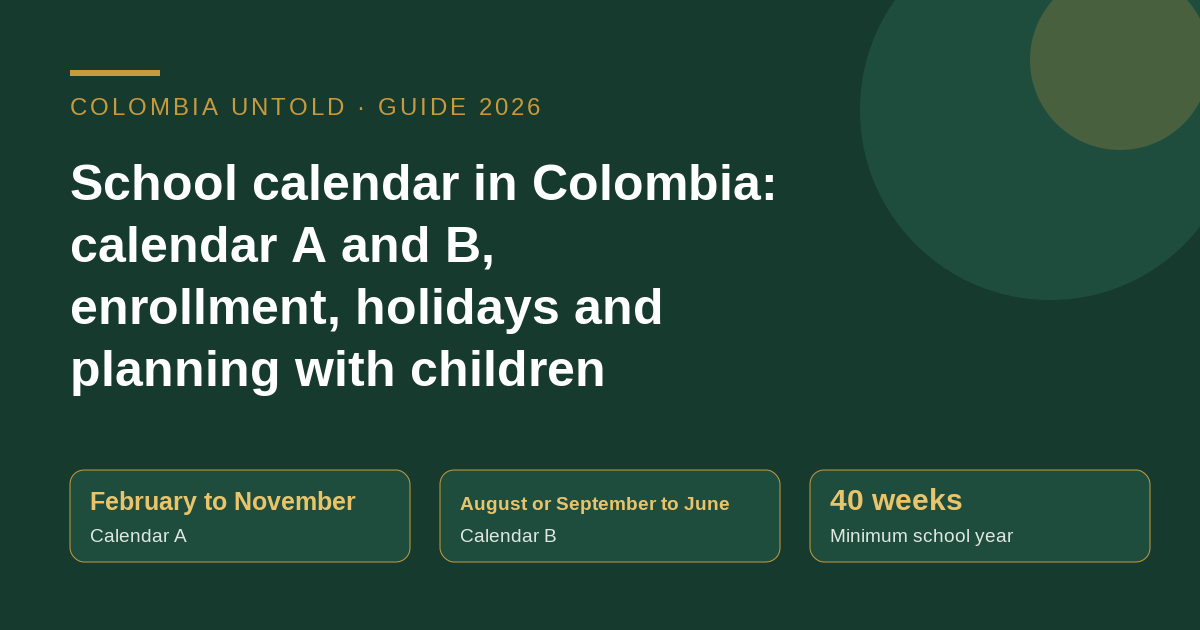
Calendar A is the most widespread. The school year starts between late January and early February and ends in November. Practically all public schools and a large majority of Spanish-language private schools use it. Calendar B starts in August or September and ends in June, and is the one adopted by bilingual and international schools that follow United States, United Kingdom or International Baccalaureate curricula, to align with universities and foreign systems. The difference matters when you plan. If your child comes from a northern-hemisphere system with a September to June year, calendar B is usually more natural. If the child arrives mid-year at a school on calendar A, he or she may need a catch-up period or may enter a different grade from the one previously attended. Always ask about the mid-year admission policy, because not every school admits students outside regular dates. The law sets a minimum school year of forty weeks with five class days per week (Law 115 of 1994 and Decree 1075 of 2015). The education secretariat of each city publishes the official calendar, and private schools can adjust details, especially mid-year breaks.
Holidays and key dates
In calendar A, holidays are usually divided like this: one week in March or April for Holy Week, three to four weeks mid-year in June and July, a one-week recess in October and around seven weeks of year-end vacation from late November to January. In calendar B, the long break falls between June and August, with shorter breaks in December and Holy Week. National public holidays add to this distribution and, when they fall on a Monday, create three-day weekends that many families use to travel. To plan trips with children, book early in peak seasons such as December, Holy Week and mid-year, because prices and demand rise considerably. See Cartagena and the Caribbean coast for foreigners: climate, costs, neighborhoods, health and the reality beyond the postcard for coastal destinations during vacations.
Public schools and private schools
Public schools are free in preschool, primary and secondary levels under the free-education policy, although they may charge minor complementary costs. Access is organized through the Student Enrollment System (SIMAT) and the education secretariats, with places assigned by availability and proximity. Instruction is in Spanish, and places in high-demand areas run out quickly. Foreign children can register by presenting their identity document, and a family's irregular migration status is not, by itself, an obstacle to entering the public education system. Private schools charge enrollment, a monthly tuition (usually paid in ten or eleven installments), and add transport, meals and supplies as extra costs. Fees vary enormously by school, city and level: from moderate-cost institutions to international schools whose tuition can equal several million pesos a month. The Ministry of Education regulates annual increases for private schools through a classification system, so check the category and authorized percentage before signing.
When and how to enroll
The best-regarded schools, especially bilingual and international ones, open applications eight to twelve months before the school year starts. For calendar A, that means beginning in the second half of the previous year; for B, early in the same year. The process usually includes a form, an interview with the family, an entrance assessment for the student, previous academic reports and payment of application fees. Places in early grades and in cycle-closing grades tend to be the most competitive. Draw up a shortlist of three to five schools, visit them before deciding and ask about: language of instruction, support for students who do not speak Spanish, student-to-teacher ratio, behavior policies, transport, international accreditations and academic results. Talk to other foreign families in local groups to compare experiences.
Documents usually requested
Passport or identity document of the child and the parents, visa or permit of stay where applicable, birth certificate, school records for the last two or three years, vaccination record and, sometimes, a psychoeducational report or a statement of support needs. Documents issued abroad usually need an apostille and, if in another language, an official Spanish translation. Gather everything early, because the apostille and translation can take weeks. On family health coverage, see Joining an EPS as a foreigner: requirements, costs and how the health system works.
Validation of studies completed abroad
When the child has completed grades in another country, the school may request validation if it concerns the final years of secondary school, or may accept foreign reports to place the child in the matching grade. To obtain the Colombian high-school diploma or validate primary and secondary studies, validation is processed before the Secretariat of Education of the territorial entity, with apostilled and translated study certificates. The timeline depends on each secretariat's workload. Ask the school which procedure your child's case requires, because in early grades a placement assessment is often enough.
Health and vaccinations
Schools usually ask for an up-to-date vaccination card in line with the national schedule. If the home country's schedule differs, a pediatrician can advise on boosters. To enroll children in an EPS or private insurance, see Joining an EPS as a foreigner: requirements, costs and how the health system works. Some international schools also require school medical insurance or an accident policy.
Costs that add up and how to budget them
Besides tuition, budget annual enrollment, uniform, supplies, books, school transport, meals, field trips and extracurricular activities. In mid-range private schools, these extras can add 20 to 40% of annual tuition. For the full family budget, check the cost of living by city and consider the distance between school and home: school commute time in Bogotá can exceed an hour on the route. See Bogotá neighbourhoods for foreigners: which to choose by lifestyle, budget and work and Medellín neighbourhoods for foreigners: El Poblado, Laureles, Envigado, Belén and more, how to choose to pick a neighborhood close to schools.
Homeschooling and alternatives
Homeschooling has no dedicated legal framework in Colombia: basic education is compulsory and must be completed in a recognized institution, although flexible programs and virtual models are offered by authorized institutions. Nomad families usually combine an institution with an online international curriculum and local activities. If your situation involves short stays, look into programs for temporary stays at international schools.
Action plan by month
For entry on calendar A: between May and August of the previous year, research schools and schedule visits; between September and November, submit applications and assessments; in December, confirm the place and pay enrollment; in January, buy uniforms and supplies and complete documents. For calendar B, shift the plan six months. If you arrive outside the window, ask schools for a waiting list and consider a temporary solution, such as a summer program or a tutor, while a place opens.
Helping your child adapt: language, friendships and routine
The first three months are usually the hardest. Talk to the school about a welcome plan, ask whether Spanish-as-a-second-language support exists and keep stable routines for sleep, meals and homework. Young children usually adapt within a few weeks; teenagers need more time and emotional support.
Language is the first barrier, but not the only one. Colombian schools tend to emphasize group projects, oral presentations and a close relationship with teachers, and many children are used to a warmer, more physical style of interaction than they knew before. Encourage your child to join one extracurricular activity in the first month, whether football, music, dance or a club, because shared activities create friendships faster than classroom time alone.
Ask the school for a buddy: an older or more experienced classmate who accompanies the newcomer during the first weeks. Many international schools run this program formally; in others you can request it. Agree on a monthly check-in with the homeroom teacher during the first semester, and keep an open channel with other parents through the class messaging group, which in Colombia is almost always on WhatsApp.
Finally, prepare for the logistical details that surprise families: uniforms that differ for daily wear and for physical education, supply lists delivered in January, parent meetings with early start times, and school buses that leave very early in large cities. Visit the route once with your child before the first day, and agree who collects the child when the bus or transport fails. Predictability reduces anxiety more than any speech about how exciting the new country will be.
Frequently asked questions
Can my child attend a public school if we are foreigners?
Yes. Foreign children can register in public schools with their identity document, and irregular migration status alone is not an obstacle to access. Places are assigned by availability, so start the process with the education secretariat early.
What is the practical difference between calendar A and B?
A runs February to November and is used by almost all public schools; B runs August or September to June and is used by many international schools. If your child comes from a September to June system, B usually fits better, although it means budgeting for higher tuition.
How far ahead should I apply?
At bilingual and international schools, eight to twelve months before the year starts. At public schools, the process runs through the windows each education secretariat opens, normally in the second half of the previous year.
Are grades from abroad recognized?
Yes, through validation before the Secretariat of Education when a diploma is required, or through the school's placement assessment in early grades. Documents must be apostilled and translated into Spanish.
How much does an international school cost?
It varies a lot by city and school; top international schools can charge several million pesos a month in tuition, plus enrollment and extras. Always compare the annual total, not just the monthly tuition.
What if we arrive mid-year?
Ask each school about its mid-year admission policy. Some accept students during the year with catch-up support; others only on regular dates. If there is no place, a waiting list and a temporary tutor are common solutions.
If you want guidance on migration requirements, you can contact Colombia Visa Legal. When a procedure is online, Cancillería recommends doing it directly; professional guidance helps you understand the process, it does not replace the official source.
Key figures and data
| Item | Value | Note |
|---|---|---|
| Calendar A | February to November | Public schools and most private schools |
| Calendar B | August or September to June | Bilingual and international schools |
| Minimum school year | 40 weeks | Law 115 of 1994 and Decree 1075 of 2015 |
| Year-end break (calendar A) | About 7 weeks | From late November to January |
Official sources and reliable reading
Related guides
- Utilities in a foreigner’s name
- Budget for the first 90 days
- Opening a bank account in Colombia as a foreigner: requirements, banks and pitfalls
General information based on current rules and practice; it may change. Confirm your case with the official source or an authorized professional. Not legal, tax or medical advice.