Marrying a Colombian: legal process, documents and the spouse visa step by step
Updated: 13 October 2026 · Colombia Untold
Quick answer: To marry a Colombian you need a valid passport, an apostilled and translated birth certificate, proof of single status or capacity to marry from your home country and two witnesses; the civil wedding takes place before a notary or judge and is entered in the civil registry. With the marriage record you can apply for the M spouse or permanent-partner visa and then obtain the foreigner ID card.
Marrying a Colombian is one of the most common routes to residence, and also one of the most misunderstood. People hear that marriage grants citizenship at once, that you can marry in any country and be done, or that the spouse visa is approved without review. None of that is true. Marriage opens a specific immigration path, with documentary requirements, deadlines and a real assessment of the relationship, and it involves two different procedures: the civil act, governed by family law and notarial rules, and the visa, governed by the Foreign Ministry's regulations. This guide explains the whole process, from home-country documents to the foreigner ID card, and distinguishes between marriage and a de facto marital union.
Two different procedures: the marriage and the visa
Marriage is a legal act that is celebrated and registered; it produces civil, property and family effects. The visa is an immigration authorization the Foreign Ministry grants based on that bond. They can be done in sequence, but they are not the same: having a valid marriage does not equal having a visa, and a spouse visa requires proving the bond with the corresponding civil registry record. If you marry outside Colombia, the marriage must be apostilled and, where applicable, entered in the Colombian civil registry to take full effect. A practical consequence: plan the immigration calendar before the social calendar. If you enter as a tourist, your permitted stay has a day limit, and getting married does not extend it by itself. Many couples lose weeks because they later find that foreign documents require an apostille, which takes time in the home country.
Documents the foreigner needs
The foreigner's file usually includes: a valid passport, a birth certificate, a certificate of single status or capacity to marry issued by the authority of the home country (or an equivalent declaration), and, if previously married, proof that the earlier bond ended, whether a divorce judgment or the spouse's death certificate. Foreign documents must be apostilled by the home country and, if not in Spanish, translated by an official translator in Colombia. The apostille is an international certification that replaces consular legalization among Hague Convention countries. Notaries may accept a sworn statement of single status, but their criteria vary. Ask your chosen notary directly which documents it requires and request the list in writing. The Colombian partner provides his or her citizenship card and a recent birth certificate. Two adult witnesses with ID accompany the ceremony.
How the civil wedding is held
A civil marriage in Colombia can be held before a notary or a judge, and as a rule it is done before a notary for speed and cost. The procedure includes the marriage application, document verification, setting the date and the ceremony, which consists of the spouses expressing consent before the notary and witnesses. At the end the deed or record is signed and the notary enters the marriage in the civil registry. The marriage registry record is the document that carries the most weight for the visa. Notarial fees are regulated and adjusted every year; ask for current rates and for the cost of copies of the record. Request several authentic copies of the marriage record, since the Foreign Ministry, the health insurer and banks may ask for it. If you prefer a religious ceremony with civil effects, the law recognizes the marriage of certain faiths but requires later registration; the notarial route is more direct. If the foreigner wants to register in Colombia a marriage celebrated abroad, he or she must present the apostilled and translated certificate to a notary for entry in the civil registry. This lets the marriage take full effect in the country.
The M visa for a spouse or permanent partner
Resolution 5477 of 2022 of the Foreign Ministry establishes the Migrant (M) visa for the spouse or permanent partner of a Colombian national. It is requested through the ministry's visa platform, with payment of the corresponding fees, and accompanied by: valid passport, marriage record (or proof of the de facto union), the spouse's citizenship card, a photograph and, where relevant, police-clearance certificates from the countries where you have lived. The ministry may ask for additional information to verify the relationship is genuine. The visa is granted for a period that today reaches up to three years on the first grant, and allows residence in Colombia and, in most cases, work. After a continuous period of stay on the M visa, the holder can aspire to the Resident (R) visa, which requires fewer years from spouses than from other applicants and has no expiry date, although it requires presence in the country and renewal of the ID card. An immigration specialist can review your history of days outside the country before filing, because long absences affect continuity. For professional support with the visa process, our recommended partners are Colombia Visa Legal and CoVisas.
The foreigner ID card after the visa
Once the visa is approved, the holder must apply for the foreigner ID card (cédula de extranjería) at Migración Colombia within fifteen calendar days. It is the resident's identity document, needed to open accounts, enroll in health care, sign contracts and prove identity to institutions. The whole process is explained in Colombian foreigner ID card (cédula de extranjería): what it is, who needs it, requirements, costs and how to apply. Do not let that deadline lapse: a delay can bring a fine from Migración Colombia.
De facto marital union: the alternative to marriage
Colombia recognizes the de facto marital union: the permanent and exclusive community of life between two people who are not married to each other. Law 54 of 1990 provides that, after two years of cohabitation, a marital property partnership arises between permanent partners. The union can be declared through a public deed, a conciliation record or a court ruling. For immigration purposes, a declared union allows an application for the M visa as permanent partner, with proof of cohabitation such as joint leases, bills, photographs, shared accounts and testimonies. This route is chosen when the couple does not want or cannot marry right away, although it requires proving cohabitation with solid documents. The decision should be made with advice, because it affects the property regime: marriage creates a conjugal partnership by default, and the marital union creates a property partnership after the legal period.
Property effects and prenuptial agreements
Marriage creates by operation of law a conjugal partnership: assets acquired during the marriage are considered joint, with particular rules for assets brought in beforehand. Couples can agree on capitulaciones, a notarial agreement made before the marriage that sets the economic regime. If you have assets abroad, companies or investments, talk to a family lawyer about capitulaciones before the act. This also applies to anyone about to acquire housing: see How to rent an apartment in Colombia as a foreigner: full process, documents and pitfalls for rentals and the property-purchase guidance from Medellín Advisors and Premium Propiedades.
Tax, health and work consequences
A foreign spouse who lives in Colombia more than 183 days in a 365-day period becomes a tax resident, with the obligation to declare income on worldwide earnings; the full explanation is in Tax residency certificate in Colombia: who is resident, how to request it from the DIAN and what it is for. The spouse visa allows enrollment in the health system: see Joining an EPS as a foreigner: requirements, costs and how the health system works. On work, the holder of an M spouse visa can, in general, work without additional authorization, although the specific visa states the conditions, and you should review the one you were granted.
Citizenship by naturalization
Marriage does not grant automatic citizenship. To apply for Colombian nationality by adoption, the law requires a period of continuous residence on a Resident visa and requirements such as knowledge of the language and the Constitution, with a reduced period for those with Colombian spouses or children. It is a separate procedure before the Foreign Ministry. Citizenship brings a Colombian passport, political participation and civic duties, and its compatibility with your home country's law should be checked, because some countries do not allow dual nationality.
Frequent mistakes
The first mistake is marrying abroad without an apostille and without registering the marriage in Colombia. The second, submitting documents without official translation. The third, letting the permitted stay expire while the procedure is organized. The fourth, believing a marriage of convenience goes unnoticed: the Foreign Ministry can investigate the relationship and deny or cancel the visa, and consequences include immigration sanctions. The fifth, ignoring the property regime and discovering years later that you unknowingly signed up to a partnership with unwanted effects.
A realistic timeline
Think in four stages. Documents in the home country and apostille: two to eight weeks, depending on the country. Official translations and filing at the notary: one to two weeks. Marriage and entry in the civil registry: a few days after the appointment. M visa application and the ministry's decision: several weeks, depending on system load. Then the foreigner ID card within the fifteen days after approval. In total, plan between two and four months from the start to the ID card, and keep your immigration status valid throughout the process.
Frequently asked questions
Can I marry in Colombia if I entered as a tourist?
Yes. A civil marriage does not require a visa, but it does require valid, apostilled documents. Note that your tourist permitted stay has a day limit and marrying does not extend it, so plan the M visa before it runs out.
Does marriage give me Colombian citizenship?
Not automatically. It qualifies you for the M spouse visa and, over time, for the Resident visa, which in turn is a requirement to apply for naturalization in a separate procedure.
What is the difference between marrying and declaring a de facto marital union?
Marriage is held before a notary or judge and creates a conjugal partnership from the day of the act. The marital union is declared by deed, conciliation record or court ruling, and the property partnership arises after two years of cohabitation. Both allow an M visa application, but the union requires proof of cohabitation.
Do my foreign documents need an apostille and translation?
Yes. They must be apostilled in the home country and, if not in Spanish, translated by an official translator in Colombia. It is the most common cause of delay.
Can I work with the spouse visa?
In general yes; the M visa for a spouse or permanent partner authorizes work, and its text states the specific conditions. For regulated jobs such as medicine, professional requirements are added.
How long must I wait for the Resident visa?
After a continuous period on the M visa, shorter for spouses than for other applicants. Long absences from the country can affect continuity, so keep a record of your entries and exits.
If you want guidance on migration requirements, you can contact Colombia Visa Legal. When a procedure is online, Cancillería recommends doing it directly; professional guidance helps you understand the process, it does not replace the official source.
Key figures and data
| Item | Value | Note |
|---|---|---|
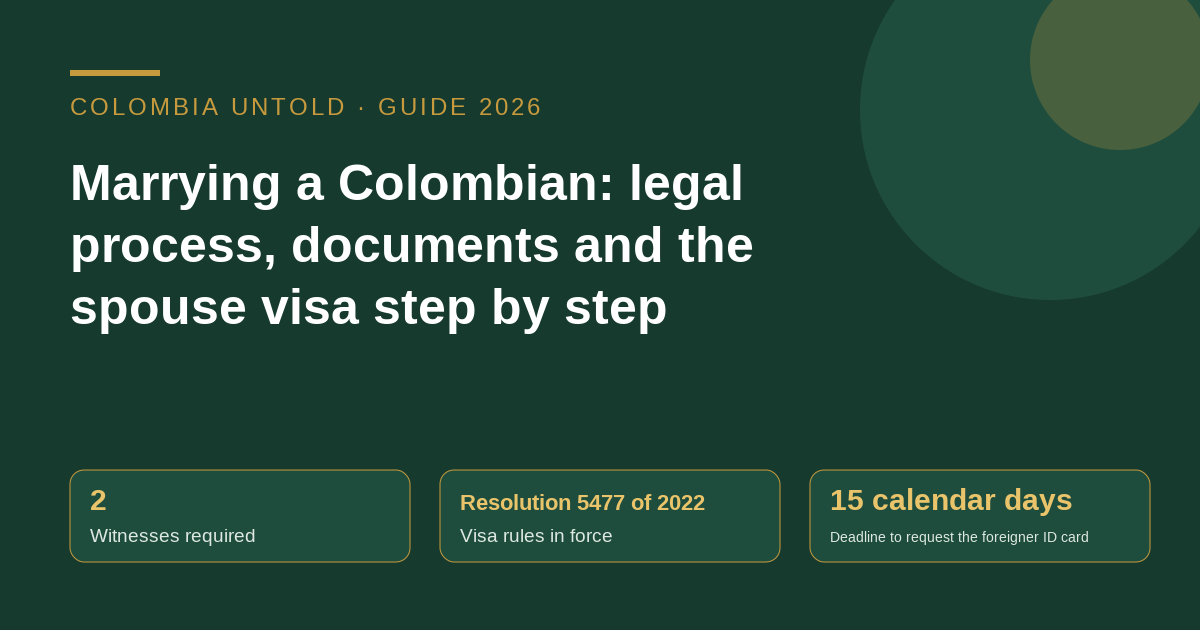
| Witnesses required | 2 | For a civil marriage before a notary |
| Visa rules in force | Resolution 5477 of 2022 | M visa for the spouse or permanent partner of a national |
| Deadline to request the foreigner ID card | 15 calendar days | From visa approval |
| De facto marital union | 2 years of cohabitation | Law 54 of 1990, basis of the marital property partnership |
Official sources and reliable reading
Related guides
- Colombian foreigner ID card (cédula de extranjería): what it is, who needs it, requirements, costs and how to apply
- Culture shock in Colombia: stages, customs, social etiquette and how to integrate without losing your identity
- Basic taxes for foreigners in Colombia
General information based on current rules and practice; it may change. Confirm your case with the official source or an authorized professional. Not legal, tax or medical advice.