Medellín vs Bogotá for foreigners in 2026: climate, cost of living, work, transport, health, safety and which to choose for your profile
Updated: 13 October 2026 · Colombia Untold
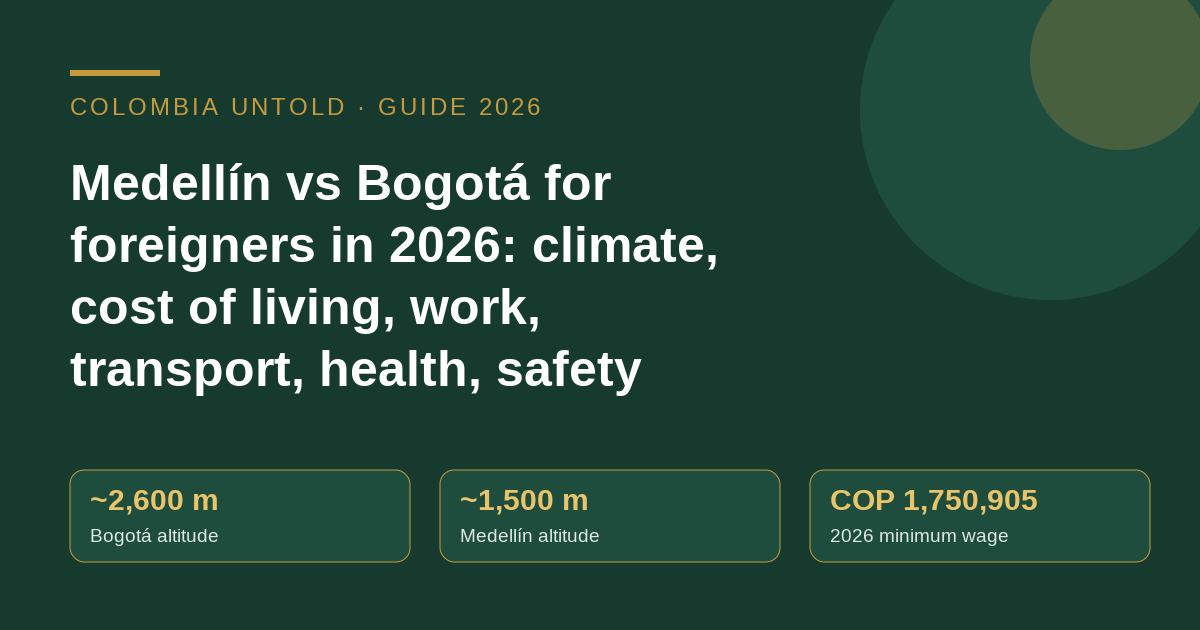
Quick answer: Medellín (~1,500 m, mild climate, its own metro, established nomad and retiree community) and Bogotá (~2,600 m, the capital with the largest job market, embassies, universities and international flights) are the two cities foreigners choose most in Colombia. Medellín usually wins on climate and everyday quality of life; Bogotá on job opportunities, paperwork and connectivity. The right choice depends on your visa, your income source and your tolerance for cold and altitude.
Almost every foreigner weighing a move to Colombia ends up asking the same question: Medellín or Bogotá? It is not a question with a single answer, because the two cities are very different in climate, pace, job market and lifestyle. This guide compares them on criteria that really change daily life: climate and altitude, cost of living, housing, work, transport, health, education, social life, safety, paperwork and connectivity. At the end you will find a way to decide according to your profile: digital nomad, retiree, family, hired professional or investor. Price data we refer to the cost-of-living guides for each city, which are updated separately.
Climate and altitude: the first filter
Bogotá is at about 2,600 meters above sea level, with an average temperature near 14 degrees Celsius, cold mornings and nights and frequent rain in two seasons a year. Medellín is at about 1,500 meters in the Aburrá Valley, with a mild climate, typical daytime temperatures between 20 and 28 degrees and less variation through the year. That is why Medellín is known as the city of eternal spring. Altitude affects Bogotá more: in the first days it is common to feel tiredness, a mild headache or trouble sleeping, and intense exercise requires gradual build-up. Anyone with a heart or respiratory condition should consult their doctor. Medellín is kinder to almost everyone. If the cold bothers you or you want sun and light clothes, this alone can tip the balance. If you prefer cool weather, jackets and gray days, Bogotá will feel natural. One thing to keep in mind in both: solar radiation is high all year because of the closeness to the equator, and using sunscreen is recommended even under cloudy skies.
Size, pace and character
Bogotá is the capital, a metropolis of several million people on a very large scale: long distances, heavy traffic and first-rate cultural, culinary and political life. Medellín is a more compact city, within a large metropolitan area, with neighborhoods grouped in the valley and up the hillsides; its pace feels more relaxed, although it also has rush-hour congestion. In Bogotá there is more anonymity and more variety of plans; in Medellín, foreign communities are more visible in certain neighborhoods and social life is easier to enter if you are new. Neither is "better": it is a matter of which scale you prefer.
Cost of living
Both cities are more expensive than the national average, and cost depends heavily on the neighborhood and lifestyle. In general terms, rent is the expense that most separates the two cities depending on the area chosen, while food, transport and leisure depend more on your habits. To avoid figures that age, we refer you to the specific guides: Cost of living in Medellín 2026: rent, transport, food, health and a real budget for foreigners, Cost of living in Bogotá 2026: rent, TransMilenio, food, health and a real budget for foreigners and the direct comparison Medellín vs Bogotá 2026: cost of living, rent, transport and climate compared, and who each city suits. When budgeting, remember three common references in 2026: the monthly minimum wage is COP 1,750,905, DANE annual inflation was 6.29 % in September 2026 and the cap on annual urban housing rent increases was 5.10 %. To convert your budget from dollars, the TRM on 2 October 2026 was COP 3,307.73 per dollar; the Banco de la República publishes the daily figure.
Housing and neighborhoods
In Medellín, the neighborhoods most sought by foreigners are concentrated in El Poblado, Laureles, Envigado and Sabaneta, each with a different character: more international and modern towers in El Poblado, more residential and walkable in Laureles, more family-oriented in Envigado and Sabaneta. In Bogotá, the most frequent areas are Chapinero, Usaquén, Rosales, Zona G and Cedritos, with profiles from cultural and culinary to quiet residential. See Medellín neighbourhoods for foreigners: El Poblado, Laureles, Envigado, Belén and more, how to choose and Bogotá neighbourhoods for foreigners: which to choose by lifestyle, budget and work, and Mejores Barrios para Expatriados en Bogotá (en español). In both cities housing leases are governed by Law 820 of 2003: article 16 prohibits demanding cash deposits and real guarantees from the tenant, article 18 caps rent at 1 % of the property's commercial value and article 20 caps the annual adjustment at the CPI. In practice, landlords ask for a co-signer or a rental insurance policy, a special obstacle for those arriving without local history; see Rental references as a foreigner. For the search, Medellín Advisors at medellinadvisors.com and Premium Propiedades at premiumpropiedades.com support rentals and purchases in Medellín.
Work and economy
Bogotá concentrates most corporate headquarters, the financial sector, embassies, international organizations, ministries and a good part of the country's largest universities. If your plan is to get local employment, find corporate clients or work in diplomacy, consulting or the public sector, Bogotá offers more opportunities. Medellín has a strong ecosystem in technology, innovation, services, textiles, health and entrepreneurship, and a prominent community of remote workers and digital nomads. To work legally you need a visa that allows it; see Working Legally in Colombia as a Foreigner and Coworking and remote work in Medellín and Bogotá.
Transport and mobility
Medellín has its own metro system, with cable cars, a tram and integrated routes, covering much of the valley and one of the city's prides. Bogotá relies on the TransMilenio bus rapid transit system, SITP routes, bike lanes and a first metro line under construction. Rush-hour traffic is heavy in both cities, and both apply vehicle restriction measures, the famous pico y placa; check it if you plan to own a vehicle. When choosing a neighborhood, proximity to the metro in Medellín or to a TransMilenio trunk line in Bogotá can save you hours each week. See Cycling and urban mobility in Colombia: bike lanes, safety and getting around without a car and SOAT and vehicle insurance. In international connectivity, Bogotá has El Dorado airport, the country's largest, with more direct international routes. Medellín is served by José María Córdova airport, in Rionegro, about 30 to 45 minutes from the valley depending on traffic, and by Olaya Herrera airport for regional flights. If you will travel abroad a lot, that difference weighs.
Health and education
Both cities have high-complexity clinics and hospitals, public and private, with specialist doctors and medical tourism services. The system combines EPS, prepaid medicine and private insurance; see Colombia's Health System Explained for Foreigners and Health Insurance for Expats: A Comparison Guide. In education, both offer international and bilingual schools and prestigious universities; see Schools for foreign families in Colombia: types, curricula, costs, admission and how to choose and International schools in Medellín for expat children: options, curricula, costs and where to live.
Safety
Safety is a legitimate concern in both cities and varies greatly by neighborhood, time and behavior. Both have tourist and residential areas with good security presence and others where caution is advised. The most common crimes affecting visitors are phone and belongings theft, impersonation in unofficial taxis and drink scams in bars. Basic recommendations are the same: use reliable ride apps, do not display your phone in the street, do not accept drinks from strangers and keep your documents safe. See ATMs in Colombia: withdrawing cash safely, fees, limits and common scams. In emergencies call 123.
Social life, culture and community
Medellín has a very visible international community, with events for foreigners, language exchanges, coworkings and a food and nightlife offer concentrated in certain areas. Bogotá offers more diverse cultural life because of its scale: museums, theater, live music, universities, festivals, restaurants of every cuisine and a diplomatic and academic community. In both cities the Sunday and holiday bike day is a great way to integrate. Learning Spanish is key in either; see Everyday Spanish in Colombia: phrases, forms of address, regionalisms and a 90-day routine.
Paperwork and bureaucracy
Immigration procedures, the foreigner ID card and several national offices are in Bogotá or have offices in both cities. Migración Colombia serves in both, although the number of points and waiting times vary. If your process depends on central offices, ministries or embassies, living in Bogotá can ease in-person procedures. For an overview, see Colombian foreigner ID card (cédula de extranjería): what it is, who needs it, requirements, costs and how to apply and Colombia Visa Types: A Complete Explained Guide. For visa help, Colombia Visa Legal at colombiavisalegal.com and CoVisas at covisascolombia.com support the process from either city.
Which to choose by profile
Digital nomad or remote worker. Medellín is usually the first choice for climate, community, coworkings and reasonable costs; Bogotá is good if you need air connectivity, local clients or large-scale urban life. Retiree. Medellín stands out for its mild climate without abrupt changes, without Bogotá's altitude; other cities with ideal retirement climates also exist, which we review in Best 10 cities to live in Colombia. Professional with a local contract. Bogotá concentrates more corporate and diplomatic opportunities; Medellín has strong demand in technology and services. Family with children. Both have good international schools; the deciding factor is usually climate, commute time and community. See Colombia for expat families: a complete guide to visas, schools, health, housing, costs and daily life. Investor or entrepreneur. Bogotá offers market scale; Medellín, an innovation and tourism ecosystem. Real estate or business investment requires legal and tax advice in both cases.
A practical test before deciding
The best decision is made by living. If you can, spend at least two or three weeks in each city before signing a long lease. Rent temporary accommodation in the neighborhood that interests you, do your real routine —work, shopping, exercise, transport—, visit at different hours and compare how you feel. Note how long your commutes take, how much you spend and how much the altitude costs you. With that data, the decision stops being an intuition.
Frequent mistakes
Deciding only from a list of "best cities". Underestimating Bogotá's altitude and cold. Signing a long lease without knowing the neighborhood. Ignoring traffic when choosing housing. Not considering the distance to the airport. Budgeting without margin for inflation and exchange rate. And not checking that your visa allows the activity you plan.
A practical example: a couple of remote workers
A couple with dollar income evaluates both cities. They spend three weeks in Bogotá and three in Medellín in temporary accommodation. In Bogotá they enjoy the cultural offer, but the cold and distances weigh on them. In Medellín they adapt faster to the climate and find community in coworkings. They calculate their budgets with the cost-of-living guides and the day's TRM, choose Medellín, and with advice from Medellín Advisors and Premium Propiedades they sign a lease with a policy instead of a deposit, in line with Law 820. To cover frequent trips, they quote insurance with Protege Tu Viaje, which offers up to 65 % discount at Protege Tu Viaje.
Frequently asked questions
Which city is better for foreigners, Medellín or Bogotá?
It depends on your profile. Medellín usually wins on climate and community; Bogotá on job opportunities, paperwork and air connectivity. Ideally spend a few weeks in each before deciding.
Is Bogotá's altitude very strong?
Bogotá is at about 2,600 meters. In the first days it is common to feel tiredness or a mild headache; adaptation usually takes a few days or weeks. Consult your doctor if you have heart or respiratory conditions.
Where is it easier to get a job as a foreigner?
Bogotá concentrates more corporate headquarters, embassies and international bodies; Medellín stands out in technology and services. In both cases you need a visa that allows work.
Which has better public transport?
Medellín has a metro, cable cars and a tram; Bogotá has TransMilenio, SITP, bike lanes and a metro under construction. Rush-hour traffic is heavy in both.
Which has better international connections?
Bogotá, with El Dorado airport and the most direct international flights. Medellín is served by José María Córdova airport, in Rionegro.
Can I rent without a deposit in both cities?
Yes. Law 820 of 2003 applies nationwide and its article 16 prohibits demanding cash deposits and real guarantees; the usual substitute is a co-signer or a rental insurance policy.
If you are evaluating housing or investment, Medellín Advisors can guide you on search, title review and the purchase or rental process. Always hire independent legal review.
Key figures and data
| Item | Value | Note |
|---|---|---|
| Bogotá altitude | ~2,600 m | Cool climate, average temperature near 14 °C |
| Medellín altitude | ~1,500 m | Mild climate, known as the city of eternal spring |
| 2026 minimum wage | COP 1,750,905 | Common reference for contracts and budgets |
| DANE inflation (Sept. 2026) | 6.29 % | To project the budget over twelve months |
Official sources and reliable reading
Related guides
- Renting an office or desk in Colombia: coworking, private office and commercial premises
- Notary and powers of attorney for foreigners in Colombia: authentications, apostille, translations, general and special powers, sworn statements and costs
- Payroll as a foreigner
General information based on current rules and practice; it may change. Confirm your case with the official source or an authorized professional. Not legal, tax or medical advice.