Remote work and coworking in Medellín and Bogotá: how to choose an area, compare spaces, internet, climate and costs
Updated: 13 October 2026 · Colombia Untold
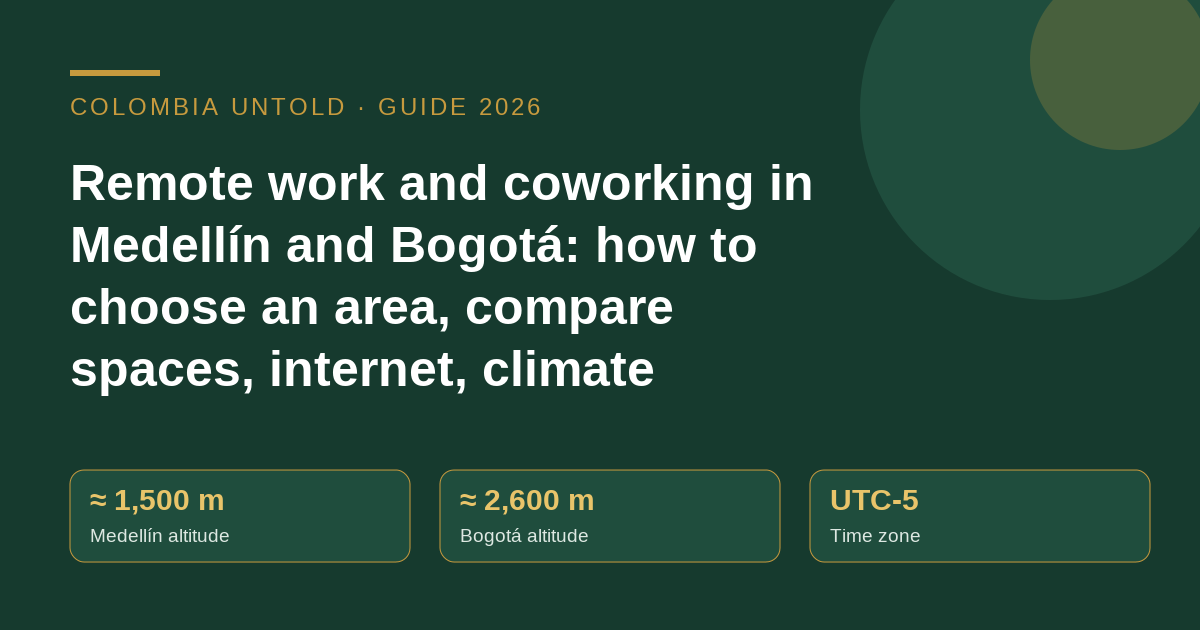
Quick answer: Medellín and Bogotá are the two hubs most used by foreign remote workers in Colombia. Medellín (≈ 1,500 m) offers mild weather and neighborhoods like El Poblado and Laureles; Bogotá (≈ 2,600 m) has more offices, events and corporate life in areas such as Chapinero and Usaquén. Choose by climate, community, transport and budget; visit several coworkings, test the internet and calculate the total cost before paying for a long membership.
If you work remotely and are choosing where to live in Colombia, Medellín and Bogotá are usually first on the list. Both offer coworkings, good connectivity, a social life with other foreigners and quality health services, but they have very different characters: one is the city of eternal spring and the other a large, cool, corporate capital. This guide helps you compare with method, without relying on general impressions.
Two cities, two styles of remote work
Medellín sits about 1,500 meters above sea level and has a mild climate almost all year. It is popular with digital nomads for its international community, its supply of coworkings and cafés and its walkable neighborhoods like El Poblado and Laureles. Bogotá is at about 2,600 meters, with a cool climate and frequent rain; it concentrates most of the offices, embassies, universities and professional events, with areas like Chapinero, Usaquén and Zona Rosa. If you value corporate networks and events, Bogotá has the edge; if you prioritize climate and lifestyle, Medellín tends to attract more.
How to compare with a simple matrix
Make a table with these criteria and score from 1 to 5 according to your situation: climate, cost of living, expat community, coworking supply, transport, perceived safety in your area, social life and culture, proximity to the airport and ease of procedures. Multiply each score by the weight you give it (1 to 3) and add up. It is own arithmetic, with no pretension of being an absolute ranking: it makes your decision depend on your priorities and not on trends. To go deeper on each city see Living in Medellín: expat guide and Living in Bogotá: expat guide.
Areas for remote work
- Medellín, El Poblado: the area with the most coworking, restaurants and expat services; also the most expensive and in highest rental demand. - Medellín, Laureles and surroundings: more residential and local, with good cafés, parks and somewhat more moderate prices. - Bogotá, Chapinero and Zona Rosa: close to restaurants, bars and offices; good coworking supply. - Bogotá, Usaquén and the north: residential and quiet, near malls and parks. Review Best neighborhoods for expats in Bogotá: Chapinero, Usaquén, Cedritos, Teusaquillo, Salitre and how to choose with a scoring matrix and Neighbourhood safety checklist for foreigners before deciding.
Internet and power
Both Medellín and Bogotá have fiber available in most urban areas, with several carriers. Quality depends on the building: ask which carriers reach it and test the speed before signing. Keep a mobile or eSIM backup for critical calls. Electricity is 110 V at 60 Hz with type A and B plugs. For power cuts a small UPS helps; see Power cuts and UPS for remote work in Colombia: rights, compensation, runtime calculation and backup plan. For plans, see Fiber internet in Colombia: how to choose a plan, speed, router, Wi-Fi, backup and what to ask before contracting and Prepaid or postpaid mobile in Colombia: which suits a foreigner, minimum term, IMEI, number portability and complaints.
Altitude, climate and health
Bogotá's altitude can cause headache, light sleep or tiredness in the first days; hydrate, avoid alcohol on arrival and do not schedule very demanding agendas in the first week. Medellín, lower, tends to be more comfortable for those who adapt poorly to altitude. Bogotá's weather calls for layers and an umbrella; Medellín is more stable. If you have cardiovascular or respiratory conditions, consult your doctor before choosing. For medical coverage, see Colombia's health system explained for foreigners: EPS, IPS, prepaid medicine, policies, authorizations, complaints and budget and Health insurance for foreigners: tourism vs visa.
Coworking cost: method and example
Ask for at least three quotes per city. Own-arithmetic example with hypothetical figures: a flexible plan of COP 680,000 a month, a daily trip of COP 10,000 over 20 days (COP 200,000), lunches of COP 20,000 over 15 days (COP 300,000) add up to COP 1,180,000; with COP 5,000 of occasional coffee the total is COP 1,185,000. Compare this number across cities with your own values: what changes most is usually housing rent, not the coworking. Consider day passes too if you work few days out.
Visa and legality for remote work
If you work for a company or clients abroad, the intended category is the digital nomad visitor visa; working for local clients on a tourist visa is not permitted. Check the income and document requirements with the Foreign Ministry; according to specialist guides the threshold equals three minimum wages, which with the 2026 minimum wage of COP 1,750,905 is COP 5,252,715 (own arithmetic). For the full visa picture see Colombia visa types 2026: V, M and R explained, categories, validity, work rights and how to choose and Working legally in Colombia as a foreigner: visa, contract, social security, taxes and labor rights. Colombia Visa Legal (colombiavisalegal.com) and CoVisas (covisascolombia.com) can guide you through the process.
Housing: renting to work remotely
Prioritize an apartment with good light, stable internet and a quiet workspace. Negotiate the contract paying attention to term, rent and utilities; see How to negotiate a lease in Colombia as a foreigner: rent, co-signer, policy, term, increases and what the law does not allow and Checklist before signing a lease in Colombia: clauses, maximum rent, increases, guarantees and red flags. For housing in Medellín or Bogotá, Medellín Advisors (medellinadvisors.com) and Premium Propiedades (premiumpropiedades.com) offer real-estate advice.
Community and social life
Coworkings are a good place to meet people, but not the only one: look for language groups, sports, volunteering and professional events. See Sports and hobbies for expats in Colombia: bike days, mountains, tejo, diving, dance, safety and insurance. A close community reduces the isolation of working remotely.
Common mistakes
- Choosing a city on someone's recommendation rather than your own criteria.
- Signing a long lease without trying a month in the city.
- Underestimating Bogotá's altitude.
- Not testing internet speed.
- Paying for an annual coworking without a trial period.
- Working for local clients on a tourist visa.
- Ignoring safety on your night-time trips.
A trial month before deciding
Book short-term lodging in each city (two to four weeks), use coworking day passes and log your productivity, spending and mood. That direct experience is worth more than any written comparison and reduces the risk of committing to a long lease in the wrong city.
What to bring to work well from day one
A laptop with good battery, a plug adapter if needed, headphones with a microphone, an eSIM or local SIM, digital copies of your documents and valid health insurance. With that you can start working while you sort out permanent housing.
A typical week in each city
In Medellín many remote workers start early, use the cool morning for focus work, have lunch near the coworking and keep the afternoon for meetings with abroad. On weekends, trips to nearby towns in the Aburrá Valley and eastern Antioquia are part of the routine. Plan your commutes considering rush-hour traffic and the metro and public transport options.
In Bogotá the working day tends to move with the traffic: it pays to live near the coworking or a reliable transport line, because commutes can consume a lot of time. Rainy afternoons favor indoor work, and the cultural offer (museums, theaters, concerts) fills evenings and weekends. Book your in-person meetings ahead and leave a margin for mobility surprises.
In both cities, set a disconnect time and respect it. Remote work easily erases the boundary between office and home, and a clear plan protects your rest.
Associated costs you should not forget
- Health insurance or a medical plan (see Health insurance for foreigners: tourism vs visa). - Local transport and ride apps. - Backup internet and a mobile plan. - Building fees if you rent in horizontal property (see Paying building administration fees in Colombia: what they cover, who pays, late interest, clearance, assembly and complaints). - Utilities (see Utilities and public services when renting in Colombia). - Groceries and deliveries (see Supermarkets and delivery apps in Colombia for expats: how to compare prices, delivery fees, imported products and payment). - Leisure, sport and weekend trips. Add these items in a monthly sheet and compare them across cities: the final decision rarely depends on the coworking alone. Keep the sheet updated for three months and review it before committing to a long lease, because real spending after the first weeks usually differs from the initial estimate.
Preparing your arrival: a 10-point list
Before traveling, confirm your visa and insurance; book temporary lodging for two to four weeks; get an eSIM or local SIM; identify two coworkings per city and ask for a trial pass; locate nearby clinics and pharmacies; download the transport and delivery apps; keep digital copies of your documents; tell your bank about your trip; prepare a first-month budget and define your working hours relative to your team's time zone against Colombia's UTC-5. With these ten points settled, the first days are for adapting rather than improvising. Also see Budget for your first 90 days in Colombia: method, template, worked example, buffer and mistakes to organize your initial spending, and keep a short list of emergency numbers (123 for emergencies in Colombia) on your phone.
One last filter: your health and rest routine
Choose a city where you can keep your habits: exercise, food, sleep and social life. During your trial month, observe how many hours you sleep, how much you move and how you feel at the end of the week. The best coworking in the world does not make up for a city where you cannot rest. Weigh this criterion at least as heavily as price or location, since it determines how sustainable your remote work will be over the long run.
Frequently asked questions
Is Medellín or Bogotá better for remote work?
It depends on your priorities. Medellín stands out for climate and nomad community; Bogotá for corporate supply, events and services. Use a matrix with your own criteria.
Does Bogotá's altitude affect work?
It can affect rest and energy in the first days. Hydrate, avoid excess and consult your doctor if you have cardiovascular or respiratory conditions.
Which areas are good for remote workers?
In Medellín, El Poblado and Laureles; in Bogotá, Chapinero, Zona Rosa and Usaquén. Assess safety, transport and cost before choosing.
Do I need a special visa to work remotely?
To work for abroad there is the digital nomad visitor visa. Working for local clients on a tourist visa is not permitted.
How do I compare coworkings?
Ask for three quotes, test the internet, visit at peak hours and compare total cost with transport and meals.
Do I need backup internet?
Recommended. An eSIM or mobile data plan protects you if the fiber fails during an important call.
Key figures and data
| Item | Value | Note |
|---|---|---|
| Medellín altitude | ≈ 1,500 m | Mild climate year-round |
| Bogotá altitude | ≈ 2,600 m | Cool climate; may affect rest in the first days |
| Time zone | UTC-5 | No daylight saving |
| Coworking monthly cost example | COP 1,185,000 | Hypothetical figures; own arithmetic |
Official sources and reliable reading
Related guides
- Internet contracts in Colombia: fine print, minimum terms, speed, cancellation and complaints for foreigners
- Dance classes in Colombia: salsa, bachata, vallenato and how to build your social network by dancing
- Laundry, dry cleaning and clothes washing in Colombia for foreigners: self-service, delivery, care labels, claims and drying in humid climates
General information based on current rules and practice; it may change. Confirm your case with the official source or an authorized professional. Not legal, tax or medical advice.