SOAT and vehicle insurance in Colombia: coverage, fine, foreigners, comprehensive cover and how to claim
Updated: 13 October 2026 · Colombia Untold
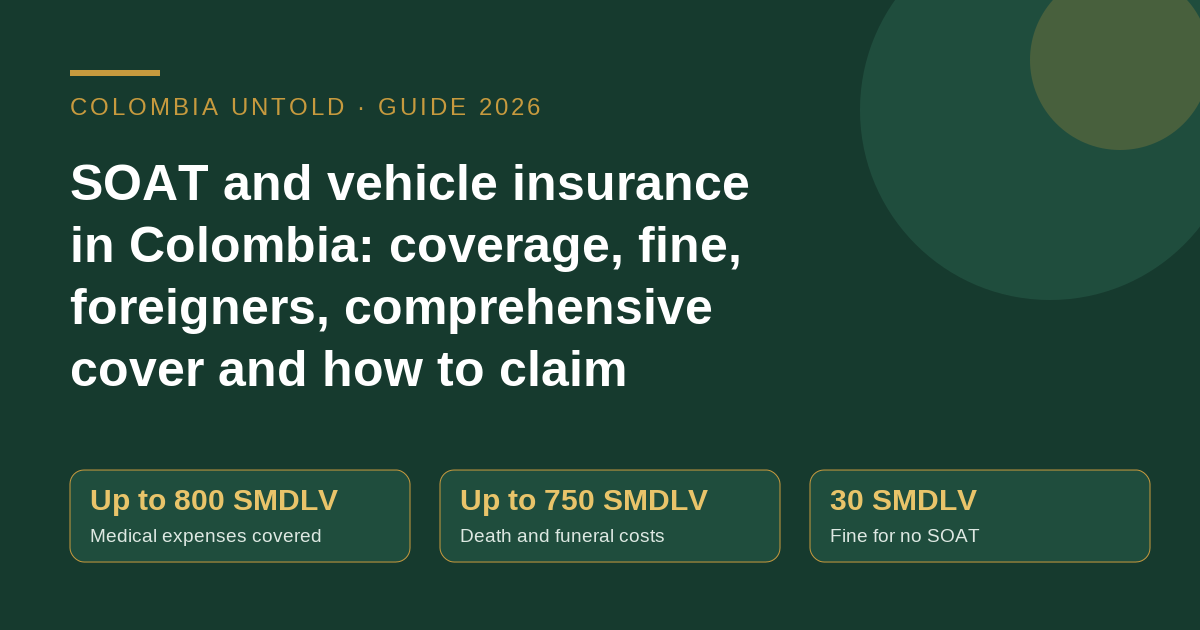
Quick answer: SOAT is the mandatory traffic-accident insurance for every vehicle driven in Colombia, foreign vehicles included: it covers up to 800 daily minimum wages in medical expenses, 750 for death and funeral costs, 180 for permanent disability and 10 for victim transport, regardless of fault. Driving without SOAT brings a 30-SMDLV fine (≈ $1,750,905 in 2026, own arithmetic) and impoundment (Law 769 of 2002, art. 131). SOAT does not cover damage to the vehicle or third-party property: comprehensive cover and liability insurance exist for that.
If you are going to drive in Colombia, be it a car or a motorcycle, there is one insurance you cannot avoid: SOAT. Many foreigners discover it at the most awkward moment, when a traffic officer asks for the document or when an accident demands immediate medical care. This guide explains what SOAT is, what it covers and does not, how it compares with other covers, what happens if you don't have it, how to buy it, what additional insurance exists and how to claim. For the general driving framework, see Driving in Colombia as a foreigner: license, SOAT, rules, fines, plate restrictions and road safety and Driving license in Colombia as a foreigner: validation, exams, medical certificate, RUNT, categories, validity and steps.
What SOAT is and whom it protects
SOAT is the Mandatory Traffic Accident Insurance (Seguro Obligatorio de Accidentes de Tránsito). It was created by Law 33 of 1986 and is regulated by the National Traffic Code (Law 769 of 2002). Its purpose is to guarantee care for people injured or killed as a result of a traffic accident, regardless of who is responsible. It protects victims: occupants of the insured vehicle, pedestrians, cyclists and occupants of other vehicles. It does not protect the vehicle or its material damage. It is mandatory for all vehicles on the country's roads, and also covers foreign vehicles circulating in Colombia. The policy is tied to the vehicle's plate, not to the person driving.
What SOAT covers: figures and what they mean
Covers are expressed in daily legal minimum wages (SMDLV), per victim: - Medical, surgical, pharmaceutical and hospital expenses: up to 800 SMDLV. Includes emergency care, hospitalization, surgery, medication, diagnostics, rehabilitation and prostheses. - Permanent disability: up to 180 SMDLV, after a ruling from the disability review boards. - Death and funeral costs: up to 750 SMDLV together, if death results from the accident and occurs within the following year. - Transport of the victim to the care center: up to 10 SMDLV. Our own arithmetic: with the 2026 monthly minimum wage ($1,750,905), the daily one is $1,750,905 ÷ 30 = $58,363.50. So 800 SMDLV equal about $46,690,800; 750 SMDLV, $43,772,625; 180 SMDLV, $10,505,430; and 10 SMDLV, $583,635. Those are caps per victim. The calculations are approximate because the daily value is rounded. In a serious accident, a medical cap of about $46.7 million can be used up quickly in an intensive-care stay; in that case, the excess is handled by the entity responsible according to the victim's enrollment. That is why it pays to have health and complementary insurance: see Health insurance for expats in Colombia: EPS, prepaid medicine, policies and international cover compared with method and example.
What SOAT does NOT cover
- Damage to your own vehicle or to third parties' vehicles. - Damage to third-party property (a wall, a pole, a shop window). - Injuries or death where the driver causes harm to others beyond SOAT's caps, which remain the responsible party's burden. - Theft of the vehicle. - Lawyer fees or court proceedings. For those risks other insurance exists: extra-contractual civil liability and own-damage policies, discussed below.
What happens if you don't have SOAT
Driving without valid SOAT is a traffic offense with a fine of 30 SMDLV, that is, 30 × $58,363.50 = $1,750,905 in 2026 (own arithmetic: it equals one monthly minimum wage). In addition, the vehicle can be impounded by the authorities until a paid SOAT is shown and the fine is paid; towing and parking are also charged, costs that can exceed the annual policy price. If you have an accident without SOAT, you must pay the victims' medical expenses out of your own pocket, with possible legal proceedings. Unpaid fines accrue interest and affect your record. Verify your SOAT's validity on the platform the traffic authority indicates and keep the digital policy on your phone.
Foreigners and SOAT: what to know
SOAT applies to vehicles, not nationalities. If you buy or import a vehicle in Colombia, you must have SOAT; if you arrive with a foreign vehicle in transit, the policy also applies. To buy SOAT you will need the vehicle's details (plate, and sometimes the registration card) and the policyholder's ID; insurers accept a passport or foreigner ID card. If you buy a used vehicle, demand valid SOAT and the status of fines and taxes before paying; see Buying a used vehicle in Colombia as a foreigner: RUNT checks, transfer, scams and a verification checklist. For the registration card, the transfer and taxes, consult an agent or your city's traffic office. For a driver's license, see Driving license in Colombia as a foreigner: validation, exams, medical certificate, RUNT, categories, validity and steps.
How much it costs and where to buy it
SOAT's price is set by the regulator with official rates by vehicle type, engine size, age and use, and it is the same at every insurer: the rate is regulated. That means you gain nothing by comparing prices, but by buying through a reliable channel. You can buy it from authorized insurers, their web portals or authorized intermediaries; be wary of offers promising prices below the rate, because they can be forgeries. Always check on the official lookup platform that the policy shows as registered under your plate. SOAT is bought for one year and must be renewed before expiry; set an alarm in advance.
Additional insurance: liability and comprehensive
- Extra-contractual civil liability: covers damage you cause to third-party property and third-party injuries or deaths above SOAT's caps. If you drive, it is the most important additional cover. It is sold alone or as part of car insurance. - Comprehensive car insurance: covers damage to your own vehicle from collision, total loss from accident or theft, and usually includes liability, roadside assistance and a replacement vehicle. It has a deductible and exclusions; read the insured value, the indemnity method (market value or agreed value), earthquake cover, the per-claim deductible and any security-device requirements. - Total loss and theft: check how the indemnity value is calculated and which devices the insurer requires. - Roadside assistance: tow, locksmith, tire change, fuel; in cities with heavy traffic it may be worth it. Example of our own arithmetic with hypothetical figures: if your comprehensive policy's deductible is 10 % with a minimum of $1,000,000 and the repair costs $8,000,000, 10 % is $800,000, below the minimum, so you pay $1,000,000 and the insurer pays $7,000,000. If the repair costs $15,000,000, 10 % is $1,500,000, above the minimum, so you pay $1,500,000 and the insurer pays $13,500,000. Check in your policy how the deductible is defined.
What to do if you have an accident
- Get to safety, call 123 and ask for medical assistance if there are injuries. - Don't move the vehicle if there are injured people, unless the authorities say so. - Take photos of the vehicles, the plates, the damage and the scene. - Exchange details with the other drivers: name, ID, plate, insurer. - Inform your comprehensive and liability insurers within the policy's deadline. - Present SOAT at the clinic: the provider treating the victims uses it to bill medical expenses. - If there are injuries or damage, wait for traffic authorities if the law or place requires, and ask for the sketch or accident report. For other traffic procedures, such as transfers or tax payments, consult your city's mobility office.
Alternatives to a car: getting around without your own vehicle
In Bogotá and Medellín many expats live without their own vehicle, using public transport, taxis and apps. That avoids SOAT, insurance, parking and pico y placa. See Moving to Bogotá: complete expat guide with a 90-day timeline, paperwork, transport, health, schools and mistakes and Moving between cities in Colombia (trasteo): licensed companies, insurance, inventory, building clearance and timeline to compare. If you buy a vehicle, calculate the total cost of ownership (SOAT, insurance, taxes, maintenance, inspection, parking) and compare it with alternative transport.
Common mistakes
- Letting SOAT expire for lack of an alarm.
- Buying SOAT through unauthorized channels or at prices below the rate.
- Believing SOAT covers damage to the car.
- Not taking out liability insurance and being exposed to a high indemnity.
- Not checking SOAT, fines and taxes when buying a used vehicle.
- Lending the vehicle without knowing whether the insurance covers other drivers.
Renewal, change of owner and other practical cases
SOAT is renewed every year and the new policy starts when the previous one ends; if you renew early, you lose no days, and if you are late you have no cover from the first day of delay. When you sell a vehicle, SOAT stays associated with the plate, so the buyer benefits from the remaining time; confirm in the sales contract who bears that value. If the vehicle goes a long time without circulating (for example, during a long trip), the policy keeps running; some insurers offer a partial premium refund if it is cancelled because of sale or total loss of the vehicle, with supporting documents. If you have a motorbike, SOAT is also mandatory and its rate differs from a car's. If you share the vehicle with other people, remember that SOAT protects victims regardless of who drives, but comprehensive and liability insurance may have restrictions on habitual drivers and ages.
Frequently asked questions
What does SOAT cover?
Medical care for victims of a traffic accident (up to 800 SMDLV), permanent disability (up to 180), death and funeral costs (up to 750) and transport (up to 10), regardless of fault. It does not cover damage to the vehicle.
What is the fine for not having SOAT?
30 daily legal minimum wages, equal to $1,750,905 in 2026 (own arithmetic), plus impoundment of the vehicle, towing and parking (Law 769 of 2002, art. 131).
Does a foreigner need SOAT?
SOAT applies to the vehicle, not the driver's nationality. If you drive a vehicle in Colombia, it must have valid SOAT, including foreign vehicles circulating in the country.
Does SOAT cover my damage if I crash?
It does not cover material damage. For those risks you need comprehensive or own-damage insurance, and for damage to third parties, a civil liability policy.
Why is SOAT's price the same at every insurer?
Because the rate is regulated by vehicle type, engine size, age and use. The difference between channels is reliability, not price.
Where do I check that my SOAT is valid?
On the official policy lookup platform indicated by the traffic authority, by entering the plate. Also keep the digital policy on your phone.
If you need a medical plan or travel insurance for your visa or stay, CoVisas Colombia can guide you on plans that meet Resolution 5477. Always compare the coverages in writing.
Key figures and data
| Item | Value | Note |
|---|---|---|
| Medical expenses covered | Up to 800 SMDLV | SOAT, per victim, regardless of fault |
| Death and funeral costs | Up to 750 SMDLV | When death results from the accident |
| Fine for no SOAT | 30 SMDLV | ≈ $1,750,905 in 2026 (own arithmetic) plus impoundment |
| Permanent disability | Up to 180 SMDLV | Requires a disability review board ruling |
Official sources and reliable reading
Related guides
- Fiber internet in Colombia: how to choose a plan, speed, router, Wi-Fi, backup and what to ask before contracting
- Cartagena and the Caribbean coast for foreigners: climate, costs, neighborhoods, health and the reality beyond the postcard
- Nequi and Daviplata for foreigners: how to open them, limits and when to use them
General information based on current rules and practice; it may change. Confirm your case with the official source or an authorized professional. Not legal, tax or medical advice.