Rental references as a foreigner in Colombia: co-signer, insurance policy, credit bureaus, employment letter and how to build your file
Updated: 13 October 2026 · Colombia Untold
Quick answer: As a foreigner with no Colombian history, you can back your lease with: a valid passport and visa, an employment letter or contract, bank statements, personal references and references from previous landlords, a rental insurance policy or a co-signer with property. Law 820 of 2003 (art. 16) forbids demanding cash deposits and real guarantees. Credit-bureau checks require your authorization (Law 1266 of 2008). Prepare an orderly, translated file to negotiate from strength.
When a foreigner arrives in Colombia and looks for an apartment, they meet a question they did not expect: "what references do you have?". The Colombian rental system leans heavily on third-party guarantees (a co-signer with property or a rental insurance policy) and on credit-history checks. Anyone with no local history and no relatives in the country starts at a disadvantage, but not without options. This guide explains what landlords and agencies ask for, what is lawful to demand and what is not, how to assemble a convincing file and what alternatives exist when you have no co-signer.
What the law allows and what it forbids
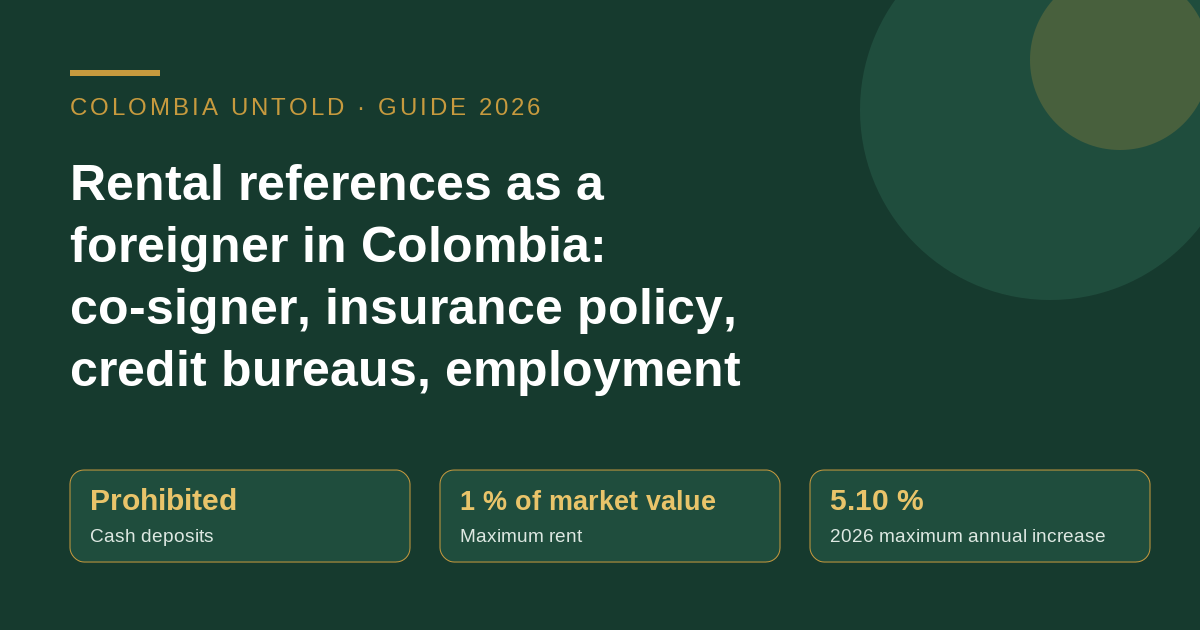
Urban housing leases are governed by Law 820 of 2003. Three rules are fundamental for negotiating: monthly rent cannot exceed 1 % of the property's market value (art. 18); cash deposits and real guarantees cannot be demanded (art. 16), so the usual guarantees are a co-signer or a rental insurance policy; and the annual increase cannot exceed CPI (art. 20), with a 2026 cap of 5.10 % based on DANE inflation. If a landlord asks you to hand over cash as a "security deposit" or demands a mortgage or pledge on one of your assets, the request contradicts article 16. See Rental deposit in Colombia: what the law says, how to recover your money and which deductions are legitimate and Renting in Colombia as a foreigner: rent, building fees, deposits and the real cost for the treatment of money handed over. Being clear on this is not a fight with the landlord: it is information for negotiating calmly. Usually the owner or agency wants to be sure you will pay; your job is to offer that assurance by a lawful route.
What they normally ask for and why
A tenant screening usually includes: identity document (passport and valid visa, or foreigner ID card), proof of income (employment letter, work contract, income certificate or bank statements), personal and commercial references, and sometimes a reference from a previous landlord. They also ask for a co-signer or a rental insurance policy. The landlord is looking for answers to three questions: are you who you say you are, can you pay and will you stay for the contract term? If your file answers all three clearly, the conversation changes.
ID and immigration status
A passport with a valid visa or entry stamp is the starting point. If your stay is as a tourist (up to 90 days, extendable to 180 per calendar year), many landlords will hesitate to offer an annual contract; offer a shorter contract or show that you have a visa process underway. With a residence visa, the foreigner ID card (see Colombian foreigner ID card (cédula de extranjería): what it is, who needs it, requirements, costs and how to apply) carries a lot of weight: it is the identity document banks and agencies use. For visa types, Colombia Visa Types: A Complete Explained Guide. For immigration support, you can consult Colombia Visa Legal (colombiavisalegal.com) or CoVisas (covisascolombia.com).
Income: how to prove it without a Colombian employment letter
The options, from most to least accepted in practice: an employment letter from a Colombian company; a remote work contract with a company abroad, translated; an income certificate from an accountant; bank statements for the last three to six months showing regular income; a tax return or equivalent fiscal document from your country; and, for retirees, the pension certificate. If your documents are in another language, submit them with a simple translation; if the agency demands an official translation, ask whether it requires an apostille (see Notary and powers of attorney for foreigners in Colombia: authentications, apostille, translations, general and special powers, sworn statements and costs). A guiding rule used by many landlords is that rent should not exceed a certain fraction of monthly income; ask which one they apply so you can prepare. Example of our own arithmetic with hypothetical figures: if your verifiable monthly income is $9,000,000 and the landlord applies a rule that rent must not exceed 30 % of income, the maximum acceptable rent would be 0.30 × $9,000,000 = $2,700,000. If you are looking at a $3,200,000 apartment, you would need to prove income of at least $3,200,000 ÷ 0.30 ≈ $10,666,667. That calculation tells you in advance whether your file is enough or you need a co-signer.
The rental insurance policy: the most common route without a co-signer
Many agencies work with insurers or rent-guarantee companies. A rental insurance policy covers the owner against unpaid rent and, depending on the product, utilities and building fees, in exchange for a premium that is normally calculated as a percentage of the rent and is paid by the tenant or negotiated between the parties. The insurer assesses the tenant with its own criteria (income, history, stability), so it is not an automatic step. Ask in writing: what exactly it covers, what the premium is, who pays it, how many months of coverage there are, what exclusions apply and what happens if the contract is renewed. Compare two or three options. If the policy is rejected, ask why and whether you can strengthen the assessment with a co-signer or additional documents.
The co-signer: who can be one and what it implies
A co-signer backs the tenant's obligation and answers for payment if the tenant fails. That is why agencies usually require them to own unencumbered property, with an up-to-date title certificate, and to have provable income. A newly arrived foreigner rarely knows someone like that. If a Colombian friend or colleague agrees to be one, explain the consequences clearly: it is a real financial responsibility, and the credit check is also done in their name. Don't pressure them or use incomplete information. If you have no co-signer, the policy is the natural alternative.
Credit bureaus and habeas data
Agencies and insurers usually query credit bureaus to see payment behavior. Law 1266 of 2008 regulates the handling of financial and credit information and requires your authorization to query and report your information. If you are a foreigner with no history in Colombia, the result is usually "no information", which is not the same as a bad history but does not build confidence either. You have the right to know, update and correct your data; complaints about improper handling go to the entity and, ultimately, to the Superintendencia de Industria y Comercio or the Superintendencia Financiera, as the case may be. To build local history, see How to build a credit history in Colombia (Datacrédito) as a foreigner.
Personal references and previous landlords
A letter from your previous landlord, even from another country, helps: it should state your name, the address, the rental period, that you paid on time and contact details, and be signed. If you can't get one, prepare two personal or work references with name, phone and email, and let them know so they respond. In Colombia references are verified by phone or message, so making contact possible in Spanish or with an interpreter helps.
The tenant's file: what to include
- Passport and visa or foreigner ID card (legible copies). - Proof of income: employment letter or contract, and bank statements for three to six months. - Tax return or equivalent fiscal document, if applicable. - Two or three personal references and, if available, one from a previous landlord. - Co-signer details or policy application. - A short introduction letter in Spanish: who you are, what you do, how long you plan to stay, whether you have pets, how many people will live there. - Simple translations of documents in another language. Deliver the file as a single PDF with an index. An orderly presentation conveys seriousness and speeds up the decision.
Alternatives when you can't meet the requirements
- Shorter or furnished contracts with an agency that manages the rental, while you build history. - A private owner who values the direct relationship, although documentary risk is higher and you must review the contract carefully (see Checklist before signing a lease in Colombia: clauses, maximum rent, increases, guarantees and red flags). - An arrangement backed by a company or sponsor, if your employer is Colombian. - Temporary lodging while you open an account and build history (see Airbnb or long-term rental in Colombia: which suits a foreigner by time, cost and law). If you seek real-estate support, you can consult Premium Propiedades (premiumpropiedades.com) and, in Medellín, Medellín Advisors (medellinadvisors.com).
Negotiating with a solid file
With clear documents you can ask for better terms: rent within the legal range, a convenient term and the option for the parties to share the policy. See How to negotiate a lease in Colombia as a foreigner: rent, co-signer, policy, term, increases and what the law does not allow for the process. After signing, Handover of a rented property in Colombia: inventory, photos, meters, record and clearance certificates guides you in documenting the apartment's condition.
Common mistakes
- Paying a cash deposit contrary to Law 820 of 2003.
- Submitting documents without translation or illegible.
- Lying about or exaggerating income: agencies verify.
- Not reading what the rental policy covers.
- Asking a friend to be a co-signer without explaining the risk.
- Signing without reviewing the increase and duration clause.
Frequently asked questions
Can the landlord demand a cash deposit?
No. Law 820 of 2003 (art. 16) forbids demanding cash deposits and real guarantees on urban housing. The usual guarantees are a co-signer or a rental insurance policy.
I have no co-signer in Colombia; what do I do?
Request a rental insurance policy through the agency, prepare a solid file of income and references, and consider a shorter contract while you build history.
Can they check credit bureaus without my permission?
No. Law 1266 of 2008 requires your authorization to query and report financial information. Review what you authorize before signing.
What income must I prove?
It depends on each landlord or insurer. Ask what proportion of income they apply to rent and calculate with your figures: minimum income = rent ÷ proportion.
Are documents in English accepted?
They are usually accepted with a simple translation. If the agency requires official translation or an apostille, ask which format they accept before spending money.
How much can rent rise each year?
It cannot exceed CPI (Law 820 of 2003, art. 20). The cap we use for 2026 is 5.10 %.
If you are evaluating housing or investment, Medellín Advisors can guide you on search, title review and the purchase or rental process. Always hire independent legal review.
Key figures and data
| Item | Value | Note |
|---|---|---|
| Cash deposits | Prohibited | Law 820 of 2003, art. 16, urban housing |
| Maximum rent | 1 % of market value | Law 820 of 2003, art. 18 |
| 2026 maximum annual increase | 5.10 % | Tied to CPI, art. 20 |
| Usual guarantees | Co-signer or policy | Alternatives to cash deposits |
Official sources and reliable reading
Related guides
- Daycare and childcare for expats in Colombia: nurseries, nannies, family compensation funds, health and documents
- Living in Medellín: expat guide
- Coworking and remote work in Medellín and Bogotá
General information based on current rules and practice; it may change. Confirm your case with the official source or an authorized professional. Not legal, tax or medical advice.