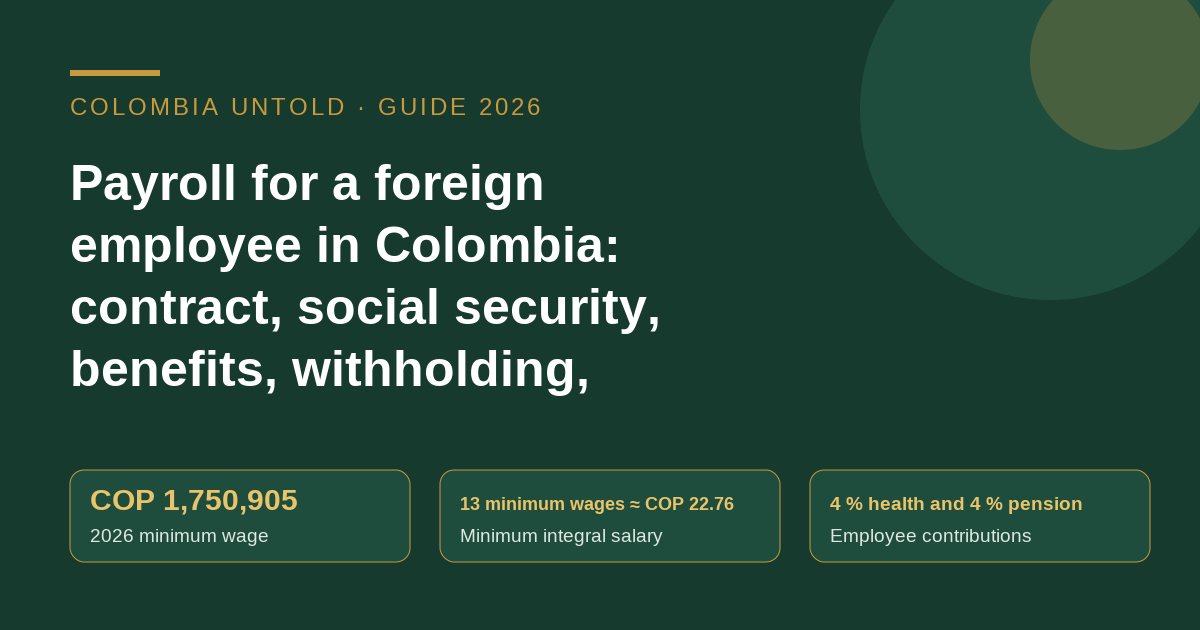
Payroll for a foreign employee in Colombia: contract, social security, benefits, withholding, electronic payroll and real cost
Updated: 13 October 2026 · Colombia Untold
Quick answer: A foreigner hired in Colombia with a visa that authorizes work has the same labor rights as a Colombian: 2026 minimum wage of COP 1,750,905, enrollment in health, pension and occupational risk coverage, service bonus, severance, interest, vacation and payroll contributions. Pension is mandatory unless covered by a regime from their own country (Law 100 of 1993, art. 15). The employer must file electronic payroll with the DIAN and withhold tax. On a COP 5,000,000 salary, the employer's extra cost is around 38 %.
Hiring a foreigner in Colombia, or being a foreigner who is hired, does not change the basic rules of payroll: Colombian labor law protects every worker who provides services in the territory, regardless of nationality. What does change are the prior requirements (the visa that allows work), a couple of particular decisions (what happens with pension if the person already contributes in another country, how it is reported to Migración Colombia) and the temptation to agree on payments in dollars or "off payroll" that end in problems. This guide walks through the whole payroll: the contract, salary, social security, benefits, withholding tax, electronic payroll and a numeric example of the real cost for the employer and the net for the worker.
First the visa: without work authorization there is no valid contract for the foreign worker
A foreigner may work in Colombia only if their visa or permit authorizes it. A migrant visa with work activity or a special permit allows it, whereas a visitor visa, as a general rule, does not allow subordinate work. Working without authorization exposes the worker to immigration sanctions and the employer to fines. The right to be paid for work already performed exists anyway, but it is better not to get there. Before signing, verify the visa, its validity and what activity it authorizes; see Working Legally in Colombia as a Foreigner and Colombia Visa Types: A Complete Explained Guide. For the employer, hiring a foreigner also means reporting the hire to Migración Colombia through the SIRE system, within the deadlines that entity sets.
The employment contract
An employment contract can be indefinite-term, fixed-term (up to three years, renewable), for a specific job or task, or an apprenticeship. It need not be written to exist, but it should be, in Spanish and, if the worker does not master it, with a courtesy version in their language. It should include: identification of the parties, position and duties, place of work, salary and payment method, working hours, duration, probation period (maximum two months) and special clauses. If the foreign worker comes to Colombia from a company abroad, there are arrangements such as secondment or local employment; each has different social security and tax consequences, and specialized advice is wise.
Minimum wage, integral salary and foreign-currency payments
The 2026 monthly minimum wage is COP 1,750,905. No contract can pay less for the maximum legal working day. There is an alternative for high salaries: the integral salary, agreed in writing and not lower than 13 minimum wages, that is, COP 22,761,765 per month in 2026. It includes a 30 % benefits factor, so service bonus, severance and their interest are not paid separately, but vacation and contributions are. Social security contributions are calculated on 70 % of the integral salary. Payments in dollars or euros are possible, but payroll is settled in Colombian pesos; if you pay in foreign currency, the applicable rate applies and there are exchange and tax effects that must be documented. For a reference exchange rate, the TRM on 2 October 2026 was COP 3,307.73 per dollar.
Social security: health, pension and occupational risks
Every employee must be enrolled in health, pension and occupational risk coverage, and the employer must pay contributions monthly through the integrated payment form (PILA). The contribution base is the monthly salary (excluding the transport allowance), with a minimum of one minimum wage. Health. The total contribution is 12.5 % of the base: the worker pays 4 % and the employer 8.5 %. Many corporate employers are exempt from the 8.5 % for workers earning less than 10 minimum wages, under article 114-1 of the Tax Statute. See Joining an EPS as a foreigner: requirements, costs and how the health system works. Pension. The total contribution is 16 %: the worker 4 % and the employer 12 %. Those earning 4 minimum wages or more also contribute to the Pension Solidarity Fund, an additional graduated percentage. Article 15 of Law 100 of 1993 provides that foreigners who stay in the country under an employment contract must enroll in the system, unless they are covered by a regime of their country of origin or any other. If your foreign worker contributes to a system in their country, ask for proof of that coverage and consult an expert on whether there is a social security agreement between both countries. For the worker's overview, see Social Security and Pension for Foreigners in Colombia. Occupational risks (ARL). Paid entirely by the employer, at a rate depending on the activity's risk class. For office activity, class I, the rate is 0.522 % of the contribution base.
Payroll-related contributions
Employers must contribute 4 % of payroll to the Family Compensation Fund. SENA (2 %) and ICBF (3 %), together with the 8.5 % health, are exempt for corporate income-tax taxpayers for workers earning less than 10 minimum wages. The fund offers subsidies and services to its members; see Daycare and childcare for expats in Colombia: nurseries, nannies, family compensation funds, health and documents for an example of compensation-fund services.
Social benefits and vacation
Service bonus (prima). Equivalent to one month's salary per year, paid in two installments: before 30 June and up to 20 December, proportional to time worked. Severance (cesantías). One month's salary per year of service, which the employer must deposit in a severance fund by 14 February of the following year. Interest on severance. 12 % per year on the severance, paid directly to the worker by 31 January. Vacation. Fifteen business days of paid rest per year of service. Transport allowance. Paid to those earning up to two minimum wages. It does not apply to higher salaries. Work clothing. Footwear and work clothes, three times a year, for workers earning up to two minimum wages. Benefits are calculated on salary and the payments that make it up. An "off payroll" arrangement to reduce contributions is illegal: if the worker claims, the judge will take the real salary. Non-salary payments must be expressly agreed and limited, and abuse brings sanctions and contribution obligations (the UGPP audits).
Withholding tax and income tax
The employer must withhold tax at source on labor payments, calculated with the table in article 383 of the Tax Statute, in UVT (the 2026 UVT is COP 52,374), after subtracting mandatory contributions and exempt income such as 25 % of labor income within legal limits and permitted deductions, such as mortgage interest or prepaid health up to caps. Withholding is an advance; the annual income tax return determines the final tax. A key point for the foreigner: if they are a tax resident (stay more than 183 days in a 365-day period), they are taxed on worldwide income with the progressive 0 to 39 % table; if not, the rate on Colombian-source labor income is 35 %. See Basic taxes for foreigners in Colombia 2026: tax residence, income tax, VAT, GMF, property tax and when to file and Tax residency certificate in Colombia: who is resident, how to request it from the DIAN and what it is for.
Electronic payroll and documents
Obligated employers must transmit to the DIAN the electronic payroll payment support document and its adjustment notes, per the entity's deadlines and conditions. Electronic payroll backs the employer's cost and deduction. The employer must also keep contracts, enrollments, payment forms, proof of service bonus and severance payments, vacation records and the immigration report. Good records reduce risk in a labor inspection or a dispute. If the company is small or starting out, an accountant or a payroll provider can automate the process; see also Electronic invoicing in Colombia for foreigners: who must invoice, RUT, DIAN, VAT, supporting document and service exports.
A numeric example: a COP 5,000,000 salary
Suppose a foreign employee with a monthly salary of COP 5,000,000, at a corporate company, office activity (class I), with a salary below 10 minimum wages and no right to transport allowance or work clothing (because it exceeds two minimum wages). Employee deductions. Health 4 % = COP 200,000; pension 4 % = COP 200,000. The Pension Solidarity Fund does not apply because COP 5,000,000 is below 4 minimum wages (COP 7,003,620). Pay before withholding: COP 4,600,000. Employer contributions. Pension 12 % = COP 600,000; ARL 0.522 % = COP 26,100; compensation fund 4 % = COP 200,000. Health, SENA and ICBF exempt. Monthly provision for benefits. Severance (one month per year) = COP 416,667; interest on severance (12 % per year) = COP 50,000; service bonus = COP 416,667; vacation (15 business days per year) = COP 208,333. Sum. Contributions and provisions on top of salary = COP 1,917,767, about 38.4 % over the salary. The employer's total monthly cost is about COP 6,917,767. The worker receives COP 4,600,000 before withholding, and withholding depends on their taxable base. The calculations are an illustration with 2026 parameters; each case may vary by risk class, exemptions and contract particulars.
Termination and final settlement
At the end of the contract, the employer must settle everything owed: pending salary, proportional service bonus, severance and interest, unused vacation and, where applicable, compensation for dismissal without just cause or for early termination of a fixed-term contract. If the worker loses their visa, the contract may end, but the employer must pay what is owed. For the foreign worker leaving the country, it is wise to make clear where to send the severance payment, which is held in a fund.
Contractors and service-fee payments
Many foreigners work as freelancers with a services contract. There is no payroll or benefits there, but there are social security contributions on a base of 40 % of monthly fees, electronic invoicing where applicable and an income tax return. Beware: if there is subordination, imposed hours and exclusivity, the contract may be a disguised employment contract (principle of primacy of reality), with consequences for the contracting party. See Setting up an SAS in Colombia as a foreigner: steps, costs, taxes and obligations if you prefer to set up a company.
Where professionals help
The visa that allows work is the first step: Colombia Visa Legal at colombiavisalegal.com and CoVisas at covisascolombia.com support the worker and the company. For the worker's cost of living, see Cost of living in Medellín 2026: rent, transport, food, health and a real budget for foreigners; for housing, Medellín Advisors at medellinadvisors.com and Premium Propiedades at premiumpropiedades.com. For travel coverage during the move, Protege Tu Viaje offers quotes with up to 65 % discount at Protege Tu Viaje.
Frequent mistakes
Hiring on a visitor visa. Paying part of the salary "off the books". Not enrolling in social security or contributing on a base below the real salary. Forgetting to deposit severance before 14 February. Confusing integral salary with a high salary without meeting the 13-wage minimum. Not reporting the hire to Migración Colombia. Not withholding tax. And not keeping payroll records.
A practical example: a tech company in Medellín
A Medellín company hires a foreign engineer with a migrant visa that authorizes work. They sign an indefinite-term contract with a salary of COP 5,000,000. They enroll the worker in an EPS, a pension fund and the ARL, pay PILA monthly, transmit electronic payroll, withhold tax and report the hire to Migración Colombia. They provision service bonus, severance, interest and vacation. The worker, who previously contributed in her country, presents proof of that coverage and the company consults its accountant on how to treat it. After a year, they deposit the severance before 14 February.
Frequently asked questions
Does a foreigner have the same labor rights as a Colombian?
Yes. Colombian labor law protects every worker who provides services in the territory, regardless of nationality: minimum wage, social security, benefits and vacation. To work legally they need a visa or permit that authorizes it.
Is it mandatory for a foreigner to contribute to pension in Colombia?
Under article 15 of Law 100 of 1993, foreigners with an employment contract must enroll, unless they are covered by a regime of their country of origin or any other. It is wise to support that coverage in writing.
What is the minimum integral salary in 2026?
13 minimum wages, that is, COP 22,761,765 per month with a minimum wage of COP 1,750,905. It includes a 30 % benefits factor.
How much does an employee really cost beyond salary?
In the example of a COP 5,000,000 salary for a corporate employer with exemptions, additional contributions and provisions add up to about 38 %. It varies by risk class and conditions.
When must severance be deposited?
In a severance fund, by 14 February of the following year. Interest on severance, 12 % per year, is paid to the worker by 31 January.
What is electronic payroll?
It is the payroll payment support document that obligated employers transmit to the DIAN, and which backs the company's cost and deduction.
If you want guidance on migration requirements, you can contact Colombia Visa Legal. When a procedure is online, Cancillería recommends doing it directly; professional guidance helps you understand the process, it does not replace the official source.
Key figures and data
| Item | Value | Note |
|---|---|---|
| 2026 minimum wage | COP 1,750,905 | Legal monthly payroll floor |
| Minimum integral salary | 13 minimum wages ≈ COP 22.76 million | 10 wages plus 30 % benefits factor |
| Employee contributions | 4 % health and 4 % pension | On the contribution base |
| Employer extra cost (example) | ≈ 38 % | On a COP 5,000,000 salary, corporate employer |
Official sources and reliable reading
Related guides
- Driving in Colombia as a foreigner: license, SOAT, rules, fines, plate restrictions and road safety
- Medellín vs Bogotá 2026: cost of living, rent, transport and climate compared, and who each city suits
- Living in Pereira: expat guide
General information based on current rules and practice; it may change. Confirm your case with the official source or an authorized professional. Not legal, tax or medical advice.