The 10 best cities to live in Colombia: climate, altitude, cost, culture and how to choose with a scoring matrix
Updated: 13 October 2026 · Colombia Untold
Quick answer: There is no single "best" Colombian city for everyone: Medellín and Bogotá lead in services and job supply, Cali in culture and salsa, Cartagena, Santa Marta and Barranquilla offer Caribbean climate, and Pereira, Manizales, Armenia and Bucaramanga combine smaller size and moderate prices. Altitude ranges from sea level to about 2,600 m (Bogotá). Choose with a matrix of your own criteria and weights and visit for at least two weeks before signing a long lease.
Colombia is not a city, it is an archipelago of cities with very different climates, rhythms and costs. Whoever asks "which is the best city to live in?" usually gets contradictory answers, because each person weighs climate, social life, perceived safety, remote work, airport proximity or cost of living differently. This guide walks through ten cities that expats consider most often, describes what sets them apart and proposes a method to choose with your own criteria. It includes no invented prices; it gives stable facts (altitude, heritage, characteristics) and points to the cost-of-living guides that explain how to estimate your budget.
How to read this list
The list is not a ranking. It is ordered by size and relevance to expats, not by merit. Before reading it, define three things: how much heat or cold you tolerate, whether your work is remote or local and whether you need an international airport nearby. Climate in Colombia depends on altitude more than on season: sea-level cities are warm all year; Andean cities are mild or cool depending on elevation. Altitude also affects the body: in Bogotá, at about 2,600 meters, initial tiredness is common; see Sports and hobbies for expats in Colombia: bike days, mountains, tejo, diving, dance, safety and insurance for acclimatization tips.
1. Medellín: mild climate, services and a nomad ecosystem
Medellín sits at about 1,500 meters in the Aburrá Valley, with an almost constant mild climate. It has a metro, cable cars integrated into transport, good hospitals and an established foreign community, especially in El Poblado, Laureles and Envigado. Its Flower Fair in August is a tradition. It is a hillside city: some neighborhoods have steep slopes, and air quality can worsen in certain seasons because of valley conditions. See Living in Medellín: expat guide, Medellín neighbourhoods for foreigners: El Poblado, Laureles, Envigado, Belén and more, how to choose and Cost of living in Medellín 2026: rent, transport, food, health and a real budget for foreigners. For real-estate and local advisory support you can consult Medellín Advisors (medellinadvisors.com) and Premium Propiedades (premiumpropiedades.com).
2. Bogotá: capital, work, universities and variety
Bogotá offers the largest concentration of formal jobs, embassies, universities and high-complexity clinics, and a very broad cultural and food scene. In exchange: altitude, traffic and a cool climate. See Living in Bogotá: expat guide, Moving to Bogotá: complete expat guide with a 90-day timeline, paperwork, transport, health, schools and mistakes and Best neighborhoods for expats in Bogotá: Chapinero, Usaquén, Cedritos, Teusaquillo, Salitre and how to choose with a scoring matrix. To decide between Bogotá and Medellín, the detailed comparison is in Medellín vs Bogotá for foreigners in 2026: climate, cost of living, work, transport, health, safety and which to choose for your profile.
3. Cali: salsa, sport and a warm valley
Cali, in Valle del Cauca, sits at about 1,000 meters and has a warm climate with cooler nights thanks to the breeze. It is known as the world capital of salsa, with schools, festivals and intense nightlife; the Feria de Cali, in December, is its big event. It has an international airport and an important sports and cultural scene. It is a good option for those who value dancing and warm weather without the humid heat of the Caribbean. See Living in Cali: expat guide.
4. Barranquilla: Carnival, port and Caribbean heat
Barranquilla, on the banks of the Magdalena River and near the sea, is an industrial and commercial city with a strongly festive identity: its Carnival was proclaimed a Masterpiece of the Oral and Intangible Heritage of Humanity in 2003 and later inscribed on the representative list in 2008. It has an international airport, university life and a cost of living that, depending on the area, can be more moderate than the Caribbean's tourist cities. Hot and humid climate. See Living in Barranquilla: expat guide.
5. Cartagena: heritage, sea and tourism
Cartagena combines a historic center declared World Heritage (1984), oceanfront neighborhoods and a tourism and port economy. Heat, humidity and air conditioning are part of the budget, as we explain in Moving to Cartagena: complete expat guide with neighborhoods, climate, air-conditioning costs, paperwork and health. See also Living in Cartagena: expat guide and Cost of living in Cartagena 2026: rent, Transcaribe, food, electricity and a real budget for foreigners.
6. Santa Marta: sea, mountains and a base for the Sierra Nevada
Santa Marta, founded in 1525 and considered one of the country's oldest cities, is the starting point for Tayrona Park, the Sierra Nevada and Ciudad Perdida. It has a calmer pace than Cartagena, nearby beaches (El Rodadero, Taganga) and a life shared between residents and tourists. Check water and power conditions in your area before deciding, and see Living in Santa Marta: expat guide.
7. Pereira: Coffee Axis, central location and mild climate
Pereira, at about 1,400 meters, is a mid-sized city with an airport, commerce, universities and a mild climate. It is in the Coffee Axis, whose Cultural Landscape was declared a UNESCO World Heritage Site in 2011. Its central location lets you reach Medellín, Cali and Armenia by road in reasonable trips. See Living in Pereira: expat guide.
8. Manizales: mountains, universities and a cool climate
Manizales sits above 2,000 meters, with a cool climate and important university life. It is surrounded by mountains and coffee farms; its proximity to the Nevado del Ruiz volcano requires staying attentive to information from the Servicio Geológico Colombiano, which monitors activity. It is a smaller city with a calm pace. See Living in Manizales: expat guide.
9. Armenia: coffee, farms and quality of life
Armenia, in Quindío, offers a mild climate, proximity to coffee farms, the Cocora Valley and towns such as Salento and Filandia. It is a small city with good quality of life for those seeking countryside and basic services at hand. See Living in Armenia: expat guide. A practical detail: the region has seismic risk, and it is wise to prefer recent buildings that comply with the NSR-10 code.
10. Bucaramanga: the city of parks
Bucaramanga, in Santander, is known for its parks and a warm-mild climate at about 950 meters. It has university life, a diversified economy and is close to the Chicamocha Canyon, San Gil and Barichara, hubs of adventure tourism and colonial towns. It is a city less known to foreigners, which offers a more local experience.
The matrix method: decide with your own weights
To choose, build a matrix with the criteria that matter to you. Assign a weight from 1 to 5 to each criterion and score each city from 1 to 5. Hypothetical example, with invented numbers used only to show the arithmetic: criteria and weights: mild climate (5), social life and culture (4), cost (4), international airport (3), quiet (2). - City A: 5, 4, 3, 5, 3 → 5×5 + 4×4 + 4×3 + 3×5 + 2×3 = 25 + 16 + 12 + 15 + 6 = 74. - City B: 4, 5, 2, 5, 2 → 20 + 20 + 8 + 15 + 4 = 67. - City C: 5, 3, 4, 3, 5 → 25 + 12 + 16 + 9 + 10 = 72. City A wins with 74, followed by C with 72. The gap is small: that is the point of the method, which shows that two cities can be nearly tied and that a single criterion decides. If cost weighed 5 instead of 4, A would gain 3 points (77) and C would gain 4 (76): A would still win, but by just one point. Repeat with your own values.
Costs: how to compare without inventing figures
To compare cities by cost, use three blocks: housing, utilities and daily life. Housing varies more between neighborhoods than between cities; compare the same type of property in the same stratum. Utilities depend on climate (air conditioning on the coast) and the local rate. For the initial budget, see Budget for your first 90 days in Colombia: method, template, worked example, buffer and mistakes. Remember that urban housing rent is capped by Law 820 of 2003 at 1 % of market value (art. 18), and the annual increase at CPI (art. 20); in 2026 we use 5.10 %.
Procedures that do not change with the city
Whichever city you choose, your immigration status is the same: tourist up to ninety days, extendable to one hundred eighty per year, or a residence visa. See Colombia Visa Types: A Complete Explained Guide. For procedural support you can consult Colombia Visa Legal (colombiavisalegal.com) and CoVisas (covisascolombia.com). For health, Joining an EPS as a foreigner: requirements, costs and how the health system works and Colombia's Health System Explained for Foreigners. If you are building your roadmap, Complete guide to moving to Colombia in 2026: visa, ID card, bank, health, housing, taxes and your first 90 days covers the general steps. If you travel to explore before moving, you can quote travel insurance with Protege Tu Viaje (Protege Tu Viaje), with discounts of up to 65 % depending on plan and conditions.
How to test a city before committing
- Rent for one to four weeks in a furnished place before signing a long lease.
- Live your real routine: work from there, go to the supermarket, use transport.
- Visit neighborhoods at rush hour and at night.
- Talk to other expats and neighbors.
- Check internet connectivity with a speed test at the property.
- Calculate your spending with data from your stay, not with other people's estimates.
Common mistakes
- Choosing a city from photos or a single tourist visit.
- Ignoring the effect of altitude or heat on your routine.
- Comparing city prices without comparing strata or property type.
- Signing a long contract before testing.
- Underestimating air-conditioning cost on the coast.
- Overlooking seismicity and building condition in Andean cities.
Frequently asked questions
What is the best city in Colombia for an expat?
There is no best for everyone. Medellín and Bogotá lead in services and job supply; Cali in culture and salsa; the coast in climate and sea; the Coffee Axis in calm and moderate prices. Use a matrix with your criteria.
Which city has the best climate?
It depends on your preference. Medellín, Pereira and Armenia have a mild climate; Bogotá and Manizales, cool; Cali, Bucaramanga and the coast, warm. Altitude determines temperature more than the time of year.
Where is it cheapest to live?
It varies by neighborhood and property type. Mid-sized cities usually offer more moderate costs than capitals and tourist areas, but compare with real quotes for the same stratum.
Is the coast or the mountains better?
It depends on the heat, humidity and power budget you tolerate. On the coast you will need air conditioning; in Andean cities, layered clothing. Try first with a short stay.
Do I need Spanish to live in these cities?
In Medellín, Bogotá and Cartagena you will find more services in English, but in daily life Spanish is very useful everywhere. See Everyday Spanish in Colombia: phrases, forms of address, regionalisms and a 90-day routine.
Can I change city after moving?
Yes. There is no internal mobility restriction for foreigners with valid immigration status. If your visa is tied to a job or company, check whether changing city requires updating any registry. See Moving between cities in Colombia (trasteo): licensed companies, insurance, inventory, building clearance and timeline.
If you want guidance on migration requirements, you can contact Colombia Visa Legal. When a procedure is online, Cancillería recommends doing it directly; professional guidance helps you understand the process, it does not replace the official source.
Key figures and data
| Item | Value | Note |
|---|---|---|
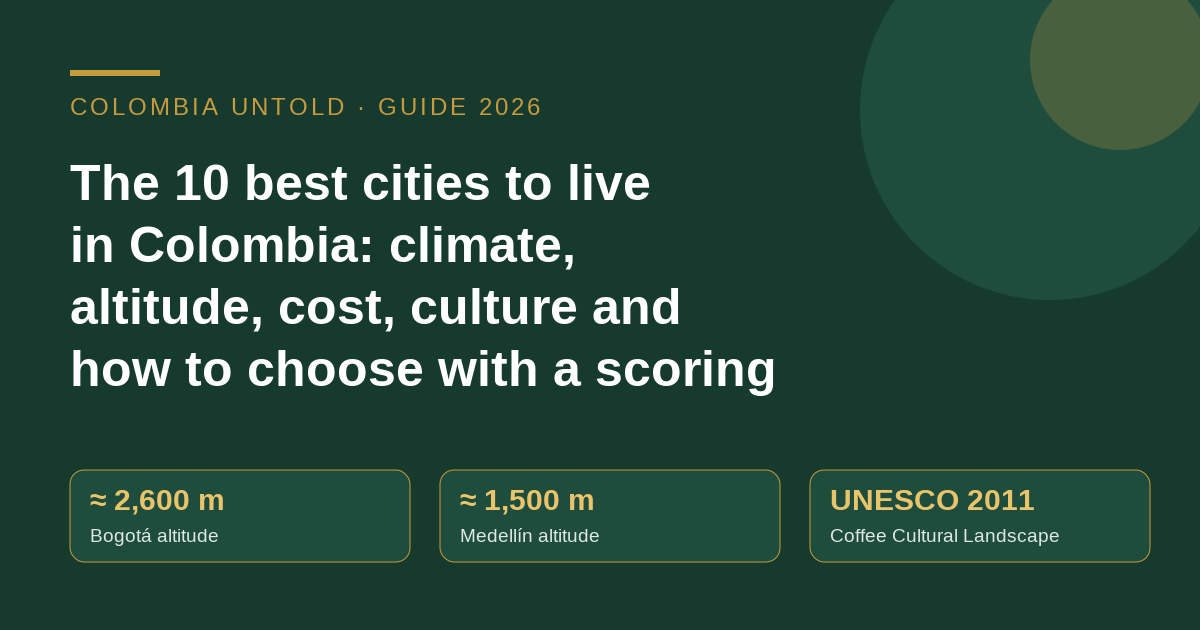
| Bogotá altitude | ≈ 2,600 m | Highest of the major cities |
| Medellín altitude | ≈ 1,500 m | Mild climate all year |
| Coffee Cultural Landscape | UNESCO 2011 | World Heritage covering Coffee Axis municipalities |
| Barranquilla Carnival | UNESCO | Masterpiece (2003) and Intangible Heritage listing (2008) |
Official sources and reliable reading
Related guides
- Basic taxes for foreigners in Colombia 2026: tax residence, income tax, VAT, GMF, property tax and when to file
- Gyms and sports for expats in Colombia: contracts, altitude, bike days, parks, adventure sports and insurance
- Savings vs checking account in Colombia: which to open as a foreigner, GMF tax, deposit insurance, fees and requirements
General information based on current rules and practice; it may change. Confirm your case with the official source or an authorized professional. Not legal, tax or medical advice.