Medellín is the Colombian city that has attracted the most foreigners in the past decade, and almost all of them arrive with the same question: how much does it really cost to live here? The answers that circulate on social media tend to be two unhelpful extremes: either "you live like a king on 1,000 dollars" or "it has become super expensive because of foreigners." Neither is exact. The real cost depends on a few big decisions —neighborhood, apartment size, whether you cook or eat out, whether you use a car— and on a handful of public figures you can verify. This guide gathers those 2026 figures with their source, calculates examples from them and makes clear which numbers are published data and which are calculations built on that data. We do not invent averages: where no recent official figure exists, we give you the method to calculate it for your own case.
The macro frame: dollar, inflation and minimum wage
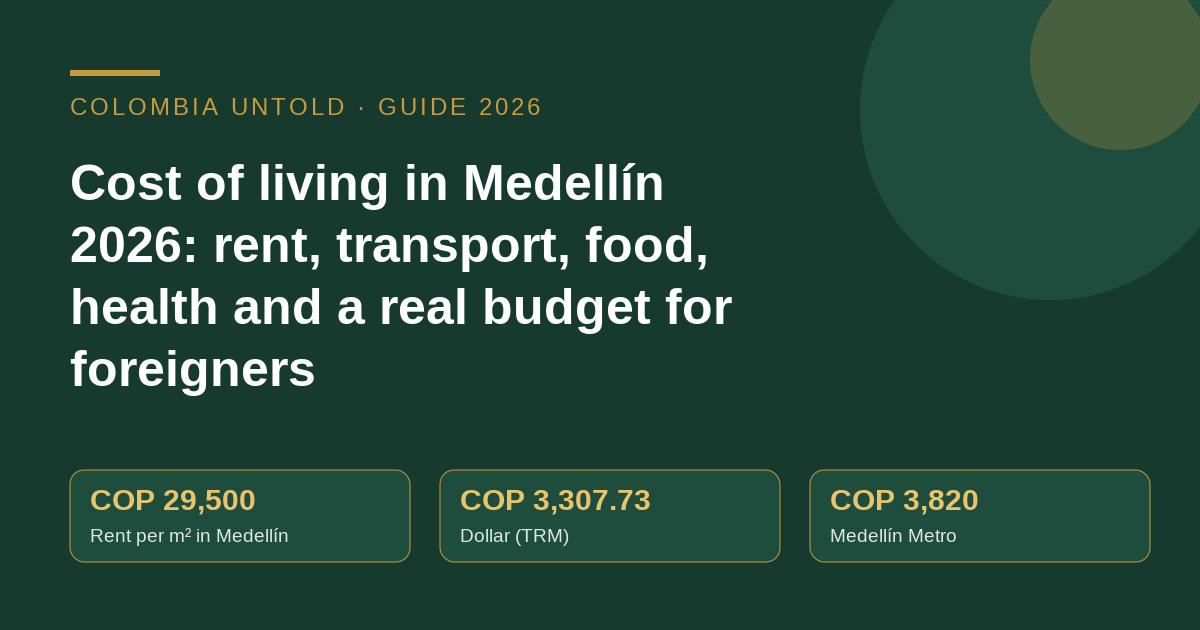
Three numbers explain almost everything you will see in prices. The first is the dollar. The Market Representative Rate, certified by the Financial Superintendence, stood at COP 3,307.73 on 2 October 2026. It changes daily, but that reference is useful for converting: one million pesos is now about 302 dollars. If you receive income in dollars or euros, your purchasing power depends on that exchange rate more than on local inflation. The second is inflation. DANE reported 6.29% annual change in September 2026. That is high against the Banco de la República target and means that prices of a year ago are, on average, 6.29% lower than today. Not all categories move the same: food, services and restaurants tend to rise differently from rents, which have their own legal cap. The third is the minimum wage. In 2026 the monthly minimum wage is COP 1,750,905, about 529 dollars at the reference rate. It serves as a comparison: a COP 2 million rent is more than one minimum wage, which explains why a good share of locals live with roommates, in peripheral neighborhoods or in lower strata. For a foreigner with income from abroad, the purchasing-power gap is what makes the city attractive, but it pays to remember it: the real estate market of El Poblado and Laureles has grown used to dollar payments, and those prices do not reflect what neighbors earn.
Housing: the expense that decides the budget
Rent is by far the biggest item. The Banco de la República publishes the monthly rent per square meter based on listing data; for Medellín, the most recent figure we use is COP 29,500 per square meter, as of October 2025. It is a city average, not a neighborhood price: El Poblado and Provenza are above, Belén or Bello below. But it helps with sizing. With that reference, the calculation is direct: 50 m² apartment: about COP 1,475,000 per month, near 446 dollars. 70 m² apartment: about COP 2,065,000 per month, near 624 dollars. 90 m² apartment: about COP 2,655,000 per month, near 803 dollars. These are calculations on the city average, not real listings. In the neighborhoods foreigners search most, furnished and well-located apartments are usually listed above that average, and short stays (under three months, Airbnb style) cost much more per accumulated night. That is why the most cost-effective decision is to negotiate a 12-month unfurnished or semi-furnished contract rather than live permanently in tourist accommodation. Rent has an increase rule: Law 820 of 2003 limits the annual rent increase to the previous year's CPI. In 2026 that cap was 5.10%. A COP 2,000,000 apartment can go up to a maximum of COP 2,102,000 at renewal. In addition, although Law 820 of 2003 (art. 16) prohibits demanding cash deposits in urban housing leases, many landlords ask for a co-signer or policy, and a foreigner with no local history needs to solve that guarantee. Details on deposits, administration fees and condominium rules are in Renting in Colombia as a foreigner: rent, building fees, deposits and the real cost. The condominium administration fee is added to rent and can be significant in buildings with a pool, gym and 24-hour doorman; find out whether it is included. Choosing the neighborhood has more impact than any other decision. For a qualitative comparison by area, see Medellín neighbourhoods for foreigners: El Poblado, Laureles, Envigado, Belén and more, how to choose and the noise and neighborhood guide How to compare neighborhoods by noise in Colombia: rules, maps, measurements and signs before you rent.
Transport: Metro, buses and bicycle
The Medellín Metro is the most efficient transport in the country and its fare is among the clearest. For the frequent user with a Cívica card, a trip costs COP 3,820; for the occasional user with a ticket, COP 4,400; and the student pays COP 1,600. Buses of the integrated system (Sitva) cost between COP 4,715 and COP 4,765, depending on type. With those figures you can calculate your spending. Someone who works Monday to Friday and makes two trips a day for 22 days makes 44 trips a month. At COP 3,820, that is COP 168,080 per month, about 51 dollars. If you combine Metro and bus with integration, the cost rises but the card usually includes transfers. Someone living in El Poblado or Laureles and working a few blocks away can walk or cycle, and transport spending falls close to zero. The guide Cycling and urban mobility in Colombia: bike lanes, safety and getting around without a car expands on that option. For one-off trips, taxis and ride-hailing apps have variable prices depending on time and demand; there is no single fare we can cite. A good habit is to budget separately for night trips or the Rionegro airport, which is about 40 minutes from downtown and is normally reached by taxi, bus or shared transport. Owning a car is a cost decision: gasoline, mandatory insurance (SOAT), technical inspection, vehicle tax, parking and the license-plate restriction. For most foreigners in central neighborhoods, a car is not justified. If you will buy or use one, see Driving in Colombia as a foreigner: license, SOAT, rules, fines, plate restrictions and road safety and Buying a used vehicle in Colombia as a foreigner: RUNT checks, transfer, scams and a verification checklist.
Food: from the set lunch to the restaurant
Eating out in Colombia has an enormous range. The "corrientazo" —the set lunch of soup, main and juice— is the thermometer. According to La República data cited by Publimetro, the average set lunch nationwide cost COP 17,542 in January 2026, 10.7% more than a year earlier. In Medellín the range by zone is wide: in a January 2024 El Colombiano piece, lunch cost about COP 11,000 downtown and COP 19,500 in the south, and those values have risen since. If you lunch out 22 working days a month at the January 2026 national average, spending would be about COP 385,924 a month, around 117 dollars. Cooking at home is cheaper, but the difference depends on what you buy. Market squares and neighborhood fruit shops offer fruit, vegetables and tubers at prices well below chain supermarkets; imported products such as cheeses, wines, branded cereals, olive oil or premium meats are noticeably more expensive. A diet based on local products —rice, beans, plantain, eggs, chicken, seasonal fruit— keeps grocery spending low. Food weighs less in overall inflation than it seems, although variations by product can be large: between January 2025 and January 2026, plantain rose 35%, while eggs and rice fell. Delivery is part of urban life. Apps charge commissions and delivery fees, so ordering often adds up quickly. Keep a separate budget for eating out, leisure and delivery, and review it monthly.
Utilities, internet and mobile
In Medellín, EPM provides electricity, water, sewage, piped gas and waste collection under a single bill. Strata 5 and 6 pay a solidarity surcharge on consumption, and stratum 4 pays the full rate; in the guide Utilities in Colombia for foreigners: water, electricity, gas, waste, strata, bills and complaints we explain how strata, subsistence consumption and complaints work. A 70 m² apartment with one or two occupants typically consumes between 150 and 250 kWh of electricity a month, without air conditioning, since Medellín has a temperate climate and almost never needs it. Residential fiber internet and the mobile plan are two fixed expenses. Check minimum-term contracts and cancellation conditions in Internet contracts in Colombia: fine print, minimum terms, speed, cancellation and complaints for foreigners. For recurring payments and transfers, local banking offers automatic debit and apps; in Banking and payments in your first 90 days in Colombia: cards, cash, wallets and your first account we explain how to operate before you have a full history.
Health: social security and insurance
If you live in Colombia on a visa that allows work or with your own income, you can enroll in the health system. For an independent worker, the health contribution is 12.5% of the contribution base income, calculated on 40% of monthly income with a minimum of one minimum wage. With the minimum base of COP 1,750,905, the health contribution is about COP 218,863 per month and pension (16%) about COP 280,145. These are calculations on the legal minimum base; your case may vary depending on your income and type of engagement. Many foreigners combine the public system with prepaid medicine or international insurance. For short stays or frequent travel, travel insurance with medical coverage is an alternative to consider. Protege Tu Viaje offers an online quote with up to 65% discount through this partner link: Protege Tu Viaje. If you are a resident, check with your adviser what coverage your visa requires.
A budget with three verifiable anchors
With the figures above you can build the base of a monthly budget for one person in a 50 m² apartment, with three verified anchors: Average rent for 50 m²: COP 1,475,000. Metro transport (44 trips): COP 168,080. Lunches out (22 a month): COP 385,924. The sum of these three anchors is COP 2,029,004, about 613 dollars. To that you must add what depends on your life: groceries, utilities, internet, mobile, health, leisure, clothing, travel and savings. A practical way to estimate it is to add up your current spending by category in your home country and adjust it for inflation and price differences by category. Services (internet, mobile, gym) tend to be cheaper than in Europe or the United States; imported goods, more expensive.
Money, taxes and transfers
The biggest hidden cost is not in the city but in the currency exchange. When you send money from abroad, the gaps between the TRM and the rate you get can be considerable. Compare transfer platforms and banks, check fixed and percentage fees and avoid exchanging at airports. In Colombia, bank movements pay the Financial Transactions Tax (GMF) of 0.4%, with exemptions for one designated savings account. See Savings vs checking account in Colombia: which to open as a foreigner, GMF tax, deposit insurance, fees and requirements to decide which account to open. If you spend more than 183 days in a 365-day period in the country, you become a tax resident and are taxed on worldwide income; see Tax residency certificate in Colombia: who is resident, how to request it from the DIAN and what it is for before reaching that threshold.
How to save without living worse
Negotiate a 12-month contract, not a short one. Avoid tourist neighborhoods if you do not need them. Shop at market squares and neighborhood stores. Use the Metro's Cívica card. Share housing if you are alone and flexible. Choose internet and mobile plans without abusive minimum terms. And review your bank account each month to spot fees.
A practical example: a couple in a 70 m² apartment
A couple with remote income rents a 70 m² apartment near Laureles. With the city average, rent would be about COP 2,065,000; in practice they negotiate a one-year contract and get a value close to that. Each makes 44 Metro trips a month for COP 168,080, although they walk more. They lunch out three days a week. In the first month they adjust their budget with the EPM bill and internet. A local adviser can save them weeks of searching: Medellín Advisors, at medellinadvisors.com, and Premium Propiedades, at premiumpropiedades.com, accompany foreigners in choosing the neighborhood and the property.
Frequent mistakes
Calculating the budget with last year's dollar. Confusing the short-stay price with that of an annual contract. Forgetting the administration fee. Not reading the internet minimum-term contract. Paying excess currency-exchange costs. Not accounting for the annual rent increase. Underestimating health spending. And comparing yourself with local prices that do not reflect the market of foreigners' neighborhoods.
Frequently asked questions
How much does it cost to live in Medellín in 2026 for one person?
It depends on neighborhood and lifestyle. Three verifiable anchors for a 50 m² apartment add up to about COP 2,029,004: average rent of COP 1,475,000, Metro at COP 168,080 and lunches at COP 385,924. Groceries, utilities, health and leisure come on top.
What is the maximum rent increase in 2026?
Law 820 of 2003 limits the annual increase to the previous year's CPI. For 2026 it was 5.10%, so a COP 2,000,000 rent rises to at most COP 2,102,000 at renewal.
How much does the Medellín Metro cost?
A trip costs COP 3,820 for a frequent user with a card, COP 4,400 for an occasional user and COP 1,600 for students. Integrated-system buses cost between COP 4,715 and COP 4,765.
Is it better to rent furnished or unfurnished?
An unfurnished or semi-furnished annual contract is usually cheaper per month than tourist accommodation. Short-stay furnished makes sense for the first weeks while you look for a formal contract.
How much should I pay for health as an independent worker?
The health contribution is 12.5% of the contribution base income, calculated on 40% of your income with a minimum of one minimum wage. With the minimum base of COP 1,750,905, that is about COP 218,863 per month.
Is it better to have a car in Medellín?
For most foreigners in central neighborhoods it is not justified. The Metro, buses, bicycle and taxis cover most trips, and a car adds SOAT, maintenance, parking and the license-plate restriction.
If you are evaluating housing or investment, Medellín Advisors can guide you on search, title review and the purchase or rental process. Always hire independent legal review.
Key figures and data
| Item | Value | Note |
|---|---|---|
| Rent per m² in Medellín | COP 29,500 | Monthly average, Banco de la República (October 2025) |
| Dollar (TRM) | COP 3,307.73 | TRM on 2 October 2026 |
| Medellín Metro | COP 3,820 | Frequent-user fare per trip; occasional COP 4,400 |
| Annual inflation | 6.29% | DANE, September 2026 |
| Rent increase cap | 5.10% | Equal to 2025 CPI applied in 2026 |
Official sources and reliable reading
Related guides
- Cost of living in Bogotá 2026: rent, TransMilenio, food, health and a real budget for foreigners
- Cost of living in Cartagena 2026: rent, Transcaribe, food, electricity and a real budget for foreigners
- Basic taxes for foreigners in Colombia
General information based on current rules and practice; it may change. Confirm your case with the official source or an authorized professional. Not legal, tax or medical advice.