Renting an office or desk in Colombia: coworking, private office and commercial premises
Updated: 13 October 2026 · Colombia Untold
Quick answer: To work from a space of your own in Colombia you can choose between a coworking desk, a private serviced office or renting commercial premises. The first two are flexible and monthly; a commercial lease is governed by the Commercial Code, not Law 820, and gives a right of renewal after two years of occupation.
Working from home works until it stops working: the neighbour who renovates, the internet that drops, the kitchen that turns into an office and the absence of a border between work and personal life. For many expats, digital nomads and entrepreneurs in Colombia the next step is renting a space of their own, and there a question appears that looks simple and is not: a coworking desk, a private office, or premises under a commercial lease? The three options have different costs, flexibility and legal rules, and choosing badly can mean paying too much, being tied to a contract you did not expect or discovering that your activity requires a registration you did not have. This guide compares the alternatives, explains the legal framework of commercial leasing in Colombia, breaks down the real costs and offers a checklist to decide and negotiate with information. Figures are orders of magnitude, and every contract must be read in full.
Three formats, three logics
Coworking (flexible or fixed desk). You pay a monthly or daily membership for a seat in a shared space with internet, meeting rooms, coffee and sometimes a locker and mail handling. It is the quickest and cheapest way to start, with no investment in furniture or utilities, and it makes it easy to meet other professionals. Contracts are usually monthly, with short notice. The limitations: noise, little privacy and, at times, restrictions on using the address for tax purposes or receiving clients. For specific cities and spaces, see Coworking and remote work in Medellín and Bogotá, Coworking contracts and Hybrid: home and coworking. Private serviced office. A closed, furnished office with internet, cleaning, reception and common rooms, contracted at a fixed monthly price that includes utilities and building fees. It is useful for small teams that need privacy and a professional address, with flexible terms of six to twelve months. It costs more per square metre than a traditional lease but saves time and fit-out costs. Office or commercial-premises lease. A direct contract with the owner for a property for commercial or office use, with typical terms of one to three years. It is the cheapest per square metre in the medium term but implies fit-outs, utilities in your name, furniture, maintenance and tax and formalisation obligations for your activity.
Which law governs each contract
Coworking and serviced offices are usually governed by service or licence-to-use contracts, with rules agreed by the parties and the Civil and Commercial Codes as the framework. The lease of premises and offices for commercial purposes is governed by the Commercial Code, not by Law 820 of 2003, which covers urban housing. That difference matters for two reasons. First, the Commercial Code gives the business tenant who has occupied the same premises with a commercial establishment for two consecutive years a right to renew the contract, which protects investment in a location. Second, for the landlord not to renew, they must invoke legal grounds and give specific notice, normally six months in advance, and may owe compensation if they fail to comply. This does not apply in the same way to a person using an office without a commercial establishment. A lawyer can advise on whether your activity qualifies; the important thing is not to assume that housing rules protect a commercial lease.
Real costs: what the listing does not show
- Monthly rent: the price per square metre varies enormously by city, neighbourhood and building class. Corporate districts in Bogotá and Medellín cost more than peripheral zones. - Building fee: in office buildings the administration fee can be high and is added to the rent. - VAT: the lease of offices and commercial premises by VAT-liable lessors is invoiced with 19% VAT, which can raise the cost if your activity does not let you offset it. - Utilities and internet: may not be included; connect early. - Fit-out and furniture: paint, partitions, lighting, cabling and furniture. - Deposit and guarantees: commercial leases usually ask for a deposit, guarantor or policy; see Internet contract: fine print and Utilities in a foreigner’s name for the other contracts. - Insurance: contents and civil liability. - Withholding: if you are a legal entity or a liable person, rent payments may be subject to withholding tax. A realistic way to compare is to calculate the total monthly cost per workstation, adding all items, and compare it with the opportunity cost of your time and concentration. For a solo professional, coworking is usually cheaper until the business requires a team, client reception or storage.
If you need a tax or business address
Many activities in Colombia require a domicile for the commercial registry and the RUT. If you set up an SAS, your domicile determines the competent Chamber of Commerce and the municipality where you pay industry-and-commerce tax. Some coworking spaces offer a virtual office with an address, but not all allow it to be used for commercial registration, and contracts must be read carefully. Before choosing, review Setting up an SAS in Colombia as a foreigner: steps, costs, taxes and obligations and Tax ID (RUT) for foreigners. An inappropriate land use, for example running a business open to the public in a residential property, can bring penalties and closure; check land use with the municipal planning office.
Invoicing and tax obligations
If your activity is commercial and you are VAT-liable, the rent of the premises or office is a deductible expense of your activity and the VAT paid may be creditable, depending on your regime. If you are an individual who is not liable, the cost is deducted in your income-tax return according to the applicable rules. The landlord, if VAT-liable, must issue an electronic invoice; always demand it, because it is the support for your accounting. See Electronic invoicing basics and Basic taxes for foreigners in Colombia. Accounting advice at the start avoids costly mistakes.
How to negotiate a commercial lease
- Ask for at least three comparable quotes, with the same conditions.
- Negotiate grace periods or rent-free months for fit-out in long contracts.
- Ask for a clear annual increase cap; commercial leases usually agree a percentage linked to CPI.
- Demand in writing what the rent includes and what the administration charges.
- Include an early-termination clause with reasonable notice and known costs.
- Check land use, electrical capacity and the state of the installations.
- Verify the title certificate and the owner’s identity, as with housing; see How to rent an apartment in Colombia as a foreigner: full process, documents and pitfalls.
Staff, working hours and obligations if you hire
If you open an office and hire, you must comply with labour rules: the maximum legal week is 42 hours from 15 July 2026, and workers must be enrolled in social security. This shapes the office’s opening hours and costs. To understand the limits of local hiring, see Local employment contract and visa and Payroll as a foreigner.
When each option makes sense
- Coworking: you work alone or in a very small team, need flexibility and community, or are testing a city.
- Private serviced office: you need privacy, client meetings and a professional image with little paperwork.
- Commercial lease: you have a stable team, need your own fit-out, serve the public or want the lowest cost per square metre over the long term.
Partner services
If you are evaluating setting up your office in Medellín or looking for commercial property or housing for you and your team, Medellín Advisors and Premium Propiedades can guide on search, titles and contracts. To put your migration status in order before opening a business, Colombia Visa Legal accompanies you, and to protect your equipment and health, quote at Protege Tu Viaje with discounts of up to 65%.
A sample budget to decide with numbers
Imagine a self-employed professional who needs a fixed desk for a year. With coworking she pays a monthly membership that already includes internet, coffee and meeting rooms; she invests nothing in furniture, opens no utility accounts and can leave on short notice. With a private office she pays more per month but gains a door, quiet and a professional address to receive clients. With rented premises she pays the rent plus building fee, VAT if applicable, utilities, fit-out, furniture and insurance, and takes on a long term. The difference lies not only in the rent but in the cost of starting and leaving: coworking has almost none; premises can require several months of investment before generating a peso. A good exercise is to build a table with six columns: rent, building fee, utilities, fit-out amortised over twelve months, taxes and insurance, and add them up. Divide by the number of desks and compare with the coworking quote in your city. If renting turns out only 10 or 15% cheaper, coworking’s flexibility usually compensates. If the difference exceeds 30%, a direct lease starts to make sense, provided your business will last at least two years in that place. Remember too that the cheapest option on paper is not always the cheapest in practice. A long lease that you must break after six months because the team shrank, or because the commute made recruiting hard, can cost more in penalties than a year of coworking would have. Before signing, ask yourself how sure you are about headcount, clients and city twelve months from now, and let that answer set the contract length.
Frequently asked questions
What is the difference between a coworking and a private office?
Coworking sells a seat in a shared space with flexible membership; a private serviced office is a closed space for you or your team with services included. The latter offers privacy, the former savings and community.
Does Law 820 protect my office lease?
No. Law 820 of 2003 regulates urban housing. Commercial leasing is governed by the Commercial Code, which provides, for example, a right of renewal for the business tenant with a commercial establishment after two years of occupation.
Must I pay VAT on office rent?
If the landlord is VAT-liable, the lease of offices and commercial premises is invoiced with 19% VAT. Depending on your regime, that VAT may be creditable in your activity; consult your accountant.
Can I use a coworking as my company’s registered address?
It depends on the contract and the space itself: some allow the address to be used as a domicile for commercial registration and others do not. Verify in writing before incorporating and confirm the land use.
How long a contract should I sign?
For coworking and serviced offices, one to twelve months depending on the flexibility you need. For a direct commercial lease, one to three years is usual with a negotiated early-termination clause.
Do I need an electronic invoice for the rent?
Yes, if the landlord is VAT-liable or required to invoice. Always demand it: it supports your expense and your accounting.
If you are evaluating housing or investment, Medellín Advisors can guide you on search, title review and the purchase or rental process. Always hire independent legal review.
Key figures and data
| Item | Value | Note |
|---|---|---|
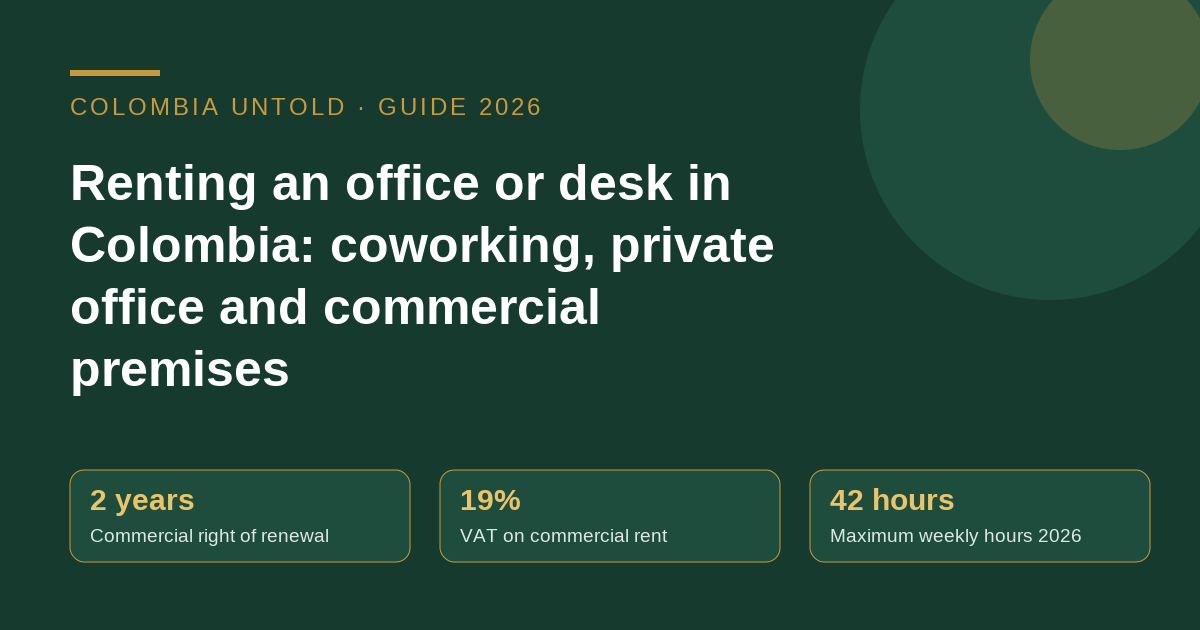
| Commercial right of renewal | 2 years | Tenant with a commercial establishment, Commercial Code art. 518 |
| VAT on commercial rent | 19% | Invoiced on leases of premises and offices by VAT-liable lessors |
| Maximum weekly hours 2026 | 42 hours | Law 2101 of 2021, in force since 15 July 2026 |
| Typical flexible contract length | 1 to 12 months | Coworking and serviced offices |
Official sources and reliable reading
Related guides
- Notary and powers of attorney for foreigners in Colombia
- Payroll as a foreigner
- Driving in Colombia as a foreigner
General information based on current rules and practice; it may change. Confirm your case with the official source or an authorized professional. Not legal, tax or medical advice.