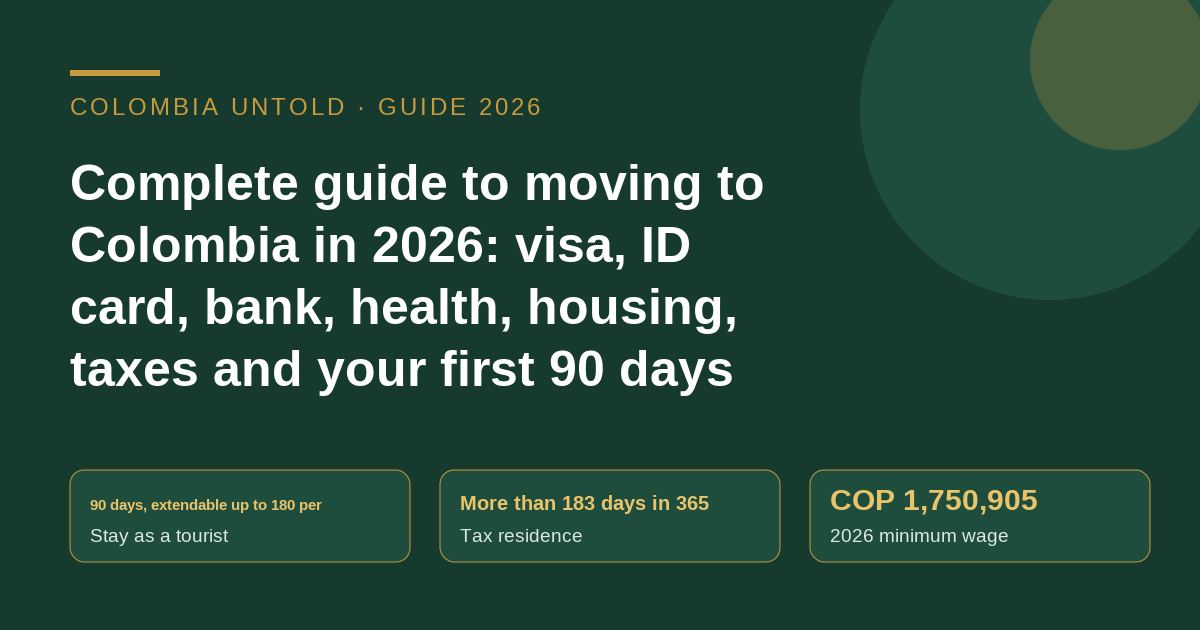
Moving to another country is a sum of small decisions that, badly ordered, become expensive: the wrong visa, a lease with illegal clauses, a bank account opened without full documents or a tax you did not know you had to declare. This guide brings together in one route everything a foreigner needs to settle in Colombia in 2026: which visa to choose, how to enter, which documents to process, how to open an account, how to enroll in health coverage, how to rent safely, which taxes apply, how much living costs and how to organize your first 90 days. Each topic has a deeper guide on the site, linked in the text; here you get the overview and the right order.
Step 1: decide how long and why you are moving
Everything is organized from two questions: how long you plan to stay and what you will do. A stay of a few months without working in Colombia is generally handled as a visitor. A long-term life with work, investment, a pension or family is handled with a migrant or resident visa. If your plan is to work for a foreign company from Colombia, there is a specific category for remote workers; see Digital Nomad Visa Colombia 2026: Complete Guide if it applies to you. The Colombian visa regime is organized into three broad categories: visitor (V), migrant (M) and resident (R). The visitor visa covers short stays for purposes such as tourism, business, short studies or remote work. The migrant visa is granted to those who want to live in the country for a defined period with a specific activity, such as working for an employer, investing, studying or being the partner or relative of a Colombian or a resident. The resident visa is permanent and is obtained after meeting set times or conditions. The current visa regulation is Resolution 5477 of 2022 of the Ministry of Foreign Affairs; the full list of categories, requirements and fees is available on the Ministry's official site. For an overview of each type, see Colombia Visa Types: A Complete Explained Guide. As a tourist, most nationals of visa-exempt countries may remain up to 90 days, which Migración Colombia can extend to a maximum of 180 days within the same calendar year. If your plan exceeds that, start the visa before your permit runs out, because staying without regular status generates fines and later problems.
Step 2: enter the country well prepared
To enter you need a passport with enough validity (many airlines require at least six months) and, depending on your nationality, a visa. Airlines may ask you to show onward travel if you enter as a tourist. At immigration, the officer sets the time you are authorized; check the stamp or the record and the deadline. Carry supporting documents for your trip: accommodation booking, proof of sufficient funds and, if applicable, medical insurance. Colombia does not require insurance for all visitors, but having it is very good practice; see Travel insurance for visiting family. If you carry cash, note that there are declaration obligations when entering and leaving with amounts above the threshold set by customs and foreign-exchange rules; check with the DIAN before traveling with cash. If you bring many belongings or a full move, see International Moving to Colombia: What to Expect to understand customs, timing and costs. If you travel with a pet, see Bringing Your Pet to Colombia.
Step 3: foreigner ID card and registration
Anyone who obtains a migrant or resident visa valid for more than three months must register and obtain the cédula de extranjería, the identity document of foreigners in Colombia, from Migración Colombia. It is the document that banks, notaries, health entities and landlords ask for. The procedure is done shortly after the visa is approved; the exact deadlines and requirements are set by Migración Colombia, and it is best to start as soon as you have the visa, because delay generates fines. Everything is explained in Colombian foreigner ID card (cédula de extranjería): what it is, who needs it, requirements, costs and how to apply. In addition, accommodation providers and employers must report the presence of foreigners through Migración Colombia's SIRE system. If you stay in a hotel or in a rented apartment, the person hosting you normally makes that report, but it is one of the reasons to have everything in order from day one.
Step 4: RUT, NIT and tax life from the start
The DIAN manages the Single Tax Registry (RUT), which identifies those with tax obligations or formal economic relationships in Colombia. You will need it if you work as a freelancer, receive income, set up a company or carry out certain transactions. In many cases it is also requested to open certain financial products or to invoice. The RUT is processed with the DIAN with a valid ID and, for foreigners, with the foreigner ID card or passport as applicable. On taxes, the central rule is tax residence: under article 10 of the Tax Statute, you are a tax resident if you stay in Colombia more than 183 calendar days, continuous or not, in a period of 365 consecutive days. Residents pay tax on worldwide income; non-residents, on Colombian-source income. In 2026 personal income tax for resident individuals uses a progressive table in UVT with marginal rates of 0, 19, 28, 33, 35, 37 and 39 %, and the UVT is COP 52,374. Non-residents are generally taxed at 35 % on certain Colombian-source income. We explain the basics in Basic taxes for foreigners in Colombia 2026: tax residence, income tax, VAT, GMF, property tax and when to file and how residence is certified in Tax residency certificate in Colombia: who is resident, how to request it from the DIAN and what it is for. This content is informational; for your specific case consult an accountant.
Step 5: open a bank account and move money
An account in Colombia lets you receive income, pay rent and utilities, use direct debit and avoid fees for repeated international transfers. Banks normally ask for a valid ID (foreigner ID card or passport with visa, depending on the entity), RUT in some cases, proof of income, proof of address and references. Each bank sets its policy, and requirements for foreigners vary. See the guide How to open a bank account in Colombia as a foreigner: complete guide and the checklist Checklist to open a bank account in Colombia as a foreigner: documents, KYC questionnaire and how to avoid rejection. For digital wallets such as Nequi and Daviplata, see Nequi and Daviplata for foreigners: how to open them, limits and when to use them. Keep in mind the Financial Transactions Tax (GMF) of 0.4 % on withdrawals and movements, with exemptions for a marked savings account up to 350 UVT per month, and the deposit insurance of Fogafín, which covers up to COP 50 million per depositor per entity. To receive money from abroad, compare costs and exchange rates; see Sending money to Colombia: how to compare fees, exchange rates, timing and exchange-control paperwork. The market representative exchange rate (TRM) on 2 October 2026 was COP 3,307.73 per dollar; the Banco de la República publishes the daily figure.
Step 6: health
Health in Colombia combines a contributory system with insurers called EPS and complementary private plans. Residents with a visa and employment or income usually enroll in an EPS, with contributions calculated on income. Prepaid medicine plans and private insurance offer faster appointments and access to private clinics. Visitors without enrollment need travel or international insurance. Emergency care is provided in all cases, but later coverage depends on your enrollment. See Colombia's Health System Explained for Foreigners, Joining an EPS as a foreigner: requirements, costs and how the health system works and Health Insurance for Expats: A Comparison Guide. The emergency number is 123.
Step 7: housing and the lease
Searching for housing carefully is one of the most important decisions. Urban housing leases are governed by Law 820 of 2003. Three articles protect you in practice: article 16 prohibits demanding cash deposits and real guarantees from the tenant, and clauses requiring them have no effect; article 18 caps the monthly rent at 1 % of the commercial value of the property; and article 20 caps the annual increase in rent at the CPI. In 2026 the increase cap was 5.10 %. In practice landlords ask for a co-signer or a rental insurance policy; foreigners without local credit history often face this barrier, and there are alternatives we explain in Rental references as a foreigner and Renting in Colombia as a foreigner: rent, building fees, deposits and the real cost. For the search see How to find an apartment in Colombia as a foreigner: complete guide, for the contract Checklist before signing a lease in Colombia: clauses, maximum rent, increases, guarantees and red flags and for the handover Handover of a rented property in Colombia: inventory, photos, meters, record and clearance certificates. Choosing a city and neighborhood is part of the decision. See Best 10 cities to live in Colombia, Medellín neighbourhoods for foreigners: El Poblado, Laureles, Envigado, Belén and more, how to choose and Bogotá neighbourhoods for foreigners: which to choose by lifestyle, budget and work. If you are looking for housing in Medellín, Medellín Advisors at medellinadvisors.com and Premium Propiedades at premiumpropiedades.com support the search and the purchase or rental.
Step 8: utilities, connectivity and daily life
Once you have housing you need utilities: electricity, water, gas, internet and mobile. Public utilities are governed by Law 142 of 1994; companies must answer your petitions, complaints and appeals within 15 business days, and positive administrative silence applies if they do not. Electricity and water are billed by socioeconomic strata, from 1 to 6; your home's stratum determines subsidies or contributions. See Utilities in Colombia for foreigners: water, electricity, gas, waste, strata, bills and complaints and Utilities and public services when renting in Colombia. For internet and mobile, see Fiber internet in Colombia: how to choose a plan, speed, router, Wi-Fi, backup and what to ask before contracting and SIM and eSIM in Colombia for foreigners. Electricity is 110 volts at 60 Hz, with type A and B plugs, as in the United States and Canada; European travelers need an adapter. Colombia uses UTC-5 all year, with no daylight saving time.
Step 9: work, study and learn Spanish
To work legally you must hold a visa that allows it; working on a visitor visa without authorization carries sanctions. See Working Legally in Colombia as a Foreigner. If your professional degree is foreign and you need to practice or continue studying, see Validating a foreign professional degree in Colombia: requirements, apostille, translation, costs, timelines and professional license. Learning Spanish speeds up everything else; see Everyday Spanish in Colombia: phrases, forms of address, regionalisms and a 90-day routine.
Step 10: real living costs
The 2026 monthly minimum wage is COP 1,750,905, and the cost of living varies strongly between cities and lifestyles. Annual inflation measured by DANE was 6.29 % in September 2026, a useful figure for projecting your budget over twelve months. Before deciding, build a budget with ranges for rent, utilities, health, food, transport and leisure. See Cost of living in Medellín 2026: rent, transport, food, health and a real budget for foreigners, Cost of living in Bogotá 2026: rent, TransMilenio, food, health and a real budget for foreigners, Cost of living in Cartagena 2026: rent, Transcaribe, food, electricity and a real budget for foreigners and Budget for the first 90 days.
The first 90 days, week by week
Week 1. Temporary accommodation, SIM or eSIM, health or travel insurance, a digital copy of all your documents and a check of your stay permit. Avoid signing long contracts on day one. Weeks 2 to 4. Visit neighborhoods at different hours, compare apartments, ask for references and start opening a bank account. If you hold a long-term visa, begin the foreigner ID card procedure without delay. Month 2. Sign the lease with time to read it, set up utilities, enroll in health coverage, process the RUT if you need it and organize recurring payments. Month 3. Adjust your budget with real data, define your tax strategy with an accountant, explore communities and activities and review what you missed. A complementary step-by-step guide is in Moving to Colombia: complete checklist for the first 90 days.
The mistakes that cost the most
Choosing a visa for convenience and not for your reality. Delaying the foreigner ID card. Accepting a lease with cash deposits or guarantees that the law prohibits. Paying high fees for repeated international transfers. Not enrolling in health coverage. Ignoring tax residence. And signing a property purchase without legal advice and without verifying titles. See the full list in The 12 most common mistakes when moving to Colombia in 2026 and how to avoid them: visa, rent, money, taxes, health and safety.
When it makes sense to lean on professionals
An immigration procedure done well from the start saves months. Colombia Visa Legal at colombiavisalegal.com and CoVisas at covisascolombia.com support the choice and handling of the visa, the foreigner ID card and related procedures. To travel with medical coverage, Protege Tu Viaje offers quotes with up to 65 % discount at Protege Tu Viaje.
An example of an orderly route
A couple of remote designers arrives in Medellín. Month one: temporary accommodation, eSIM and travel insurance. Meanwhile, with immigration advice, they choose the visa that fits their situation. Month two: visa approved, foreigner ID card in process, bank account opened and apartment search with a policy instead of a deposit. Month three: lease signed under Law 820, utilities installed, health enrollment, RUT and an appointment with an accountant to plan their tax residence. With that order, the process is predictable and their budget has no surprises.
Frequently asked questions
How long can I stay in Colombia as a tourist?
Normally up to 90 days, which Migración Colombia can extend to a total of 180 days within the same calendar year. If you want to stay longer, you need an appropriate visa.
What is the first document I should process once I get the visa?
The foreigner ID card (cédula de extranjería), if your visa is a migrant or resident visa valid for more than three months. It is the document that banks, health entities and landlords ask for.
Can I rent a home without paying a deposit?
Yes, and the law backs it: Law 820 of 2003, article 16, prohibits demanding cash deposits and real guarantees from the tenant. The usual substitute is a co-signer or a rental insurance policy.
When am I a tax resident in Colombia?
When you stay in the country more than 183 calendar days, continuous or not, within a period of 365 consecutive days, under article 10 of the Tax Statute.
Do I need health insurance to live in Colombia?
If you live here on a visa and have income, you normally enroll in an EPS; as a visitor, you need travel or international insurance. Emergencies are always treated, but later costs depend on your coverage.
How much should I budget for the first three months?
It depends on the city and your lifestyle. Add temporary accommodation, apartment rent, utilities, health, food, transport, procedures and a 15 to 20 % cushion for contingencies, and compare it with the minimum wage of COP 1,750,905 as a reference.
If you want guidance on migration requirements, you can contact Colombia Visa Legal. When a procedure is online, Cancillería recommends doing it directly; professional guidance helps you understand the process, it does not replace the official source.
Key figures and data
| Item | Value | Note |
|---|---|---|
| Stay as a tourist | 90 days, extendable up to 180 per calendar year | General visitor regime without a long-stay visa |
| Tax residence | More than 183 days in 365 | Tax Statute, article 10 |
| 2026 minimum wage | COP 1,750,905 | Reference for budgets and contracts |
| Emergency line | 123 | Police, ambulance and fire |
Official sources and reliable reading
Related guides
- Basic taxes for foreigners in Colombia 2026: tax residence, income tax, VAT, GMF, property tax and when to file
- Gyms and sports for expats in Colombia: contracts, altitude, bike days, parks, adventure sports and insurance
- Savings vs checking account in Colombia: which to open as a foreigner, GMF tax, deposit insurance, fees and requirements
General information based on current rules and practice; it may change. Confirm your case with the official source or an authorized professional. Not legal, tax or medical advice.