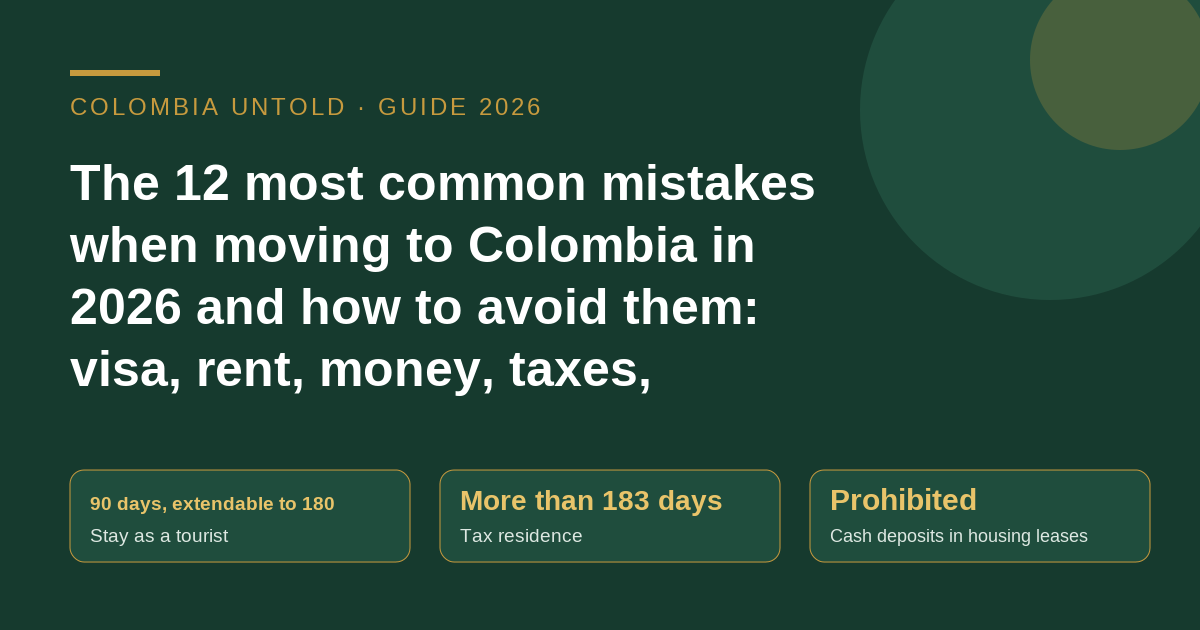
Moving to Colombia is, for most who do it, a good decision. But almost all of them make at least one of the same mistakes in the first months, and most are avoidable. They are not mistakes of naivety: they are mistakes of information. Nobody is born knowing that the tourist stamp is not a plan, that a rental deposit is illegal in urban housing, that Bogotá's altitude is felt or that exceeding 183 days changes your taxes. This guide gathers the twelve most frequent mistakes we see in 2026, explains why they happen, what they cost and how to avoid them, and points you to the detailed guides on each topic. Read it before buying the ticket, not after settling in.
1. Arriving without an immigration plan
The most common mistake is entering as a tourist and "seeing what happens". As a tourist you can generally stay up to 90 days, extendable to 180 in the same calendar year, according to the permit granted by Migración Colombia. That is for exploring, not for living, working or opening a full account. Anyone who decides to stay without having thought about the visa finds out late that some categories must be applied for from a certain place, with apostilled documents and waiting times. Before traveling, define what brings you —remote work, investment, marriage, study, pension— and which visa fits. The guide Colombia Visa Types: A Complete Explained Guide summarizes the categories, and Colombia Visa Legal at colombiavisalegal.com and CoVisas at covisascolombia.com guide you case by case.
2. Not registering the visa or processing the foreigner ID card in time
Getting the visa does not end the process. Whoever holds a visa that requires a foreigner ID card must register it and apply within a short period after issuance, which in practice is counted in a few weeks. Not doing so generates fines and complicates basic procedures: without the card, the bank, the mobile operator and the health system put up obstacles. The guide Colombian foreigner ID card (cédula de extranjería): what it is, who needs it, requirements, costs and how to apply explains the procedure. Write down the issue date the same day you receive the visa.
3. Renting without verifying the owner or the property
Rental scams exploit urgency. Copied photos, "owners" abroad, reservations paid in advance to a third party's account. The defense is simple: ask for the title and liens certificate, verify that the name matches the person signing, visit the property and pay nothing without a contract. The guide Checklist before signing a lease in Colombia: clauses, maximum rent, increases, guarantees and red flags gathers the checks and Renting in Colombia as a foreigner: rent, building fees, deposits and the real cost explains the total cost of renting.
4. Accepting deposits and guarantees the law prohibits
In Colombia, Law 820 of 2003 prohibits demanding cash deposits or other real-security guarantees in urban housing leases. Even so, many landlords ask for them, especially of foreigners without a co-signer, and many foreigners pay without knowing they can refuse. What is lawful is a personal guarantee or a policy. If you pay something out of necessity, insist on a receipt and document everything. See Rental deposit in Colombia: what the law says, how to recover your money and which deductions are legitimate and Handover of a rented property in Colombia: inventory, photos, meters, record and clearance certificates to protect your money.
5. Choosing a city by trend, not lifestyle
Medellín, Bogotá, Cartagena, Cali, Santa Marta, Pereira: each city is a different country. With 2026 data, Medellín and Bogotá cost almost the same in rent per square meter, and the real difference lies in climate, altitude, transport and daily life. Cartagena is much more expensive in tourist zones and adds the cost of air conditioning. Choosing without trying is an expensive mistake. Rent a month in each candidate before committing to an annual contract. Compare in Medellín vs Bogotá 2026: cost of living, rent, transport and climate compared, and who each city suits, Cost of living in Medellín 2026: rent, transport, food, health and a real budget for foreigners, Cost of living in Bogotá 2026: rent, TransMilenio, food, health and a real budget for foreigners and Cost of living in Cartagena 2026: rent, Transcaribe, food, electricity and a real budget for foreigners.
6. Underestimating altitude and climate
Bogotá is at about 2,600 meters. Many foreigners feel fatigue, insomnia or headaches in the first days, and those with heart or respiratory conditions should consult their doctor before choosing it. On the Caribbean coast, heat and humidity change energy use and routine. Plan clothing, sleep and energy spending according to the city. Do not make long-term decisions during the first week, while your body is adapting.
7. Mishandling money: exchange, bank and GMF
Arriving without a working account, exchanging currency at the airport, paying fees on every withdrawal or not understanding the 4 per thousand are mistakes that cost hundreds of dollars a year. The TRM was COP 3,307.73 on 2 October 2026, and the gap between that value and the rate applied to you is the hidden cost of every transfer. Open a savings account, designate it GMF-exempt and compare transfer platforms. See Checklist to open a bank account in Colombia as a foreigner: documents, KYC questionnaire and how to avoid rejection, Savings vs checking account in Colombia: which to open as a foreigner, GMF tax, deposit insurance, fees and requirements and Sending money to Colombia: how to compare fees, exchange rates, timing and exchange-control paperwork.
8. Ignoring taxes and tax residence
Many believe that, being foreigners or working for clients in another country, they have no obligations in Colombia. But whoever stays more than 183 days, continuous or not, in a 365-day period is a tax resident and is taxed on worldwide income at progressive rates up to 39%. Miscounting the days, not registering in the RUT or not declaring assets abroad above 2,000 UVT generates penalties. Plan day 183 in advance. See Basic taxes for foreigners in Colombia 2026: tax residence, income tax, VAT, GMF, property tax and when to file, Tax residency certificate in Colombia: who is resident, how to request it from the DIAN and what it is for and, if you invoice, Electronic invoicing in Colombia for foreigners: who must invoice, RUT, DIAN, VAT, supporting document and service exports.
9. Arriving without health insurance
Colombia has a health system of good quality in the main cities, but accessing it requires enrollment or insurance, and an accident or emergency without coverage can cost significant sums. For short stays, travel insurance with medical coverage is a minimum. Protege Tu Viaje offers an online quote with up to 65% discount through this partner link: Protege Tu Viaje. For residents, evaluate enrollment in an EPS, prepaid medicine or international insurance. The guides Healthcare in Colombia for foreigners: EPS, prepaid plans, private policies and international insurance and Health Insurance for Expats: A Comparison Guide compare the options.
10. Neglecting everyday safety
Colombia is safe for most visitors who take basic precautions, but opportunistic theft, ATM fraud, drink spiking and phone scams exist. Avoid showing your phone on the street, use ATMs inside banks or malls, do not accept help from strangers at ATMs and never share passwords or codes with anyone calling and claiming to be from the bank. See ATMs in Colombia: withdrawing cash safely, fees, limits and common scams, Dynamic keys in Colombian banks: what they are, how to activate them, what to do without a local number and how to avoid fraud and Phone: insurance and theft prevention. When something happens, the emergency number is 123.
11. Working without a permit or with the wrong contract
Working for a Colombian company or providing local services requires that your visa allows it. Some start working on a visa that does not authorize it, or sign a contract without understanding its benefits. The consequences can include fines and immigration problems. Before accepting a job or a services contract, check your visa and the arrangement. See Working Legally in Colombia as a Foreigner and Local employment contracts in Colombia for foreigners: visa, contract types, benefits and limits.
12. Not learning Spanish or understanding the culture
You can survive in English in very foreign neighborhoods, but quality of life improves markedly with functional Spanish. Paperwork, neighbors, doctors, contracts and friendships depend on language. On top of that comes culture shock: flexible punctuality, hierarchy in procedures, indirect politeness, the pace of bureaucracy. Whoever arrives with patience and humility integrates faster. See Everyday Spanish in Colombia: phrases, forms of address, regionalisms and a 90-day routine and Culture shock in Colombia: stages, customs, social etiquette and how to integrate without losing your identity.
How to prepare a move without surprises
A reasonable order is the following. Before traveling: define the visa, gather and apostille documents, take out insurance, choose two candidate cities and book temporary lodging for a month. In the first weeks: visit neighborhoods, open an account, get a local number, register the visa and process the ID card. In the first quarter: sign a reviewed lease, move utilities to your name, organize your taxes and your health. Good local support speeds everything up; in Medellín, Medellín Advisors at medellinadvisors.com and Premium Propiedades at premiumpropiedades.com help with housing and neighborhood.
A practical example: the difference between improvising and preparing
Two people arrive in Medellín the same day with the same budget. The first enters as a tourist, rents through a platform reservation, exchanges money at the airport and has no insurance. At 80 days she discovers she must leave or process a visa, that her bank account will not open without an ID card and that the visa requires apostilled documents she must request from her country. The second arrives with the visa defined, apostilled documents, insurance and a month of lodging. She visits three neighborhoods, signs a reviewed contract and opens her account in the first week. At three months, the first has spent weeks and hundreds of dollars correcting; the second is already living.
Frequently asked questions
How long can I stay in Colombia as a tourist?
Generally up to 90 days, extendable to 180 in the same calendar year, according to the permit granted by Migración Colombia. If you want to live or work, you need an appropriate visa.
What happens if I do not process the foreigner ID card in time?
There may be fines and practical obstacles to opening accounts, contracting services and accessing health care. Write down your visa's issue date and process the card as soon as possible.
Is it legal for them to ask for a deposit when I rent?
In urban housing, Law 820 of 2003, art. 16, prohibits demanding cash deposits or other real-security guarantees. You can offer a co-signer or a rental policy.
When am I a tax resident?
When you stay more than 183 days, continuous or not, in a 365-day period. Then you are taxed on worldwide income. Plan ahead.
Do I need health insurance to move?
It is strongly recommended. For short stays, travel insurance with medical coverage; for residents, an EPS, prepaid medicine or international insurance depending on your case.
Which mistake costs the most?
Immigration and housing ones are usually the costliest: ending up without the right visa or paying a fake owner. Both are avoided with prior verification.
If you want guidance on migration requirements, you can contact Colombia Visa Legal. When a procedure is online, Cancillería recommends doing it directly; professional guidance helps you understand the process, it does not replace the official source.
Key figures and data
| Item | Value | Note |
|---|---|---|
| Stay as a tourist | 90 days, extendable to 180 | Within the same calendar year, under the entry and stay permit |
| Tax residence | More than 183 days | In 365 days, continuous or not |
| Cash deposits in housing leases | Prohibited | Law 820 of 2003, art. 16 |
| Bank tax | GMF 0.4% | With exemption for a designated savings account, up to 350 UVT a month |
Official sources and reliable reading
Related guides
- Basic taxes for foreigners in Colombia 2026: tax residence, income tax, VAT, GMF, property tax and when to file
- Gyms and sports for expats
- Savings vs checking account in Colombia: which to open as a foreigner, GMF tax, deposit insurance, fees and requirements
General information based on current rules and practice; it may change. Confirm your case with the official source or an authorized professional. Not legal, tax or medical advice.