Utilities and public services when renting in Colombia: strata, bills, contracts, claims and disconnections
Updated: 13 October 2026 · Colombia Untold
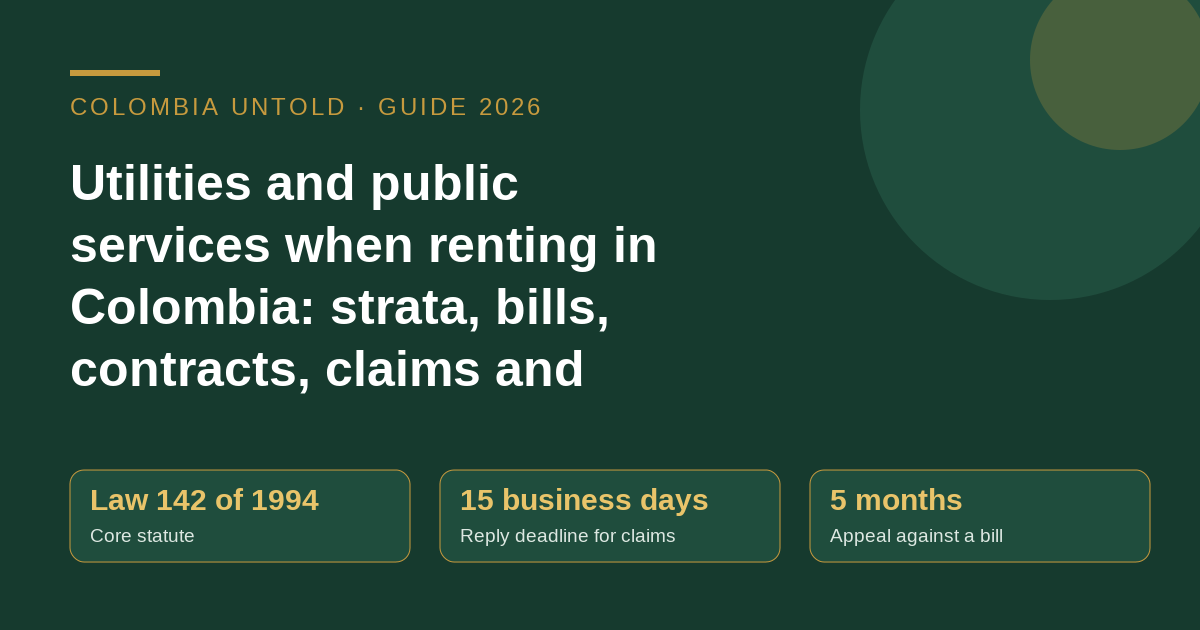
Quick answer: When renting in Colombia, public utilities (water, power, gas, waste collection, internet) are billed per property and the rate depends on the stratum assigned by the municipality. Whoever is the subscriber answers to the company and, under Law 142 of 1994 (art. 130), owner, subscriber and user are jointly liable. Ask for a clearance statement before moving in, photograph the meters, keep the bills and claim in writing: the company must reply within 15 business days or positive administrative silence applies (Law 142, art. 158).
One of the first shocks when renting in Colombia is understanding how utilities work: who the account holder is, why the bill shows a "stratum", how it is paid, what happens if the previous tenant left debts and how to claim if a charge looks excessive. This guide explains the system, your rights and a practical routine so you do not overpay or end up without service.
What home public utilities are
Law 142 of 1994 regulates home public utilities: water supply, sewerage, waste collection, electricity, fuel gas and basic public switched telephony, plus complementary activities. In practice, when renting you will receive bills for water and sewerage, waste collection (sometimes on the same bill as water), electricity and natural gas or cylinders, plus internet and mobile or fixed telephony, which are contracted separately. In horizontal property you may also have common meters and building fees (see Paying building administration fees in Colombia: what they cover, who pays, late interest, clearance, assembly and complaints).
The stratum and how it affects what you pay
The stratum (1 to 6) is assigned by the municipality to residential properties according to their characteristics and surroundings. Strata 1, 2 and 3 receive utility subsidies, and strata 5 and 6, as well as commerce and industry, pay a contribution that the law limits to a surcharge of at most 20 %. The stratum appears on the bill; if you believe the assigned one is wrong you can ask the municipal planning office to review it. Ask for the stratum and the average consumption of recent months before renting, because two apartments with the same rent can have very different bills.
Subscriber, owner and tenant: who is liable
The utility contract is with the company and is in the name of a subscriber. The law provides that the property's owner or possessor, the subscriber and the users are jointly liable for the contract's obligations (Law 142, art. 130), so a service debt can be pursued against the property. That is why, before receiving it, you should ask for the clearance statement (paz y salvo) for each service or the latest paid bills. The lease should state clearly who pays utilities during its term and how a copy of each bill is delivered. Housing lease rules (Law 820 of 2003) and the model in Checklist before signing a lease in Colombia: clauses, maximum rent, increases, guarantees and red flags help you draft it.
Steps when you move in
- Photograph the water, power and gas meters with date and time.
- Ask the owner for the latest bills and the details of each service.
- Verify there are no outstanding debts and request the clearance statement.
- Decide whether you change the account holder to your name or keep the owner's; record it in the lease.
- Check the condition of the installations (leaks, sockets, water heater) and include it in the inventory in Handover of a rented property in Colombia: inventory, photos, meters, record and clearance certificates.
How to read a bill
The bill shows the billing period, the previous and current reading, consumption, stratum, fixed charge and consumption charge, subsidies or contributions, waste collection and other charges, and the payment deadline. Compare consumption with previous months: if it jumps without a change in your habits there may be a leak or an error. For water, abnormal consumption may indicate an internal leak; ask the company for an inspection. For power, check the meter reading and the equipment that uses the most (heaters, air conditioning, dryers).
How to pay
You can pay at banks, agents, payment points, apps and company portals, by automatic debit or online. Keep the receipt. If you live in a complex, some bills arrive through the administration. If you use a card, check the charge on your statement. To organize your payments from the start, see How to open a bank account in Colombia as a foreigner: complete guide and Dynamic keys in Colombian banks: what they are, how to activate them, what to do without a local number and how to avoid fraud.
Disconnection and reconnection
The company can suspend service for non-payment, but the law requires a minimum period: the default must last no less than two billing periods (Law 142, art. 140). Paying on time avoids cuts and surcharges; if you are cut off, ask for the reconnection fee and demand that service be restored once you pay. If the cut seems unjustified (for example because of a bill under claim), claim in writing. In your lease, define who bears reconnection and late fees.
How to claim a bill
- Petition or complaint: file it in writing or through the company's channels, with the bill and your arguments. Ask for a ticket number. - Reply deadline: the company must reply within 15 business days; if it does not, positive administrative silence applies and the claim is deemed resolved in your favor (art. 158). - Appeal: if the answer does not satisfy you, you may file an appeal with the company; it is not available against bills more than five months old (art. 154). - Superservicios: if the problem persists, go to the Superintendence of Home Public Utilities, which oversees the companies. Keep payment receipts, meter photos and written communications. If the claim involves the owner, use mediation or see Claims against the administrator and the HOA in Colombia: rights, steps, coexistence committee, sanctions and challenging decisions.
Saving water and power
Check for leaks in taps and toilets, use efficient bulbs, unplug idle devices, ventilate instead of using air conditioning when the weather allows and set the water heater. A 10 % cut in consumption lowers the bill and the environmental footprint. In mild-climate cities like Medellín air-conditioning use is low; on the coast it can weigh heavily. For power cuts see Power cuts and UPS for remote work in Colombia: rights, compensation, runtime calculation and backup plan.
Internet and telephony
Internet and phone services are contracted with private carriers; see Fiber internet in Colombia: how to choose a plan, speed, router, Wi-Fi, backup and what to ask before contracting, Prepaid or postpaid mobile in Colombia: which suits a foreigner, minimum term, IMEI, number portability and complaints and Landline and intercom in Colombian condominiums: what foreign tenants need to know about phone lines, entry systems and internet. If you move, request the service transfer in advance and calculate early-termination penalties.
When the lease ends
Ask for the final meter readings, pay outstanding bills, request a clearance statement and return equipment lent by carriers. Keep the receipts in case a later charge appears. For the deposit and its return see Rental deposit in Colombia: what the law says, how to recover your money and which deductions are legitimate and How to negotiate a lease in Colombia as a foreigner: rent, co-signer, policy, term, increases and what the law does not allow.
Common mistakes
- Receiving the property without a clearance statement.
- Not photographing the meters.
- Assuming "all inclusive" covers all utilities.
- Ignoring abnormal consumption on the bill.
- Paying late and accumulating surcharges.
- Filing claims only by phone, without a ticket number.
- Not defining in the lease who pays each utility.
A calculation example
Own-arithmetic example with hypothetical figures: water COP 65,000, power COP 140,000, gas COP 45,000, waste collection included in water, internet COP 110,000 and building fee COP 380,000 add up to COP 740,000 a month on top of rent. If rent is COP 2,500,000 your real monthly cost is COP 3,240,000, 29.6 % more. Always ask for these figures before comparing apartments.
Documents to keep
Lease, inventory, paid bills, clearance statements, meter photos, emails with the company and with the owner. A digital folder with these is your best backup against any later charge.
Frequent practical cases
The bill arrives in the owner's name. This is normal. Ask the owner to hand you a copy each month or access the company portal with the account number. Pay on time and keep receipts to prove you complied.
Water consumption is high and you do not know why. Close all taps and check whether the meter keeps turning; if it does, there is a leak. Report it in writing to the owner and the company. An internal leak that predates your arrival should not fall only on you if you documented it with photos.
The administration charges common services in the fee. In horizontal property, part of the water, waste collection or power of common areas is covered by the building fee; ask what it includes so you do not pay twice.
You move out mid-period. Request the final reading and pay proportional consumption. Ask the company for a closing bill or a dated clearance statement.
The owner wants to charge a different amount from the bill. Ask for the supporting document. Overcharging is grounds for a claim; without support, do not pay the difference and record it in writing.
The meter is shared with another unit. This happens in older buildings. Ask the owner how consumption is split and put the formula in the lease, or ask the company about installing an individual meter, since a shared meter makes it hard to prove what you actually consumed.
Frequently asked questions
Who pays utilities in a rental?
What you agree in the lease. Toward the company, the law makes owner, subscriber and users jointly liable (Law 142 of 1994, art. 130), so ask for a clearance statement and keep the receipts.
What is the stratum and how does it affect my bill?
It is a classification from 1 to 6 assigned to the property by the municipality. Strata 1 to 3 receive subsidies and strata 5 and 6 pay a contribution with a surcharge of at most 20 %.
Can they cut my service for the previous tenant's debt?
The debt can be pursued against the property. Ask for the clearance statement before receiving it; if you already received a bill with debt, claim in writing and ask for a review.
How long does the company have to answer my claim?
15 business days; if it does not reply, positive administrative silence applies (Law 142, art. 158).
Can I claim an old bill?
The appeal is not available against bills more than five months old (art. 154). Claim quickly and in writing.
Whom do I turn to if the company does not resolve it?
The Superintendence of Home Public Utilities, which oversees providers.
Key figures and data
| Item | Value | Note |
|---|---|---|
| Core statute | Law 142 of 1994 | Public home-utilities regime |
| Reply deadline for claims | 15 business days | Positive administrative silence (Law 142, art. 158) |
| Appeal against a bill | 5 months | Not available against bills older than five months (art. 154) |
| Suspension for non-payment | 2 billing periods | Minimum before service is suspended (art. 140) |
Official sources and reliable reading
Related guides
- Hybrid work in Colombia: how to combine home and coworking, costs, internet, ergonomics and rules
- SOAT and vehicle insurance in Colombia: coverage, fine, foreigners, comprehensive cover and how to claim
- Fiber internet in Colombia: how to choose a plan, speed, router, Wi-Fi, backup and what to ask before contracting
General information based on current rules and practice; it may change. Confirm your case with the official source or an authorized professional. Not legal, tax or medical advice.