Nequi and Daviplata for foreigners: how to open them, limits and when to use them
Updated: 13 October 2026 · Colombia Untold
Quick answer: Nequi and Daviplata are Colombian digital wallets that open from your phone and let you pay, receive and transfer money instantly. Foreigners can use them with the documents each platform accepts, but with balance and transaction caps that rise when you present a cédula de extranjería.
Spend a week in Colombia and you will see the same gesture in the bakery, the taxi and the market: someone takes out a phone, scans a code and the payment arrives instantly. Behind that gesture are, above all, two wallets: Nequi, from Bancolombia, and Daviplata, from Davivienda. For a newly arrived foreigner they are a practical entry point into the local financial system, because they open from your phone, charge no management fee on their basic product and work as a bridge while the visa, the cédula de extranjería and a traditional bank account are processed. This guide explains what they are, how to register, what limits they have, how to use them well, which risks to avoid and when to move to a full savings account. The information is general and conditions change, so the final figures and rules are those of each platform.
What they are and how they differ from a bank account
Nequi and Daviplata are low-amount deposit products, designed for financial inclusion, that let you store, receive and send money from your phone. Unlike a full savings account they have caps: a maximum balance, a monthly transaction limit and, in general, fewer services, such as cheques or free-use loans with more paperwork. In return they are quick to open and simple to use. They operate under the supervision of the Financial Superintendence, through supervised institutions (Bancolombia and Davivienda), and are subject to the same know-your-customer and anti-money-laundering rules. The most important practical difference is acceptance. Paying by QR code, mobile number or instant-payment key works in shops, deliveries, ride-hailing taxis, market squares, informal transport and even with street vendors. Receiving money from a Colombian friend, splitting a bill or paying rent to a private landlord is much simpler if both have a wallet.
Which documents foreigners are accepted with
Each platform defines which documents it accepts and may change them. In general terms: - Cédula de extranjería: the document that unlocks all functions and the highest caps. If your visa entitles you to it, get it soon; see Cédula de Extranjería: What It Is and How to Get It. - Passport with visa or permit: at times the platforms have accepted passports with limited products; check whether your document category is enabled in the app before buying a line. - Colombian mobile number: essential, because registration and authentication use a local number. Get a line first; see Prepaid vs postpaid mobile and SIM and eSIM in Colombia for foreigners. - Email and a facial-verification selfie, depending on the flow. If the app rejects your passport, do not insist with other data: the failed attempt is usually recorded. Use a trusted colleague’s or friend’s account only to receive small payments as a transitional step, never to keep your money or share your keys.
How to open it step by step
- Install the official app from your operating system’s store; check the developer name.
- Enter your Colombian mobile number and validate the code that arrives by message.
- Choose the document type and photograph the document in good light, without glare.
- Take the selfie or liveness check the app asks for.
- Create a numeric password that is not your birth date or consecutive digits.
- Enable your phone’s biometric authentication and movement notifications.
- Top up with a transfer from another account, at a collection point or with a cash deposit if the plan allows it.
Balance and transaction limits
Wallets have balance and monthly transaction caps generally expressed in UVT that can vary with the level of verification. In 2026 the UVT is COP 52,374, and the caps are calculated as multiples of that unit. If the cap falls short, you have two paths: verify your identity with a document that opens a higher level, or open a traditional savings account for your main money and leave the wallet for daily expenses only. As a rule, do not keep in the wallet more than you will spend in two or three weeks.
What you can do with them
- Pay with QR and keys: shops, restaurants, cafés, hairdressers and market squares.
- Send money to other people: free or at low cost between users of the same platform and to other banks through the instant-payment system.
- Pay bills: power, water, gas, internet and mobile top-ups.
- Save in pockets or goals: set aside money for rent, trips or emergencies.
- Get paid as a freelancer: share your number or key to receive small payments from Colombian clients.
- Shop online: with virtual cards depending on the product.
Taxes and costs that do exist
The basic product charges no management fee, but there are occasional costs: withdrawals at certain ATM networks, top-ups through third-party channels and transfers to other banks depending on the plan. The GMF tax (4x1000) applies to movements as in any account, and you can mark only one savings account as exempt in the whole system; if you use the wallet as your main one, bear this in mind. Read The 4x1000 Tax in Colombia: What It Is and What It Means for You to decide where to mark the exemption. If you receive income, keep the records: wallets do not exempt you from tax obligations; see Basic taxes for foreigners in Colombia.
Security: what prevents the most fraud
Wallets are a frequent scam target because they move money immediately. The essential rules: - Never share the code that arrives by message or your password, not even with someone claiming to be customer service. The platform will not ask for them. - Distrust messages announcing prizes, account blocks or links to “update data”. - If you buy or sell via social media, do not send advance payments to strangers and demand proof. - Enable notifications and review movements every week. - If you lose your phone, block the account from another device or via the official line and suspend the SIM; see Phone: insurance and theft prevention. - Avoid public wifi to log in to the app. For more on keys, tokens and ATMs see Dynamic keys and banks and ATMs and safety.
When to move to a full savings account
The wallet is a good first product, but it has a ceiling. Open a traditional savings account when you need to: receive your salary or regular income, set up direct debit for bills, have a credit card or consumer loan, pay rent by transfer with a formal bank receipt, receive significant international transfers or meet visa requirements that ask for bank statements. If you are at that stage, see Opening a bank account in Colombia as a foreigner: requirements, banks and pitfalls. A practical scheme: a traditional account for the main money and a wallet for the day to day.
What to do if something goes wrong
If there is a charge you do not recognise, report it in the app and through the official channel immediately; if it is fraud, keep screenshots and file the complaint with the institution and, as a second instance, with the Financial Superintendence. Platforms must handle claims through formal channels, and the financial consumer ombudsman is a free body. Keep screenshots of conversations, reference numbers and receipts.
Wallets and travel insurance
If you are visiting, besides paying by wallet it is wise to have travel insurance with medical and baggage cover. You can quote with discounts of up to 65% at Protege Tu Viaje. And if your migration status is part of your doubts, Colombia Visa Legal advises on which document applies to you.
Nequi versus Daviplata: which to pick first
Both wallets do the essentials: store, pay and transfer. The differences lie in the ecosystem. Nequi, backed by Bancolombia, has become very popular among young people, professionals and freelancers, and its app includes pockets, savings goals, a cushion, a virtual card and QR payments widely used in urban shops. Daviplata, from Davivienda, has a large user base across the country, including people who receive subsidies and state payments, and works very well in small towns and market squares. For a foreigner living in a big city, the practical decision is usually which one your contacts use: if your landlord, your domestic helper or your circle of friends use one, opening the same saves friction. There is no harm in opening both, provided you keep balances low and use different passwords.
Three practical cases for the first month
Case 1: you arrive on a visitor visa and need to pay without cash. Get a Colombian phone, try to register with the document the app accepts and, if that is not possible, use cash and an international card while you progress with your visa. Do not depend on a wallet in month one. Case 2: you have just received your cédula de extranjería. This is the moment to register with the full document, raise your caps and open a traditional savings account in parallel. Mark the 4x1000-exempt account at the one where you move the most money. Case 3: you are a digital nomad billing clients abroad. Wallets are not the destination of your international income; receive it in a traditional bank account and, from there, send to the wallet only what you will spend each week. That way you separate expenses, control caps and keep clear records for your tax return and possible visa renewals.
Good financial-order habits with a wallet
- Separate money into pockets: rent, food, leisure and emergencies; the habit prevents impulse spending.
- Review the history once a week and reconcile it with your real spending.
- Do not use the wallet to hold long-term savings; savings accounts and investment products exist for that.
- Keep screenshots of important payments, such as rent or tuition.
- Change the password from time to time and do not reuse it in other apps.
Frequently asked questions
Can I open Nequi or Daviplata with a passport?
It depends on each platform’s current rules, which have varied. In general, the highest caps and all functions are enabled with a cédula de extranjería, while with a passport options are limited or unavailable. The most practical thing is to try registering in the app before relying on it.
Do I need a Colombian mobile number?
Yes. It is the account identifier and the authentication channel. Without a local line you cannot register or receive security codes.
Is it safe to keep money in Nequi or Daviplata?
They are products of institutions supervised by the Financial Superintendence, and security depends largely on your habits: do not share codes or passwords, enable notifications and do not leave high balances. For significant sums a traditional savings account is better.
Can I receive payments from abroad in a wallet?
Wallets are designed for local low-amount operations. Payments from abroad usually arrive in traditional bank accounts, which offer more support for international transfers and for proving income to the migration authority.
How much does it cost to keep the account?
The basic product charges no management fee. There may be costs for withdrawals on some networks, transfers to other banks depending on the plan or additional services; check the platform’s fee table, and remember the 0.4% GMF if you have no exempt account marked.
Is a wallet good for paying rent?
It works if the landlord also uses a wallet or accepts instant transfers. Even so, for formal leases it is better to pay by bank transfer and keep the receipt, because it is the strongest proof in a dispute.
Key figures and data
| Item | Value | Note |
|---|---|---|
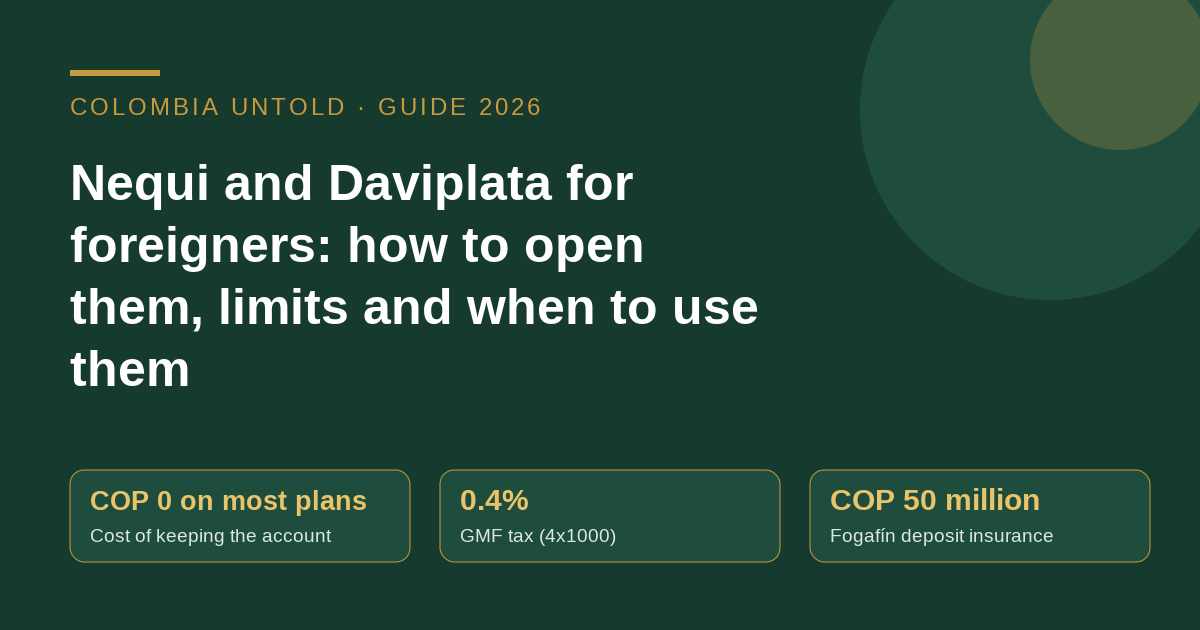
| Cost of keeping the account | COP 0 on most plans | No management fee on the basic product |
| GMF tax (4x1000) | 0.4% | Applies to movements as with any account |
| Fogafín deposit insurance | COP 50 million | Covers registered institutions; check whether your product is included |
| Typical sign-up time | 10 to 30 minutes | With an accepted document and a Colombian mobile number |
Official sources and reliable reading
Related guides
- Lease deposit: return
- How to find an apartment in Colombia as a foreigner: complete guide
- Best cities to live in Colombia for expats: comparison
General information based on current rules and practice; it may change. Confirm your case with the official source or an authorized professional. Not legal, tax or medical advice.