Checklist before signing a lease in Colombia: clauses, maximum rent, increases, guarantees and red flags
Updated: 13 October 2026 · Colombia Untold
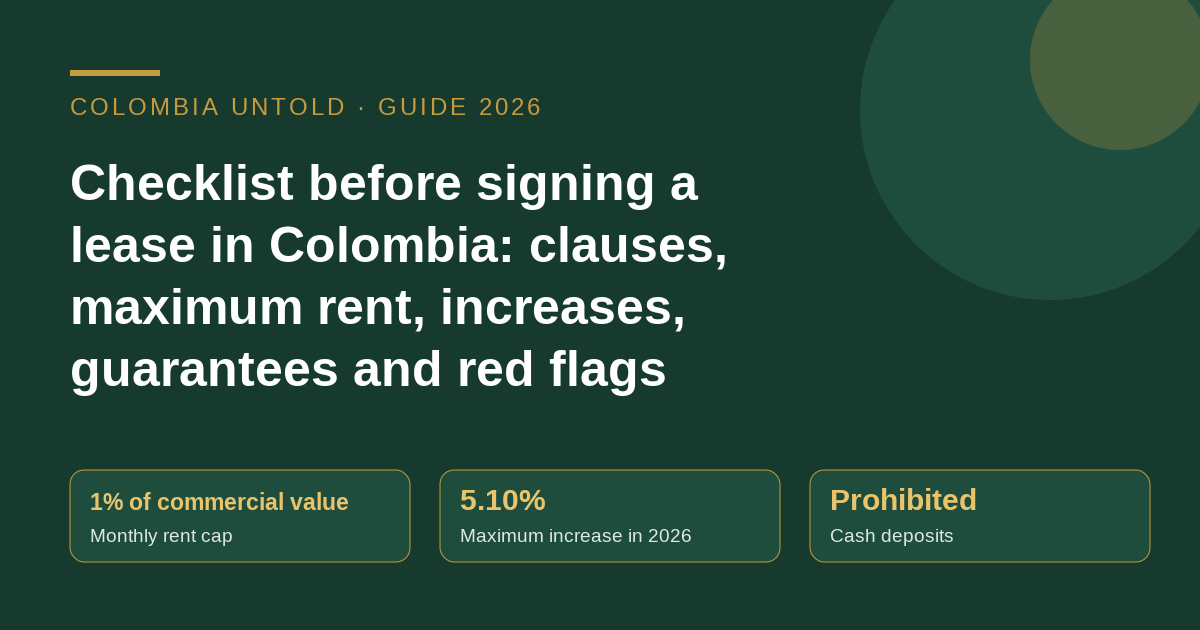
Quick answer: Before signing a housing lease in Colombia, verify who the owner is, that the contract is written and complete, that the rent does not exceed 1% of the property's commercial value (Law 820 of 2003, art. 18), that the annual increase does not exceed CPI (5.10% in 2026), that you are not asked for a cash deposit (art. 16), that the building fee and utilities are defined, and that there is a handover inventory with photos.
Signing a lease is the most important financial decision of a foreigner's first months in Colombia, and it is almost always made in a hurry: the apartment is appealing, other interested people are waiting, the broker already has the document printed and the language, customs and lack of references push you to sign anything. Yet a twelve-month contract commits tens of millions of pesos, and the mistakes made at that table are the same again and again. This guide is a checklist to use before putting your signature: what to check about the owner and the property, what the contract must say, what the law says about rent, increases, guarantees and termination, which clauses are worth changing and which signals should make you stop.
First, verify who you are dealing with
The first risk is not a clause: it is signing with someone who cannot lease you the property. Rental scams exist: listings with copied photos, fake owners who ask for a reservation and disappear, or intermediaries who sublet without authorization. Before paying anything, check the following. Ownership. Ask for the property's title and liens certificate, issued by the Public Instruments Registry Office and obtainable online from the Superintendence of Notaries and Registry for a low fee. It shows who the registered owner is, whether there are mortgages or seizures and the real estate registration number. The name must match that of the person signing. If an attorney-in-fact or an agency signs, demand the current power of attorney or management contract. Identity. Check the landlord's ID and that the contact, phone and payment account correspond to the same person or the agency. Visit. Visit the property in person or with a trusted representative, by day and by night if noise matters. Never pay a reservation without having seen it. The guide How to compare neighborhoods by noise in Colombia: rules, maps, measurements and signs before you rent explains what to check about the surroundings. Agency. If an agency is involved, ask for its registration, its mandate contract with the owner and who charges the commission. In Bogotá you can check whether the agency is registered with the District Housing Secretariat. Utilities in whose name. Ask for the latest utility and building-fee bills to see consumption and rule out debts. See Utilities in Colombia for foreigners: water, electricity, gas, waste, strata, bills and complaints.
The contract must be written and complete
Although a verbal lease can exist, for a foreigner the prudent course is always a written contract, signed by both parties, with all the data. A complete contract includes the identification of the parties, the address and registration of the property, the use (housing), the rent and payment date, the term, the increase, who pays the building fee and utilities, the guarantees, the rules on pets, subletting and renovations, the grounds for termination, the address for notices and the attached inventory. A contract with blanks or with annexes to be filled in later is an invitation to conflict. Insist on a signed copy of everything. If you are handed an agency's standard form, read it in full; do not sign out of trust what you do not understand. If the contract is only in Spanish and your level is basic, ask for a translation or a review by a trusted lawyer: the cost is lower than that of a mistake. For a legal and immigration review of your situation, Colombia Visa Legal at colombiavisalegal.com and CoVisas at covisascolombia.com guide foreigners, and for the search and signing process in Medellín, Medellín Advisors at medellinadvisors.com and Premium Propiedades at premiumpropiedades.com.
The rent: how much can be charged and how much it can rise
Law 820 of 2003, which regulates urban housing leases, provides that the monthly price may not exceed one percent of the property's commercial value (article 18). If an apartment has a commercial value of COP 400,000,000, the maximum rent would be COP 4,000,000. In practice, many listings exceed that cap, especially in tourist zones, and although the cap exists, it is hard to enforce if you accepted a price; that is why it pays to know it when negotiating. If a rent looks well above one percent of commercial value, ask for the appraisal or compare with similar properties. The annual increase cannot exceed the CPI of the previous calendar year, under the same law. For 2026 the cap was 5.10%: a COP 2,000,000 rent can rise at most to COP 2,102,000 on renewal. Any clause fixing a larger increase is ineffective. Check in the contract the date the increase applies and that it is calculated on the current rent, not on a higher one. Confirm whether the rent includes the building fee. It is the most common surprise: a COP 2,000,000 listing with a COP 400,000 building fee costs COP 2,400,000. The guide Renting in Colombia as a foreigner: rent, building fees, deposits and the real cost explains the total cost of renting.
Guarantees: what can be demanded and what cannot
Article 16 of Law 820 of 2003 prohibits demanding cash deposits or other real-security guarantees in urban housing leases. They are not valid, and the clause is ineffective. What is allowed are personal guarantees: a co-signer or guarantor, or a rental policy taken out with an insurer. If you have no local co-signer, the policy is the alternative; ask its cost, which is usually a percentage of annual rent, who pays it and what it covers. Distrust anyone who asks for blank promissory notes, post-dated checks, several months of rent in advance or a "reservation" deposit with no receipt. If you decide to pay out of necessity, insist on a signed receipt with amount, purpose and return period. The guide Rental deposit in Colombia: what the law says, how to recover your money and which deductions are legitimate explains how to claim it later.
Term, renewal and termination
Read the term carefully and what happens at expiry. In urban housing, contracts are usually twelve months and renew automatically for equal periods if neither party gives notice of intent not to renew with the agreed or legal advance. Write down the notice deadline. The law regulates the cases in which the landlord can terminate and the indemnities, as well as termination by the tenant, which normally requires written notice, and for early termination it contemplates an indemnity equal to one and a half months of rent in certain cases. Confirm in the contract the notice period, the way to notify and the penalties, and compare them with the law: clauses that worsen your legal position may be ineffective. Also check whether there is a minimum-stay clause with a penalty, and what happens if you must leave for a supervening reason, such as a change of job or visa. Negotiate that the notice be reasonable and that the penalty, if any, be proportionate.
Clauses worth reviewing
Building fee and extraordinary levies. Define who pays the condominium's extraordinary levies: normally they fall on the owner when they relate to building works or investments. Utilities. Who holds the accounts, how they are paid and what happens with prior debts. Repairs. Minor ones, from normal use, fall on the tenant; substantial ones, on the owner. Have the contract say so clearly. Pets. If you have a pet, confirm that the condominium rules and the contract allow it, and whether there is an extra charge. Subletting and visitors. Many contracts forbid subletting or using the property for tourist lodging. If you plan to share the apartment, ask for it in writing. Renovations and painting. Do not do works without written authorization. Avoid clauses obliging you to repaint or replace excessively on exit. Landlord entry. The landlord cannot enter without your consent. Agree a procedure for maintenance visits or showing the property. Domicile and notices. Provide a valid email and address to receive communications. Governing law and conciliation. It is normal for the contract to mention prior conciliation; confirm that it does not limit your rights.
The inventory and the handover
Do not sign without an inventory. The state of the property on receiving it must be recorded in a signed record with photos and meter readings. The guide Handover of a rented property in Colombia: inventory, photos, meters, record and clearance certificates explains how to do it step by step. Check that each existing defect is written down and that keys, remotes and cards are counted.
Payments: how and to whom
Define how rent is paid: date, account and holder. Always pay by transfer to the landlord's or agency's account named in the contract, and keep the proof. Avoid paying cash without a receipt. If a third party asks you to pay into another account "because of a bank change", verify in writing with the owner. See Banking and payments in your first 90 days in Colombia: cards, cash, wallets and your first account to organize your payments in the first months.
Red flags that should stop you
The price is much lower than similar properties. They ask for money before you visit or see documents. The "owner" is abroad and sends the keys by courier. The person signing does not match the holder and has no power of attorney. They insist on paying fast because of supposed other offers. They refuse to give you the title and liens certificate. They ask for blank promissory notes. The contract does not exist or has empty spaces. The building fee or utilities have debts. If you find one or more, pause and verify.
Frequent mistakes
Signing without reading. Paying a reservation without seeing the property. Not asking for the title certificate. Not defining who pays the building fee. Accepting an increase above CPI. Ignoring the notice and automatic renewal. Not making an inventory. Paying cash without a receipt. Not keeping copies. And assuming that what is valid in your country is valid here.
A practical example: a COP 3,000,000 apartment
A foreigner finds an apartment at COP 3,000,000 a month with a COP 450,000 building fee. He asks for the title certificate and verifies that the owner matches the person signing. He estimates the commercial value at COP 450,000,000; the one-percent cap would be COP 4,500,000, so the rent is within the limit. He refuses the two-month deposit citing article 16 and proposes a policy, whose cost is agreed. He checks that the increase is CPI, notes the notice deadline and does the photo inventory. He pays by transfer to the account in the contract. At renewal, the rent goes to a maximum of COP 3,153,000 with a 5.10% increase.
Frequently asked questions
What is the maximum a housing rent can cost?
Law 820 of 2003 provides that the monthly rent may not exceed 1% of the property's commercial value. If the apartment is worth COP 400,000,000, the maximum would be COP 4,000,000. If a price looks higher, ask for the appraisal or compare with similar properties.
How much can rent rise in 2026?
At most the previous year's CPI: 5.10%. A COP 2,000,000 rent rises at most to COP 2,102,000 on renewal.
Which documents should I ask the owner for?
The title and liens certificate, their ID, the latest utility and building-fee bills and the condominium rules. If an attorney-in-fact signs, the current power of attorney.
Can they ask for a deposit and several months in advance?
The law prohibits demanding cash deposits and real-security guarantees in urban housing leases. Personal guarantees, such as a co-signer, or a rental policy are allowed. If you pay something out of necessity, insist on a receipt.
How do I end the contract early?
Check the notice and indemnity in the contract and compare them with Law 820 of 2003. Give notice in writing, with the agreed advance, and negotiate a proportionate exit if your situation changes.
What do I do if I suspect a rental scam?
Do not pay. Verify the title certificate, visit the property, demand a contract and ask for the owner's ID. If you already paid, keep the proofs and report to the Prosecutor's Office and your bank.
If you are evaluating housing or investment, Medellín Advisors can guide you on search, title review and the purchase or rental process. Always hire independent legal review.
Key figures and data
| Item | Value | Note |
|---|---|---|
| Monthly rent cap | 1% of commercial value | Law 820 of 2003, art. 18 (urban housing) |
| Maximum increase in 2026 | 5.10% | Equal to 2025 CPI |
| Cash deposits | Prohibited | Law 820 of 2003, art. 16 |
| Proof of ownership | Title and liens certificate | Requested from the Public Instruments Registry Office |
Official sources and reliable reading
Related guides
- SIM and eSIM in Colombia for foreigners
- Travel insurance for visiting family
- Cycling and urban mobility in Colombia: bike lanes, safety and getting around without a car
General information based on current rules and practice; it may change. Confirm your case with the official source or an authorized professional. Not legal, tax or medical advice.