Returning to your home country from Colombia: checklist for visa, lease, taxes, health, pets, finances and moving
Updated: 13 October 2026 · Colombia Untold
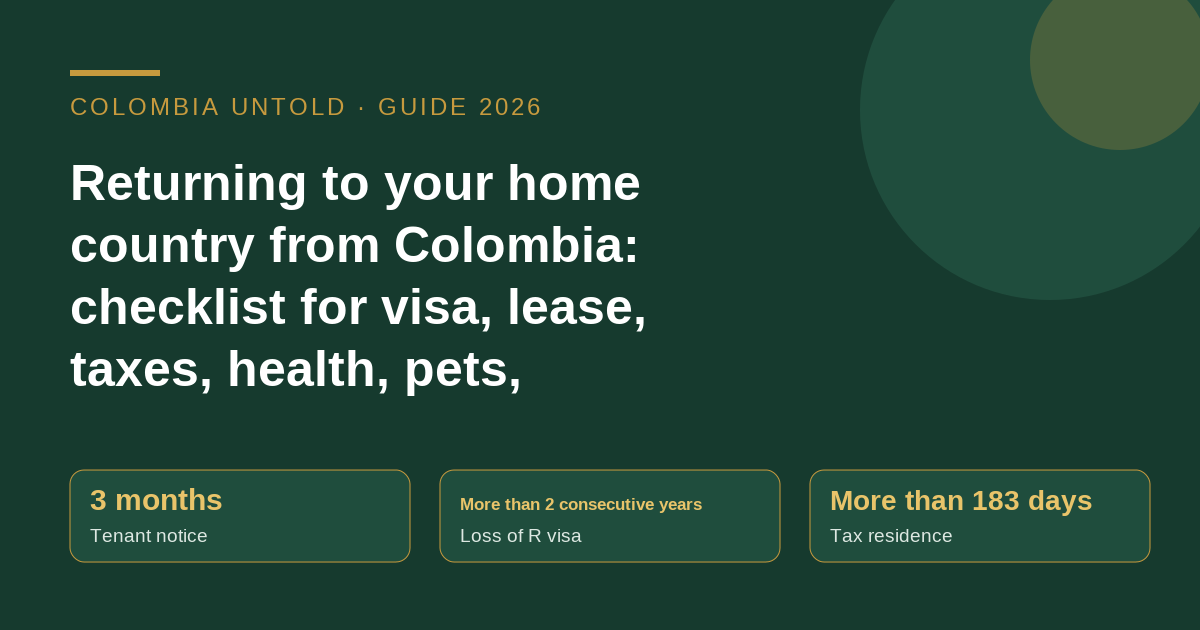
Quick answer: Before leaving Colombia, organize six fronts: lease (three months' notice and handover with inventory), visa and foreigner ID card (note: the R visa is lost after more than two consecutive years abroad), work and benefits, taxes and bank accounts, health and insurance, and pets and moving. Make the list 90 days ahead, keep copies of everything and ask for certificates you may need in your home country.
Returning to your country after living in Colombia is like a move inside another move: there are contracts to end, taxes to close, belongings to ship, a visa to decide whether to keep and relationships to maintain. Those who do it calmly, with a list and in time avoid fines, unexpected charges and loss of rights. This guide gives you an orderly route, from 90 days before departure to your first weeks at home.
Decide first: permanent or temporary return?
The answer changes almost everything. If it is temporary (for example, a year away), it is wise to keep the bank account, your health enrollment in suspension (if applicable) and a valid visa. If it is permanent, you close cycles. Bear in mind that the resident (R) visa is lost by staying more than two consecutive years outside Colombia, under Resolution 5477 of 2022; if you want to keep the option of coming back, plan visits before that period elapses. Check the rules for your visa with the Foreign Ministry. To recall the categories see Colombia visa types 2026: V, M and R explained, categories, validity, work rights and how to choose and From expat to permanent resident: the R visa in Colombia, routes, required years and ID card.
A 90-day timeline
- 90 days before: send the lease termination notice, decide what to do with your furniture, request moving quotes, review your visa and documents.
- 60 days before: tell your employer (if applicable), ask for certificates, quote flights and travel insurance, and plan the shipment of pets.
- 30 days before: schedule the handover of the property, cancel utilities, close subscriptions and decide what to do with your bank account.
- 7 days before: take final meter readings, pay outstanding bills, pack key documents in carry-on luggage and confirm flight times.
Lease: notice, handover and deposit
Law 820 of 2003 (art. 24) requires the tenant to give three months' notice to end the contract; if you end before the agreed term without complying, an indemnity equal to three months' rent is due. Own-arithmetic example with hypothetical figures: with rent of COP 2,500,000, the indemnity would be COP 7,500,000, so sending the notice in time, or negotiating in writing an early exit with the landlord, can save you that amount. Review the contract and deadlines; if your contract renewed automatically, notice is still the rule. For the handover, prepare the photo inventory, repair what applies and ask for a receipt record; see Handover of a rented property in Colombia: inventory, photos, meters, record and clearance certificates and Rental deposit in Colombia: what the law says, how to recover your money and which deductions are legitimate. If you sublet or assign the contract, you need the landlord's express authorization (art. 17); see Subletting in Colombia for foreigners: legal risks, landlord authorization, Law 820 of 2003 and how to protect yourself.
Utilities and subscriptions
Ask each company for the final reading and a clearance statement; pay outstanding bills and request service termination. Cancel internet, phone, gyms, insurance and subscriptions with due notice and keep cancellation receipts. See Utilities and public services when renting in Colombia: strata, bills, contracts, claims and disconnections and Fiber internet in Colombia: how to choose a plan, speed, router, Wi-Fi, backup and what to ask before contracting. If you have a prepaid or postpaid mobile line, assess whether to keep it for procedures or cancel it; see Prepaid or postpaid mobile in Colombia: which suits a foreigner, minimum term, IMEI, number portability and complaints.
Work and benefits
If you are an employee, agree the termination date in writing and request the benefits settlement: severance (one month's salary per year of service, with interest), service bonus, pending vacation and owed wages. Ask for the employment certificate and proof of social security contributions, useful for procedures in your country. If you are self-employed, close your service contracts and keep a record. If your visa depends on the employer, termination affects your status: you have 30 calendar days to leave the country or apply for another visa; see Working legally in Colombia as a foreigner: visa, contract, social security, taxes and labor rights.
Visa and foreigner ID card
Before leaving, decide whether to keep the visa (for example, to return in future) or let it expire. Ask the Foreign Ministry and Migración Colombia whether you must report your departure, hand in the foreigner ID card or cancel any registration. If you hold an R visa, remember the two-years-abroad rule. Keep digital copies of your visas, ID card, migration-movement certificates and earlier permits: they may help in future procedures. Colombia Visa Legal (colombiavisalegal.com) and CoVisas (covisascolombia.com) can guide you on these decisions and on documentation.
Taxes and tax residence
Tax residence in Colombia depends on stay: more than 183 days, continuous or not, in a 365-day period (Tax Statute, art. 10). The year of departure usually requires reviewing your position before the DIAN: pending returns, withholdings, income and withholding certificates, and a possible change from resident to non-resident. Keep your records for the period the law requires and consider consulting an accountant. For the general framework see Basic taxes for foreigners in Colombia 2026: tax residence, income tax, VAT, GMF, property tax and when to file and Tax residency certificate in Colombia: who is resident, how to request it from the DIAN and what it is for. Also inform your home country's tax authority of your departure if applicable.
Bank accounts, cards and sending money
Decide whether to close or keep your accounts. If you close them, withdraw balances, cancel direct debits, cards and payment accounts, and request a closing letter. If you keep them, check fees, maintenance charges and inactivity conditions. To send money to your country, compare transfer costs and times and keep proof of the origin of funds. Remember the financial-transactions tax (GMF, 0.4 %) on certain withdrawals and transfers. See How to open a bank account in Colombia as a foreigner: complete guide and Dynamic keys in Colombian banks: what they are, how to activate them, what to do without a local number and how to avoid fraud to manage your access.
Health, insurance and pension
Cancel or suspend your EPS enrollment depending on your case and request medical-history and vaccine certificates. Ask your health or life insurer about cancellation or transfer conditions. If you contributed to a pension in Colombia, keep proof of weeks contributed, since they could help under social security agreements with your country (agreements exist with Argentina, Chile, Ecuador, Spain and Uruguay, plus the Ibero-American Convention); see Social security and pensions for foreigners in Colombia: health, pension, occupational risk, freelancers, treaties and the pension reform. If you need coverage while traveling or arriving, consider travel insurance; you can quote with Protege Tu Viaje, which offers discounts of up to 65 % depending on plan and conditions.
Vehicle
If you own a car or motorbike, decide whether to sell it, export it or leave it with a third party. To sell, review the transfer, pending taxes and SOAT; see Buying a used vehicle in Colombia as a foreigner: RUNT checks, transfer, scams and a verification checklist and SOAT and vehicle insurance in Colombia: coverage, fine, foreigners, comprehensive cover and how to claim. Cancel voluntary insurance and notify the company.
Pets
To take your pet to another country, requirements depend on the destination. Colombia issues the exit document through the ICA, at offices in ports, airports and border crossings; check ICA and destination-country requirements well ahead (vaccines, microchip, health certificate and timing). For dogs under 12 months a 15-digit microchip is required on exit, according to the rule cited by media. If you prefer to leave your pet with a third party, formalize the care and hand over its records. Also see Bringing your pet to Colombia: ICA requirements, vaccines, health certificate, flight, quarantine and first steps to understand how entry into Colombia works, and Pet insurance in Colombia: vet cover, liability, special-handling dogs, waiting periods, deductibles and how to compare.
Moving and personal belongings
Get at least three international moving quotes, review insurance and your country's customs conditions, and make a detailed inventory. Decide what to sell, give away or donate. Buy or rent only what you need at destination. To choose a company use Checklist for moving to Colombia: 90-day countdown, mover contract, consumer rights and the first month. Keep copies of invoices for valuable goods and ask your country's customs about allowances.
Documents to carry or request
- Study, employment and police-record certificates, if needed in your country.
- Civil records of children born in Colombia, apostilled if applicable; see Civil registry for foreigners in Colombia: birth, marriage and death, apostille, translation and children's nationality.
- Medical histories, vaccines and prescriptions.
- Tax residence certificate and tax records.
- Contracts and closing letters from banks, utilities and lease.
- Digital copies in the cloud and a physical backup.
Emotional and logistical aspects of arrival
Returning can bring reverse culture shock: customs, pace, costs and relationships change. Plan temporary lodging, reconnect with your network, update your identity documents, accounts, health coverage and employment, and keep ties with your community in Colombia. If you plan to return, set out a plan to preserve your status.
Common mistakes
- Sending the lease notice with less than three months.
- Losing the R visa after more than two years abroad.
- Not requesting the settlement or employment certificates.
- Closing accounts without withdrawing balances or cancelling direct debits.
- Not reviewing your tax position for the departure year.
- Forgetting ICA requirements for pets.
- Leaving the move without an inventory or insurance.
A printable checklist
Tick each item with a date: lease notice; handover with inventory; utility clearance; benefits settlement; certificates; closing or transferring accounts; visa decision; EPS and insurance; vehicle; pet; move; tickets; children's documents; digital copies. Review the list weekly during the last three months.
If you are not sure about returning
Consider a trial period: travel for a few months, keep your obligations in Colombia and assess. That phase lets you decide without closing doors. Meanwhile, keep insurance, taxes and housing contract up to date.
Long absences and M visa validity
Before leaving for a long period, check the absence rule. Under Article 65 of Cancillería Resolution 5477 of 2022, an M-type visa automatically loses validity when the holder stays outside the country for more than 180 continuous days within a 365-day period. Anyone planning a long stay in their home country, for example to care for a relative or finish a contract, should count absence days from the departure date recorded by Migración Colombia, not from the date on the ticket.
What to do in practice. Keep your migration movements history, which can be consulted online, and set a calendar alert at day 150 of absence. If you are about to exceed the limit, return to Colombia before reaching it, even briefly, and check with the Cancillería whether the count restarts in your case. This rule differs from the one for student visas, whose absence limit is 90 days under Article 36, and from the R visa, which is lost after more than two consecutive years abroad. If you are leaving for good, cancel services, close accounts and keep copies of your documents as this guide describes; if the absence is temporary, protect your visa validity first. To review your current category see Colombia visa types 2026: V, M and R explained, categories, validity, work rights and how to choose.
Frequently asked questions
How much notice must I give to end my lease?
Three months' notice (Law 820 of 2003, art. 24). If you end before the term without complying, an indemnity equal to three months' rent is due.
Do I lose my resident visa if I leave?
The R visa is lost by staying more than two consecutive years outside Colombia. Plan visits if you want to keep it.
What should I ask my employer for?
The benefits settlement (severance with interest, service bonus, vacation), the employment certificate and proof of social security contributions.
Do I have to close my bank account?
Not necessarily. If you keep it, check fees and inactivity; if you close it, withdraw balances, cancel debits and ask for a closing letter.
How do I take my pet to my country?
Check ICA exit requirements and those of the destination country (vaccines, microchip, health certificate and deadlines) well in advance.
What happens to my pension contributions?
Keep proof of weeks contributed; they may help under social security agreements with your country, such as those with Argentina, Chile, Ecuador, Spain and Uruguay.
If you want guidance on migration requirements, you can contact Colombia Visa Legal. When a procedure is online, Cancillería recommends doing it directly; professional guidance helps you understand the process, it does not replace the official source.
Key figures and data
| Item | Value | Note |
|---|---|---|
| Tenant notice | 3 months | Law 820 of 2003, art. 24; indemnity of 3 months' rent if you end early |
| Loss of R visa | More than 2 consecutive years abroad | Ground provided in Resolution 5477 of 2022 |
| Tax residence | More than 183 days | In any 365-day period (Tax Statute, art. 10) |
| Notice savings example | COP 7,500,000 | Hypothetical figures; own arithmetic |
Official sources and reliable reading
Related guides
- Living in Santa Marta: expat guide to climate, neighborhoods, water supply, cost of living, Tayrona, health care and visas
- Moving between cities in Colombia (trasteo): licensed companies, insurance, inventory, building clearance and timeline
- ATMs in Colombia: withdrawing cash safely, fees, limits and common scams
General information based on current rules and practice; it may change. Confirm your case with the official source or an authorized professional. Not legal, tax or medical advice.