Pet insurance in Colombia: vet cover, liability, special-handling dogs, waiting periods, deductibles and how to compare
Updated: 13 October 2026 · Colombia Untold
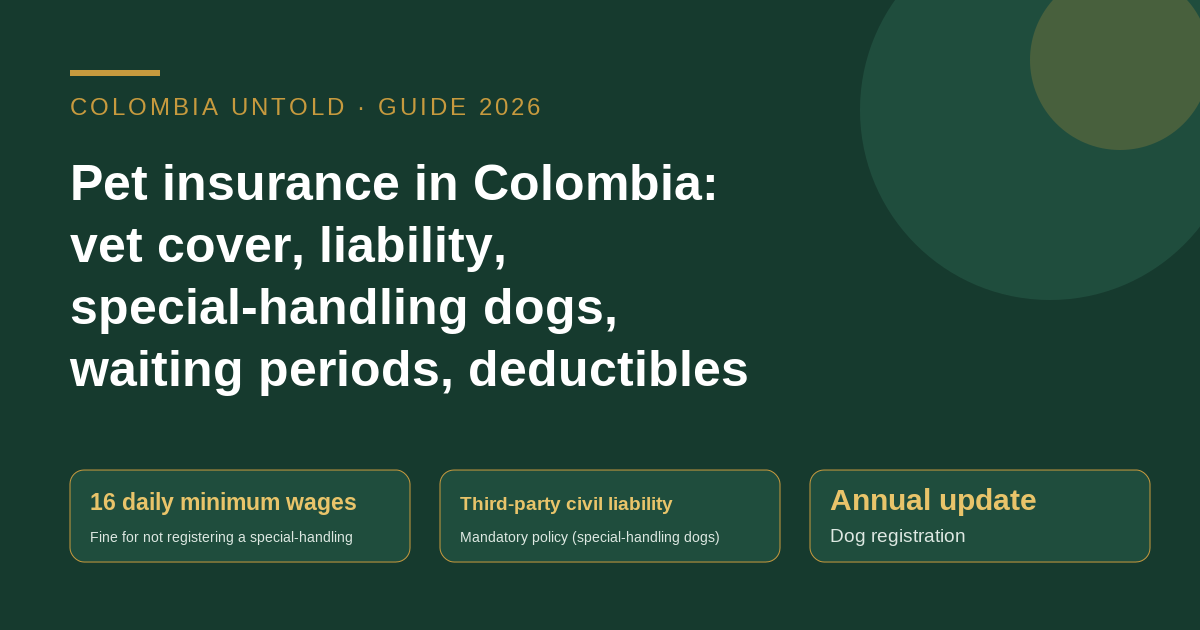
Quick answer: Pet insurance in Colombia can cover veterinary costs (accident and illness), third-party liability, funeral costs and assistance. Compare annual cap, deductible, coinsurance, waiting periods, pre-existing conditions and excluded breeds. For special-handling dogs (for example Rottweiler or Doberman), Law 746 of 2002 requires registration at the mayor's office and a third-party civil liability policy; the fine for non-compliance is 16 daily minimum wages (≈ $933,816 in 2026, own arithmetic).
For many expats the pet is part of the family and they are unwilling to move without it. In Colombia, owning a pet carries legal obligations (registration, vaccines, coexistence in horizontal property), veterinary costs that can be high in an emergency and, for some dogs, a civil liability policy. Pet insurance exists in the Colombian market, but its offer is less standardized than human health, so it pays to know what to compare. This guide gives you that framework, with verified legal data and examples of our own arithmetic with hypothetical figures.
What pet insurance covers
Pet policies combine, depending on the product, four types of cover. Veterinary cover pays consultations, tests, surgery and hospitalization for accidents and, in some plans, for illness. Civil liability covers damage your pet causes to third parties (injuries to a person, damage to another animal or property). Funeral or cremation costs cover the end of the animal's life. Assistance includes services such as telephone vet advice, transport or boarding if the owner is hospitalized. Not all plans include everything, and the price varies with species, age, breed and level of cover. Pet policies often limit enrollment by age (taken out as a puppy or with maximum age limits), and exclude pre-existing conditions, cosmetic treatments, routine vaccines and hereditary diseases, depending on the product. That is why reading the exclusions is the most important part.
What the law requires: special-handling dogs
Law 746 of 2002 regulates the keeping and registration of dangerous or special-handling dogs. Breeds usually cited as special-handling include the Pit Bull Terrier, American Staffordshire Terrier, Dogo Argentino, Rottweiler, Fila Brasileiro, Bullmastiff and Doberman, among others, and the regulation includes dogs that have attacked people. If you have one of these dogs, you must register it in the census of the mayor's office of your place of residence, with data on the animal and the owner, where it will live and its function, and update that registration every year. The owner must also take out a third-party civil liability policy covering damage to people, animals or property. Authorities may impose fines of up to 16 daily legal minimum wages for non-compliance. Our own arithmetic with the 2026 minimum wage ($1,750,905): the daily minimum wage is $1,750,905 ÷ 30 = $58,363.50 and a fine of 16 daily minimum wages is 16 × $58,363.50 = $933,816, approximately. In any case, the law bans the import of certain breeds; if you plan to bring a dog, see Bringing Your Pet to Colombia and Flying to Colombia with pets: ICA requirements, vaccines, crate, airlines, altitude and arrival. On walks in public spaces, these dogs require a collar and handling leash, and in many situations a muzzle; the coexistence rules (Law 1801 of 2016) and your city's rules detail when.
Liability for damage and animal abuse
Even if your dog is not special-handling, you are responsible for the damage it causes. Civil liability of animal owners aims for the victim to be compensated, and a civil liability policy can cover that compensation up to the contracted cap, without you paying out of pocket. On the other hand, Law 1774 of 2016 recognizes animals as sentient beings and makes animal abuse a crime, so abandonment or violence has criminal consequences. In horizontal property, Law 2054 of 2020 and the Coexistence Code protect pet ownership, and bylaws cannot simply ban them, although they can require responsible handling; see Pets and renting in Colombia for foreigners: lease, horizontal property, breeds, banned deposits and coexistence for pets in rentals and Claims against the administrator and the HOA in Colombia: rights, steps, coexistence committee, sanctions and challenging decisions if there are conflicts.
How to compare policies: what to read
- Annual and per-event cap: the most the policy pays. - Deductible: the amount you pay before the insurer starts paying. - Coinsurance: the percentage of the bill you keep paying after the deductible. - Waiting periods: time from enrollment until some covers start (for example, for illness). - Pre-existing conditions: conditions the animal already had before enrolling; normally excluded. - Breeds and ages: excluded breeds or higher premiums, and maximum entry and renewal age. - Vet network: whether you must use network clinics or can choose freely and claim reimbursement. - Payment method: direct payment to the clinic or later reimbursement. - Renewal: whether the premium rises with age and whether they can cancel you after a claim. - Civil liability: per-event cap, exclusions and whether it covers special-handling dogs. Example of our own arithmetic with hypothetical figures: if your vet policy has a $200,000 deductible, 20 % coinsurance and a $5,000,000 annual cap, and your dog has a $3,000,000 surgery, the insurer would pay (3,000,000 − 200,000) × 0.80 = $2,240,000, and you would bear $760,000. If the bill were $9,000,000, the calculation would give (9,000,000 − 200,000) × 0.80 = $7,040,000, but the $5,000,000 annual cap would limit payment to that amount and you would bear $4,000,000. That second scenario shows why the cap weighs as much as the premium.
Insure or save?
There are two strategies. Insuring transfers the risk of a high bill in exchange for a fixed premium; it works best on young animals without prior illnesses, and civil liability is indispensable if you have a special-handling dog. Saving means setting aside an amount each month in a separate account as a vet fund; it can be more efficient if the premium is high relative to expected costs, but it does not cover a serious event in the first months. A reasonable combination: a civil liability policy (usually cheap relative to the risk) and a savings fund for routine vet care, plus vet insurance with a high cap only for major emergencies. To build the budget, see Budget for your first 90 days in Colombia: method, template, worked example, buffer and mistakes.
Documents worth having
Current vaccination card, registration or census if applicable, animal identification (microchip or photo and details), vet history and a copy of the policy. If you travel with your pet, you will need health certificates; see Flying to Colombia with pets: ICA requirements, vaccines, crate, airlines, altitude and arrival. If you move to Colombia with it, Bringing Your Pet to Colombia explains ICA requirements.
How to claim
- Notify the insurer within the policy's deadline, ideally before a non-urgent treatment, to confirm cover. - Keep itemized invoices, medical records and test results. - File the claim form with supporting documents. - If the claim is rejected, ask for the reason in writing. You can go to the insurer's financial consumer ombudsman and, ultimately, to the Superintendencia Financiera de Colombia. For protection when traveling with a pet, some travel policies include limited veterinary assistance; you can quote with Protege Tu Viaje (Protege Tu Viaje), with discounts of up to 65 % depending on plan and conditions, and compare what each plan covers.
Common mistakes
- Taking out cover without reading exclusions and pre-existing conditions.
- Waiting until the pet is ill to enroll.
- Not registering a special-handling dog and being left without the mandatory policy.
- Looking only at the premium and not the cap or coinsurance.
- Not keeping the vet history.
- Ignoring the horizontal property's coexistence rules.
Veterinary emergency plan: prepare before it happens
A veterinary emergency rarely gives notice. Before it happens, identify a clinic with emergency care near your neighborhood and save its phone and address; find out whether it operates twenty-four hours, whether it accepts your policy with direct payment and what advance payment it requires. Keep the vaccination card, history and policy at hand on your phone and on paper. Learn which signs justify going immediately: difficulty breathing, persistent vomiting or diarrhea, seizures, a swollen abdomen, inability to urinate, trauma or ingestion of toxic substances. Avoid medicating your animal with human drugs without veterinary instruction, because several are toxic to dogs and cats. If you live in an apartment, share a key and basic instructions with a trusted neighbor, so someone can look after your pet if you are hospitalized or traveling.
Pets and renting: how insurance and the lease connect
If you rent, your pet also shows up in your lease. Ask the landlord, in writing, whether animals are accepted, of what size and how many, and whether a clause on damage is required. Damage your animal causes to the property (scratched doors, stained floors, odors) is deducted from what is due when you hand back the apartment; document the initial condition with photos and an inventory, as explained in Handover of a rented property in Colombia: inventory, photos, meters, record and clearance certificates. A pet civil liability policy usually covers damage to third parties, but not necessarily damage to the property you rent, so read that point. Also ask the building administration about common-area rules: leash in corridors, elevator use, walking hours and picking up waste. Complying avoids fines and conflicts with neighbors, and makes it easier for the landlord to renew your contract.
Frequently asked questions
Is insurance mandatory for my dog?
It is mandatory, together with registration at the mayor's office, only for special-handling dogs (Law 746 of 2002): a third-party civil liability policy. For other dogs it is voluntary, although you are responsible for the damage they cause.
What is the fine for not registering a special-handling dog?
Up to 16 daily legal minimum wages, which in 2026 equals about $933,816 (own arithmetic on the $1,750,905 minimum wage).
What does vet insurance cover?
Depending on the plan: consultations, tests, surgery and hospitalization for accidents and sometimes illness. It usually excludes pre-existing conditions, routine vaccines and cosmetic treatments.
What is a waiting period?
It is the time between enrollment and the start of certain covers, for example for illnesses. During the waiting period you cannot claim for those events.
Can my horizontal property ban pets?
It cannot ban them in general; it can regulate their handling. Law 2054 of 2020 and coexistence rules protect responsible ownership. See Claims against the administrator and the HOA in Colombia: rights, steps, coexistence committee, sanctions and challenging decisions for the procedure if there is a conflict.
Can I insure an old pet or one with illnesses?
Some insurers limit entry age and exclude pre-existing conditions. Ask about the limits before enrolling and compare several options.
If you need a medical plan or travel insurance for your visa or stay, CoVisas Colombia can guide you on plans that meet Resolution 5477. Always compare the coverages in writing.
Key figures and data
| Item | Value | Note |
|---|---|---|
| Fine for not registering a special-handling dog | 16 daily minimum wages | ≈ $933,816 in 2026 (minimum wage $1,750,905 ÷ 30 × 16, own arithmetic) |
| Mandatory policy (special-handling dogs) | Third-party civil liability | Required for the mayor's office registration |
| Dog registration | Annual update | Special-handling dog census |
| Typical covers | 4 | Vet, liability, funeral, assistance |
Official sources and reliable reading
Related guides
- Civil registry for foreigners in Colombia: birth, marriage and death, apostille, translation and children's nationality
- Claims against the administrator and the HOA in Colombia: rights, steps, coexistence committee, sanctions and challenging decisions
- Flying to Colombia with pets: ICA requirements, vaccines, crate, airlines, altitude and arrival
General information based on current rules and practice; it may change. Confirm your case with the official source or an authorized professional. Not legal, tax or medical advice.