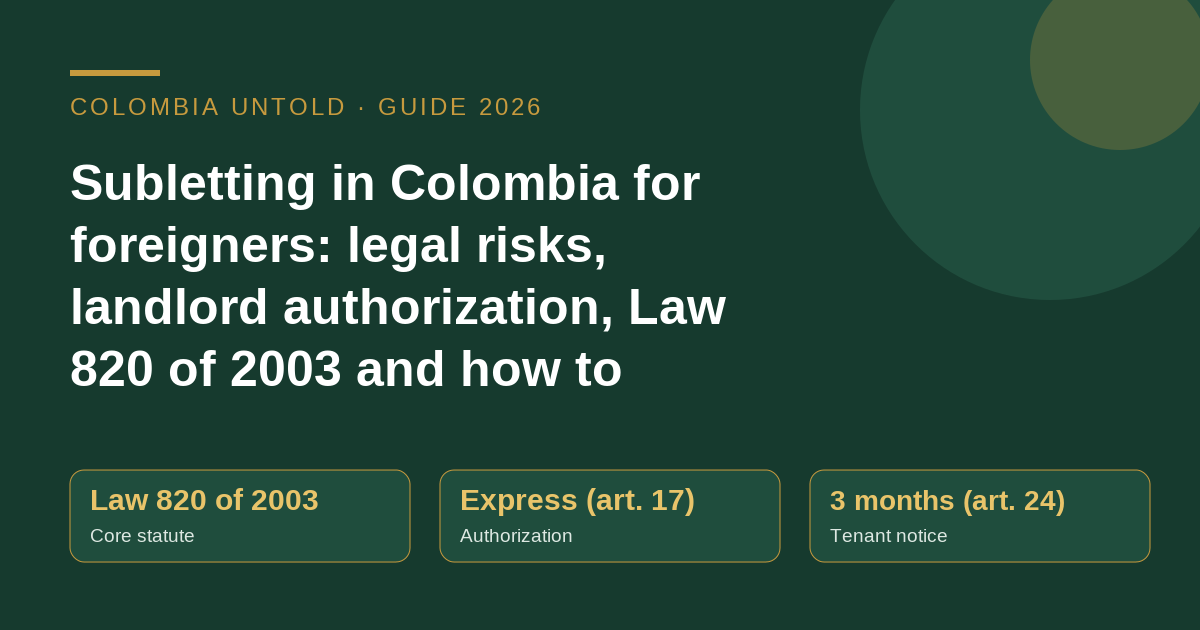
Subletting in Colombia for foreigners: legal risks, landlord authorization, Law 820 of 2003 and how to protect yourself
Updated: 13 October 2026 · Colombia Untold
Quick answer: Subletting in Colombia is valid only if the landlord expressly authorizes it (Law 820 of 2003, art. 17). Without that authorization the landlord can end the lease on legal grounds (art. 22, num. 3) and you, as the main tenant, remain answerable for the subtenant. If you plan to sublet or become a subtenant, insist on written authorization, a separate contract, an inventory and payment receipts to reduce the risk of losing your deposit or your home.
Subletting looks like an easy fix: you have an apartment or a room you will not use, or you need a place quickly and someone offers to "pass on" their lease. In Colombia, however, subletting is one of the situations where foreigners most often lose money, deposits and peace of mind, because it is done verbally, without the owner's authorization and without a contract of one's own. This guide explains what the law says, what risks you face in each position (tenant who sublets, subtenant, landlord) and how to document the arrangement so you are not at anyone's mercy.
What subletting is and how it differs from assignment
Subletting means renting out, in whole or in part, a property that you yourself rent. Two contracts are chained together: the owner's with you, and yours with the subtenant. The owner has no direct legal relationship with the subtenant. Assignment of the lease, by contrast, means you leave and someone else takes your place as tenant with the same obligations toward the owner. Both share one rule: Law 820 of 2003, art. 17, requires the landlord's express authorization to sublet or assign, and provides that without it the contract can be terminated. Everyday example: you go home for two months and leave your room to a friend who pays you part of the rent. If the landlord did not authorize it in writing, your friend is an unprotected occupant and you are a tenant in breach.
What Law 820 of 2003 says
- Art. 17: the tenant may not sublet or assign the lease without the landlord's express authorization; if done, the contract is exposed to termination. - Art. 22, num. 3: among the grounds for the landlord to seek return of the property is a prohibited or unauthorized assignment or sublease. - Art. 24: the tenant may end the contract with three months' notice; ending before the agreed term requires an indemnity equal to three months' rent. Without notice, the contract renews automatically. - Art. 20: the annual rent increase cannot exceed CPI; for 2026 the cap is 5.10 % based on the DANE figure. - Art. 18: monthly rent cannot exceed 1 % of the property's commercial value. These rules protect the tenant in the main lease, but they also create a risk: whoever sublets without permission hands the landlord an argument to end the contract and drags the subtenant down with them.
Risks if you are the tenant who sublets
You lose the lease. If the landlord discovers an unauthorized sublease, they may start recovery proceedings under art. 22. Even if the process takes time, the wear and cost are real and you may lose your deposit if there is damage or debt. You answer for the subtenant. Toward the owner, you are the only party obligated. If the subtenant does not pay or damages the property, the owner charges you, and you must pursue your subtenant separately. Liability inside the building. In a horizontal-property complex the administrator only knows the owner and the registered tenant. Fines for noise or damage fall on the owner and tenant; Law 675 of 2001, art. 29, creates joint liability between owner and occupant for ordinary expenses. A problematic subtenant can generate penalties that end up on your account. Tax and use risks. If you charge more than you pay, you have income that may have tax consequences; see Basic taxes for foreigners in Colombia 2026: tax residence, income tax, VAT, GMF, property tax and when to file. And if the building's bylaws restrict use (for example, banning short-stay rentals), the contract holder is the one in breach.
Risks if you are the subtenant
- No direct relationship with the owner. If the main lease ends, yours falls with it. You can receive an eviction notice with a few days' warning even if you are up to date on payments.
- Unbacked deposit. The money you hand over goes to the person subletting to you, not to the owner. If that person disappears, recovering it requires a legal process. Remember that Law 820, art. 16, prohibits demanding cash deposits or real guarantees in urban housing leases, so a charge of this kind should raise a flag.
- Typical scams. Room ads with photos copied from other listings, "reservation" payments by transfer before you see the property, or contracts the supposed tenant cannot show. If they will not show you the main lease and the owner's authorization, do not pay.
- Utilities and building fees. Ask who pays what and how you will get the bills; see Utilities and public services when renting in Colombia and Paying building administration fees in Colombia: what they cover, who pays, late interest, clearance, assembly and complaints.
Risks if you are the landlord
Although this guide is aimed at foreigners who rent, many are also owners. As a landlord, an unauthorized sublease entitles you to ask for termination, but it also exposes you to occupants you do not know, more wear on the property and conflicts with the building administration. Authorize only in writing, set a maximum number of occupants, require a copy of the subtenant's ID and make clear that the main tenant remains responsible.
How to do it right: written authorization and your own contract
If you decide to sublet or become a subtenant, this is the minimum sequence: - Get the landlord's written authorization, with the subtenant's name and ID, term and, if applicable, the part of the property. - Review the main contract: remaining term, rent, use clauses and building bylaws. - Sign a sublease contract with rent, payment date, term, utilities, care obligations, grounds for termination and handover. - Make a photo inventory signed by both; the model in Handover of a rented property in Colombia: inventory, photos, meters, record and clearance certificates is a good base. - Pay by bank transfer to an account in the name of the person who signs, and keep every receipt. - Inform the administration if the bylaws require it, to avoid penalties and access problems. To review clauses use Checklist before signing a lease in Colombia: clauses, maximum rent, increases, guarantees and red flags and, if your visa or immigration status affects your capacity to contract or your ties to the country, consult Colombia Visa Legal (colombiavisalegal.com), which can guide you on immigration paperwork.
Hypothetical case study
Imagine Sofia, a foreigner renting an apartment at COP 2,800,000 a month. She leaves for four months and sublets to Marc for COP 2,800,000 without telling the owner. After two months the landlord visits, finds Marc and sends a formal notice. Sofia faces three problems: the termination ground in art. 22, the risk of losing her deposit and Marc's claim, since he paid in advance. With written authorization from the start the scenario would have been different: Marc with his own contract, the owner informed and Sofia protected. The case is hypothetical and the figures are illustrative.
What to do if you are already in an irregular sublease
- Stop paying in cash and ask for a receipt for everything you handed over. - Contact the landlord or administrator to regularize: proposing a written authorization or a new direct contract is often the best way out. - Document the condition of the property with photos. - If you are asked to leave, ask for a written deadline and demand support for what they claim. - For improper charges or misleading advertising, you may go to the Superintendence of Industry and Commerce; for lease conflicts, to conciliation or to a lawyer. If the cause is a need for temporary housing, first read How to negotiate a lease in Colombia as a foreigner: rent, co-signer, policy, term, increases and what the law does not allow and Rental deposit in Colombia: what the law says, how to recover your money and which deductions are legitimate.
Rooms, coliving and short-stay rentals
A common case is a room in a shared apartment. Here it matters to distinguish: are you signing with the owner, with the main tenant or with a coliving company? Each option offers a different level of protection. With a formal company the contract is usually commercial and the rules clear; with a flatmate who "sublets" you depend on the owner's authorization. For short stays (tourism), specific lodging rules and horizontal-property rules apply and vary by building; ask whether the bylaws allow them before committing.
Common mistakes
- Subletting verbally and without the owner's authorization.
- Handing over deposit and first month without a written contract.
- Not verifying that the person subletting is really the tenant.
- Accepting payments or receipts without name or date.
- Ignoring the horizontal-property bylaws.
- Leaving the subtenant without an inventory or handover conditions.
- Trusting an ad without seeing the property or the documents.
Documents worth gathering
Before handing over money or receiving keys, assemble a folder with: a copy of the main lease, the landlord's written authorization, the parties' ID, the signed sublease, a photo inventory, payment receipts and the building administration's contact. If any is missing, treat it as a warning sign, not a minor detail. This folder is your best defense in a dispute.
How a conflict is resolved
First, written communication and conciliation, which are usually faster and cheaper than a lawsuit. If there is no agreement the landlord may go to court to recover the property, and you can defend your position with the documents. In disputes with the administration, review the bylaws and the coexistence committee procedure (Law 675, art. 58), which cannot impose sanctions. A local lawyer, or the partners mentioned on this site, can help you choose the path.
Frequently asked questions
Can I sublet my apartment if I rent in Colombia?
Only with the landlord's express and preferably written authorization (Law 820 of 2003, art. 17). Without it, the landlord may seek termination under art. 22, num. 3.
What is the difference between subletting and assigning the lease?
In a sublease you remain the tenant toward the owner and rent the property to a third party. In an assignment you leave the contract and someone else takes your place. Both need the landlord's express authorization.
If I become a subtenant, do I have rights against the owner?
You have no direct relationship with the owner; your contract is with whoever sublets to you. If the main contract ends, yours does too. So ask to see the authorization and the main lease before paying.
Can they ask me for a cash deposit to rent housing?
Law 820 of 2003, art. 16, prohibits demanding cash deposits or real guarantees in urban housing leases. If asked, be wary and request the legal basis for the charge.
How much notice must I give to end my lease?
The tenant must give three months' notice (art. 24). Ending before the agreed term triggers an indemnity of three months' rent. Without notice, the contract renews automatically.
Who is liable if the subtenant damages the apartment?
Toward the owner, you as main tenant. You can then claim from the subtenant using the contract, inventory and photos you both signed.
If you want guidance on migration requirements, you can contact Colombia Visa Legal. When a procedure is online, Cancillería recommends doing it directly; professional guidance helps you understand the process, it does not replace the official source.
Key figures and data
| Item | Value | Note |
|---|---|---|
| Core statute | Law 820 of 2003 | Urban housing lease regime |
| Authorization | Express (art. 17) | Subletting or assigning without it allows termination |
| Tenant notice | 3 months (art. 24) | Three months' rent indemnity if you leave early |
| Annual increase cap | 5.10 % in 2026 | Equal to CPI per DANE; rent cannot rise more than that |
Official sources and reliable reading
Related guides
- Setting up an SAS in Colombia as a foreigner: steps, costs, taxes and obligations
- Pet insurance in Colombia: vet cover, liability, special-handling dogs, waiting periods, deductibles and how to compare
- Civil registry for foreigners in Colombia: birth, marriage and death, apostille, translation and children's nationality
General information based on current rules and practice; it may change. Confirm your case with the official source or an authorized professional. Not legal, tax or medical advice.