Rental deposit in Colombia: what the law says, how to recover your money and which deductions are legitimate
Updated: 13 October 2026 · Colombia Untold
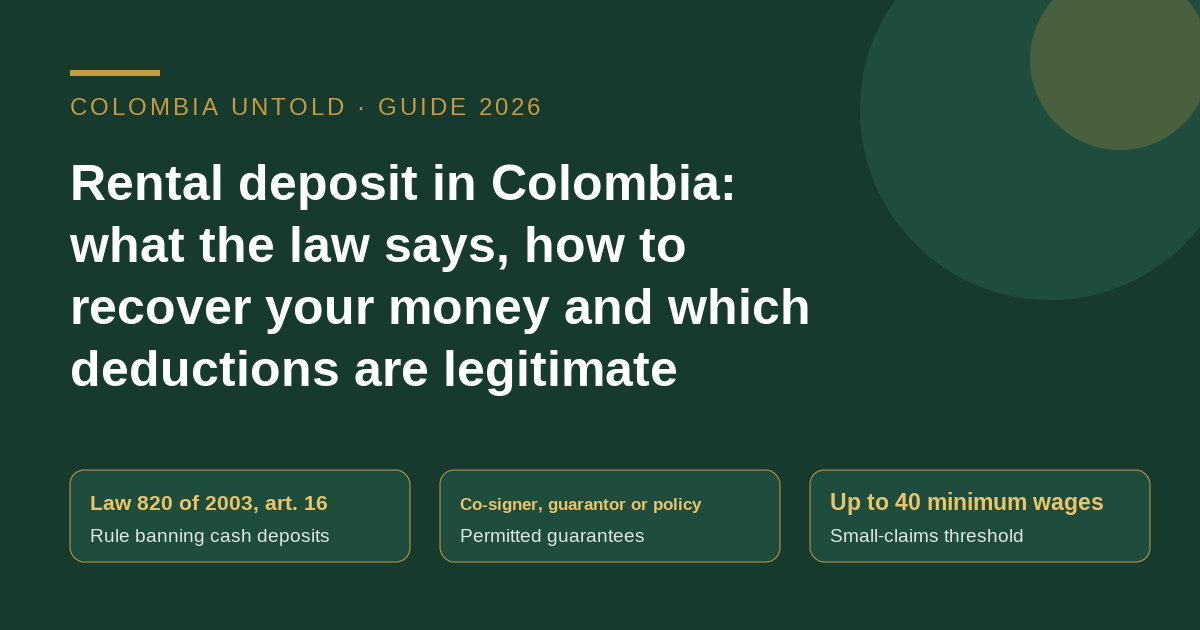
Quick answer: Law 820 of 2003 (art. 16) prohibits demanding cash deposits or other real-security guarantees in urban housing leases, and contrary clauses are ineffective. If you already paid a sum as a deposit, you can claim it in writing, go to conciliation and, if it is not returned, sue; in small-claims cases (up to 40 minimum wages) the law allows acting without a lawyer. The landlord may only deduct real debts and damage beyond natural wear.
Few disputes between landlord and tenant are as frequent as the deposit: the owner asked for a sum "as a guarantee", the tenant left six months or two years later, and then deductions appear for paint, for a stain on the carpet, for a key, for a building fee that "was left pending". For a foreigner, the situation is more delicate, because they usually accept what is asked to get the apartment and because they are unaware of a key fact: in Colombia, for urban housing, demanding a cash deposit is prohibited by law. This guide explains exactly what the rule says, what to do if you already paid, how to claim step by step, which deductions a landlord can legitimately make and how to prepare the contract and handover so you do not have to claim anything.
What the law says
Article 16 of Law 820 of 2003, which regulates urban housing leases, establishes that cash deposits or any other kind of real security may not be demanded to guarantee the tenant's obligations. The prohibition also reaches indirect formulas: it is not valid to ask for it through an intermediary, in a document other than the contract or under another name, such as "reservation", "performance guarantee" or "advance". The consequence is that the clause contrary to the law is ineffective by operation of law, that is, deemed unwritten. The Constitutional Court has explained in several rulings that Law 820 of 2003 is of public order and mandatory: its rules protect a balance that the parties cannot remove by agreement. That means that even if you sign accepting a deposit, the clause does not bind you. It also means that many landlords keep asking for it because in practice few tenants claim. What is lawful? Personal guarantees: a co-signer or guarantor who answers for the obligations, or a rental policy covering payment defaults. Those guarantees do not mean the landlord holds your money. What the law questions, by contrast, is handing over promissory notes, bills of exchange or post-dated checks as security, depositing a term-deposit certificate for the value of the contract, paying rent before it is due, or creating a mortgage from a third party to back the contract. All of the above applies to urban housing. Leases of commercial premises, offices, rural properties or tourist lodgings are governed by other rules, and there the practice of deposits or guarantees is different; review the contract carefully if it is not housing.
Why they still ask for it
The market is ahead of the rule. Owners, and especially agencies, fear non-payment and damage, and the process to recover a property can take a long time. They ask for a "deposit" because having the money in hand gives them security. Foreigners are asked more often, because they have no local credit history or Colombian co-signer, and because they tend to accept without arguing. The lack of a guarantor is the real problem: the deposit is the informal substitute. If you are asked, you have three paths. First, cite article 16 calmly and offer a lawful alternative: a rental policy taken out with an insurer, a co-signer, or the guarantee the agency offers. Second, negotiate conditions that reduce the owner's risk without breaking the law: a twelve-month contract with punctual payment, references, proof of income. Third, if you need the apartment and decide to pay, do it with maximum documentation: amount, purpose, return period, a signed receipt and express mention that it is handed over "as a guarantee" and must be returned. That documentation is what lets you claim it later. The guide Renting in Colombia as a foreigner: rent, building fees, deposits and the real cost develops how the total cost of renting is structured.
If you already paid: how to claim step by step
When the contract has ended, you handed over the property and the landlord does not return what you paid, follow this order. Every step leaves a record. 1. Gather the evidence. The contract, the receipt or proof of payment, the conversations, the opening inventory with photos, the key handover record, the utilities and building-fee clearance certificates and the photos of the condition when you left. Without this evidence the claim becomes one word against another. 2. Send a written communication. An email with read confirmation or a letter by certified mail, addressed to the landlord or the agency, stating the handover date, the amount handed over, the request for return and a reasonable deadline, for example ten business days. Cite article 16 of Law 820 of 2003 and attach copies of the evidence. 3. Ask for justified deductions. If the landlord alleges damage or debts, demand a detailed list with invoices or quotes, not a lump sum. Ask which services are pending and demand the bills. 4. Go to conciliation. It is a prior requirement to sue in most civil matters. You can do it at conciliation centers, university legal clinics, justice houses or authorized notaries. In many cases it is free or low-cost. A conciliation record with an agreement is enforceable; a record without agreement allows you to sue. 5. Lawsuit. If there is no agreement, you can file a claim for the pending sum before the competent judge. When the amount does not exceed 40 monthly minimum wages —about COP 70 million with the 2026 minimum wage— it is a small-claims proceeding, in which the law allows acting without a lawyer. A sum withheld without cause can generate legal interest; the civil rate is 6% a year. 6. Administrative alternative. In Bogotá, the District Housing Secretariat oversees registered landlords and agencies and receives complaints. In other cities, ask at the local mayor's office which unit handles lease conflicts. If you are about to leave the country, you can grant a power of attorney to a trusted person or a lawyer to continue the claim. A power of attorney issued abroad requires authentication or apostille; if you do it inside Colombia, a notary is enough. The guide Consulates and embassies in Colombia: when to contact them, what services they provide and how to ask for help explains the notarial acts that consulates provide.
Which deductions are legitimate and which are not
A landlord can charge what is genuinely owed. Legitimate deductions include pending rent and utilities, unpaid building fees, condominium fines attributable to the tenant and damage beyond natural wear. The Civil Code requires returning the property in the state it was received, except for natural deterioration from legitimate use and force majeure. Not legitimate deductions are general repainting from normal use, wear on floors and walls, replacing burnt-out bulbs, maintenance of equipment whose useful life has ended, or deep cleaning that was not needed because of abuse or neglect. Nor are lump sums without support, or renovations the owner wants for the next tenant. The difference between wear and damage is proved by the opening inventory: a stained mattress is damage if it was clean on entry; a wall faded by years of sun is wear. Some contracts include a repainting clause at the end. If it is a reasonable and proportionate charge, it can be agreed, but it cannot become a disguised form of deposit. Read the clause before signing and ask that it be limited to the real, verifiable value.
How to prevent conflict from day one
The best claim is the one you do not have to make. These are the practices that reduce risk. Inventory with dated photos. Before handing over any money, make an inventory by room, with photos of walls, floors, ceilings, bathrooms, appliances, furniture, keys and meters. Attach it to the contract signed by both parties. See Handover of a rented property in Colombia: inventory, photos, meters, record and clearance certificates. Written and complete contract. Rent, payment date, increase, duration, building fee, utilities, pets, subletting, works, who pays repairs. Do not sign an incomplete contract with the promise of filling it in later. Lawful guarantee. Prefer a policy or co-signer. Ask how much the policy costs and who pays, and compare. Receipts for everything. Every payment with support: transfer with reference, signed receipt, invoice. If you pay in cash, ask for a receipt on the spot. Utilities up to date. When leaving, pay the last bill of each service and request clearance from the building and from each company. See Utilities in Colombia for foreigners: water, electricity, gas, waste, strata, bills and complaints. Written notice. When you want to end the contract, give notice in writing and with the agreed advance, to avoid charges for breach. Handover with a record. On the day you leave, walk through the property with the landlord, sign a record and take photos and video of the final state.
Model claim letter
An effective letter is short and specific. It can say: "I, [name], identified with [document], handed over the property located at [address] on [date], with a signed handover record. On [date] I paid the sum of [amount] as a guarantee, according to the attached receipt. Law 820 of 2003, article 16, prohibits demanding cash deposits in urban housing leases. I request its return within ten business days to the account [details]. If you consider that any deduction applies, I request the detailed list with invoices and quotes. If I receive no answer, I will go to conciliation and the corresponding judicial bodies." Attach the evidence and keep proof of sending.
Frequent mistakes
Paying the deposit in cash without a receipt. Not making a photo inventory. Signing the contract with blanks. Handing over promissory notes or post-dated checks as a guarantee. Leaving the country without leaving a power of attorney or a bank account for the return. Accepting lump-sum deductions without support. Not asking for utilities and building-fee clearance. Letting months pass without claiming in writing. And not checking whether the contract includes clauses that contradict the law.
A practical example: a deposit of two months' rent
A foreigner rents an apartment for COP 2,500,000 a month and is asked, besides the first month, for a deposit of two months' rent, COP 5,000,000. He cites article 16 and proposes a policy; the owner insists. Because he needs to settle in, he pays, but insists on a signed receipt that says "as a guarantee, returnable at the end of the contract". He makes the photo inventory, keeps the utility receipts and, after a year, hands the apartment back with a record. The owner tries to deduct COP 1,200,000 for general repainting. The tenant answers with a letter: the inventory shows the walls had normal wear, the deduction has no invoice and the law does not allow the deposit. With conciliation pending, the owner returns COP 4,500,000 and recognizes COP 500,000 for a broken curtain. The documentation decided the result. If you are organizing your arrival and want the contract, guarantee and neighborhood well resolved from the start, Medellín Advisors at medellinadvisors.com and Premium Propiedades at premiumpropiedades.com accompany foreigners in searching and signing, and for the immigration side, Colombia Visa Legal at colombiavisalegal.com and CoVisas at covisascolombia.com.
Frequently asked questions
Is it legal for them to ask for a deposit when I rent housing?
Not for urban housing. Article 16 of Law 820 of 2003 prohibits demanding cash deposits or other real-security guarantees, and the contrary clause is ineffective. Personal guarantees, such as a co-signer, or a rental policy are allowed.
I already paid a deposit, can I recover it?
Yes, once the contract ends and you hand over the property. Claim in writing with your evidence, go to conciliation and, if it is not returned, you can sue. In small-claims cases, up to 40 minimum wages, the law allows acting without a lawyer.
What can the landlord legitimately deduct?
Real debts for rent, utilities and building fees, and damage beyond natural wear from legitimate use. The landlord must justify it with invoices or quotes and compare it with the opening inventory.
What do I do if the landlord does not answer?
Send a formal letter with the evidence, request conciliation at an authorized center and, if there is no agreement, file a claim before the competent judge. In Bogotá you can also file a complaint with the District Housing Secretariat.
Can I claim if I have already left Colombia?
Yes. You can grant a power of attorney to a lawyer or a trusted person, with authentication or apostille formalities if signed abroad, and leave an account for the return.
Which guarantees can I offer?
A co-signer or guarantor, a rental policy with an insurer or the agency's guarantee. Prefer a policy if you have no local co-signer.
If you are evaluating housing or investment, Medellín Advisors can guide you on search, title review and the purchase or rental process. Always hire independent legal review.
Key figures and data
| Item | Value | Note |
|---|---|---|
| Rule banning cash deposits | Law 820 of 2003, art. 16 | Urban housing: contrary clauses ineffective |
| Permitted guarantees | Co-signer, guarantor or policy | Personal or insurance guarantees, not deposits |
| Small-claims threshold | Up to 40 minimum wages | About COP 70 million at the 2026 minimum wage (COP 1,750,905) |
| Legal civil interest | 6% a year | Applicable to sums that must be returned, under the Civil Code |
Official sources and reliable reading
Related guides
- How to find an apartment in Colombia as a foreigner: complete guide
- Best cities to live in Colombia for expats: comparison
- How to build a credit history in Colombia (Datacrédito) as a foreigner
General information based on current rules and practice; it may change. Confirm your case with the official source or an authorized professional. Not legal, tax or medical advice.