How to negotiate a lease in Colombia as a foreigner: rent, co-signer, policy, term, increases and what the law does not allow
Updated: 13 October 2026 · Colombia Untold
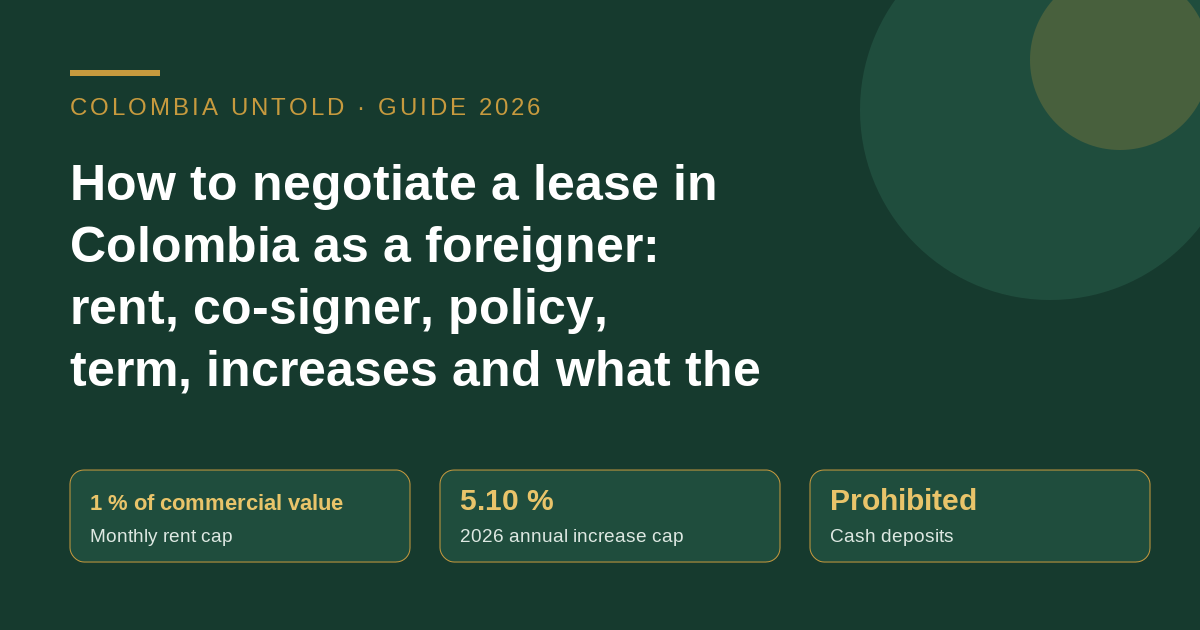
Quick answer: Negotiating a lease in Colombia as a foreigner is possible and legal: you can discuss the rent, term, form of backing (co-signer or rental insurance policy), repairs and exit conditions. Law 820 of 2003 caps rent at 1 % of commercial value (art. 18), caps the annual adjustment at the CPI (art. 20, 5.10 % cap in 2026) and prohibits demanding cash deposits and real guarantees (art. 16). Negotiate in writing and in good time.
Many foreigners arrive in Colombia thinking the rent price is "what the listing says" and that conditions are accepted or rejected. In reality, almost everything in a lease can be negotiated: the rent, the term, the backing, who pays which repairs, whether a pet is accepted, from when the lease runs and how to exit it. What changes for a foreigner is that the landlord usually distrusts more —because they cannot verify your history or easily collect if you leave the country— and that the backing requested is usually the hardest point. This guide explains how to negotiate with information, what limits the law sets and which strategies work for someone arriving without local history.
What is not negotiable because the law fixes it
Before negotiating, know the limits that Law 820 of 2003 imposes on any urban housing lease. Three protect you in practice. Article 18 caps the monthly rent at one percent of the property's commercial value; rent above that cap is not enforceable for the excess. Article 20 caps the annual rent increase at a percentage not exceeding the CPI accrued over the previous twelve months; in 2026 the cap on increases was 5.10 %. Article 16 prohibits demanding cash deposits and real guarantees from the tenant, and establishes that clauses requiring them have no effect. Those three points are your negotiating floor: you do not need to accept an increase above CPI, rent above the cap or a cash deposit. To calculate the 1 % cap you need the property's commercial value, which can be estimated with the cadastral appraisal, a market reference or a commercial appraisal. If the rent asked seems high against that value, ask about the basis of the calculation. It is a delicate but legitimate conversation.
Why backing is hardest for a foreigner
In Colombia, the usual way to back a lease is a co-signer with real estate or a rental insurance policy issued by an insurer or real estate agency. A newly arrived foreigner has no local co-signer or credit history, and many insurers and agencies require demonstrable income and time of residence. That is the central obstacle. There are several strategies. Rental insurance policy. An insurance that backs the landlord if you do not pay. It is issued by insurers or managed through real estate agencies. A premium is normally paid, and the insurer studies your profile: income, documents, history. Ask how much it costs, which documents it requires and whether it accepts foreign income. Co-signer. A person who answers for your obligation. It can be a friend or acquaintance with property. It is a serious burden for whoever accepts, so it is no small favor. References and support. An employment contract, bank statements, reference letters from previous landlords and proof of foreign income can help convince an owner. See Rental references as a foreigner. Advance payment by periods. Some foreigners offer to pay several months of rent in advance instead of a deposit. It is a delicate topic: article 16 of Law 820 prohibits demanding deposits, but voluntarily paying rent in advance is a different agreement. If you do it, formalize it in writing as payment of rent, with receipts, not as a deposit, and understand that money is not recovered like a guarantee. Weigh the risk before advancing money to someone you do not know. Agencies that work with foreigners. Some know the problem and have solutions. Medellín Advisors at medellinadvisors.com and Premium Propiedades at premiumpropiedades.com support foreigners in the search and management of leases in Medellín. For the full picture of deposits and guarantees, see Renting in Colombia as a foreigner: rent, building fees, deposits and the real cost and Rental deposit in Colombia: what the law says, how to recover your money and which deductions are legitimate.
Prepare your profile before negotiating
Your negotiating power rises when you arrive prepared. Gather and keep at hand: passport, visa or foreigner ID card, proof of income (contract, invoices, statements), references from previous landlords, an employer letter and verifiable contact details. If you have a Colombian bank account, offer payment by transfer or direct debit; see Checklist to open a bank account in Colombia as a foreigner: documents, KYC questionnaire and how to avoid rejection. If you work remotely, prepare a clear summary of your income source and its stability. An orderly profile conveys security.
Which variables you can negotiate
Rent. It is the first word, but not the only one. A slightly lower rent may be worth more than a discount for advance payments. If the property has been vacant a while, your power increases. Term. A twelve-month lease is the most common. A longer term may give you lower rent or a controlled increase; a shorter term, flexibility at a higher price. If you are not sure how long you will stay, negotiate an early-termination clause at a reasonable cost. Increase. The law caps the adjustment at CPI; you can agree a lower one. To project, keep in mind DANE inflation was 6.29 % in September 2026, while the cap applicable to adjustments was 5.10 %. Repairs and maintenance. Define in writing who pays what: normal-use damage versus misuse damage, minor repairs, painting at the end, leaks and included appliances. See Checklist before signing a lease in Colombia: clauses, maximum rent, increases, guarantees and red flags. Building fees and utilities. Clarify what the building fee includes and who pays utilities; see HOA admin fee payment and Utilities and public services when renting in Colombia. Pets, guests and subletting. Ask in writing for what you need; see Pets and renting in Colombia for foreigners: lease, horizontal property, breeds, banned deposits and coexistence and Temporary guests in a rented apartment in Colombia: lease rules, building reception, immigration reporting, subletting and coexistence. Furniture and improvements. If the property is unfurnished, ask that it include curtains, a built-in kitchen or a washing machine; if there are improvements you will make, agree who pays and what happens at the end. Start and handover date. Agree that rent starts running from the actual handover of the property, with an inventory; see Handover of a rented property in Colombia: inventory, photos, meters, record and clearance certificates.
How to conduct the conversation
An effective negotiation is respectful and information-based. Compare with similar properties in the area and use that data calmly. Ask before proposing: why that rent, what it includes, what happened with previous tenants. Make one clear offer with reasons, instead of endless haggling. If there is a hard point, such as the guarantee, propose a concrete solution: a rental insurance policy whose cost you assume, or a co-signer with documents. Listen to the landlord's reasons; often their real concern is non-payment, not your nationality. And do not close under pressure: ask for time to read the contract. If your Spanish is limited, ask someone you trust to accompany you or use a professional translator to read the lease before signing. Do not sign something you do not understand. If the contract is only in Spanish and you cannot read it, ask for a translation of the key clauses.
What must be in writing
Everything negotiated must be in the lease or a signed annex: rent and payment date, term, increase, guarantees, who pays what, special permissions, initial inventory, termination clause and notice. Nothing is proven verbally. Before signing, check the text against what was said. See the checklist Checklist before signing a lease in Colombia: clauses, maximum rent, increases, guarantees and red flags. After signing, keep a copy of the lease, payment receipts and communications.
Warning signs
A landlord who demands a large cash deposit is a warning sign, because the law prohibits it. So are one who does not want to sign a written lease, who asks for cash payment without receipt, who is neither the owner nor has written authorization, who pushes you to decide the same day or a price far below market. Verify ownership: ask for the property's certificate of tradition and liberty and the owner's ID, or the power of attorney of whoever acts on their behalf. If you need guidance granting or verifying powers of attorney, see Notary and powers of attorney for foreigners in Colombia: authentications, apostille, translations, general and special powers, sworn statements and costs. To avoid fraud, see ATMs in Colombia: withdrawing cash safely, fees, limits and common scams.
When to renegotiate
You can renegotiate at renewal: if you were a good tenant, you have more power. Ask to keep the rent or a lower increase, and offer a longer term. If the market falls, or if the landlord wants to keep you, talk. Remember the annual increase cannot exceed CPI.
Frequent mistakes
Accepting the first rent without comparing. Paying a cash deposit that the law prohibits. Not clarifying who pays repairs. Signing without reading. Not getting promises in writing. Paying in advance to someone who did not verify being the owner. And not preparing documents that support your profile.
A practical example: a nomad with foreign income
A remote worker with dollar income wants to rent an apartment in Medellín. They have no co-signer or local history. They gather client contracts, bank statements, a letter from their previous landlord and open a Colombian account. With help from a real estate agency, they quote a rental insurance policy and offer it to the owner as backing, instead of a deposit the law does not allow. They negotiate somewhat lower rent in exchange for a twelve-month term, agree an increase equal to CPI and put in writing that a pet is accepted. The owner accepts, they sign with inventory and photos, and the worker keeps all supporting documents.
When to ask for help
For visas and immigration procedures that support your profile, Colombia Visa Legal at colombiavisalegal.com and CoVisas at covisascolombia.com guide you. To be covered on trips while you settle in, Protege Tu Viaje offers quotes with up to 65 % discount at Protege Tu Viaje.
Frequently asked questions
Can I negotiate rent as a foreigner?
Yes. It is legal and usual to negotiate rent, term, increases and conditions. Law 820 of 2003 sets caps: rent cannot exceed 1 % of the property's commercial value (art. 18) and the annual adjustment cannot exceed CPI (art. 20).
Can they require a cash deposit?
No. Article 16 of Law 820 of 2003 prohibits demanding cash deposits and real guarantees from the tenant, and clauses requiring them have no effect. The usual substitute is a co-signer or a rental insurance policy.
What do I do if I have no co-signer or history in Colombia?
You can offer a rental insurance policy, proof of income, references from previous landlords and payment by transfer. Some agencies work with foreigners and know alternatives.
How much can rent rise each year?
The annual increase cannot exceed the CPI of the previous twelve months (art. 20 of Law 820). In 2026 the cap was 5.10 %.
What must be in writing?
Rent, term, increase, guarantees, who pays repairs and utilities, special permissions such as pets, inventory and a termination clause with notice.
How do I verify the person renting to me is the owner?
Ask for the property's certificate of tradition and liberty and the owner's ID, or a written power of attorney from whoever acts on their behalf, and compare the data with the lease.
If you are evaluating housing or investment, Medellín Advisors can guide you on search, title review and the purchase or rental process. Always hire independent legal review.
Key figures and data
| Item | Value | Note |
|---|---|---|
| Monthly rent cap | 1 % of commercial value | Law 820 of 2003, article 18 |
| 2026 annual increase cap | 5.10 % | CPI variation, Law 820 of 2003, article 20 |
| Cash deposits | Prohibited | Law 820 of 2003, article 16 |
| DANE inflation (Sept. 2026) | 6.29 % | To project the cost of rent over time |
Official sources and reliable reading
Related guides
- Tax residency certificate in Colombia: who is resident, how to request it from the DIAN and what it is for
- Pets and renting in Colombia for foreigners: lease, horizontal property, breeds, banned deposits and coexistence
- Utilities and public services when renting in Colombia
General information based on current rules and practice; it may change. Confirm your case with the official source or an authorized professional. Not legal, tax or medical advice.