Timeshare in Colombia: precautions, withdrawal rights, contracts and how to avoid sales pressure
Updated: 13 October 2026 · Colombia Untold
Quick answer: Before signing a timeshare contract in Colombia, ask for the full text in writing, do not decide the same day, calculate the total cost over the years (down payment, annual fees, maintenance, interest) and check usage and exit rights. The Consumer Statute (Law 1480 of 2011) recognizes a five-business-day withdrawal right on distance sales and certain non-traditional sales; confirm in writing whether your contract includes it and how to exercise it.
Many travelers and expats receive, on vacation or in a shopping mall, an invitation to "a welcome breakfast" or to "claim a gift" in exchange for listening to a talk. Behind it there is often a timeshare offer: the right to use a tourist unit for certain weeks a year in exchange for an initial payment and periodic fees. Not all are scams, but this model concentrates many complaints about sales pressure, verbal promises and contracts that are hard to cancel. This guide gives you a method to assess an offer, understand your rights and walk away safely.
What a timeshare is
It is a scheme in which you acquire usage rights (sometimes partial ownership, sometimes only use) over a lodging unit for a week or fixed period each year, in a hotel or resort, for a set or indefinite term. Variants include redeemable points, fixed or floating weeks and memberships tied to a network of destinations. What you buy may be a contractual right, not real estate, which changes a lot: resale, inheritance, cancellation and maintenance.
How offers typically appear
- Invitations at the airport, hotel, plazas or malls with gifts or discounts. - Talks of several hours with salespeople who insist on deciding the same day. - Discounts "valid only today" and promises that you can resell at a profit. - Request for immediate payment by credit card. - Verbal promises of benefits that do not appear in the contract. None of these practices is automatically illegal, but all are signs to slow down and ask for everything in writing.
Your right of withdrawal and what it covers
Law 1480 of 2011 (Consumer Statute) recognizes the right of withdrawal in distance sales and in sales through non-traditional methods: you may return the product or cancel the service and ask for a refund within five business days after delivery or after the contract is made (art. 47). Not every timeshare sale fits that category, and the period and conditions may vary depending on how it was contracted. So ask in writing: does my contract have a withdrawal right?, until what date?, to which address or email do I send the request? If you are sold in person inside a hotel or sales center, ask that the contract expressly state the withdrawal conditions. Keep proof of sending.
How to evaluate the total cost
The down payment is only part of it. Add up, with your own arithmetic, all payments over the term. Hypothetical example: down payment of COP 9,000,000, annual maintenance fee of COP 750,000 for 10 years (COP 7,500,000) and reservation administration charges of COP 0: total over 10 years COP 16,500,000. If you would use the benefit only one week a year, the equivalent cost is COP 1,650,000 per week, a value you can compare with the price of renting similar lodging for a week. The numbers are illustrative: use those in your contract. Also ask about annual fee adjustments, destination-change charges, real availability in peak season, late-payment penalties and what happens if the resort closes or changes operator.
What to ask for before signing
- The complete contract, legible and in Spanish, with all conditions. - The company's legal identification (company name, NIT, address) and that of the lodging provider. - Duration of the right and what happens at the end. - Fees, adjustments and reasons for increases. - Booking procedure and availability guarantee. - Conditions for resale, assignment or inheritance. - Withdrawal or cancellation procedure and deadlines. - If anything is promised orally, have it put in writing. Take at least a day. If you are pressed to sign immediately, that is the reason not to.
Payments: credit card and receipts
Paying by credit card may give you an additional claims mechanism with your bank if there is an unrecognized charge or a service not provided, although conditions depend on your issuer. Ask for a detailed invoice or receipt, keep the voucher and check your statement. Do not sign promissory notes or debit authorizations without reading their scope. For your local finances see How to open a bank account in Colombia as a foreigner: complete guide and Dynamic keys in Colombian banks: what they are, how to activate them, what to do without a local number and how to avoid fraud.
If you already signed and regret it
- Review the contract for withdrawal, cancellation and termination clauses. - Send a written communication immediately with proof of delivery (certified mail or email with receipt). - If they do not respond, file a claim with the Superintendence of Industry and Commerce, the consumer-protection authority. - If you believe you were deceived, consider reporting to the Attorney General's Office. - Consult a local lawyer; some conciliation services are free or low-cost. - Notify your bank if there are charges you do not recognize. Act quickly: withdrawal periods are short and options narrow with time.
More flexible alternatives
If you want to travel comfortably, compare: booking lodging by the night, renting apartments by the week, paying for a travel plan or memberships with flexible cancellation. For frequent travelers, travel insurance may be a more useful investment than a multi-year commitment; see Table: travel insurance vs visa medical plan. And if you are weighing buying a home, see Renting in Colombia as a foreigner: rent, building fees, deposits and the real cost and consult advisors such as Medellín Advisors (medellinadvisors.com) and Premium Propiedades (premiumpropiedades.com).
Common mistakes
- Accepting the invitation without the discipline to listen without deciding.
- Signing for the promise of "easy resale".
- Not reading the fee and adjustment clauses.
- Paying a cash deposit without a receipt.
- Not keeping a copy of the contract.
- Letting the withdrawal period lapse.
- Giving card details without understanding the charge.
Checklist at the moment of the offer
Carry a charged phone, photograph the documents, ask for a copy of the contract before paying, note the salesperson's name and the time, and do not sign anything you cannot read in full. If the salesperson refuses to give you the text, walk away. A good offer survives a night of reflection.
What to do if you are scammed
Gather the contract, receipts and messages; file a complaint with the SIC and, if there are signs of fraud, a report with the Attorney General's Office; inform your bank and your embassy or consulate if you are a foreigner (see Consulates and embassies in Colombia: when to contact them, what services they provide and how to ask for help). A fast, documented reaction increases your options.
How to recognize sales pressure and respond calmly
Sign 1: artificial urgency. "Only today", "two units left", "the discount is lost if you leave". A legitimate offer can wait a day. Reply: "I will take the contract and answer tomorrow."
Sign 2: salesperson hand-offs. When you say no, a supervisor appears with a "special" offer. It is a known technique; hold your answer and do not sit down to negotiate again.
Sign 3: promises not in writing. If the salesperson offers free week changes, easy cancellation or guaranteed resale, demand that it be written into the contract. What is not on paper cannot easily be claimed.
Sign 4: difficulty seeing the contract. If they only show a summary or ask you to sign on a tablet without being able to read, that is a warning. Ask for a PDF or printed copy before paying.
Sign 5: immediate payment. Pressure to hand over a card or transfer on the spot. Ask for time and, if you decide to pay, use a traceable method.
A three-step plan to make the decision
- Step 1, information: ask for the contract, rates, fees, withdrawal conditions and the company's legal details.
- Step 2, calculation: add up all payments over the term and divide them by the weeks you will actually use; compare with renting on your own.
- Step 3, validation: consult a lawyer or a trusted person, look for verifiable reviews of the company and check whether there are complaints at the Superintendence of Industry and Commerce.
If after those steps the offer still makes sense, sign with the full contract in hand and keep a copy. If not, you will have avoided a multi-year commitment at the cost of a few calm hours.
What to always document
Keep the salesperson's name, the date and time, the company named in the contract, receipts, screenshots of the offer and any message where something is promised. If your contract is in English or another language, also ask for the Spanish version, because in a local claim that is the one that will be reviewed. Also note the reservation number and the official service channels. This folder, though it may seem excessive, is what makes the difference between a claim that succeeds and one left without support.
Questions to ask a lawyer
If the amount at stake is significant, spend an hour with a local lawyer before signing. Ask: Is the right I am buying a contractual right or a property right? What happens if the operator goes bankrupt or the resort changes hands? Can I cancel, and at what cost? What law and courts govern the contract? Are the fees allowed to rise without limit? Is any arbitration clause compatible with my rights as a consumer? A short consultation is inexpensive compared with the total cost of the contract and can save you years of payments you cannot easily undo.
Frequently asked questions
Is timeshare legal in Colombia?
It is a commercial model that can exist, but it is subject to consumer-protection rules. What matters is that the contract is clear and that you respect withdrawal deadlines where they apply.
How long do I have to change my mind?
The Consumer Statute recognizes five business days of withdrawal in distance and non-traditional sales (Law 1480, art. 47). Ask in writing whether your contract includes it and when the period starts.
Can I easily resell my timeshare?
Do not assume so. Resale is often hard and depends on the contract. Do not sign on a verbal promise of resale.
What do I do if I am pressured to decide the same day?
Walk away and ask for the contract in writing. A serious offer lets you review it calmly.
Whom do I complain to?
First the company in writing; if there is no answer, the Superintendence of Industry and Commerce. If there are signs of fraud, the Attorney General's Office.
Is it wise to pay by credit card?
It can give you an extra claims channel with your bank, though it depends on the issuer. Always keep the receipt.
Key figures and data
| Item | Value | Note |
|---|---|---|
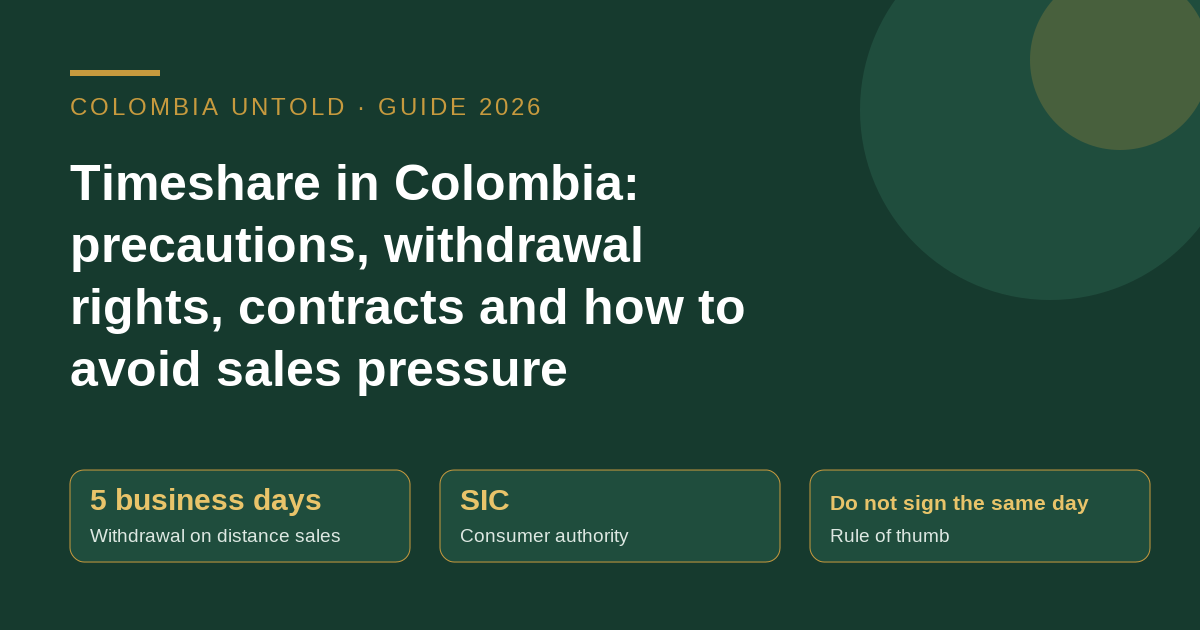
| Withdrawal on distance sales | 5 business days | Law 1480 of 2011, art. 47 |
| Consumer authority | SIC | Superintendence of Industry and Commerce |
| Rule of thumb | Do not sign the same day | Ask for the written contract and review it calmly |
| 10-year cost example | COP 16,500,000 | Hypothetical figures; own arithmetic |
Official sources and reliable reading
Related guides
- Living in Armenia: expat guide
- Airbnb or long-term rental in Colombia: which suits a foreigner by time, cost and law
- Bogotá neighbourhoods for foreigners: which to choose by lifestyle, budget and work
General information based on current rules and practice; it may change. Confirm your case with the official source or an authorized professional. Not legal, tax or medical advice.