Claims against the administrator and the HOA in Colombia: rights, steps, coexistence committee, sanctions and challenging decisions
Updated: 13 October 2026 · Colombia Untold
Quick answer: To claim against a building administrator in Colombia (Law 675 of 2001): 1) write the complaint with date and evidence, 2) escalate it to the administration council, 3) go to the coexistence committee (art. 58, cannot impose sanctions), 4) use conciliation or the police inspection office, and 5) challenge assembly decisions in court within two months (CGP art. 382). Fines for non-monetary breaches require prior written notice and have caps (art. 59). If you are a tenant, your natural channel is the owner or the administrator, and you share liability for ordinary fees (art. 29).
Living in a building or gated complex in Colombia means living under the horizontal property regime, regulated by Law 675 of 2001. It is a form of organization with clear rules (assembly, council, administrator, bylaws), but also a frequent source of conflict: administration fees, noise, pets, parking, works, common areas, fines. For a foreigner, the added difficulty is not knowing whom to address or with what arguments. This guide explains who is who, what you can demand, how to escalate a claim step by step and what limits the law imposes. The figures and deadlines I cite come from the text of the law; where I don't cite it, it is a practical criterion.
Who is who in horizontal property
Horizontal property has several bodies. The general owners' assembly is the highest body: it approves the budget, elects the administrator and the council, and amends the bylaws. The administration council, where one exists, oversees the administrator. The administrator is the legal representative and has immediate administration of the building, with powers of execution, conservation, representation and collection (art. 51). The statutory auditor (revisor fiscal) audits the accounts: it is mandatory in commercial or mixed-use buildings or complexes, and in residential ones it is optional if the assembly so decides (art. 56). The coexistence committee handles conflicts between neighbors and is elected for one year with three or more members, in an odd number (art. 58). Two essential concepts: the horizontal property bylaws (the document that sets each unit's rights and duties, including the use of common areas) and common expenses (the administration fee and shared costs). Ask for a copy of the bylaws before claiming; almost every conflict is settled by looking at what they say.
If you are a tenant: what you can and cannot do
The legal relationship with the co-ownership belongs to the owner, not the tenant. However, Law 675 establishes joint liability for ordinary common expenses between the owner and the holder of the property (art. 29): the tenant can be billed if there are arrears. In practice, if your contract says you pay the administration fee, keep the receipts, and if the owner pays it, ask for the clearance certificate. In assemblies only owners vote, unless they give you a proxy; check the bylaws. For coexistence or service claims you can address the administrator directly in writing; for decisions affecting your home, coordinate with the owner. See Paying building administration fees in Colombia: what they cover, who pays, late interest, clearance, assembly and complaints to understand billing and Renting in Colombia as a foreigner: rent, building fees, deposits and the real cost for contract rules.
Step 1: document the problem
A claim without evidence is an opinion. Before writing, gather: date, time and place of each incident; photos or videos lawfully taken in places where nobody's privacy is invaded; earlier messages; the bylaw article you think was breached; and witnesses' names if any. If the problem is damage or a leak, add a repair quote and before-and-after photos. Put everything in one digital folder.
Step 2: the written complaint to the administrator
Submit a written communication (letter or email, with proof of receipt) addressed to the administrator, including: your details and unit, a description of the facts, the applicable bylaw or norm, what you request (a concrete action and a reasonable deadline) and attachments. Keep the stamped copy or the sent email. A well-written, firm, insult-free complaint resolves most cases. Set a reasonable deadline, for example five to ten business days, and make clear that without a reply you will go to the council. The administrator must act diligently and answers for damages caused by willful misconduct or slight or gross negligence (art. 50).
Step 3: the administration council and the assembly
If the administrator does not respond, write to the administration council (if there is one) with a copy of the original complaint. If the problem is general (for example, a poorly executed work, excessive spending or lack of accountability), you can ask that the topic be added to the assembly agenda. The ordinary assembly meets at least once a year; if the bylaws do not set a date, it must be held within three months after the budget period ends, and the call must be made with at least fifteen calendar days' notice (art. 39). Those meetings are the time to ask for financial statements, management reports and explanations. Always ask for the minutes: they are proof of what was decided.
Step 4: coexistence committee and conciliation
For conflicts between neighbors (noise, pets, use of common areas), the coexistence committee is the first instance. Its function is to try to bring the parties to an agreement; by express legal provision, it cannot impose sanctions (art. 58, paragraph 2). If that fails, you can turn to alternative mechanisms, such as a conciliation center or, in coexistence matters, the police inspection office, under the National Police and Coexistence Code (Law 1801 of 2016). Document your attempt at a solution: it shows good faith and orders the process.
Step 5: fines and sanctions, and their limits
The bylaws and the law allow sanctioning breaches of non-monetary obligations, but with safeguards for the owner: the sanction must be preceded by a written notice giving a deadline to comply (art. 59). Successive fines cannot each exceed twice the monthly necessary expenses, and in total up to ten times that value; restrictions cannot affect essential common goods. The administrator enforces sanctions, with police support if necessary (art. 61). If you receive a fine, check: was there prior notice? Is the conduct in the bylaws? Does the amount respect the cap? Was it approved by the assembly or council as the bylaws require? If not, answer in writing and ask for it to be revoked. Example of our own arithmetic with hypothetical figures: if a unit's monthly necessary-expense fee were $400,000, each successive fine could not exceed 2 × $400,000 = $800,000, and total fines could not exceed 10 × $400,000 = $4,000,000. Those values change with your property's real fee.
Arrears in the administration fee
If there are arrears, interest equals one and a half times the bank current rate; the assembly may set a lower one (art. 30). While the default persists, the minutes may list owners in arrears and their names may be posted, but only in places without constant visitor traffic. In addition, on a sale, the notary requires a clearance certificate of expenses (art. 29). If you dispute a charge, ask in writing for the detail (items, dates, interest) and pay what is not in dispute so the debt does not grow.
Challenging an assembly decision
Owners, the administrator and the statutory auditor may challenge assembly decisions that do not comply with the law or the bylaws (art. 49). The deadline and procedure are now governed by the General Code of Procedure: the challenge must be filed in court within two months of the decision (CGP, art. 382). It is a judicial process, so a lawyer's advice is advisable. Before challenging, weigh cost and benefit, and document why the decision violates the law or the bylaws (for example, insufficient quorum or an incorrect call).
Utility claims and other topics
Problems with water, power or gas in your unit are claimed from the provider company; see Utilities in Colombia for foreigners: water, electricity, gas, waste, strata, bills and complaints and Utilities and public services when renting in Colombia. If the claim is a consumer matter (for example, a poorly provided service by a third party), you can go to the Superintendencia de Industria y Comercio. Other frequent topics: Pets and renting in Colombia for foreigners: lease, horizontal property, breeds, banned deposits and coexistence, Temporary guests in a rented apartment in Colombia: lease rules, building reception, immigration reporting, subletting and coexistence, Subletting: risks for foreigners and Landline in HOA.
Complaint template (adapt it)
- Subject: Claim regarding [topic] in unit [number].
- Facts: dates, times, place, clear description without adjectives.
- Basis: bylaw article or Law 675 of 2001 provision you consider applicable.
- Request: concrete action, deadline (for example, 10 business days).
- Attachments: photos, messages, invoices.
- Closing: without a reply, you will escalate to the administration council and the coexistence committee.
Common mistakes
- Claiming in the building's WhatsApp group without leaving a formal communication.
- Mixing the complaint with insults or with complaints about several things at once.
- Not reading the bylaws before claiming.
- Not keeping copies or proof of receipt.
- Letting the deadline to challenge an assembly decision lapse.
- Stopping payment of the fee as a protest: it creates arrears and interest.
Frequently asked questions
Whom do I complain to first, the administrator or the council?
First the administrator, in writing and with a deadline. If there is no reply or it is insufficient, write to the administration council with a copy of the initial complaint. That sequence leaves evidence and orders the process.
Can the coexistence committee fine me?
No. By law the coexistence committee only seeks agreements between the parties and cannot impose sanctions (Law 675 of 2001, art. 58). Sanctions follow the art. 59 procedure and are imposed by the body the bylaws designate.
What is the maximum fine in horizontal property?
Each successive fine cannot exceed twice the monthly necessary expenses, and the total cannot exceed ten times that value, after a written notice (art. 59).
How long do I have to challenge an assembly decision?
Two months from the decision, under the General Code of Procedure (art. 382). It is a judicial process: consult a lawyer before the deadline expires.
I'm a tenant; can they charge me overdue administration fees?
Yes, for ordinary common expenses there is joint liability between the owner and the holder (art. 29). Keep payment receipts and define in the contract who pays them.
Can they post my name for owing the administration fee?
The law allows posting owners in arrears, but only in places without constant visitor traffic (art. 30). Ask that this condition be respected.
If you are evaluating housing or investment, Medellín Advisors can guide you on search, title review and the purchase or rental process. Always hire independent legal review.
Key figures and data
| Item | Value | Note |
|---|---|---|
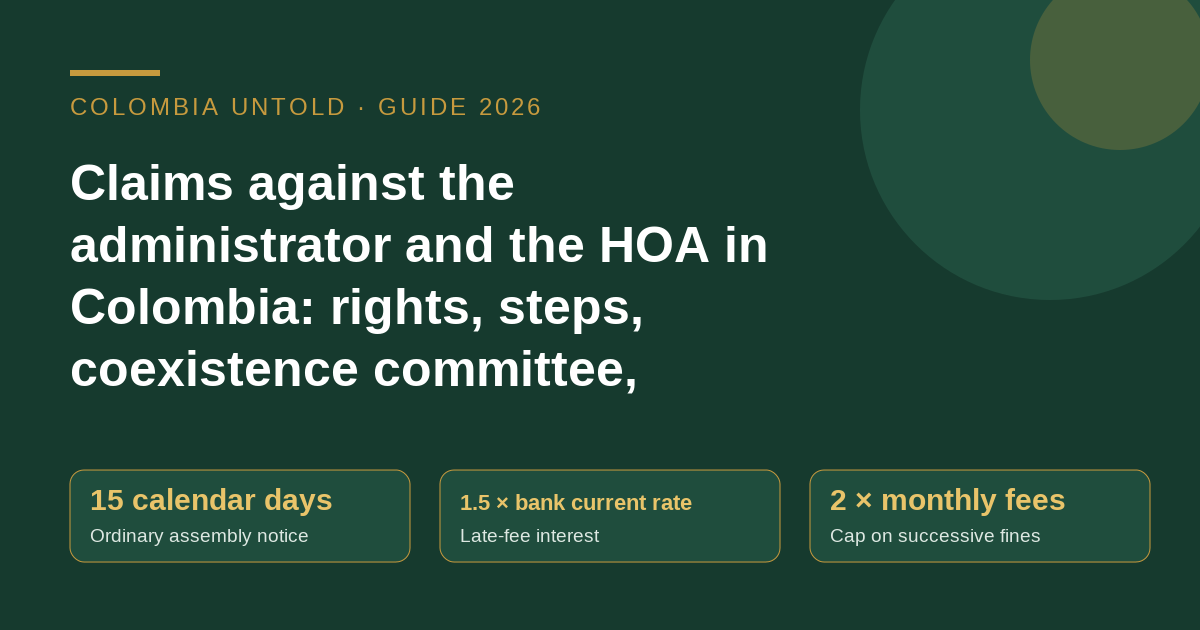
| Ordinary assembly notice | 15 calendar days | Minimum notice, Law 675 of 2001, art. 39 |
| Late-fee interest | 1.5 × bank current rate | Law 675 of 2001, art. 30 |
| Cap on successive fines | 2 × monthly fees | Each fine, art. 59; total up to 10 times |
| Coexistence committee | 3 or more members, 1 year | Odd number, cannot impose sanctions (art. 58) |
Official sources and reliable reading
Related guides
- Flying to Colombia with pets: ICA requirements, vaccines, crate, airlines, altitude and arrival
- Supermarkets and delivery apps
- How to negotiate a lease in Colombia as a foreigner: rent, co-signer, policy, term, increases and what the law does not allow
General information based on current rules and practice; it may change. Confirm your case with the official source or an authorized professional. Not legal, tax or medical advice.