Paying building administration fees in Colombia: what they cover, who pays, late interest, clearance, assembly and complaints
Updated: 13 October 2026 · Colombia Untold
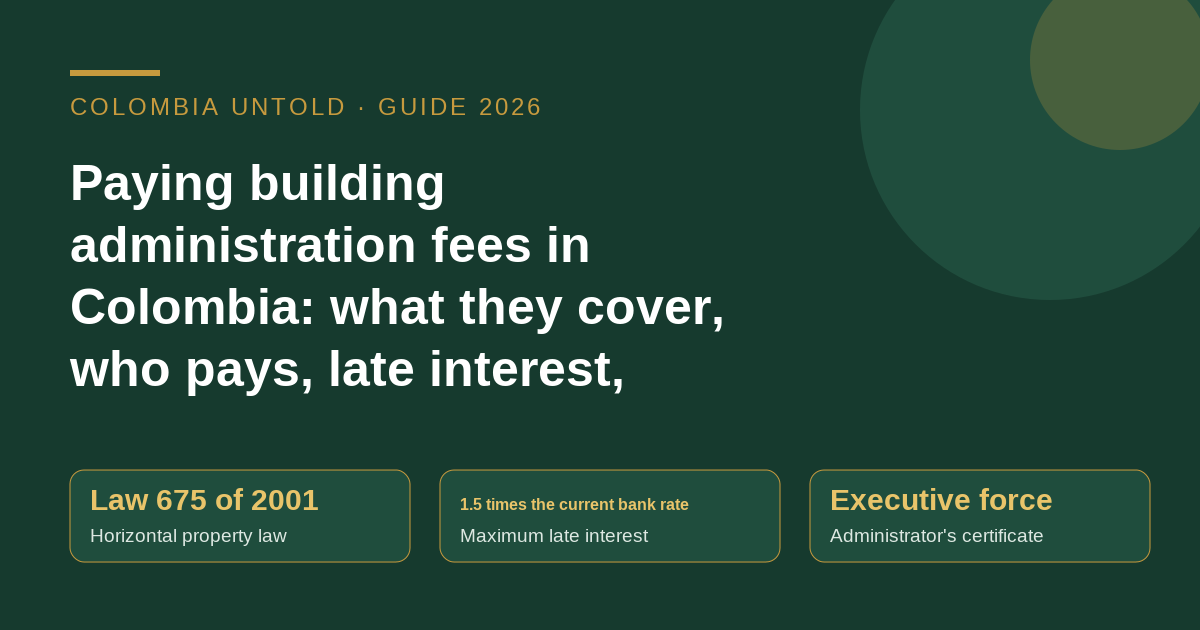
Quick answer: The administration fee is the monthly contribution that owners in a horizontal property pay to sustain common areas, security, cleaning and maintenance (Law 675 of 2001). The owner answers to the building; the tenant pays only if the lease says so. Late payment accrues interest of up to one and a half times the current bank interest rate (art. 30), and the administrator's debt certificate has executive force. Always ask for a receipt and a clearance certificate.
Almost every foreigner who rents or buys in Colombia ends up paying a fee called administración, and almost all ask the same: what exactly is it, why does it change, who owes it, what happens if I am late and how do I dispute it if I disagree? Administration is the economic heart of horizontal property, the regime that governs buildings and residential complexes. Understanding it avoids fines, conflicts with the landlord and surprises when selling or returning a property. This guide explains how it works under Law 675 of 2001: what the fee covers, how it is set, who answers, how it is paid, what late payment means and how a foreign tenant or buyer is protected.
What the administration fee is
Law 675 of 2001 regulates horizontal property: a regime in which owners hold exclusive ownership of their unit (apartment, house or commercial space) and co-ownership of common property (elevators, facades, corridors, green areas, pool, reception). To sustain those common assets and services, owners pay administration fees, which are ordinary, for recurring expenses, or extraordinary, for unforeseen expenses or approved investments. The amount depends on the approved budget and each unit's co-ownership coefficient, which is the percentage of the total that corresponds to it. A larger unit usually has a larger coefficient and therefore a larger fee.
What it usually covers
Items vary by building, but normally include security and reception, cleaning of common areas, maintenance of elevators, pumps, generators and facades, public utilities of common areas (electricity for corridors and pumps, water for green areas), gardening, fees of the administrator and accountant, mandatory insurance for common areas and a contingency fund. Some buildings include the apartment's water or gas in the fee; others charge them separately. Before renting or buying, ask for the detail of what the fee covers. Two apartments with the same rent can cost very differently if one has a pool, gym and sauna and the other does not.
Who pays: owner and tenant
Toward the co-ownership, the unit's owner answers. The tenant has no direct relationship with the building. However, the lease can transfer payment of the fee to the tenant, and it is very common for that to be agreed, whether the tenant pays the administration or the fee is added to the rent. Read your lease carefully: it must say clearly who pays ordinary administration, who pays extraordinary fees and what happens with increases. A reasonable practice is that the tenant pays the ordinary fee, which corresponds to daily use, and the owner the extraordinary ones, which are usually investments that add value to the property. If the lease says nothing, it is better to clarify in writing before signing. To negotiate this point, see How to negotiate a lease in Colombia as a foreigner: rent, co-signer, policy, term, increases and what the law does not allow and Checklist before signing a lease in Colombia: clauses, maximum rent, increases, guarantees and red flags. An important point: Law 820 of 2003 caps rent at 1 % of the property's commercial value and the annual adjustment at CPI, but administration is a different item, set by the owners' assembly and not by the landlord. If administration rises in a year by more than CPI, that does not violate Law 820, because it is not rent. But if the lease says the rent includes administration, the total increase should respect the cap.
How it is set and changed: the assembly
The annual expense budget and the fees are approved by the general assembly of owners, normally once a year, in the first months. The administrator presents the budget, financial statements and management report, and owners vote according to their coefficient. The administration council supervises the administrator. If you are a tenant you do not vote, but the owner can attend or give a power to someone else, and you can ask them to inform you of decisions affecting the fee. If you are a foreign owner, you can attend assemblies or grant a power; see Notary and powers of attorney for foreigners in Colombia: authentications, apostille, translations, general and special powers, sworn statements and costs. Always ask for the assembly minutes and the budget when you buy; they reveal whether there are large works pending, extraordinary fees approved or conflicts.
How it is paid
Payment methods are usually bank deposit with a reference number, payment through PSE or the administration's platforms, transfer or direct debit. Many buildings use online portals with an account statement. Always pay with a reference that identifies your unit and keep the proof. If you pay a person in cash, demand a signed receipt. For foreigners, a Colombian account eases recurring payments; see Checklist to open a bank account in Colombia as a foreigner: documents, KYC questionnaire and how to avoid rejection and Nequi and Daviplata for foreigners: how to open them, limits and when to use them. It is wise to pay by the deadline the building sets, which usually includes a prompt-payment discount or a late surcharge.
Late payment: what happens if you do not pay on time
Article 30 of Law 675 of 2001 provides that delay in paying fees causes late-payment interest, which cannot exceed one and a half times the current bank interest rate certified by the Financial Superintendence. In addition, the horizontal property rules may provide other consequences for defaulters, such as reasonable restrictions on the use of certain non-essential services or posting the defaulters list in the building, within the limits the law sets. The administrator's certificate of debt has executive force, which means the co-ownership can collect it judicially without a long process to prove it. If you are a tenant and the owner does not pay, the debt is the owner's, but a conflict can affect your coexistence and your lease. Clarify in the lease who pays and demand copies of the receipts.
Clearance (paz y salvo): the document almost everything requires
The administration clearance (paz y salvo) is a certification issued by the administrator confirming that the unit has no debts with the co-ownership. It is asked for when buying or selling a property, because in a sale the administration debt follows the unit; when ending a lease, to hand over the property with no balances; and when moving, because many buildings do not authorize removing furniture without it. If you are a buyer, demand the clearance before the deed; see Comprar Propiedad en Colombia Siendo Extranjero: Proceso Paso a Paso (en español). If you are a tenant, request it on leaving; see Handover of a rented property in Colombia: inventory, photos, meters, record and clearance certificates and Moving between cities in Colombia (trasteo): licensed companies, insurance, inventory, building clearance and timeline.
Extraordinary fees and fines
Extraordinary fees are approved by the assembly for unforeseen expenses or investments, such as facade repairs, elevator replacement or waterproofing. Check in the minutes who approved them and for what amount. Fines for breaching the rules —noise, moves outside hours, pets without leash, damage to common areas— are imposed by the body the rules designate, following a procedure that respects due process: notice, opportunity to defend yourself and a reasoned decision. If you receive a fine, ask for the record and answer in writing within the deadline. If you think it is unfair, you can challenge it; see HOA claims and administrator.
What to do if you disagree with a charge
First, review your account statement and compare it with the budget approved at the assembly. Second, ask the administrator in writing for the detail of the charge and the basis of increases. Third, if the error persists, file a formal claim with the administrator and, if appropriate, with the administration council. Fourth, if you are an owner, you can challenge assembly decisions that contravene the law or the rules within the legal deadline. Fifth, coexistence conflicts can be taken to the building's coexistence committee and, where applicable, to conciliation. Always keep evidence: receipts, emails, minutes. A local lawyer can advise you depending on the case.
Administration and the total cost of living
When comparing homes, add rent and administration, not just rent. A high administration may reflect good services or a poorly managed building; check what it includes. In a purchase, administration is a permanent fixed expense that reduces returns if you invest to rent out or for tourist rental; see Medellín Condo Bylaws vs. Airbnb: What to Know Before Buying to Rent. To estimate your budget in each city, see Cost of living in Medellín 2026: rent, transport, food, health and a real budget for foreigners and Cost of living in Bogotá 2026: rent, TransMilenio, food, health and a real budget for foreigners. As a national reference, the 2026 minimum wage is COP 1,750,905 and DANE annual inflation was 6.29 % in September 2026, which gives an idea of the pressure on building budgets.
Insurance and liability
The law requires the co-ownership to take out insurance on common areas, but that insurance does not cover your belongings or your liability inside the apartment. Consider contents and civil liability insurance as a tenant or owner. For trips with coverage while you settle in, Protege Tu Viaje offers quotes with up to 65 % discount at Protege Tu Viaje.
Frequent mistakes
Signing a lease without knowing who pays administration and extraordinary fees. Paying in cash without a receipt. Not asking for the clearance when buying, selling or ending a lease. Assuming administration includes all utilities. Ignoring a fine or a late notice. Not reading the assembly minutes before buying. And not comparing administration when choosing between two apartments.
A practical example: a tenant and an extraordinary fee
A foreign tenant rents an apartment in Medellín with a lease that says he pays ordinary administration. Months later, the assembly approves an extraordinary fee to renovate the facade. The tenant reviews the lease, sees that extraordinary fees are not his responsibility and informs the owner in writing, attaching the invoice. The owner assumes it. When the lease ends, the tenant asks for the clearance and photographs the apartment's condition. If you are looking for housing in Medellín, Medellín Advisors at medellinadvisors.com and Premium Propiedades at premiumpropiedades.com advise on administration costs before you decide, and Colombia Visa Legal at colombiavisalegal.com and CoVisas at covisascolombia.com on immigration procedures.
Frequently asked questions
What is the administration fee?
It is the monthly contribution paid by owners in a horizontal property to sustain common areas and services, under Law 675 of 2001. It is set by the approved budget and each unit's co-ownership coefficient.
Who must pay administration, the owner or the tenant?
Toward the building the owner answers. The lease can transfer payment to the tenant, which is very common. Clarify in writing who pays ordinary and who pays extraordinary fees.
What happens if I am late paying?
Late payment accrues interest of up to one and a half times the current bank interest rate (art. 30 of Law 675), and the administrator's certificate has executive force to collect the debt judicially.
What is the administration clearance (paz y salvo)?
A certificate from the administrator confirming there are no debts with the co-ownership. It is required when buying or selling, ending a lease and often when moving.
Is administration capped by Law 820 like rent?
No. Law 820 caps rent and its adjustment, but the administration fee is set by the owners' assembly. If the lease includes administration within the rent, the total must respect the caps.
How do I claim if I think I am overcharged?
Ask the administrator in writing for the detail, compare it with the approved budget, file a formal claim and, if it persists, go to the administration council, the coexistence committee or conciliation.
If you are evaluating housing or investment, Medellín Advisors can guide you on search, title review and the purchase or rental process. Always hire independent legal review.
Key figures and data
| Item | Value | Note |
|---|---|---|
| Horizontal property law | Law 675 of 2001 | Regulates fees, assemblies and sanctions |
| Maximum late interest | 1.5 times the current bank rate | Law 675 of 2001, article 30 |
| Administrator's certificate | Executive force | Allows judicial collection of overdue fees |
| Emergency line | 123 | Police, ambulance and fire |
Official sources and reliable reading
Related guides
- Timeshare: caution
- Living in Armenia: expat guide
- Airbnb or long-term rental in Colombia: which suits a foreigner by time, cost and law
General information based on current rules and practice; it may change. Confirm your case with the official source or an authorized professional. Not legal, tax or medical advice.