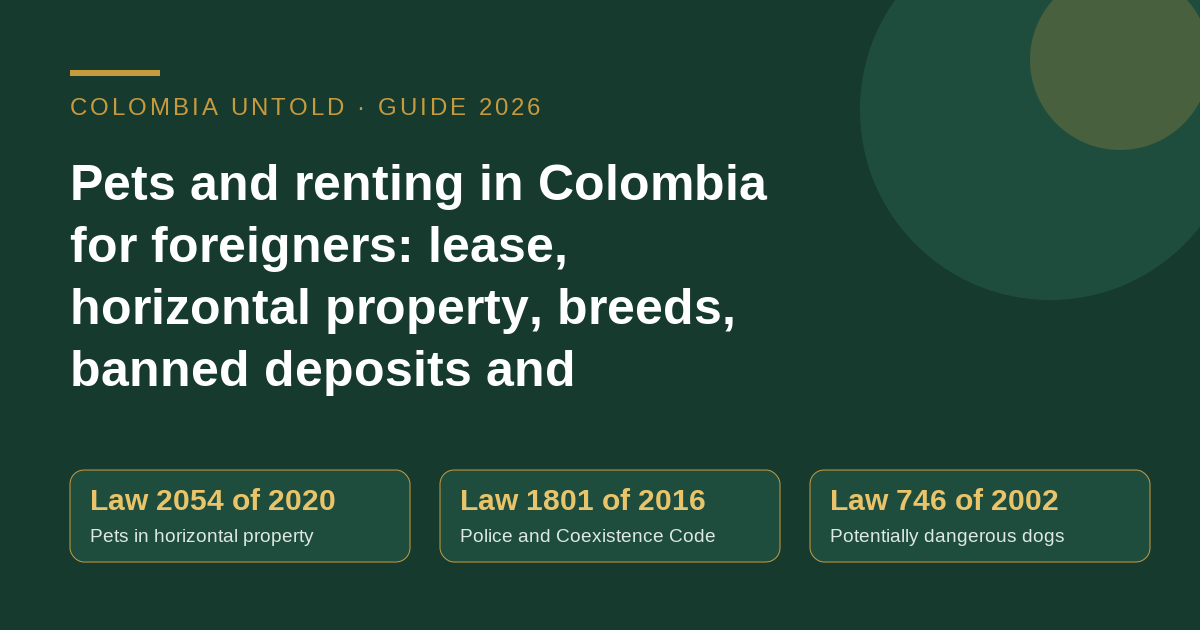
Pets and renting in Colombia for foreigners: lease, horizontal property, breeds, banned deposits and coexistence
Updated: 13 October 2026 · Colombia Untold
Quick answer: In Colombia horizontal property administrations cannot ban pet ownership (Law 1801 of 2016 and Law 2054 of 2020), but they can set coexistence rules such as leash, picking up waste and liability for damage. The lease is a separate agreement: negotiate in writing before signing. Law 820 of 2003, article 16, prohibits demanding cash deposits, so a cash "pet deposit" is not enforceable.
Arriving in Colombia with a dog or cat and finding an apartment is, for many foreigners, the biggest obstacle of the whole move. Rental ads say "no pets accepted", landlords fear damage and noise, buildings have rules with requirements and leases may carry clauses you do not know. The good news is that Colombian law protects keeping companion animals and that, with a little preparation, you can find housing without giving up your pet. This guide explains what the law says, what an administration or landlord can and cannot demand, how to negotiate, which breeds have special rules and how to coexist without fines.
Two different relationships: the administration and the landlord
When you rent an apartment in a building or residential complex there are two separate relationships. The first is with the co-ownership, that is, the horizontal property regulated by Law 675 of 2001, expressed in rules and an administration. The second is with your landlord, governed by the lease and Law 820 of 2003. The pet rules can come from both sides, and they do not always coincide.
What the law says about pets in horizontal property
The National Police and Coexistence Code, Law 1801 of 2016, establishes that horizontal property cannot prohibit keeping domestic animals. Law 2054 of 2020 reinforces that idea by stating that the passage and stay of pets in common areas may not be prohibited. In practice, that means rules cannot simply say "pets not allowed". What administrations can do is set coexistence rules: require a leash in common areas, order the collection of waste, regulate use of elevators, require that animals not cause excessive noise or nuisance and hold the owner liable for damage to third parties or common property. Fines for breaking these rules depend on the applicable norm; the Police Code provides sanctions for not picking up waste or not keeping the dog on a leash, and the rules for potentially dangerous dogs are stricter. In 2025, fines that could exceed COP 700,000 were reported for not using a muzzle on dogs of potentially dangerous breeds in common areas. Always check the current amount with the local authority, because it is calculated as a function of the minimum wage.
What Law 1774 of 2016 says
Law 1774 of 2016 recognizes animals as sentient beings, not things, and establishes criminal and administrative penalties for mistreatment. For someone renting with a pet, that has two practical consequences: you cannot leave your animal alone for long periods without care or confine it in inadequate conditions, and neighbors can report mistreatment or abandonment. Caring for your pet is a legal obligation, not just a matter of good coexistence.
Breeds and potentially dangerous dogs
Law 746 of 2002 regulates keeping potentially dangerous dogs. It defines as such certain dogs, among them breeds such as Staffordshire Terrier, American Staffordshire Terrier, Pit Bull Terrier, Rottweiler, Doberman and others the norm lists, and those with documented aggressive episodes. It requires that in public spaces and common areas of horizontal property they be kept on a leash and muzzled, and sets obligations for the owner, such as registering the animal with the local authority and holding a civil liability policy, among others. If your dog is one of those breeds, review the norm and ask your city hall which procedures you must follow. Note that importing Pit Bull and Staffordshire dogs into Colombia is prohibited; see Flying to Colombia with pets: ICA requirements, vaccines, crate, airlines, altitude and arrival. Many landlords and buildings are especially reluctant with these breeds and with large dogs. If your dog is large or of a regulated breed, start your search early and be transparent from the first contact.
The lease: negotiate before signing
The lease is an agreement between two parties, and may include clauses about pets: prohibiting them, allowing them with conditions, limiting the number or size, requiring liability for damage. The fact that the administration cannot ban pets does not prevent a landlord from setting conditions in the lease; if you sign a clause that prohibits them, you are accepting that condition, and a later conflict will be much harder for you. So the most important thing is to negotiate in writing before signing. Some tips for that conversation. Introduce yourself with concrete information: species, breed, age, size, neutering, up-to-date vaccines and behavior. If possible, offer a letter from your veterinarian or references from your previous landlord. Propose reasonable commitments, such as covering repairs for any damage caused by the animal, doing a professional cleaning at the end of the lease and keeping the animal vaccinated and dewormed. Ask that the permission be stated in the text of the lease or in a signed annex. To review the whole lease, see Checklist before signing a lease in Colombia: clauses, maximum rent, increases, guarantees and red flags; to negotiate, Negotiate rent as a foreigner.
The "pet deposit": what the law says
It is common for a landlord to ask for an additional cash deposit for having a pet. Law 820 of 2003, article 16, prohibits demanding cash deposits and real guarantees from the tenant and establishes that clauses requiring them have no effect. Therefore a cash "pet deposit" is not enforceable under the law. What is possible and legal is to agree that you answer for damage your animal causes, which is the normal responsibility of any tenant, or to back it with a co-signer or a rental insurance policy. If you are asked for money in advance, seek advice before paying. To understand the guarantee system and refunds, see Rental deposit in Colombia: what the law says, how to recover your money and which deductions are legitimate and Renting in Colombia as a foreigner: rent, building fees, deposits and the real cost.
How to search for pet-friendly housing
Start the search with clear filters. Many rental portals let you filter by "pets accepted"; always confirm in writing with the owner, not just the listing. Consider housing types: houses and apartments in small buildings are usually more flexible than large complexes with strict rules, although every case is different. Ask for the horizontal property rules before signing and read the sections on pets, elevators and common areas. If you have a large or high-energy dog, prioritize proximity to parks and green areas. See How to find an apartment in Colombia as a foreigner: complete guide for the full search process, and Medellín neighbourhoods for foreigners: El Poblado, Laureles, Envigado, Belén and more, how to choose or Bogotá neighbourhoods for foreigners: which to choose by lifestyle, budget and work to choose areas with parks. If you are looking for housing in Medellín, Medellín Advisors at medellinadvisors.com and Premium Propiedades at premiumpropiedades.com can guide you toward properties that accept pets and connect you with willing owners.
Coexistence: noise, smells, leash and common areas
Most neighbor conflicts originate in barking, uncollected waste and the animal entering areas where children are. A few practices avoid almost all problems. Walk your dog several times a day so it burns energy and does not bark from boredom. Always pick up waste and carry bags. Use a leash in common areas. Do not leave your pet alone on the balcony. Tell your neighbors about your pet and leave a contact in case of complaint. If you receive a complaint or a fine from the administration, ask for the record or basis and answer it in writing. For ways to complain to an administration, see HOA claims and administrator.
Damage, cleaning and returning the apartment
You are responsible for damage your pet causes in the property and common areas. To protect yourself from unfair claims at the end of the lease, document the condition of the apartment on entry with photos and a signed inventory, and document it again on exit; see Handover of a rented property in Colombia: inventory, photos, meters, record and clearance certificates. Protect floors and furniture with rugs and covers, keep the animal's nails trimmed and do a deep clean before handing over the property. Distinguish normal wear from use, which corresponds to the landlord, from damage caused by misuse.
Insurance, health and services for your pet
Your animal needs veterinary care, up-to-date vaccines and, depending on the area, parasite prevention. Find a nearby vet as soon as you arrive. There are pet insurance policies that cover consultations, emergencies or civil liability; see Basic pet insurance. Daycare, walking and grooming services are a consumer relationship governed by Law 1480 of 2011. Ask for recommendations, check the place and put conditions in writing. For trips by you and your family, travel insurance can be useful: Protege Tu Viaje offers quotes with up to 65 % discount at Protege Tu Viaje.
If the landlord does not accept: alternatives
If you find the ideal home but the landlord does not accept pets, you have several options. You can negotiate with additional legal guarantees, such as a co-signer or a policy, or propose a trial period. You can look for another property. You can buy a home, if your length-of-stay plan justifies it, and so control your own rules within the horizontal property law. You can rent a house or a country property instead of an apartment. What is not advisable is hiding your pet: if the lease prohibits it and the landlord finds out, you may face termination of the lease.
Pets and visas
Having a pet does not affect your immigration status, but it does affect your relocation and housing decisions. If you are processing your visa, Colombia Visa Legal at colombiavisalegal.com and CoVisas at covisascolombia.com guide you through the process, so your length-of-stay plan and your pet-friendly housing plan are aligned. A guide to visa types is in Colombia Visa Types: A Complete Explained Guide.
Frequent mistakes
Hiding the pet from the landlord. Signing a lease with a prohibition clause believing "the law allows it". Paying a cash deposit for a pet without understanding that the law prohibits it. Not reading the building's rules. Not picking up waste. Leaving the animal alone and barking. Not documenting the apartment's condition on entry. And not vaccinating or deworming the animal regularly.
A practical example: a couple with a Labrador in Bogotá
A couple with an adult Labrador looks for an apartment in Bogotá. They filter for properties that accept pets and contact three owners. With the one they like most, they present a vet's letter, up-to-date vaccines and a reference from the previous landlord, and propose a written commitment to answer for any damage by the dog. The owner accepts, the permission goes in an annex to the lease and the couple pay no cash deposit, in line with Law 820. They read the complex's rules, understand they must use a leash in common areas and pick up waste, and record photos of the apartment's condition on entry. During the lease they walk the dog several times a day, and at the end they hand over the property clean with the photos as backup.
Frequently asked questions
Can they ban me from having a pet in a residential complex?
A horizontal property administration cannot ban keeping domestic animals (Law 1801 of 2016 and Law 2054 of 2020), but it can set coexistence rules. The lease is separate: negotiate the permission in writing before signing.
Can the landlord charge me a deposit for my pet?
Law 820 of 2003, article 16, prohibits demanding cash deposits and real guarantees, and those clauses have no effect. You do answer for damage your animal causes, and you can back it with a co-signer or a policy.
Which breeds have special rules?
Law 746 of 2002 regulates potentially dangerous dogs, among them Staffordshire, Pit Bull, Rottweiler and Doberman, with leash and muzzle in public spaces and common areas and additional duties for the owner.
What fine can I get for not picking up waste or not using a leash?
The Police Code provides sanctions for those behaviors, calculated as a function of the minimum wage, and they are higher for potentially dangerous dogs without a muzzle. The exact amount is set by the local authority.
Who is liable if my dog damages something in the apartment?
You are, toward the landlord and the co-ownership. Document the property's condition on entry and exit with photos and a signed inventory to distinguish normal wear from damage.
Can I have more than one pet in a rented apartment?
It depends on what the lease says and on the building's coexistence rules. Ask for written authorization for each animal and confirm you do not exceed the space and hygiene conditions.
If you are evaluating housing or investment, Medellín Advisors can guide you on search, title review and the purchase or rental process. Always hire independent legal review.
Key figures and data
| Item | Value | Note |
|---|---|---|
| Pets in horizontal property | Law 2054 of 2020 | Protects passage and stay in common areas |
| Police and Coexistence Code | Law 1801 of 2016 | Horizontal property cannot ban domestic animals |
| Potentially dangerous dogs | Law 746 of 2002 | Leash and muzzle in public spaces and common areas |
| Cash deposits in housing leases | Prohibited (art. 16) | Law 820 of 2003 |
Official sources and reliable reading
Related guides
- Utilities and public services when renting in Colombia
- Hybrid: home and coworking
- SOAT and vehicle insurance
General information based on current rules and practice; it may change. Confirm your case with the official source or an authorized professional. Not legal, tax or medical advice.