Flying to Colombia with pets: ICA requirements, vaccines, crate, airlines, altitude and arrival
Updated: 13 October 2026 · Colombia Untold
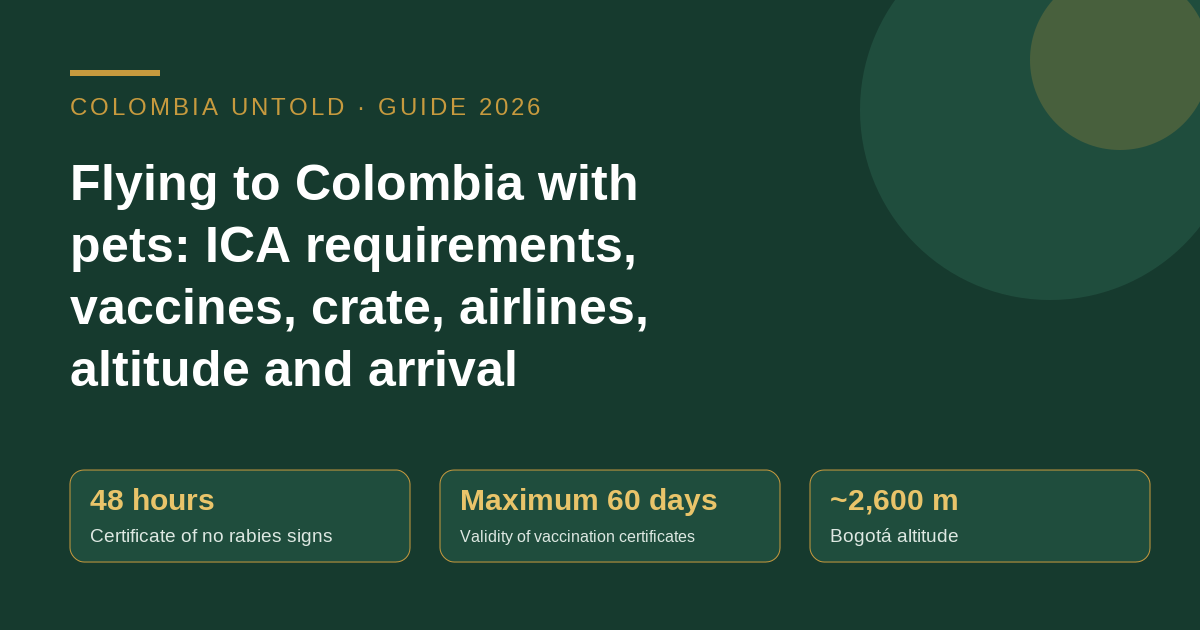
Quick answer: To enter Colombia with a dog or cat, the ICA requires an international veterinary certificate stating the animal showed no clinical signs of rabies in the 48 hours before boarding and valid vaccination certificates no more than 60 days old (rabies, and for dogs distemper, hepatitis, leptospirosis and parvovirus; for cats panleukopenia). Importing Pit Bull and Staffordshire dogs is prohibited (Law 746 of 2002). The airline also sets crate, cabin and cargo-hold rules.
Moving a pet to another country is one of the most stressful parts of a relocation, for a simple reason: several authorities and companies decide whether your animal can board the plane and enter the country, and each one has its own paperwork. This document organizes the process for Colombia: what the Colombian Agricultural Institute (ICA) requires of dogs and cats entering, what the airline requires in addition, how to choose and prepare the crate, what changes with the altitude of cities such as Bogotá, which breeds are restricted and what to do on arrival. It is designed so that you build a realistic timeline and avoid your pet being held at the airport.
Three filters: the origin country, the airline and Colombia
Your pet must pass three different filters, and all three must be in order. The first is the country you leave: it may require an official export certificate, inspection by an authorized veterinarian or procedures with its agricultural authority. The second is the airline: it defines whether the animal travels in the cabin, in a pressurized, temperature-controlled hold or as cargo, what crate size it accepts, which breeds it restricts and how many animals it admits per flight. The third is Colombia, whose agricultural health authority is the ICA. Start by learning the most demanding requirement of the three and plan backwards from the flight date.
What the ICA requires to enter with a dog or cat
According to the ICA's official page on the international movement of dogs and cats, the entry requirements for dogs and cats are as follows. First, an international veterinary certificate stating that the animal showed no clinical signs of rabies in the 48 hours before boarding. Second, valid vaccination certificates, no more than 60 calendar days old. For cats, vaccination against rabies (inactivated virus, when the animal comes from countries where the disease exists) and against feline panleukopenia. For dogs, rabies vaccination under the same criterion, and vaccination against distemper, hepatitis, leptospirosis and parvovirus. The ICA also states that animals arriving without the required certifications may be sent back, seized or, in extreme cases, put down, so the documentation is not an optional detail. For specific questions, the ICA lists the email cuarentena.animal@ica.gov.co. For dogs and cats that page describes no mandatory quarantine; quarantine with an Import Zoosanitary Document applies to other species, such as poultry and rodents. If your animal is neither a dog nor a cat, it needs a different procedure; ask the ICA before buying the ticket. The ICA page does not list the microchip as an entry requirement for Colombia. However, microchipping is common for other reasons: many origin countries ask for it, as do some airlines and the European Community countries if one day you travel with your pet there. It is a recommended practice for safety, because it lets the animal be identified if lost. Requirements change over time, so treat this list as the base and check the ICA page the week before the trip.
Restricted breeds
Law 746 of 2002, article 108-E, prohibits the import of dogs of the Staffordshire Terrier, American Staffordshire Terrier, Pit Bull Terrier and American Pit Bull Terrier breeds, as well as their crosses or hybrids. If your dog is one of those breeds or a cross, it will not be able to enter the country. In addition, that law regulates the keeping of potentially dangerous dogs within Colombia, with leash and muzzle requirements in public spaces and common areas. Check the law before making relocation decisions if your dog looks like one of those breeds; a veterinarian's evaluation or a breed document does not always settle doubts at an airport. Cats have a different restriction: felines coming from countries with native cases of bovine and feline spongiform encephalopathy are not allowed in. Many airlines also apply their own restrictions to brachycephalic, short-nosed breeds such as bulldogs, pugs, boxers or Persian cats, because of the respiratory risk in flight, especially in the hold and in heat. Some exclude them from hold transport during certain months or on certain routes.
Choosing how your pet travels: cabin, hold or cargo
Cabin. Normally allowed only for small animals that fit, with their crate, under the seat in front. The airline sets the maximum weight and dimensions, and the number of places per flight is limited, so book in advance. It is the least stressful option for the animal, because it is near you. Hold. For larger animals. It travels in a compartment with controlled pressure and temperature, in an approved crate. Airlines may apply temperature embargoes, meaning they will not accept animals in the hold when it is too hot or too cold at origin, connection or destination. Ask about those rules. Cargo. Some airlines prefer or require animals to travel as cargo, especially larger ones or on routes without baggage service. A cargo agent or a company specialized in pet transport is used, handling documents and logistics. It costs more but reduces paperwork errors. The International Air Transport Association (IATA) publishes rules for the transport of live animals, which airlines use as a reference for crates and travel conditions. See IATA's information on pets.
The crate: size, ventilation and adaptation
A suitable crate must let your pet stand, turn around and lie down in a natural position. It should be rigid, with a secure latch, ventilation on several sides, a waterproof floor with absorbent material, and water and food dishes fixed to the door. Measure your pet from the tip of the nose to the base of the tail, and its height to the head or ears, and compare with the dimensions the airline asks for. Label the crate with your name, phone, destination and the words "live animal". Get your pet used to the crate several weeks before: leave it open at home, with its blanket, treats and toys. An animal that already considers the crate its safe place arrives calmer. Avoid sedating your pet without express veterinary instruction. Many airlines and experts advise against sedatives in flight, because of the risk to breathing and circulation. Ask your veterinarian about anxiety, motion sickness and safe options for your animal.
Altitude: Bogotá, Medellín and the coast
Bogotá is at about 2,600 meters above sea level and Medellín at about 1,500 meters. Many dogs and cats adapt without trouble, but animals with heart or respiratory disease, short-nosed breeds and very old animals may have difficulties. Talk to your veterinarian before traveling and find a local vet on arrival. On the coast, heat and humidity are the challenge: avoid walks in the hottest hours, offer water often and never leave your pet in a closed vehicle. Ticks and tropical parasites are a concern in warm areas; ask your vet for a prevention plan.
Timeline: what to do and when
Two or three months before. Research the airline, the route and the ICA requirement. Book your pet's place as soon as you buy the ticket. Consult your veterinarian about vaccines, health and microchip. Start crate adaptation. One month before. Confirm vaccines: remember the vaccination certificates the ICA asks for cannot be more than 60 days old at entry. Ask your vet what procedure is required in the origin country for the international certificate and, if applicable, validation by the official authority. The last days. Obtain the international veterinary certificate stating there were no clinical signs of rabies in the 48 hours before boarding. Check the airline's rules again, the schedules and the weather along the route. Prepare a kit with food, water, bags, a blanket with your scent and copies of the documents. Flight day. Arrive at the airport earlier than usual. Carry original documents and copies. Avoid feeding your pet a heavy meal right before the flight.
What happens on arrival
On landing in Colombia you must present the documentation at the control points, where agricultural health officials may review the certificates. If everything is in order, your pet leaves with you. If something is missing, the ICA may order measures such as sending the animal back. That is why traveling with complete documents is essential. After arriving, locate a veterinarian near your home in advance and ask whether your pet needs boosters or deworming depending on the area. When you arrive, also review the rules of the building and the lease. Law 1801 of 2016, the National Police and Coexistence Code, and Law 2054 of 2020 generally protect keeping companion animals in horizontal property, with coexistence rules such as leash, picking up waste and liability for damage. For this see Pets and renting in Colombia for foreigners: lease, horizontal property, breeds, banned deposits and coexistence and Bringing Your Pet to Colombia. Law 1774 of 2016 recognizes animals as sentient beings and establishes sanctions for mistreatment, so care during the trip also has a legal dimension.
Costs: what to add without inventing figures
Costs vary by airline, route and animal size, so build your own budget. Add the pet's ticket or fee, the approved crate, veterinary consultations, vaccines, certificates and legalizations in the origin country, transport to the airport and, if you use a specialized company, its service. Add a margin for contingencies such as a flight change or an animal that needs an additional vaccine. Compare that total with other options, such as leaving the pet with a relative, and decide based on the animal's welfare and your length-of-stay plan.
Insurance and veterinary care
There are pet insurance policies with coverage that changes between policies; see Basic pet insurance. Ask whether they cover pre-existing conditions, emergencies and civil liability for damage to third parties. If you travel with your family, remember your own travel coverage; Protege Tu Viaje offers quotes with up to 65 % discount at Protege Tu Viaje, and it is worth checking whether the plan you choose includes the conditions you need for the trip.
Frequent mistakes
Booking the ticket without confirming the pet's place. Letting the 60-day window of the vaccination certificates expire. Getting the certificate of no rabies signs more than 48 hours ahead. Taking a crate that does not meet the airline's rules. Traveling with a restricted breed without knowing it. Sedating the animal without veterinary instruction. Ignoring altitude and heat. And not researching your building's rules in advance.
A practical example: a cat from Europe to Medellín
A person travels with an adult cat from Madrid to Medellín with one connection. Three months earlier they confirm with the airline that the cat can travel in the cabin on both legs and book the place. A month before, their vet updates the rabies and feline panleukopenia vaccines and records the microchip. Two weeks before, they begin the process for the international veterinary certificate, which is issued within 48 hours before departure. They train the cat with the crate for several weeks, print three copies of the documents and arrive at the airport in good time. In Medellín they present the certificates on arrival and, once settled, find a nearby vet and ask their landlord in writing for permission to keep the cat.
When to ask for help
If your family's move includes visa and housing in addition to the pet, Colombia Visa Legal at colombiavisalegal.com and CoVisas at covisascolombia.com guide you through the immigration process, and Medellín Advisors at medellinadvisors.com and Premium Propiedades at premiumpropiedades.com support the search for a property that accepts pets.
Frequently asked questions
What documents does the ICA require to enter with a dog or cat?
An international veterinary certificate stating the animal showed no clinical signs of rabies in the 48 hours before boarding and valid vaccination certificates no more than 60 days old. For dogs: rabies, distemper, hepatitis, leptospirosis and parvovirus. For cats: rabies and panleukopenia.
Does my pet have to be quarantined in Colombia?
According to the ICA page, no mandatory quarantine is mentioned for dogs and cats that meet the requirements. Quarantine applies to other species, such as poultry and rodents.
Can I bring a pit bull into Colombia?
No. Law 746 of 2002, article 108-E, prohibits importing dogs of the Staffordshire Terrier, American Staffordshire Terrier, Pit Bull Terrier and American Pit Bull Terrier breeds and their crosses.
Can my pet travel in the cabin?
It depends on the airline, the size and weight of the animal with its crate, and the places on the flight. It is usually accepted only for small animals that fit under the seat. Book the place when you buy the ticket.
Is a microchip mandatory?
The ICA page does not list it as an entry requirement for Colombia, but many origin countries, airlines and destinations require it, and it is good safety practice. Ask your airline and your vet.
Does Bogotá's altitude affect my pet?
Most animals adapt without difficulty, but short-nosed, old and heart- or respiratory-disease animals may need attention. Consult your vet before traveling.
If you need a medical plan or travel insurance for your visa or stay, CoVisas Colombia can guide you on plans that meet Resolution 5477. Always compare the coverages in writing.
Key figures and data
| Item | Value | Note |
|---|---|---|
| Certificate of no rabies signs | 48 hours | Before boarding, according to the ICA |
| Validity of vaccination certificates | Maximum 60 days | Age at entry, according to the ICA |
| Bogotá altitude | ~2,600 m | Ask your vet before flying with sensitive breeds |
| Breeds banned from import | Pit Bull and Staffordshire | Law 746 of 2002, article 108-E |
Official sources and reliable reading
Related guides
- Supermarkets and delivery apps
- Negotiate rent as a foreigner
- Tax residency certificate in Colombia: who is resident, how to request it from the DIAN and what it is for
General information based on current rules and practice; it may change. Confirm your case with the official source or an authorized professional. Not legal, tax or medical advice.