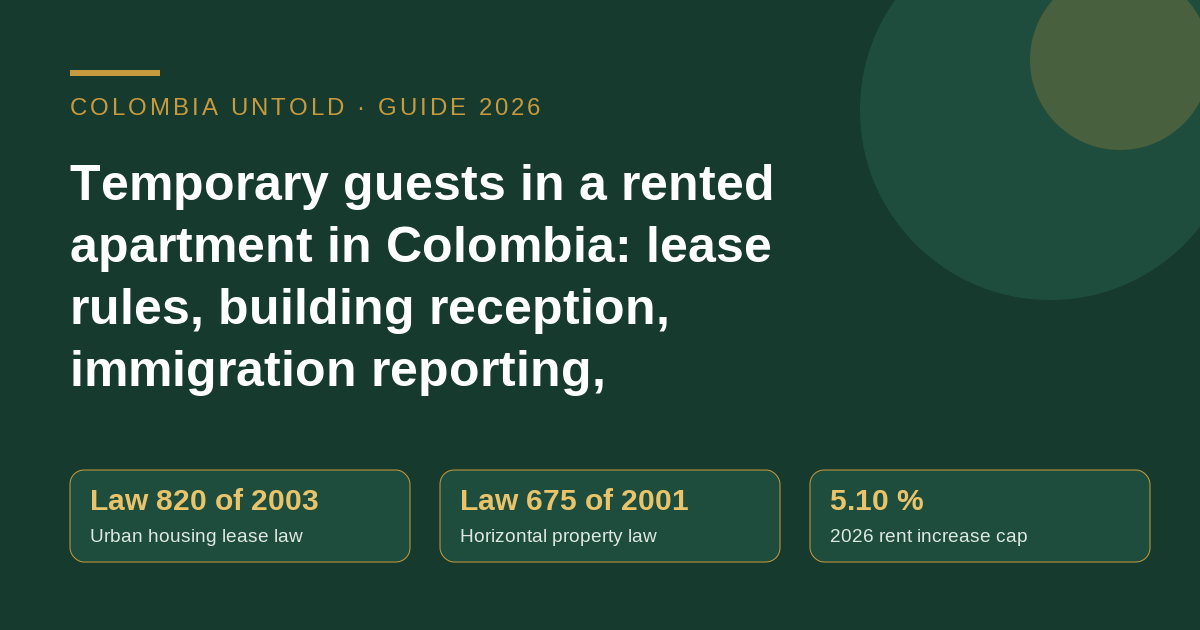
Temporary guests in a rented apartment in Colombia: lease rules, building reception, immigration reporting, subletting and coexistence
Updated: 13 October 2026 · Colombia Untold
Quick answer: Having temporary guests in a rented apartment in Colombia is legal but has limits: the lease must allow it or at least not prohibit it, the horizontal property regulations (Law 675 of 2001) set entry and coexistence rules, subletting or renting by the day without the landlord's authorization is a breach, and when the guest is a foreigner the stay may carry immigration reporting duties. Get permissions in writing and notify the building reception.
Sooner or later the visit comes: your partner arrives for a month, your parents cross the ocean to see your city, a friend needs a place while looking for an apartment or a remote-working colleague wants to stay two weeks. In a rented apartment, which usually sits in a building with horizontal property regulations, hosting guests is not only a matter of mattresses and keys. There is a lease to comply with, an administration that may require registration, neighbors with a right to quiet and, when the guest is a foreigner, immigration registration duties that fall on the host. This guide explains what the law says, what the lease usually says, what the reception asks for and how to receive visitors without putting your tenancy at risk.
Visitor, guest and subtenant: three different figures
The first distinction is the most important. A visitor is someone who spends a few hours or a night at your home and pays nothing. A temporary guest is someone who stays several days or weeks, normally without paying or informally sharing costs. A subtenant is someone to whom you give the use of all or part of the property in exchange for payment. The law and the lease treat the three differently. Urban housing leases are regulated by Law 820 of 2003. That law establishes that the property is leased for the housing of the tenant and their family, and that the tenant may not sublet or assign the contract without the landlord's express authorization. That rule is the basis of everything else: receiving visitors and occasional guests is a normal consequence of living in a home; charging for the use of the space, or installing another person on a stable basis, is another matter and requires permission.
What the lease usually says
Housing leases usually have clauses on use, number of occupants, subletting and assignment, changes to the property and compliance with the horizontal property regulations. Read them before signing; the checklist Checklist before signing a lease in Colombia: clauses, maximum rent, increases, guarantees and red flags serves that purpose. Check the following in particular. Use. If the lease says the property is for housing, you cannot use it as an office with client visits, a hostel or tourist lodging without permission. Individual remote work, without clients visiting the apartment, is normally compatible with housing, but confirm it if you doubt. Number of occupants. Some leases set a maximum number of people who may live in the apartment. A guest for a few days does not change that; a guest for months can be read as one more occupant. If you plan to host someone for a long period, notify and ask for written authorization. Subletting and assignment. If the lease prohibits subletting without authorization, the breach can lead to termination and a claim for damages. This includes renting by the day on lodging platforms. If you want to do it, you need the landlord's express authorization and also compliance with tourism regulation, explained below. Liability for damage. You are liable to the landlord for damage caused by your guests. If someone breaks a piece of furniture or soils the property excessively, the repair is your responsibility. Document the condition of the property with the move-in inventory; see Handover of a rented property in Colombia: inventory, photos, meters, record and clearance certificates. Noise and coexistence. The lease almost always obliges you to respect the building rules. A party with guests that disturbs neighbors can generate fines from the administration and a conflict with the landlord.
The horizontal property rules and the reception desk
If the apartment is in a building or residential complex, Law 675 of 2001 applies, which regulates horizontal property. Each building has regulations approved by the owners that set rights and duties: use of common areas, hours, pets, noise, entry of visitors, moves and sanctions. The administration may impose fines for non-compliance, normally charged to the owner, who passes them on to the tenant if the lease allows. In practice, the reception is the point of contact. Many buildings register visitors with an ID and the resident's authorization through an intercom or app; others require prior registration of a guest who will stay several nights. If you host someone for several days, notify the administration or reception in advance and ask whether there is a registration form or a restriction on long stays. Some buildings limit or prohibit renting apartments by the day and state it in their regulations; if the building prohibits it, it does not matter that your landlord authorizes it: the building rules prevail on coexistence. Visitor registration involves processing personal data, regulated by Law 1581 of 2012. It is reasonable for a reception desk to ask for your guest's name and ID, and reasonable for you to explain why.
Foreign guests: immigration reporting
When the person staying in your home is a foreigner, there is a reporting obligation to Migración Colombia that falls on the host. Migración Colombia runs a system called SIRE, through which hotels, employers, universities and other persons or entities that lodge or hire foreigners report their arrival and departure. In practice a hotel does it through the system; if you host a foreigner at home for a significant stay, check the official Migración Colombia website for how to meet that obligation and in what time frames. This applies to the host, not only the guest, and non-compliance can lead to sanctions. In addition, your foreign guests must have their immigration status in order. A tourist normally has 90 days of stay, which Migración Colombia can extend to 180 days per calendar year. If your guest wants to stay longer, they need an appropriate visa; hospitality does not replace immigration status. A guide to visa types is in Colombia Visa Types: A Complete Explained Guide, and if your guest is going to live with you, the right path is to regularize their situation, not to stretch the visit.
Rental by the day and platforms
If you plan to use your rented apartment as tourist lodging, there are three filters. The first is the lease: without the landlord's express authorization, it is a breach. The second is the building's regulations: they may prohibit it. The third is tourism regulation: providers of tourist lodging must meet requirements such as the National Tourism Registry, under sector rules and the Ministry of Commerce, Industry and Tourism, and Law 2068 of 2020, which also regulates lodging platforms. In practice, most people who arrive in Colombia with a housing lease are not in a position to sublet by the day legally. If your interest is a temporary stay rather than a long lease, compare the two options in Airbnb or long-term rental in Colombia: which suits a foreigner by time, cost and law.
Guests and expenses: how to share without conflict
A guest for several days consumes utilities: water, electricity, internet, gas and cooking. Among friends and family it is normal to absorb them, but if the visit is long or your utilities have high consumption, it is worth talking about contributing. A simple way is to agree from the start on a weekly contribution for food and utilities. If utility bills are in the landlord's name or yours, remember that the value of consumption is your obligation toward the landlord and the company; see Utilities and public services when renting in Colombia.
Safety, keys and access
Handing keys, access cards or building codes to a guest involves trust and responsibility. Ask your guest to follow the building's security rules, not let third parties in and not lend the keys. If the lock is digital, change the code when the visit ends. Leaving a guest alone in the apartment for many days is a decision you should weigh, because you answer for what happens. For cities where safety is a concern, see ATMs in Colombia: withdrawing cash safely, fees, limits and common scams.
Partners, roommates and cohabitants
A frequent case is the partner who starts staying and ends up living there. From the moment someone lives in the apartment on a stable basis, they are no longer a guest: they are an occupant. If your lease sets a maximum number of occupants, or if the landlord does not know another person lives there, it is wise to notify and, if necessary, sign an addendum to the lease or include that person as tenant or co-tenant. Doing it in time protects both: if something goes wrong, the person living there without being on the lease has no rights against the landlord. If your partner is a foreigner and you will live together, also see Marrying a Colombian: legal process, documents and the spouse visa step by step and Visa de Matrimonio en Colombia: Requisitos 2026 (en español) for the immigration picture.
What to do when a guest stays longer than agreed
If a guest stays longer than agreed and the situation causes problems, talk first and put agreements in writing. If it is a guest with no contractual bond who refuses to leave, the route depends on the circumstances; in a situation of risk or violence, call the emergency line 123. For coexistence conflicts there are conciliation and police mechanisms available. A local lawyer can advise you according to the facts.
Frequent mistakes
Assuming the lease allows everything. Lodging someone for months without telling the landlord. Subletting by the day on platforms without authorization. Not telling the reception and creating a conflict with the administration. Forgetting the immigration report for a foreign guest. Letting a guest break the noise rules. And not documenting permissions in writing, which is the proof that matters if a conflict arises.
A practical example: the parents' visit
A couple rented an apartment in Medellín with a lease that says it is for housing and does not mention visitors. Their parents, visiting from Europe, will stay six weeks. The couple notify the landlord and the administration in writing, share the visitors' details with the reception, confirm that the parents entered as tourists with a 90-day permit and check the immigration reporting duty as hosts. They agree how to split utility costs, put a cover on the sofa bed to avoid damaging the furniture and make the quiet hours clear. With that, they look after the relationship with the landlord and the neighbors.
When to ask for help
If your plan includes helping a foreign relative or friend stay in Colombia longer, Colombia Visa Legal at colombiavisalegal.com and CoVisas at covisascolombia.com advise on the right visa. If you are looking for an apartment where the lease contemplates visitors or more occupants, Medellín Advisors at medellinadvisors.com and Premium Propiedades at premiumpropiedades.com support the search.
Frequently asked questions
Can I have guests in a rented apartment?
Yes. Receiving visitors and occasional guests is a normal part of living in a home. The limits come from the lease, the horizontal property regulations and, if the guest is a foreigner, the host's immigration duties.
Can I sublet a room or rent the apartment by the day?
Only with the landlord's express authorization, and provided the building rules and tourism regulation allow it. Doing it without permission is a breach that can lead to termination of the lease.
Do I have to tell the reception if my guest stays several days?
It is recommended and, in many buildings, required by the rules. Give the guest's name and ID in advance and ask whether there is a registration form.
Do I have immigration duties if I host a foreigner?
Migración Colombia has a reporting system, called SIRE, for those who lodge or hire foreigners. As a host, check the official site for how and when to comply. The guest must also have their immigration status in order.
Who is liable if my guest damages something in the apartment?
You are, toward the landlord. That is why you should document the condition of the property when you receive it and agree with your guests on the care of furniture and common areas.
Can my partner live with me without being on the lease?
In fact they can, but if their stay is stable you should inform the landlord and formalize it with an addendum or as a co-tenant, so they have backing and the lease is not breached.
If you want guidance on migration requirements, you can contact Colombia Visa Legal. When a procedure is online, Cancillería recommends doing it directly; professional guidance helps you understand the process, it does not replace the official source.
Key figures and data
| Item | Value | Note |
|---|---|---|
| Urban housing lease law | Law 820 of 2003 | Framework of tenant rights and duties |
| Horizontal property law | Law 675 of 2001 | Building rules, coexistence and common areas |
| 2026 rent increase cap | 5.10 % | CPI variation applicable to the annual adjustment |
| Emergency line | 123 | Police, ambulance and fire |
Official sources and reliable reading
Related guides
- Insurance and adventure sports
- Checklist to open a bank account in Colombia as a foreigner: documents, KYC questionnaire and how to avoid rejection
- Living in Cali: expat guide
General information based on current rules and practice; it may change. Confirm your case with the official source or an authorized professional. Not legal, tax or medical advice.