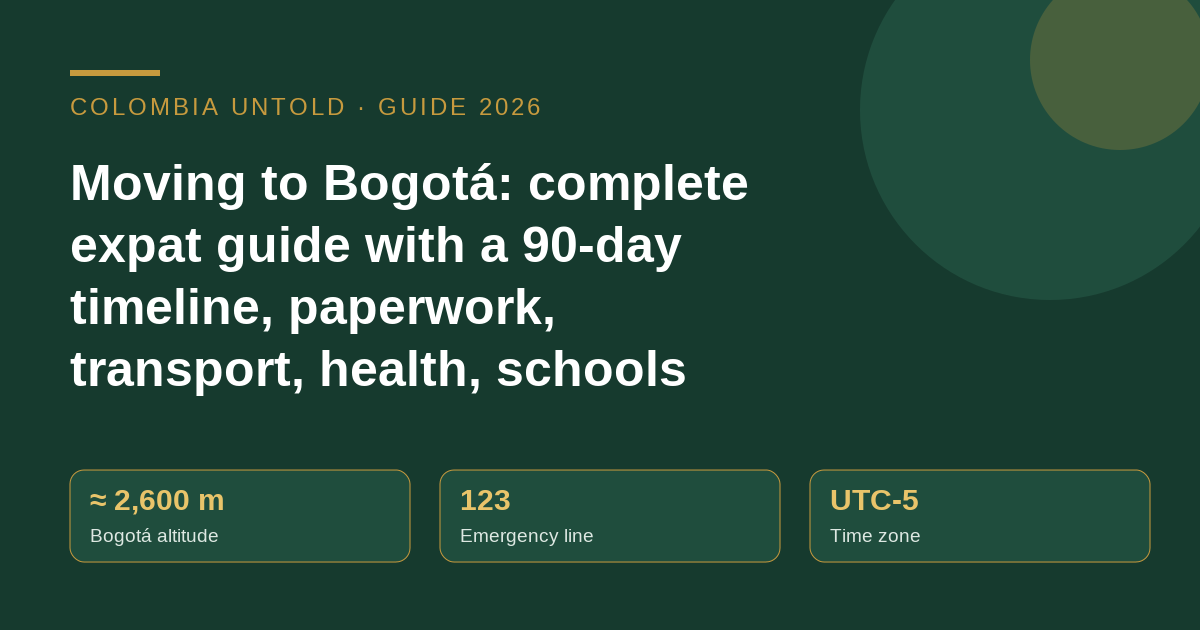
Moving to Bogotá: complete expat guide with a 90-day timeline, paperwork, transport, health, schools and mistakes
Updated: 13 October 2026 · Colombia Untold
Quick answer: To move to Bogotá, organize three fronts: immigration (visa and foreigner ID card), housing (neighborhood and contract under Law 820 of 2003) and daily life (bank account, EPS or insurance, SIM, TuLlave for TransMilenio). The city sits at about 2,600 m, so acclimatize; pico y placa restricts private cars. A sensible order: week 1 temporary lodging and SIM, weeks 2-4 neighborhood and contract, month 2 bank and health, month 3 routines and a budget review.
Bogotá is the capital, the political and economic center of the country and the city that concentrates most corporate headquarters, embassies, universities and high-complexity clinics. It is also a demanding city for newcomers: it sits at considerable altitude, the climate is cool and changeable, traffic is heavy and distances are long. With good preparation, however, it offers a very complete urban life. This guide gives you the order of procedures, the calendar for your first ninety days and the criteria to decide where to live, how to get around and whom to turn to, without promising figures you cannot verify.
Before you travel: visa, documents and expectations
First, define the immigration status you arrive with. A tourist can stay up to ninety days, extendable to one hundred eighty per calendar year; if you plan to work, study, retire or invest, you need the corresponding visa. The Foreign Ministry administers visas and Migración Colombia registers and controls stays. Review Colombia Visa Types: A Complete Explained Guide to choose the category and Working Legally in Colombia as a Foreigner if your plan includes employment. For immigration support you can consult Colombia Visa Legal (colombiavisalegal.com) or CoVisas (covisascolombia.com). Useful documents to bring: a passport with enough validity, digital and paper copies of degrees, background-check certificates, medical certificates if your visa requires them, and civil-status documents. Some must be apostilled or legalized; see Notary and powers of attorney for foreigners in Colombia: authentications, apostille, translations, general and special powers, sworn statements and costs for powers of attorney and documents abroad. If you bring a pet, Bringing Your Pet to Colombia explains the process. If you move with furniture, International move to Colombia: household goods, DIAN, 15 % duty, deadlines, freight, insurance and what to leave behind covers household goods and costs.
Arrival: airport, transport and the first week
El Dorado International Airport is on the west side of the city. From there you can take a regulated taxi, ride-hailing apps or public transport; use official points and avoid offers from people who approach you in the terminal. For the first week, book temporary lodging in a central, well-connected neighborhood instead of signing a long contract blind. Use that week to: buy a SIM or eSIM (see SIM and eSIM in Colombia for foreigners), get cash for small expenses, explore the neighborhood on foot and acclimatize. Take your first nights easy. At 2,600 meters many people sleep poorly in the first days, feel headaches or tire climbing stairs. Hydrate, avoid alcohol for the first nights and don't plan intense effort. If symptoms are strong or persist, see a doctor.
Where to live: the decision that orders everything else
Bogotá has twenty boroughs and many distinct areas. For foreigners, the most sought-after areas are Chapinero, Usaquén, Cedritos, Teusaquillo and Ciudad Salitre; in Best neighborhoods for expats in Bogotá: Chapinero, Usaquén, Cedritos, Teusaquillo, Salitre and how to choose with a scoring matrix we compare them with a matrix you can use with your own criteria, and in Bogotá neighbourhoods for foreigners: which to choose by lifestyle, budget and work you will find another reading of the areas. To live near work it pays to measure the commute cost. An example of our own arithmetic: if your trip is 60 minutes each way, 22 workdays a month add up to 60 × 2 × 22 = 2,640 minutes, that is 44 hours a month (almost two days) spent moving. Cutting each trip to 30 minutes returns 22 hours a month. When you have finalists, visit at different hours and check noise, light, damp and building condition. Properties built after 2010 must comply with the Colombian seismic-resistant construction code (NSR-10). Urban housing leases are governed by Law 820 of 2003: rent cannot exceed 1 % of market value (art. 18), cash deposits and real guarantees are not allowed (art. 16) and the annual increase is limited to CPI (art. 20); for 2026 the cap we use is 5.10 %. For the process, see Checklist before signing a lease in Colombia: clauses, maximum rent, increases, guarantees and red flags and How to negotiate a lease in Colombia as a foreigner: rent, co-signer, policy, term, increases and what the law does not allow. If you need real-estate support, consult Premium Propiedades (premiumpropiedades.com).
Getting around: TransMilenio, SITP, taxis, bikes and cars
The TransMilenio trunk system and the SITP buses are paid with the TuLlave card, which you can buy and top up at authorized points; check the official site for sales points and current fares, which change periodically. At rush hour buses are crowded, so if you can choose, live near a station. The city has an extensive bike-path network and a famous Sunday ciclovía, which you can combine with your leisure routes (see Sports and hobbies for expats in Colombia: bike days, mountains, tejo, diving, dance, safety and insurance). Taxis and ride-hailing apps are common; always confirm the plate and share your route. If you will bring or buy a car, consider pico y placa, which restricts driving by the last digit of the plate and is updated by semester; check the Secretaría Distrital de Movilidad. See also Driving in Colombia as a foreigner: license, SOAT, rules, fines, plate restrictions and road safety, Driving license in Colombia as a foreigner: validation, exams, medical certificate, RUNT, categories, validity and steps and SOAT and vehicle insurance for licenses and insurance. For most expats who live well connected, a car is optional; weigh the total cost (parking, SOAT, maintenance, technical inspection) against taxis and apps.
Procedures for the first thirty days
An efficient order for the first month: - Immigration registration and foreigner ID card if your visa requires it: see Colombian foreigner ID card (cédula de extranjería): what it is, who needs it, requirements, costs and how to apply for updated deadlines and requirements. - Bank account: see How to open a bank account in Colombia as a foreigner: complete guide and Checklist to open a bank account in Colombia as a foreigner: documents, KYC questionnaire and how to avoid rejection. With a foreigner ID the opening is usually simpler. - Health affiliation: Joining an EPS as a foreigner: requirements, costs and how the health system works for the contributory regime, or a private plan; Colombia's Health System Explained for Foreigners explains the alternatives. - Utilities: water (Empresa de Acueducto de Bogotá), power (Enel Colombia), natural gas (Vanti) and internet; see Utilities in Colombia for foreigners: water, electricity, gas, waste, strata, bills and complaints and Fiber internet in Colombia: how to choose a plan, speed, router, Wi-Fi, backup and what to ask before contracting. Remember the stratum sets the rates. - Phone plan: Prepaid or postpaid mobile in Colombia: which suits a foreigner, minimum term, IMEI, number portability and complaints. - Budget: Budget for your first 90 days in Colombia: method, template, worked example, buffer and mistakes gives you a template and a suggested buffer.
Health in Bogotá: systems, clinics and insurance
Bogotá concentrates a good share of the country's high-complexity clinics and hospitals, and there are private institutions of national reference. For a resident, the usual route is: join an EPS (contributory) and complement with prepaid medicine or health insurance for faster access to specialists. For short or transitional stays, travel insurance may be enough; see Table: travel insurance vs visa medical plan. You can quote a travel policy with Protege Tu Viaje (Protege Tu Viaje) with discounts of up to 65 % depending on plan and conditions. In an emergency the single number is 123. Always keep a copy of your policy, passport and emergency contacts on your phone and on paper.
Family and schools
If you move with children, the school calendar and admissions need advance planning. Bogotá has bilingual and international schools, plus public and private national ones; see Schools for foreign families in Colombia: types, curricula, costs, admission and how to choose and School calendar in Colombia: calendar A and B, enrollment, holidays and planning with children for dates and selection criteria. For young-child care, Daycare and childcare for expats in Colombia: nurseries, nannies, family compensation funds, health and documents describes options and how to verify licenses. When choosing a neighborhood, measure the school route in real time.
Weather, clothing and daily life
Bogotá's climate is cool all year, with variation through the day: cold mornings, milder afternoons and frequent rain in certain months. A good rule is to dress in layers: a T-shirt, a sweater and a light waterproof jacket. Apartments rarely have central heating; consider blankets, a dehumidifier if the property is damp and check the state of windows and seals. The working day tends to start early; many businesses open around 8:00 and close at night, and on Sundays and holidays trade varies by area. For grocery shopping and deliveries, see Supermarkets and delivery apps. For occasional power or internet cuts in remote work, Power cuts and UPS for remote work in Colombia: rights, compensation, runtime calculation and backup plan explains how to calculate a UPS's runtime. And for those who work from home, Coworking and remote work in Medellín and Bogotá compares coworking options.
A 90-day calendar
- Days 1-7: temporary lodging, SIM, getting to know the neighborhood, acclimatization.
- Days 8-30: choose a neighborhood and sign a lease, immigration procedure, bank account, health affiliation.
- Days 31-60: set up utilities, establish a transport routine, enroll children in school or daycare, first social and sports activities.
- Days 61-90: review the budget with real data, adjust the neighborhood if needed, plan visa renewal or residence if applicable (see From Expat to Permanent Resident: Visa R).
Common mistakes when moving to Bogotá
- Signing a long contract without knowing the neighborhood at different hours.
- Underestimating traffic and distance between boroughs.
- Not acclimatizing and pushing yourself physically from day one.
- Paying a cash deposit or accepting clauses contrary to Law 820 of 2003.
- Not taking out health insurance while the affiliation arrives.
- Dressing only for midday weather and leaving without a jacket or umbrella.
Frequently asked questions
How long can I stay in Bogotá as a tourist?
Up to ninety days, extendable to one hundred eighty per calendar year, under Migración Colombia's control. If you want to work, study or reside, you must process the corresponding visa before your stay expires.
How do I pay for public transport in Bogotá?
With the TuLlave card, which works for TransMilenio and SITP. Check the official site for sales points, top-ups and current fares, because they change.
Do I need a car in Bogotá?
It is not essential. With a well-connected neighborhood you can get around by TransMilenio, SITP, taxis and apps. If you have a car, consider pico y placa and parking and maintenance costs.
What do I do if altitude makes me feel unwell?
Rest, hydrate, avoid alcohol and don't exert yourself in the first weeks. If you have a severe headache, persistent dizziness or shortness of breath, seek medical care.
Can I rent without being a resident?
Yes, but landlords may ask for a passport, employment letter, bank statements or a co-signer. The law forbids demanding cash deposits and real guarantees on urban housing (Law 820 of 2003, art. 16); the usual guarantees are a co-signer or a policy.
What is the emergency number in Bogotá?
123, the single emergency and security line. Also keep your embassy or consulate's details and your medical insurer's contacts.
If you are evaluating housing or investment, Medellín Advisors can guide you on search, title review and the purchase or rental process. Always hire independent legal review.
Key figures and data
| Item | Value | Note |
|---|---|---|
| Bogotá altitude | ≈ 2,600 m | Acclimatization in the first weeks |
| Emergency line | 123 | Single security and emergency number in Colombia |
| Time zone | UTC-5 | No daylight saving time |
| Commute time (example) | 44 hours/month | 60 minutes each way, 22 workdays; own arithmetic |
Official sources and reliable reading
Related guides
- Basic taxes for foreigners in Colombia 2026: tax residence, income tax, VAT, GMF, property tax and when to file
- Gyms and sports for expats in Colombia: contracts, altitude, bike days, parks, adventure sports and insurance
- Savings vs checking account in Colombia: which to open as a foreigner, GMF tax, deposit insurance, fees and requirements
General information based on current rules and practice; it may change. Confirm your case with the official source or an authorized professional. Not legal, tax or medical advice.