Local employment contracts in Colombia for foreigners: visa, contract types, benefits and limits
Updated: 13 October 2026 · Colombia Untold
Quick answer: A foreigner can only work in Colombia with a visa or permit that authorizes it; the employer must report the hiring to Migración Colombia. The contract can be indefinite, fixed-term, for a task, or for services, and an employment contract carries health, pension, occupational risk insurance, severance, bonus, vacation and a maximum 42-hour week from 15 July 2026. A comprehensive salary requires a minimum of 13 monthly minimum wages.
Getting a job with a Colombian company as a foreigner is possible, but it requires aligning three systems that move at different paces: the immigration one, which decides whether you may work; the labor one, which sets the rights and duties of the contract; and the social-security and tax one, which determines what it costs and what you receive. Many foreigners accept an offer without checking that their visa authorizes that job, or sign services contracts that actually hide an employment relationship, or do not understand the difference between ordinary and comprehensive salary. This guide explains the immigration requirements, contract types, basic labor rights, limits and risks for the worker and the employer.
Visa first: without authorization there is no valid contract
In Colombia, a foreigner needs a visa or permit that authorizes work. Migrant (M) visas in the worker category and other special visas authorize employment under specific conditions. Some visas are tied to a specific employer and activity; if you change employer, you must update the visa. Others, such as those for spouses of a Colombian or of a resident, allow work without employer restrictions, depending on their text. Visitor visas, including the digital nomad visa, and tourist status do not allow working for a Colombian employer. Always review your visa's text to know which activity it authorizes; see Marrying a Colombian: legal process, documents and the spouse visa step by step for the spouse case and Colombian foreigner ID card (cédula de extranjería): what it is, who needs it, requirements, costs and how to apply for the ID document. Working without authorization exposes the worker to fines and removal from the country, and the employer to financial sanctions. The employer must also report the foreigner's hiring to Migración Colombia through the reporting system the agency provides, within the period the rule sets. It is the employer's obligation, but you should confirm it was done. For support with work visas, the recommended partners are Colombia Visa Legal and CoVisas.
Proportion of foreign workers
The Substantive Labor Code limits the hiring of foreigners: in general, employers must keep a proportion of Colombian workers of 90% in ordinary staff and 80% in skilled or specialized staff. Exceptions exist, such as those allowing specialist foreign technicians for limited periods, or those applying to small companies, and the Ministry of Labor can authorize specific cases. Ask your employer how it complies with this rule, because it affects the feasibility of the hire.
Contract types
Indefinite-term contract. It has no end date. It offers the greatest stability and requires compensation if the employer ends it without just cause. It is the most protected contract. Fixed-term contract. It has a defined duration, no longer than three years, renewable. If not renewed, the employer must give written notice at least thirty days ahead; otherwise it is deemed extended. Contract for a task or project. It lasts while a specific project or task is carried out. It is used in specific projects. Services contract. It is a civil or commercial contract between a contracting party and an independent contractor, without subordination. The contractor bears his or her own social security and taxes. If in practice there are fixed hours, orders and dependency, the relationship is considered employment under the principle of primacy of reality, with all its consequences. A foreigner needs a visa that authorizes this type of activity. Apprenticeship contract. For training placements, with specific rules. Ask for the contract in writing, with full identification of the parties, position, duties, place, salary, form and frequency of payment, hours and duration. Keep a signed copy.
Ordinary and comprehensive salary
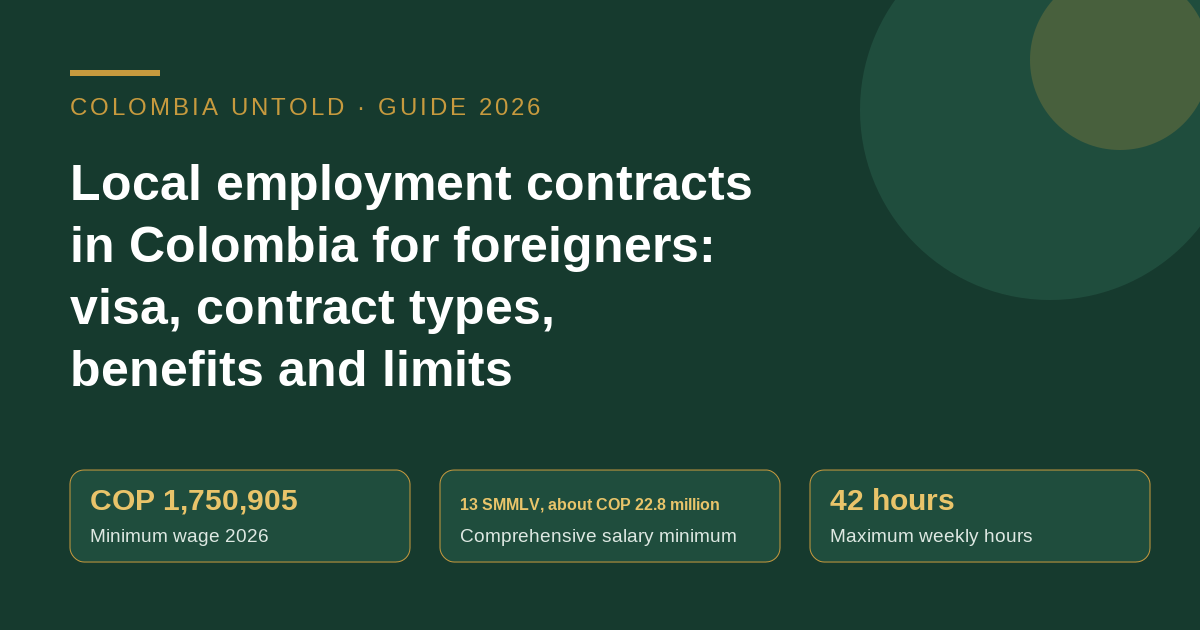
The monthly minimum wage in 2026 is COP 1,750,905. Ordinary salary is made up of base pay plus regular payments, and benefits are calculated on it. Comprehensive salary, available to those who earn at least 13 monthly minimum wages, that is about COP 22.8 million, includes a 30% benefits factor, so severance, service bonus and their interest are not paid separately, though vacation and social-security contributions remain, calculated on 70% of the salary. Before accepting a comprehensive salary, calculate what you would receive under an ordinary scheme and compare. This scheme is widely used for senior and management roles.
Benefits and basic rights
Social security. Health, pension and occupational risks (ARL). Health is contributed at 12.5% of income, of which the employer pays 8.5% and the worker 4%; pension at 16%, with 12% from the employer and 4% from the worker. Foreigners with an employment contract must enroll in the system, except those covered by their home country's regime or another regime, in which case they may be exempt from pension. See Joining an EPS as a foreigner: requirements, costs and how the health system works for health enrollment. Severance and interest. Equal to one month's salary per year worked, with 12% annual interest on the severance, deposited in a fund. Service bonus. Equal to one month's salary per year, paid in two installments: June and December. Vacation. Fifteen paid business days for each year worked. Work clothing. For those earning up to two minimum wages, shoes and work clothing three times a year. Transport allowance. For those earning up to two minimum wages. Working hours. The legal maximum weekly hours fall gradually under Law 2101 of 2021 and reach 42 hours from 15 July 2026. Overtime and night, Sunday and holiday work carry surcharges. Exceptions exist for certain management, trust and handling positions. Payroll contributions. Paid by the employer, for family compensation funds, SENA and ICBF, with exemptions for certain employers and salaries.
Trial period, termination and compensation
The contract may include a written trial period of up to two months, during which either party may end it without compensation. After that, termination without just cause by the employer generates compensation, calculated by contract type and seniority. Termination with just cause must follow the legal procedure. If you resign, give the agreed notice and sign the settlement only after reviewing the calculations. The settlement includes unpaid salary, severance, interest, bonus and proportional vacation. When the contract ends, if your visa is tied to the employer, you must regularize your immigration status within the set deadlines; do not wait.
Remote work for a foreign company
If you work for a company abroad and live in Colombia, the relationship is governed by the contract with that company and by immigration rules, not by a Colombian employment contract, but your stay must be in order with a visa suited to remote workers or digital nomads. That situation can create tax obligations in Colombia if you exceed 183 days of presence; see Tax residency certificate in Colombia: who is resident, how to request it from the DIAN and what it is for. If the foreign company wants to hire you formally in Colombia, it can do so through a local entity or an employer of record. See for handling foreign income.
What happens to your visa if you change jobs
If your work visa is tied to an employer or position, a change of job requires processing a new visa or modifying the existing one before starting in the new post. Starting to work with another employer without authorization can be considered an immigration violation. Ask an immigration adviser before signing a new offer and make the start conditional on visa approval.
Risks of services contracts
Many foreigners receive services-contract offers, which are cheaper for the contracting party because they carry no benefits. If you work fixed hours, under orders and with the company's tools, you may be entitled to have the relationship declared as employment, but this involves a process. To start with clarity, decide which scheme suits you: if you want stability and benefits, ask for an employment contract; if you want flexibility and several clients, a services contract with your own contributions can work, but then you must contribute as an independent and file taxes. See Setting up an SAS in Colombia as a foreigner: steps, costs, taxes and obligations for operating as your own company.
Taxes on your salary
Your employment income is subject to withholding tax and to the income-tax return if you exceed the thresholds. The rate depends on your income level and your tax-residency status. Employers apply monthly withholding. Request the certificate of income and withholdings each year. Review the section on resident taxes before accepting the offer.
How to evaluate an offer
Compare net salary after contributions and withholdings, non-salary benefits (medical insurance, education, housing), contract type, the visa type the company supports, payment of visa and relocation costs, and termination conditions. Ask in writing for everything offered. Calculate the family budget with real figures; see Colombia for expat families: a complete guide to visas, schools, health, housing, costs and daily life and Banking and payments in your first 90 days in Colombia: cards, cash, wallets and your first account.
Frequent mistakes
Working on a tourist visa. Accepting an offer without checking that the visa authorizes the post. Not demanding a written contract. Accepting a comprehensive salary without comparing. Changing employer without updating the visa. Confusing a services contract with an employment contract. Signing the settlement without review. Not keeping proof of contributions. Not reporting foreign income if you are a tax resident.
What to do in a labor dispute
First, try to resolve it with the company in writing. If that is not possible, go to the Ministry of Labor for conciliation or file a complaint. For claims over wages or compensation, labor court is the last resort. Keep contracts, pay slips, emails and messages. A labor lawyer can advise you. Keep your immigration status in order during the dispute.
Frequently asked questions
Can I work in Colombia on a tourist visa?
No. You need a visa or permit that authorizes work. Working without authorization exposes the worker and the employer to sanctions.
What is a comprehensive salary?
A scheme for those earning at least 13 monthly minimum wages that includes a 30% benefits factor, so severance, bonus and interest are not paid separately, although vacation and social security on 70% remain.
How many hours can I work per week?
The legal maximum is 42 weekly hours from 15 July 2026 under Law 2101 of 2021, with surcharges for overtime and night, Sunday and holiday work.
Does a services contract give me benefits?
No. It is a civil or commercial contract without benefits. If there is subordination in practice, the relationship may be considered employment, but that requires a formal claim.
What happens to my visa if I change employer?
If it is tied to the employer, you must update it before starting in the new post. Consult an immigration adviser before signing.
Must my employer enroll me in social security?
Yes. With an employment contract, the employer must enroll you in health, pension and occupational risks, except the exceptions for those already covered by a home-country regime.
If you want guidance on migration requirements, you can contact Colombia Visa Legal. When a procedure is online, Cancillería recommends doing it directly; professional guidance helps you understand the process, it does not replace the official source.
Key figures and data
| Item | Value | Note |
|---|---|---|
| Minimum wage 2026 | COP 1,750,905 | SMMLV |
| Comprehensive salary minimum | 13 SMMLV, about COP 22.8 million | With 30% benefits factor included |
| Maximum weekly hours | 42 hours | From 15 July 2026, Law 2101 of 2021 |
| Health contribution | 12.5% | 8.5% employer and 4% employee |
Official sources and reliable reading
Related guides
- Power cuts and remote work in Colombia: a backup plan for electricity and internet
- Rental references as a foreigner
- Daycare for expat children
General information based on current rules and practice; it may change. Confirm your case with the official source or an authorized professional. Not legal, tax or medical advice.