Airbnb or long-term rental in Colombia: which suits a foreigner by time, cost and law
Updated: 13 October 2026 · Colombia Untold
Quick answer: For stays under one or two months, Airbnb or a seasonal furnished rental is usually the practical choice; from three to six months, a long-term lease costs much less per month, though it requires a contract, deposit and utilities. Law 820 of 2003 governs urban housing leases and tourist rentals require registration in the RNT.
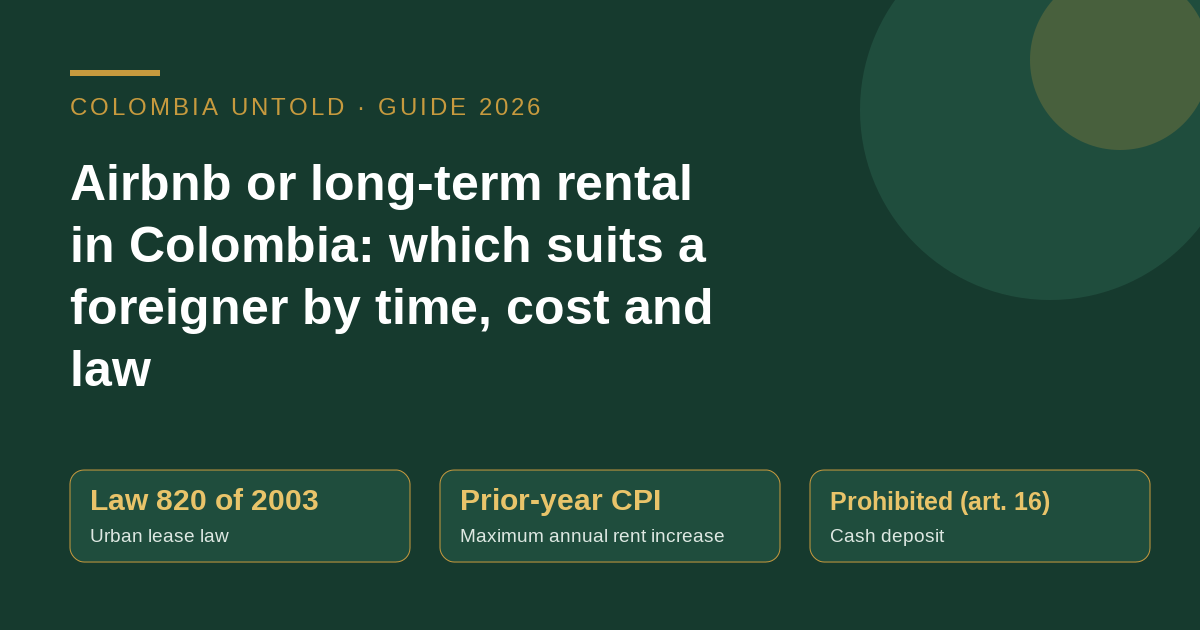
Almost every foreigner arriving in Colombia does the same thing first: book a few weeks in an Airbnb to “see what it is like” and decide later where to stay. It is a good strategy, but it helps to know when to stop paying tourist-lodging rates and move to a long-term lease, because the monthly difference can be considerable and because legal rules, contracts and protections change. A furnished apartment in a popular area of Medellín can cost twice as much per month on Airbnb as on a one-year lease, but the lease requires documents, references, deposits and utilities that a newcomer does not always have. This guide compares both paths with concrete criteria of time, cost, flexibility, risk and legal framework, proposes a reasonable transition route and explains frequent traps. The figures are market references that vary by city and neighbourhood; use the method to do your own calculations.
Three options, not two
Many travellers see a binary dilemma, but in fact there are three options and an intermediate fourth: - Tourist lodging by the day (Airbnb, hotels, aparthotels): flexible, furnished, with services and cleaning included, no long-term contract; it is the most expensive per month. - Furnished seasonal or monthly rental: contracts of one to six months, often with long-stay discounts; a midpoint found directly with managers and owners. - Long-term urban housing lease: typical twelve-month contracts, unfurnished or furnished, with deposit, building fees and utilities in your name; the cheapest per month but the least flexible. - Coliving and nomad housing: monthly contracts with community, internet and cleaning; useful for the first month if you work remotely. Each answers a different stage. Most people go through the first, then the second and finally the third.
Legal framework: two different regimes
The lease of urban housing is regulated by Law 820 of 2003, which sets obligations of landlord and tenant, grounds for termination, deposits and guarantees, and how rent is adjusted. At renewal, the annual rent increase may not exceed the consumer price index of the previous year, a limit that protects the tenant. The law also provides that certain contracts must be in writing and that handover and return of the property must be done with an inventory. For more detail, read Checklist before signing a lease, Lease deposit: return and Negotiate rent as a foreigner. Tourist rental, by contrast, is governed by tourism rules: lodging providers must register in the National Tourism Registry (RNT), and platforms demand the registration number. Daily rentals in horizontal property are also subject to each building’s rules, and many prohibit or restrict tourist rental. This matters to you in two ways: as a guest, a listing without an RNT or in a building that does not allow it can leave you without lodging mid-stay, and as someone thinking of subletting, doing so can violate the building rules and the contract; see Subletting: risks for foreigners.
Comparing costs properly
Do not compare the nightly price with monthly rent: compare the total monthly cost of each option. On Airbnb or tourist lodging, add the nightly rate multiplied by days, the cleaning fee, the platform commission and, if applicable, taxes. It generally includes furniture, internet, utilities and cleaning. For stays of a month or more, many hosts offer significant discounts; negotiate directly by message. On a long lease, add the rent, the building fee (if not included), utilities (power, water, gas, internet), the agreed guarantee (co-signer or policy; the law prohibits demanding cash deposits in urban housing leases), the cost of furnishing if the apartment arrives empty, and any insurance, parking and maintenance costs. To make the comparison fair, divide entry costs such as the policy and furniture by the number of months you plan to stay. As a rule of thumb, from three to four months a furnished or long lease is usually cheaper than tourist lodging. Before that, the monthly saving does not offset the entry cost and the contract’s rigidity. Check updated living costs in Cost of living in Medellín 2026: rent, transport, food, health and a real budget for foreigners, Cost of living in Bogotá 2026: rent, TransMilenio, food, health and a real budget for foreigners and Cost of living in Cartagena 2026: rent, Transcaribe, food, electricity and a real budget for foreigners.
What they ask for to sign a long lease
A Colombian landlord usually requests: - Identity document (passport with visa or cédula de extranjería). - Proof of income or ability to pay: contract, statements from abroad or letters. - Personal, work or previous-landlord references. - In some cases, a guarantor or co-signer with real estate in Colombia, or a rental policy that replaces them. - A personal guarantee (co-signer or guarantor) or a rental policy; the law prohibits demanding cash deposits in urban housing leases. For a newly arrived foreigner with no local history, the difficulty appears in the references and the guarantor. Alternatives: offer several months in advance prudently, pay for a policy or guarantee service, or start with a furnished monthly rental while you build a history. See Rental references as a foreigner, Renting in Colombia as a foreigner: rent, building fees, deposits and the real cost and How to build a credit history in Colombia (Datacrédito) as a foreigner.
Frequent risks and how to avoid them
Rental scams. Listings with very low prices that ask for transfer advances without a visit, stolen photos or fake hosts. Always visit, pay only against a contract and receipt and verify the owner’s identity with documents and the title certificate. Payments off-platform. On Airbnb, payments outside the platform leave you unprotected; keep bookings inside. Buildings that prohibit tourist rental. Ask whether the building allows it and whether the host has the RNT. Contracts without inventory. Without a photo inventory, the deposit can be lost for damage that already existed. See Lease handover inventory. Noise, internet and utilities. If you work remotely, test the internet speed before signing; see Fiber internet and plans in Colombia. Unauthorised subletting. It is grounds for termination of the contract.
A reasonable transition route
Weeks 1 to 4: tourist lodging in a well-connected area, to learn neighbourhoods and routines; visit three to five apartments and compare. Months 2 to 3: a furnished monthly rental, negotiated directly, with a short written contract and no excessive deposit. From months 4 to 6: a long lease in the neighbourhood you liked best, with a formal contract, inventory and utilities in your name. If you want to stay more than a year, also consider buying; see Buying property in Colombia as a foreigner in 2026 to understand the process. For neighbourhoods and areas read Medellín neighbourhoods for foreigners: El Poblado, Laureles, Envigado, Belén and more, how to choose and Bogotá neighbourhoods for foreigners: which to choose by lifestyle, budget and work.
Migration flexibility and the contract
If your status is visitor, keep in mind that the permit is temporary: do not sign a twelve-month contract without an early-termination clause and without understanding your migration plan. If you have a multi-year visa or seek a nomad, investor or pensioner visa, a long-term lease supports your domicile. To put your status in order, consult Colombia Visa Legal. And to find rental or purchase properties in Medellín, contact Medellín Advisors and Premium Propiedades, which guide the search and the review of contracts and titles.
Taxes and legality if you are the one renting out
If you buy a property and plan to earn income from daily rentals, you must comply with tourism rules (RNT), the building’s rules, taxation of the income and safety obligations. A daily rental without registration can be penalised, and the income must be declared. See Basic taxes for foreigners in Colombia and consult an accountant before starting. Keep every contract, receipt and platform statement: they are your evidence if a guest, a neighbour or an authority ever questions the activity, and they simplify your annual tax filing considerably.
Three profiles and what usually suits them
The exploring visitor (up to two months). The priority is flexibility: they may change city or plan. Tourist lodging or a one- or two-month furnished rental with flexible cancellation, in a safe, well-connected area, suits best. They should not sign long contracts or pay large deposits. The digital nomad or remote professional (three to six months or more). They need stable internet, a desk, quiet and utilities included. A furnished monthly apartment or a long lease with an early-termination clause gives stability without tying them down. Test the connection before signing and confirm the building does not restrict working from home. The family or the expat with a multi-year visa. They gain more from a long lease, with schools, neighbourhoods and services defined, and the chance to negotiate the rent. Here it is worth investing time in reviewing the contract, the inventory, the administration and the property insurance, and considering whether buying is a medium-term option. In all three cases the common criterion is not to commit more time than your migration and work situation really allow.
Frequently asked questions
After how many months does it make sense to move from Airbnb to a lease?
As a reference, from three or four months a furnished or long lease is usually cheaper. Before that, flexibility and entry costs such as deposits and furniture do not offset the saving. Calculate the total monthly cost of each option.
What documents do I need to sign a lease as a foreigner?
Passport with visa or cédula de extranjería, proof of income, references and, in many cases, a guarantor or rental policy. With no local history, you can start with a furnished monthly rental.
Can the landlord raise the rent whenever they want?
No. In urban housing the annual rent increase at renewal cannot exceed the previous year’s CPI, and the agreed term must be respected. Changes without agreement are not valid.
Is it legal to rent by the day in any apartment?
Not necessarily. Tourist rental requires registration in the RNT and respect for the horizontal-property rules; many buildings prohibit it. As a guest, ask about the RNT and the building’s policy.
Is it legal for them to ask for a deposit, and how do I get back what I paid?
Law 820 of 2003 (art. 16) prohibits demanding cash deposits in urban housing leases. If you paid a sum out of necessity, it is recovered when returning the property in the state received, with inventory, utilities and building-fee clearance. Document with photos from day one and insist on a receipt.
Can I sublet my apartment on Airbnb while I travel?
Only if the contract expressly authorises it and the building’s rules allow it. Otherwise it is grounds for termination of the contract and may bring penalties.
Should I choose a furnished or an unfurnished apartment for a long lease?
Furnished is easier in the first year because you avoid buying furniture, but the rent is higher and you depend on the owner’s taste and the condition of the items. Unfurnished costs less per month yet needs an upfront outlay; if you may leave within a year, furnished usually wins.
If you are evaluating housing or investment, Medellín Advisors can guide you on search, title review and the purchase or rental process. Always hire independent legal review.
Key figures and data
| Item | Value | Note |
|---|---|---|
| Urban lease law | Law 820 of 2003 | Regulates urban housing leases |
| Maximum annual rent increase | Prior-year CPI | Legal cap for urban housing at renewal |
| Cash deposit | Prohibited (art. 16) | Law 820 of 2003: personal guarantees or a policy are allowed |
| Tourist rentals | RNT mandatory | National Tourism Registry for providers |
Official sources and reliable reading
Related guides
- Bogotá neighbourhoods for foreigners: which to choose by lifestyle, budget and work
- Basic funeral plan
- Subletting: risks for foreigners
General information based on current rules and practice; it may change. Confirm your case with the official source or an authorized professional. Not legal, tax or medical advice.