How to start a company in Colombia as a foreigner: step-by-step SAS guide
By Francisco Viloria · Updated: 13 October 2026
Quick answer: A foreigner can create a Simplified Stock Company (SAS) in Colombia under Law 1258 of 2008: the incorporation document is drafted, registered with the Chamber of Commerce, the RUT and NIT are obtained from the DIAN, a bank account is opened and foreign investment is registered. The commercial registration is renewed every year.
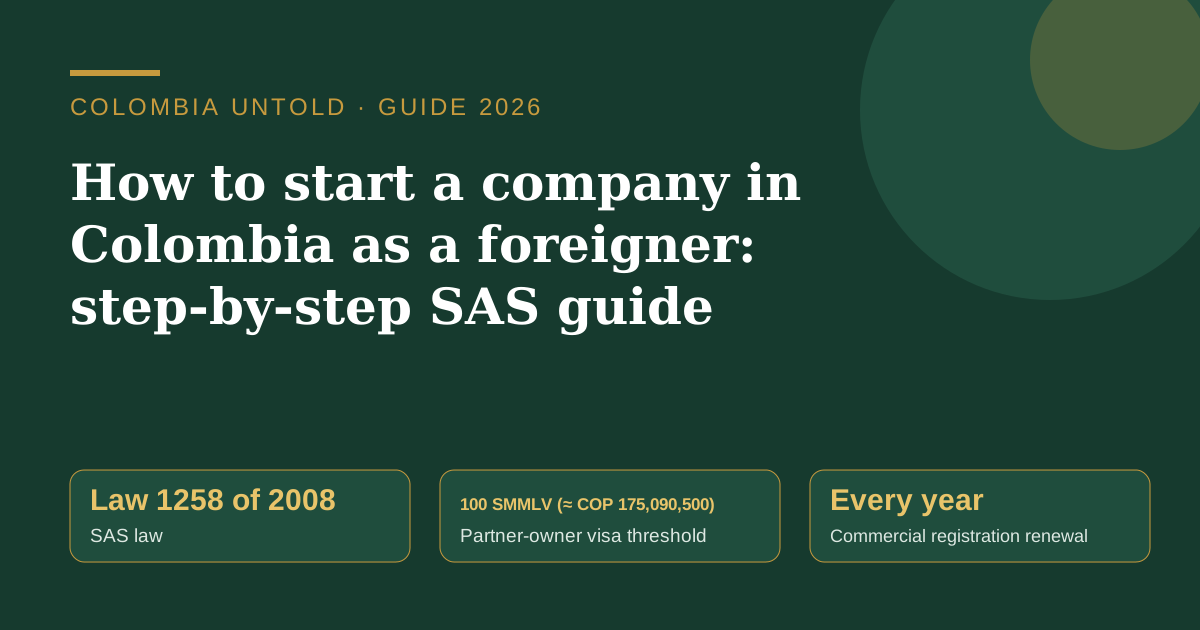
Starting a company in Colombia as a foreigner is possible and, with the Simplified Stock Company, relatively quick. The SAS was designed to be flexible: a single person can create it, it requires no minimum capital and it lets you agree freely on much of its internal rules. Even so, opening the company is the easy part; the hard part is keeping it in order, with accounting, taxes, electronic invoicing and renewals up to date. This guide explains what an SAS is, what you need to incorporate it, how it is registered, how it connects to the investor visa and what obligations follow. Rules, fees and procedures change: confirm each point with a Colombian commercial lawyer and accountant before incorporating. This content is informational and is not legal, accounting or tax advice.
What is an SAS and why is it the most used form?
The Simplified Stock Company was created by Law 1258 of 2008. It is a capital company with its own legal personality in which shareholders' liability is limited, in general, to the amount of their contributions. One or several people, natural or legal, can create it; it needs no board of directors and no statutory auditor unless the law requires one because of size, and it is normally incorporated by a private document registered with the Chamber of Commerce, unless assets requiring a public deed, such as real estate, are contributed. Its flexibility makes it the preferred form for entrepreneurs, investors and foreigners. For an overview, read Opening a SAS as a foreigner in Colombia and Forming an SAS Company in Colombia as a Foreigner.
Can a foreigner be a shareholder and legal representative?
In general terms, a foreigner can be a shareholder of a Colombian SAS and also its legal representative. To handle procedures as representative you will need valid identity documents, normally a passport or foreigner ID card, and an RUT. Keep in mind that being a partner in a company is not the same as having a work permit: to work in your own company you must check whether your visa allows it. Those arriving without a residence visa often structure the company and the visa in parallel with professional help. Read Work permission and limits by visa to avoid working with a visa that does not authorize it.
Before incorporating: define the business and structure
A good incorporation starts with clear answers: what you will sell, to whom, with what capital, who the partners will be and who will legally represent the company. Define the corporate purpose broadly enough that you do not have to amend the bylaws every time you add a line of business, but not so vaguely that it raises doubts with banks and clients. Decide whether capital will be paid immediately or in installments and whether you need partner agreements on entry and exit. Check whether your activity requires special permits or registrations, such as health, food, tourism, education or finance. Also consider whether the structure suits your tax and immigration planning. Read Starting a Business in Colombia as a Foreigner: Legal Guide.
The company name and the RUES search
Before registering, verify that the chosen name is not already used. The Single Business and Social Registry, RUES, lets you search names and registrations of all chambers of commerce in the country. Also check that it does not clash with a trademark registered with the Superintendency of Industry and Commerce, because a name available in the commercial register does not protect you against a trademark holder. If your business depends on a brand, register the trademark as a separate procedure; the SAS and the trademark are different rights. This simple check avoids costly company-name changes after you already have a bank account, contracts and invoices.
The incorporation document and bylaws
The SAS is incorporated by a document containing the shareholders' details, the company name followed by the letters SAS, the domicile, the term, the corporate purpose, the authorized, subscribed and paid-in capital, the form of administration and representation, and the basic operating rules. The law allows broad freedom to agree on matters such as profit distribution, share classes, majorities and exit clauses. Have a lawyer draft or review it, because these clauses matter when disagreements arise. If a partner acts from abroad, the document can be signed through a power of attorney or with the apostille and translation formalities of the country of origin, if applicable. Read Apostille and translations for Colombia visas.
Registration at the Chamber of Commerce
The document is filed with the Chamber of Commerce of the company's domicile, where it is registered and the commercial registration is obtained. In that procedure the registration tax and registration fees are paid, whose amount depends on capital and on the current rate of each chamber and department. At the end you receive the certificate of existence and legal representation, the document you use to show banks, clients and agencies that the company exists and who represents it. Check the certificate details as soon as you receive it: an error in a name, document number or power is easier to fix at the start. Always keep a current copy, because many entities ask for certificates less than a month old.
RUT and NIT: the company's tax identity
Once registered, the company must enroll in the DIAN's Single Tax Registry and obtain its NIT. In many cases the Chamber of Commerce handles a preliminary RUT during registration, and you then complete and formalize the enrollment. The RUT defines the company's tax responsibilities, such as IVA, withholding and electronic invoicing, and its economic activities. A badly completed RUT produces invoicing errors and penalties, so review it with an accountant. Read Tax ID (RUT) for foreigners for those who also need an RUT as individuals.
Business bank account
With the certificate of existence, the RUT and the documents of partners and representative, you can open a business account. Banks apply know-your-customer processes and may ask about the source of funds, ultimate beneficiaries, activity and expected financial statements. Present information in a consistent and complete way; delays usually come from inconsistent documents. Some banks are quicker with foreign-capital companies than others, so it pays to ask more than one. Read Banking Your Business in Colombia and How to open a bank account in Colombia as a foreigner: complete guide.
Foreign capital: how it is registered
When partners' contributions come from abroad, they constitute foreign investment and must be channeled through the foreign exchange market with the corresponding exchange declaration, which is registered with the Bank of the Republic. That registration proves the capital entered legally, protects your right to remit profits and repatriate the investment in compliance with the rules, and is the support requested when the investment backs a visa. Do not bring capital in through informal channels or mix personal and business funds. Read Colombia's Foreign Exchange Regime for FDI: A Guide to Central Bank Form 4 and Banrep extract and investor visa.
From company to visa: partner-owner
A company can open the door to a migrant investor visa under the partner or owner modality. According to our guides, the investment threshold is 100 SMMLV, which with the 2026 minimum wage of COP 1,750,905 equals COP 175,090,500, a figure computed with the wage in force at application. The Foreign Ministry checks that the investment is backed by the company registration, the registered foreign investment and other documents. A common mistake is capitalizing an insufficient amount or without exchange registration and finding out at application time. Plan the visa and the company together. Read Colombia investor visa 2026 and Investor Visa (M/R): Fatal Errors When Buying Shares, Property, or CDs.
Tax obligations: what comes next
A Colombian company must file and pay income tax, plus IVA, withholdings and other taxes depending on its activity. The general corporate income tax rate has been 35% under current rules, although special regimes and rates exist; confirm the one that applies to you with an accountant. The general IVA is 19%, with excluded or exempt goods and services, and there is the municipal industry and commerce tax. There are also third-party reporting obligations and electronic invoicing, which is mandatory for most taxpayers. For the tax picture of a business with a foreign owner, read Taxes for Foreigners with a Business in Colombia.
Accounting, statutory auditor and renewals
Every company keeps accounting under the applicable standards and preserves its books. Above certain thresholds of assets or income expressed in minimum wages, the law requires a statutory auditor, an independent public accountant who oversees management; confirm with your accountant whether your company reaches them. The commercial registration is renewed every year with the Chamber of Commerce, in the first months of the year, and failing to do so brings penalties and can affect the company's standing. Note the DIAN tax calendar dates from day one; late-filing penalties are usually more expensive than accounting advice.
Liability of partners and managers
Although the SAS limits shareholders' liability to their contributions, that protection is not absolute: the law provides that if the company is used to defraud the law or harm third parties, shareholders and managers who took part may answer for the damages. Managers, including the legal representative, have duties of care and loyalty and responsibilities that may also be criminal and tax-related. This is especially relevant for a foreigner acting as legal representative without knowing the system. Read Criminal and Civil Liability for Administrators of Colombian SAS Companies.
Employees, contracts and business permits
If you will hire staff, you must formalize employment contracts, enroll workers in social security and meet payroll obligations. Many activities also require permits: sanitary registration, national tourism registry, operating licenses, land use, among others. Check the conditions before opening, because operating without permits can cost fines or closure. If you will operate with a commercial establishment, you must also register it with the Chamber of Commerce, as a separate registration from the company. Read Local employment contract and visa.
Common mistakes when starting a company as a foreigner
Incorporating without thinking about the visa, capitalizing without exchange registration, using the personal account for business, not renewing the registration, ignoring electronic invoicing, forgetting tax calendars, choosing an accountant without experience with foreign capital and hiring the incorporation to someone who promises "everything in a day" without explaining later obligations. All are avoided with a written roadmap and professional advice from the start.
Our analysis
Creating an SAS as a foreigner is an accessible process, but it must be designed together with the visa, the investment and taxes. The order that works best is to define the business, structure the bylaws, incorporate and register the investment, open the bank account and only then operate, with accounting and electronic invoicing from day one. To back the partner or investor visa, Colombia Visa Legal can guide you; for health and travel insurance, CoVisas; and if your business involves real estate in Medellín, Medellín Advisors and Premium Propiedades can accompany you in the purchase or management of the property. Always compare more than one professional opinion.
Frequently asked questions
Can a foreigner start a company in Colombia?
Yes. A foreigner can be a shareholder and legal representative of a Colombian SAS, with valid identity documents and the corresponding registration. Owning a company is not the same as having a work permit: check what your visa allows.
What is an SAS?
The Simplified Stock Company, created by Law 1258 of 2008. A single person can create it, it requires no minimum capital and it generally limits shareholders' liability to their contributions.
Where is an SAS registered?
At the Chamber of Commerce of the company's domicile, where the commercial registration and the certificate of existence and legal representation are obtained. The RUT and NIT are then formalized with the DIAN.
How much must I invest for the partner-owner visa?
According to our guides, 100 SMMLV, which with the 2026 minimum wage (COP 1,750,905) equals COP 175,090,500. It is computed with the wage in force at application and you should confirm it with the Foreign Ministry.
Do I have to register the capital I bring from abroad?
Yes. Foreign investment must be channeled through the foreign exchange market with the exchange declaration and registered with the Bank of the Republic, which supports repatriation and the visa.
What obligations does an SAS have each year?
Renewing the commercial registration, keeping accounts, filing and paying taxes, issuing electronic invoices and meeting third-party reporting, plus a statutory auditor if it exceeds the legal thresholds.
Can a foreigner be a shareholder of an SAS?
Yes, foreigners can be shareholders and legal representatives, with identification requirements and, as applicable, foreign investment rules.
Do I need a visa to set up a company?
Forming a company is not the same as having work authorization. If you will work in it, verify the proper visa.
Where is the SAS registered?
At the Chamber of Commerce of its domicile, where the commercial registration is obtained.
What is the matrícula mercantil?
It is the registration of the merchant or company with the Chamber of Commerce, renewed annually.
What is the company's RUT?
It is the DIAN registration that identifies the company for tax obligations.
What is the NIT?
It is the Tax Identification Number assigned by the DIAN.
How much capital do I need?
The SAS has no legal minimum capital; capital is set in the articles. Size it to your activity.
Do I need a lawyer and an accountant?
Not always mandatory, but helpful. Some companies must have a statutory auditor depending on size.
What is a revisor fiscal?
A certified public accountant who oversees the accounts of companies required to have one.
What taxes does an SAS pay?
Income tax, VAT where applicable, withholdings and the industry and commerce tax, among others.
What is the VAT rate?
The general rate is 19%, with exceptions and exclusions.
How do I register foreign investment?
Through an exchange declaration and registration with the Banco de la República.
How do I hire employees?
With an employment contract and social security enrollment.
Can I close a company easily?
There is a dissolution and liquidation process with requirements.
What is the Chamber of Commerce?
It is the private entity with public functions that keeps the commercial registry and issues certificates of existence and legal representation.
What is the certificate of existence and legal representation?
It is the document that proves the company exists and who represents it. Banks and agencies ask for it frequently.
What is the corporate purpose?
It is the activity the company declares it will carry out; in the SAS it can be broad and even "any lawful activity".
What is the legal representative?
It is the person who acts on behalf of the company and binds it before third parties.
Can I be the sole shareholder of an SAS?
Yes, an SAS can be formed by one or several persons.
What is the RUES?
It is the Registro Único Empresarial y Social, where information on companies registered with chambers of commerce can be looked up.
What is the commercial registration renewal?
It is the annual procedure, to be done within the first months of each year, to keep the registration current.
What is the ICA or industry and commerce tax?
It is the municipal tax paid by companies for their commercial, industrial and service activities.
What is the company's income tax return?
It is the annual income tax return of the company filed with the DIAN.
Where can I get advice to set up a company in Medellín?
Medellín Advisors guides you through the incorporation and setup process in the city.
If you are evaluating housing or investment, Medellín Advisors can guide you on search, title review and the purchase or rental process. Always hire independent legal review.
Key figures and data
| Item | Value | Note |
|---|---|---|
| SAS law | Law 1258 of 2008 | Created the Simplified Stock Company |
| Partner-owner visa threshold | 100 SMMLV (≈ COP 175,090,500) | With the 2026 minimum wage of COP 1,750,905; confirm the current figure |
| Commercial registration renewal | Every year | In the first months of the year, with the Chamber of Commerce |
| Value-added tax (IVA) | 19% | General rate; some items excluded or exempt |
Official sources and reliable reading
Related guides
- Taxes in Colombia for foreign residents: guide to tax residence, income tax and VAT
- Jobs and work permits in Colombia for foreigners: which visa you need
- Business opportunities in Colombia for foreigners: sectors, routes and risks
General information based on current rules and practice; it may change. Confirm your case with the official source or an authorized professional. Not legal, tax or medical advice.