Setting up an SAS in Colombia as a foreigner: steps, costs, taxes and obligations
Updated: 13 October 2026 · Colombia Untold
Quick answer: A foreigner can set up a Simplified Stock Company (SAS) in Colombia with a private document registered at the Chamber of Commerce, with no minimum capital and a single shareholder. Afterwards you need a RUT, bank account, beneficial-owner registration, electronic invoicing and, if capital comes from abroad, channelling through the foreign-exchange market to register the investment.
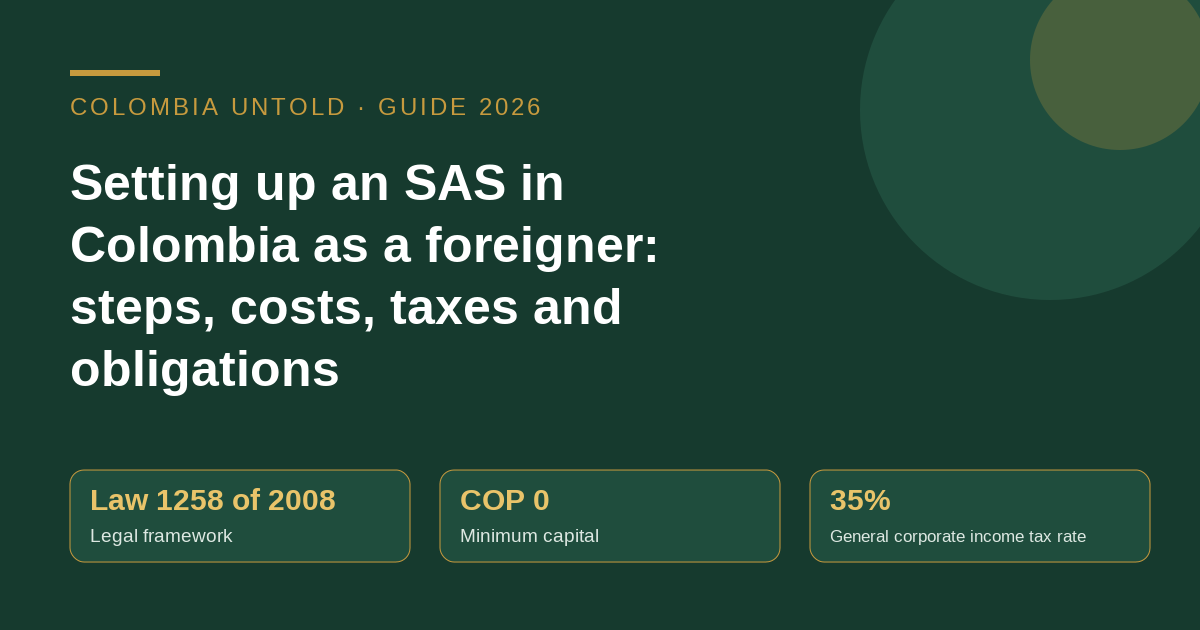
Colombia is one of the countries in the region where a company can be set up fastest and cheapest, and a large part of the reason is a 2008 law: the one that created the Simplified Stock Company, known as the SAS. That form removed many of the demands of traditional companies, such as minimum capital, a mandatory board or a notarial deed, and today it is the favourite vehicle of entrepreneurs, freelancers, digital nomads with local clients and foreigners who want to invest or invoice in the country. But creating the company is the easy part: the hard part is understanding what comes next, which includes tax filings, accounting, payroll, beneficial-owner registers and, if the investment comes from abroad, its exchange-market channelling. This guide walks through the full process in order, with 2026 figures, so you decide with information rather than intuition. It does not replace the advice of a lawyer and an accountant, and every case has nuances.
What an SAS is and why foreigners choose it
The SAS is a commercial capital company governed by Law 1258 of 2008 and, supplementarily, by the general rules of the Commercial Code. Its advantages are concrete: - It can be formed by a single person, who may be a foreigner, natural or legal. - It requires no minimum or maximum capital; capital is divided into shares and freely agreed. - It is formed by private document, with no need for a notarial deed, except when contributing assets the law requires to be formalised that way, such as real estate. - It limits shareholders’ liability to the amount of their contributions, with exceptions for fraud or abuse of the form. - It has flexible bylaws: indefinite duration, a broad corporate purpose and freedom to organise management. - It requires no statutory auditor unless it exceeds the asset or income thresholds set by law. For the foreigner these advantages mean you can structure your business without repeated travel, without mandatory local partners and with moderate incorporation costs. But a frequent mistake is to choose the SAS only for ease and neglect tax and migration planning.
Before incorporating: decisions that condition everything
What you need it for. A company makes sense if you will invoice Colombian clients with VAT, hire staff, buy property through the company, open a physical business or channel an investment. If you are a digital nomad and all your clients are abroad, you probably do not need an SAS; first review Remote work in Colombia: general idea for foreigners. Who will be the legal representative. The SAS requires a legal representative, who may be a foreigner, but must be able to sign, open accounts and answer to authorities. If they live abroad, banking and tax logistics get complicated. What corporate purpose and economic activity. Define the CIIU activity code on the RUT carefully: the municipal industry-and-commerce tax rate and some obligations depend on it. Where the registered office will be. The domicile determines the competent Chamber of Commerce, the municipality where ICA is paid and local formalities. Which migration documents you need. Being a shareholder does not require a visa, but working in the company does require a migration permit. There are specific visas for partners and investors, with amounts expressed in minimum wages; in 2026, with an SMMLV of COP 1,750,905, the 100 SMMLV threshold equals COP 175,090,500. See Colombia investor visa 2026 and Working Legally in Colombia as a Foreigner.
Step by step: from idea to registered SAS
- Obtain a valid ID document. Foreign partners can use a passport; with a cédula de extranjería, better. To act through an attorney, a power of attorney granted abroad must meet apostille and official translation: see Notary and powers of attorney for foreigners in Colombia and Powers of attorney and remote errands for foreigners in Colombia. - Check the name’s availability in the RUES to avoid clashes with existing company names. - Draft the bylaws. They must include the corporate name with the abbreviation S.A.S., domicile, duration, purpose, authorised, subscribed and paid-in capital, form of management and legal representation, and profit-distribution rules. - Sign the incorporation document (the partners or their attorneys) and file the application at the Chamber of Commerce of the domicile, in person or online. You pay the commercial registration fee and the departmental registration tax on the capital. - Obtain the certificate of existence and legal representation and the commercial registration. - Process the company’s RUT with the DIAN, defining responsibilities such as VAT, income tax and withholding. - Open the company bank account. Banks apply their know-your-customer process, and a company with foreign shareholders usually needs more support documents; see Opening a bank account in Colombia as a foreigner: requirements, banks and pitfalls. - Register the beneficial owners in the DIAN’s Single Registry of Beneficial Owners, an obligation in force for companies. - Enable electronic invoicing and choose the software; see Electronic invoicing basics. - Register in the municipality for ICA and other local obligations. With complete documents, incorporation and the RUT can be resolved in a few days; the bottleneck is usually the bank.
Costs of setting up and maintaining
Initial costs depend on capital. The Chamber of Commerce charges registration fees according to an asset-based table, and there is a departmental registration tax calculated on the capital. On top come lawyer, accountant, certificate, copy and apostille expenses. An SAS with symbolic capital has low incorporation costs, but that does not mean it is cheap to maintain: add the accountant, the yearly renewal of the commercial registration (before 31 March), ICA, VAT and withholding returns, invoicing software and payroll if you hire. Work out an annual operating budget before deciding.
Main taxes and obligations
- Income tax: the general rate for domestic companies is 35% on taxable net income, with special regimes for certain activities and zones; the simple tax regime can be an option for small companies. - VAT: general rate of 19%, with excluded or exempt goods and services; the filing frequency depends on revenue. - Withholding and self-withholding: you must apply and declare it monthly. - Industry and commerce tax (ICA): a municipal tax, with different rates by city and activity. - Information returns and filings: annual reports to the DIAN if you exceed certain thresholds. - Statutory auditor: mandatory if your gross assets at 31 December exceed 5,000 SMMLV or your gross income exceeds 3,000 SMMLV; in 2026 that is about COP 8,754 million and COP 5,253 million respectively. - Dividends: payments to foreign shareholders carry withholding tax depending on their status; plan the distribution with your accountant. For a view of your own personal taxation, see Basic taxes for foreigners in Colombia and Tax residency certificate.
Foreign investment: channelling the capital correctly
If capital comes from abroad, it must enter through the foreign-exchange market, that is, through an exchange-market intermediary such as a bank, with the corresponding foreign-investment exchange declaration. That channelling registers your investment with the Bank of the Republic and entitles you to remit dividends abroad and, where applicable, the invested capital, under the exchange regime. Failing to do so is the costliest mistake: a badly channelled investment can end up unregistered, making it hard to repatriate capital and to support the investment for migration purposes. Read Colombia's Foreign Exchange Regime for FDI: A Guide to Central Bank Form 4.
Payroll and staff
Hiring employees in Colombia means enrolling them in health, pension, occupational risks and the family compensation fund, paying social benefits (service bonus, severance, interest on severance, holidays) and complying with the maximum legal working week, which from 15 July 2026 is 42 hours. Payroll contributions raise labour cost by 40 to 50% above salary depending on the case, so many foreign entrepreneurs start with independent contractors, provided the relationship is not in reality an employment one. Read Local employment contract and visa and Payroll as a foreigner.
Frequent mistakes foreigners make when creating an SAS
- Incorporating without being clear on the fiscal year-end or hiring an accountant from the start.
- Contributing capital from personal accounts without exchange-market channelling.
- Letting the commercial renewal lapse, which brings penalties and possible dissolution.
- Confusing being a shareholder with having the right to work: work in the company requires a migration permit.
- Not declaring the beneficial owners.
- Mixing personal and company expenses, which complicates accounting and can pierce the corporate veil.
- Hiring an intermediary who promises a “company in 24 hours” without explaining the later obligations.
SAS, sole trader or branch?
The sole-trader individual has fewer formalities but answers with all their assets. The branch of a foreign company allows operating under the parent, though it requires apostilled documents and more procedure. The SAS limits liability and is the most flexible. If your activity involves risk (construction, retail, property), the SAS is usually the best protection. For a comparative view in an investment context, see How to start a company in Colombia as a foreigner: step-by-step SAS guide.
If you are looking for property for your company
Many foreign-owned SAS are created to buy or manage property. Before buying, carry out a title study and review notarial and registration costs. For housing or investment in Medellín you can contact Medellín Advisors and Premium Propiedades, which advise on search, titles and the purchase process. And for your migration status as a partner or investor, Colombia Visa Legal and CoVisas Colombia support you with visas and medical plans.
Frequently asked questions
Do I need a visa to be a shareholder of an SAS in Colombia?
No. Being a shareholder or owning shares does not require a visa. What does require a migration permit is working or performing functions in the company. If your investment exceeds certain amounts in minimum wages, you may qualify for partner, owner or investor visas.
How much capital do I need to open an SAS?
The law sets no minimum capital. Capital is what you agree in the bylaws, and the registration tax and commercial registration fee depend on it. It is advisable to set it according to the real operation and to visa thresholds if you seek migration status through investment.
Can I be the sole shareholder and legal representative as a foreigner?
Yes. The SAS can have a single shareholder, who may be a foreigner, and the legal representative can be the same shareholder. To operate in practice you will need a RUT, a bank account and, if you live in the country, the right migration permit.
What happens if I do not renew the commercial registration on time?
There are penalties and, after several years without renewal, the company can be dissolved and liquidated ex officio. The ordinary deadline is before 31 March each year, with updated assets.
When do I need a statutory auditor?
When gross assets at 31 December of the prior year exceed 5,000 SMMLV or gross income exceeds 3,000 SMMLV. In 2026 those are figures near COP 8,754 million and COP 5,253 million. Below those thresholds it is not mandatory.
Can I send profits abroad?
Yes, provided you registered the investment through the exchange market and the dividends were declared and paid according to law, with the applicable withholding. If there was no channelling, remitting funds abroad becomes harder.
If you want guidance on migration requirements, you can contact Colombia Visa Legal. When a procedure is online, Cancillería recommends doing it directly; professional guidance helps you understand the process, it does not replace the official source.
Key figures and data
| Item | Value | Note |
|---|---|---|
| Legal framework | Law 1258 of 2008 | Creates the Simplified Stock Company |
| Minimum capital | COP 0 | The law sets no minimum amount to incorporate an SAS |
| General corporate income tax rate | 35% | Plus general VAT of 19% on taxable goods and services |
| Commercial-registry renewal | Before 31 March | Every year, with updated assets |
Official sources and reliable reading
Related guides
General information based on current rules and practice; it may change. Confirm your case with the official source or an authorized professional. Not legal, tax or medical advice.