Taxes in Colombia for foreign residents: guide to tax residence, income tax and VAT
By Francisco Viloria · Updated: 13 October 2026
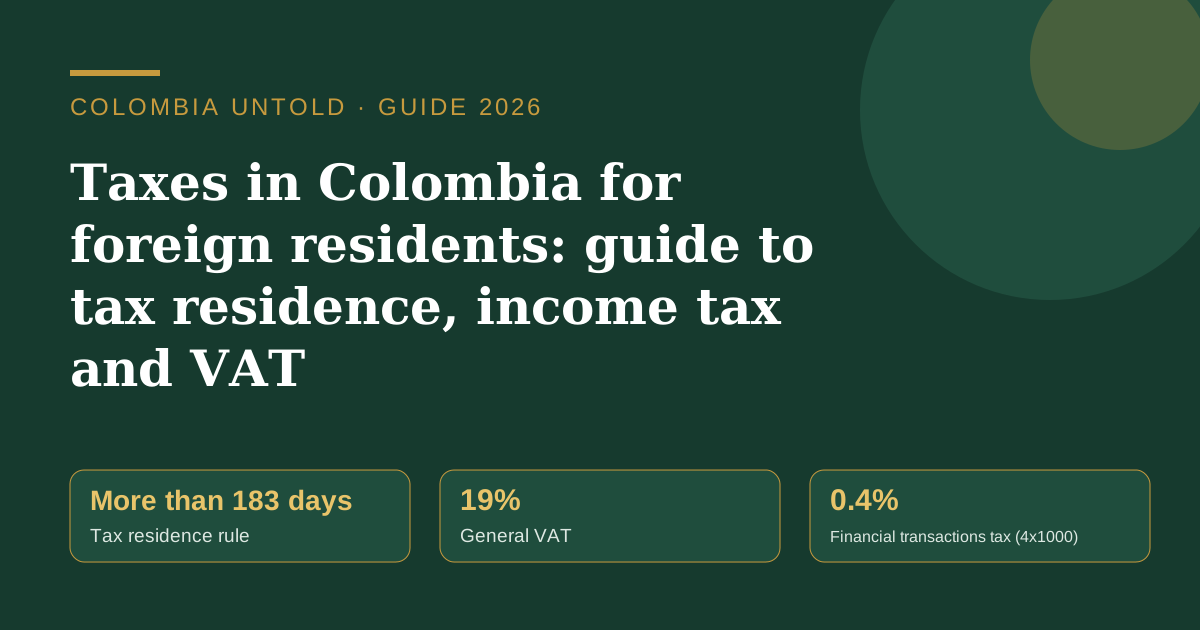
Quick answer: In Colombia you are a tax resident if you spend more than 183 days within any 365-day period. Residents are taxed on Colombian and foreign-source income and gains, while non-residents are taxed only on Colombian-source income. There are also 19% VAT, the 0.4% financial transactions tax (4x1000), property tax and the industry and commerce tax.
Taxes are the part of life in Colombia that most surprises foreigners who arrive without studying it. The reason is not that the system is impossible, but that a single decision, staying more or fewer than 183 days within a 365-day period, completely changes which income you declare and where. On top come VAT, the financial transactions tax, municipal levies and reporting obligations on assets abroad. This guide explains the logic of the system for the foreign resident: how tax residence is decided, what is declared, which taxes you pay in daily life, how to avoid double taxation and which errors produce penalties. Rates, thresholds and calendars change every year: confirm current figures with the DIAN and with a Colombian accountant. This content is informational and is not tax advice.
The key question: are you a tax resident?
Tax residence in Colombia does not depend on your visa or foreigner ID card, but on time spent in the country. In general terms, you are a tax resident if you remain in the country continuously or not for more than 183 calendar days during any period of 365 consecutive days. This has an important practical consequence: you can hold a resident visa and not be a tax resident, or be a tax resident without a resident visa. It also means trips, entry and exit days and each year's calendar deserve careful records. If you are near the limit, keep a log of dates with your stamps and your migration movements certificate. Read Basic taxes for foreigners in Colombia.
What changes if you are a resident or not
A tax resident is, in general terms, taxed on income and occasional gains from Colombian and foreign sources, that is, on worldwide income, and must declare net worth when it exceeds certain thresholds. A non-resident is taxed only on Colombian-source income, with its own rules and rates, and is usually subject to withholding on payments received from the country. That difference is why planning matters: a digital nomad who bills clients abroad can have very different obligations depending on whether they become a tax resident. Review Taxes for Digital Nomads in Colombia and Remote work in Colombia: general idea for foreigners.
The RUT: the first formal step
The Single Tax Registry is the DIAN system that identifies taxpayers. Many foreigners need to enroll in the RUT to open accounts, sign contracts, receive payments, buy or sell property or hire services. It is processed online or at DIAN offices with your identity document, and the NIT you receive is your tax identifier. Keep the RUT updated, with the right responsibilities and economic activities; an outdated RUT is a frequent source of invoicing errors and wrongful withholdings. Read Tax ID (RUT) for foreigners.
The income tax return for individuals
Income tax for resident individuals is progressive: a table by income ranges applies, expressed in tax value units, UVT, whose value the DIAN sets every year. Marginal rates on the highest incomes reach up to 39%, under the 2022 tax reform, although low incomes may be exempt or taxed at lower rates. There are deductions and exempt income, such as mandatory pension contributions, home-loan interest within limits and other items, subject to caps. The return is filed each year on a calendar based on the last digits of the NIT, normally between August and October. Confirm the calendar and the figures for the tax year on the DIAN website.
Labor, capital and pension income
Income is classified into schedules, for example labor, capital, non-labor and pensions, with different rules for each. A person receiving a foreign pension who is a tax resident should check how that income is treated in Colombia and whether a treaty with the paying country modifies it. Rental income from a property, interest and dividends have their own treatment. One of foreigners' most common questions is whether they must declare income that already paid tax in another country: in general yes, if you are a tax resident, but the system provides mechanisms to avoid double taxation. Read Taxes for Foreign Pensioners in Colombia.
Double taxation and treaties
Colombia has signed treaties to avoid double taxation with several countries. These treaties allocate the right to tax certain income between the source country and the country of residence and usually define tie-breaker criteria when a person is resident in both. To use them you need to prove tax residence with the certificate issued by the competent authority, and sometimes submit specific forms to the payer. Colombian law also allows, under conditions, a credit for taxes paid abroad. The official list of treaties in force and their conditions is on the DIAN website; check it for your country. Read Tax residency certificate.
Assets and accounts abroad
Tax residents must report to the DIAN the assets they hold outside Colombia when they exceed a threshold in UVT, through an annual foreign-assets return. They must also include them in their income tax return and, when applicable, in the net worth return. Omitting foreign assets is one of the infractions with the highest penalties, and authorities exchange financial information with many countries. If you become a tax resident, make an inventory of your accounts, investments, real estate and crypto-assets outside the country and ask an accountant how to declare them. Do not assume "no one will find out".
Net worth tax and occasional gains
There is a net worth tax that applies, in general terms, to people with net worth above a high threshold expressed in UVT; if your assets are larger, consult an accountant about your situation. The occasional gains tax, for its part, taxes certain extraordinary income, such as the sale of fixed assets held for two years or more, inheritances, bequests and prizes, at a rate different from ordinary income. These concepts matter if you sell a property or receive an inheritance. Read Real Estate Taxes for Foreigners in Colombia and Property Tax (Predial) in Colombia.
VAT: the everyday tax
The sales tax, VAT or IVA, has a general rate of 19% on many goods and services, with excluded or exempt categories, such as certain basic foods, health services or education. You pay it in the price of what you buy, and businesses collect and declare it. If you run a business, VAT becomes a periodic filing obligation. For travelers and residents, the key is to know that the final price usually includes VAT, and that payment receipts with a tax ID and company name are needed if you ever need to support an expense. Read Taxes for Foreigners with a Business in Colombia.
The 4x1000 and the financial system
The Financial Transactions Tax, known as 4x1000, is a 0.4% tax on many withdrawals, transfers and account movements. There are exemptions, such as a savings account designated as exempt up to a monthly amount, and you must ask your bank to designate it. It is a cost to consider if you move capital frequently. Read The 4x1000 Tax in Colombia: What It Is and What It Means for You and How to open a bank account in Colombia as a foreigner: complete guide. Also consider fees and exchange-rate differences when moving money from abroad.
Local taxes: property, ICA and vehicles
Municipalities charge the property tax on real estate and the industry and commerce tax, ICA, on those carrying out commercial, industrial or service activities in their jurisdiction. Departments charge the vehicle tax. Rates and calendars vary from city to city, and many city halls offer early-payment discounts. If you rent out a property or run a business, review municipal as well as national obligations. These taxes are often the ones that most surprise foreigners, because they arrive by mail or digital channels and pile up if ignored.
If you run a business or work for yourself
Anyone carrying out an economic activity as an individual or through a company has additional obligations: an RUT with the right responsibilities, electronic invoicing, periodic VAT returns, withholdings, third-party reporting, ICA and social security contributions. An accountant with experience in foreign capital is an investment, not an expense. Read How to start a company in Colombia as a foreigner: step-by-step SAS guide and Cross-Border Remote Work in Colombia: The Permanent Establishment Risk.
Social security as an obligation
Although not a tax in the strict sense, health and pension contributions are an obligation for workers, employees and self-employed, and they influence the base of your income tax return. Self-employed people with income above certain amounts contribute on a legally defined base. If you hold a visa of more than three months, health enrollment is mandatory. Read Social Security and Pension for Foreigners in Colombia and Healthcare in Colombia for foreigners: EPS, prepaid plans, private policies and international insurance.
Penalties and common mistakes
Late filing, omitted income, inaccuracy, failing to enroll in the RUT and failing to report foreign assets generate penalties calculated on the tax, income or net worth, and which can accrue interest. The most frequent mistakes are confusing immigration residence with tax residence, not keeping a record of days of stay, ignoring the obligation to declare foreign income, not supporting expenses with invoices, not requesting the tax residence certificate, mixing personal and business accounts and waiting until the last day of the calendar. Preventive advice costs far less than a correction.
How to prepare during your first year
Record your days in the country, enroll in the RUT if you need it, keep invoices and payment records, organize the documents for your foreign income, check whether your country has a treaty with Colombia, ask your bank for annual certifications of interest, balances and withholdings, and consult an accountant before the filing date. If you plan to buy property or create a company, do it with written tax planning before you sign.
Our analysis
The Colombian tax system is manageable for those who understand it from the start, and costly for those who ignore it. The starting point is always tax residence: define whether you will exceed 183 days and which income you would have to declare. From there, the RUT, the return, treaties and foreign-asset obligations are organized with a trusted accountant. To align your immigration and tax situation, Colombia Visa Legal can guide you on the visa; to cover your health while you organize your paperwork, CoVisas and Protege Tu Viaje; and if your planning includes property in Medellín, Medellín Advisors and Premium Propiedades can accompany you in the purchase.
Frequently asked questions
When am I a tax resident in Colombia?
When you stay in the country more than 183 calendar days, continuous or not, within any 365 consecutive days. Tax residence does not depend on your visa.
Which income do I declare if I am a tax resident?
In general, your Colombian and foreign-source income and gains, that is, your worldwide income, plus reporting your assets abroad when they exceed the thresholds.
What about income that already paid tax in another country?
There are double-taxation treaties and mechanisms to credit taxes paid abroad, under conditions.
What is the 4x1000?
It is the Financial Transactions Tax, 0.4% on many withdrawals and transfers, with exemptions for some savings accounts that you must request from the bank.
What is the VAT rate?
The general rate is 19%, with excluded or exempt goods and services.
Do I need an RUT as a foreigner?
Many foreigners need it to open accounts, sign contracts, receive payments or buy property. It is processed with the DIAN and the NIT is your tax identifier.
What does a tax resident pay tax on?
Generally income and occasional gains from Colombian and foreign sources, under the rule.
What does a non-resident pay tax on?
Generally Colombian-source income. Specific rates and withholdings apply.
What is the DIAN?
It is the Dirección de Impuestos y Aduanas Nacionales, Colombia's tax authority.
Do I need to file an income tax return?
It depends on income, assets and other thresholds.
What is the GMF?
It is the 4x1000, a 0.4% tax on financial movements, with some exemptions.
What is the UVT?
It is the Unidad de Valor Tributario, updated yearly and used to set thresholds and penalties.
Are there double taxation treaties?
Colombia has treaties with several countries.
Is my foreign pension taxed?
It depends on tax residence and the applicable treaty.
What is the wealth tax?
A tax on net worth above certain thresholds, under the law.
What is e-invoicing?
The digital tax document that obligated taxpayers must issue. Your accountant can tell you if it applies.
What penalties exist for not filing?
Penalties and interest, calculated under the rule. Meet the deadlines.
How do I get an RUT?
At the DIAN, online or in person, with your ID.
Must I declare assets abroad?
Tax residents may have obligations to declare foreign assets.
What is the tax year in Colombia?
The taxable year matches the calendar year, from 1 January to 31 December.
When is the individual income tax return filed?
Between August and October of the following year, depending on the last digits of the NIT and the calendar set by the Government.
What is the NIT of an individual?
It is the tax identification number, assigned to individuals when they register in the RUT.
What is employment income (rentas de trabajo)?
It is the income a person receives from salaries, fees and personal services, taxed at progressive rates.
What are occasional gains (ganancias ocasionales)?
They are extraordinary income such as the sale of a fixed asset held for over two years, inheritances or prizes, with their own rate.
What is withholding tax (retención en la fuente)?
It is an advance of income tax withheld by the payer of an income and remitted to the DIAN.
What is VAT and who pays it?
It is the value-added tax, paid by the final consumer within the price and collected by those responsible, with a general rate of 19%.
What is the property tax (predial)?
It is the annual tax on real estate, charged by each municipality based on the cadastral valuation.
What is the industry and commerce tax?
It is a municipal tax paid by companies and independent professionals for commercial, industrial and service activities.
What is the simple tax regime (régimen simple)?
It is an optional regime for small businesses that unifies several taxes into a single return with rates by activity.
What is the income and net worth return?
It is the annual return in which income, deductions, net worth and debts are reported to the DIAN.
If you want guidance on migration requirements, you can contact Colombia Visa Legal. When a procedure is online, Cancillería recommends doing it directly; professional guidance helps you understand the process, it does not replace the official source.
Key figures and data
| Item | Value | Note |
|---|---|---|
| Tax residence rule | More than 183 days | Within any 365 consecutive days |
| General VAT | 19% | Some goods and services are excluded or exempt |
| Financial transactions tax (4x1000) | 0.4% | Levy on financial movements |
| National tax authority | DIAN | Runs the RUT, income tax, VAT and tax calendar |
Official sources and reliable reading
Related guides
- Jobs and work permits in Colombia for foreigners: which visa you need
- Business opportunities in Colombia for foreigners: sectors, routes and risks
- Best bilingual and international schools in Colombia: how to choose for your children
General information based on current rules and practice; it may change. Confirm your case with the official source or an authorized professional. Not legal, tax or medical advice.