Landline and intercom in Colombian condominiums: what foreign tenants need to know about phone lines, entry systems and internet
Updated: 13 October 2026 · Colombia Untold
Quick answer: In a horizontal-property building or complex (propiedad horizontal), the intercom and front-desk system are part of the building, while the landline and internet are contracted separately with a carrier. Before renting, ask whether the unit already has a line or fiber installed, who holds the service, how visitors and couriers are authorized and what the administration fee is. Service complaints go first to the carrier and, if unanswered, to the Superintendence of Industry and Commerce.
When you arrive at an apartment in Colombia you soon discover that "the phone" has several layers: the intercom connecting you to the front desk, the landline some carrier installed years ago, the fiber that provides internet and, sometimes, an app or code-based access system for visitors. In horizontal property these layers are split between what belongs to everyone (common areas, front desk, general wiring) and what is yours (your service contract and equipment). This guide helps you understand that boundary, ask the right questions before renting and solve the most common problems.
What horizontal property is and why it matters for your communications
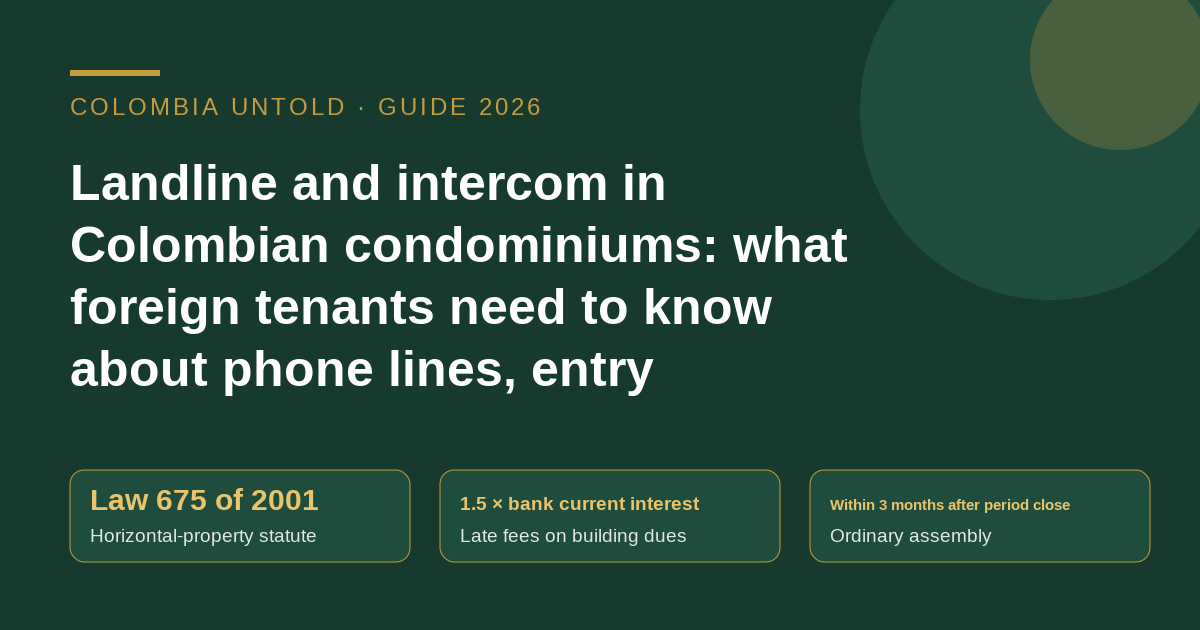
Horizontal property is the co-ownership regime governing buildings and complexes with private units (the apartments) and common property (front desk, elevators, technical rooms, ducts). It is governed by Law 675 of 2001 and each building's bylaws. An administrator manages the building under the council and the assembly. For you as a tenant it matters because the bylaws may define how antennas, cables or conduits are installed, who can enter the ducts and the rules for works. If you need to install a new service you will probably need to inform the administration and coordinate the technician's access.
Intercom, front desk and access control
The intercom is part of the building's security and access system, normally maintained with building fees. If it fails, report it to the administration and do not hire a repair yourself unless it is equipment inside your unit. Ask before renting: - Is there a 24-hour front desk or only certain hours? - How are visitors, delivery people and couriers registered? - Is there an access app or code, and who manages it? - Who authorizes entry of internet technicians or movers? For food and parcel deliveries, leave clear instructions at the desk: your name, tower and apartment. Many complexes require the resident to authorize each entry, so keep your current phone number in the front desk database.
The landline: what it is and whether you need it
Fixed telephony still exists in many buildings, but fewer people use it: most residents communicate by mobile and use fiber internet for app calls. A landline can be useful for procedures that require a fixed number, for poor mobile coverage or as a backup. If the apartment already has a line, find out who holds it (the owner, a previous tenant or you) and whether there are outstanding debts: service debts stay with the holder, so ask for a clearance statement before receiving or activating the line in your name.
Fiber internet in a building
Many cities have fiber installed in towers and complexes; in other cases the carrier must extend its network to your unit. Before renting: - Ask which carriers reach the building and at what speeds. - Check whether there is a network point or conduit in the apartment. - Ask the administration for authorization for the technician's entry and the work. - Find out whether the previous contract is still active. To compare plans see Fiber internet in Colombia: how to choose a plan, speed, router, Wi-Fi, backup and what to ask before contracting and Prepaid or postpaid mobile in Colombia: which suits a foreigner, minimum term, IMEI, number portability and complaints. For power cuts affecting your router, see Power cuts and UPS for remote work in Colombia: rights, compensation, runtime calculation and backup plan.
Contracting a service in your name
Contracting a landline or internet normally requires ID and sometimes a residence certificate or lease. Foreigners can contract with a passport or foreigner ID (cédula de extranjería) depending on the carrier's policy; check beforehand which documents they accept. The carrier must give you a contract with conditions, rate, minimum term (if any) and penalties. Keep a copy and review the termination clause. For identification procedures see Colombian foreigner ID card (cédula de extranjería): what it is, who needs it, requirements, costs and how to apply.
Complaints: carrier, administration and authorities
- Service failure: report first to the carrier through its channels and keep the ticket number. - Improper charge: file a written claim with the carrier; if it does not respond within the legal deadline, you can go to the Superintendence of Industry and Commerce, which handles telecom user complaints. - Damage in common areas or general wiring: the administration's responsibility; report it in writing. - Disputes with the administration: see Claims against the administrator and the HOA in Colombia: rights, steps, coexistence committee, sanctions and challenging decisions. The CRC regulates the user-protection regime for communications; its website explains your rights.
Who pays what
Building fees are paid monthly to the complex; the law makes owner and occupant jointly liable for ordinary expenses (Law 675, art. 29), and late payment accrues interest of up to 1.5 times the bank current interest rate (art. 30). The phone or internet service is paid by whoever contracts it. Check your lease to see who bears each cost and how bills are delivered; see Utilities and public services when renting in Colombia and Paying building administration fees in Colombia: what they cover, who pays, late interest, clearance, assembly and complaints.
When the line goes down or you move
If you move, notify the carrier in advance to end or transfer the service and check that the contract allows a change of address. If there is a minimum term, calculate the early-termination penalty before deciding. Return the equipment in good condition, ask for a receipt and make sure no charges remain. For the handover of the property use the inventory in Handover of a rented property in Colombia: inventory, photos, meters, record and clearance certificates.
Common mistakes
- Assuming the installed service is in your name or debt-free.
- Contracting without informing the administration and receiving penalties.
- Not keeping your phone updated at the front desk.
- Signing a minimum term without reading the penalty.
- Reporting failures only by phone, without a ticket number.
- Losing the carrier's equipment when you move.
Quick checklist before signing the lease
Check whether the apartment has a fiber point, a working intercom, an active landline and who holds each service. Ask about access rules, works hours and the administration fee. Request in writing what the owner commits to deliver. If something does not work, note it in the handover record so you do not pay for earlier damage. See Checklist before signing a lease in Colombia: clauses, maximum rent, increases, guarantees and red flags.
Security and privacy at the front desk
Your data (name, apartment, phone) is kept in front-desk records. Ask how they are protected and who has access. If you use an access app, avoid sharing your codes and review the list of authorized people periodically. To assess the security of your surroundings see Neighbourhood safety checklist for foreigners.
Real scenarios: how the most common cases get solved
Scenario 1: you arrive and the intercom does not ring. It may be a fault in your unit's device or in the general system. Ask a neighbor if the same happens to them. If it is general, report it in writing to the administration; if it is only your device, ask the administrator for the authorized technician's contact and agree with the owner who covers the repair under the lease.
Scenario 2: the internet technician cannot get in. Often the front desk requires prior permission. Notify the administration in advance, give date, time and company, and leave your name and apartment on the list. Ask whether there are restricted hours for works or installations on weekends and holidays.
Scenario 3: the carrier runs cables along the facade or common areas. This usually requires authorization from the administration or the assembly, because it affects common property. If the technician proposes an improvised solution, ask the administration to approve it before accepting; otherwise you could receive a warning or a charge.
Scenario 4: deliveries arrive and the front desk will not let them in. Check the protocol: some complexes receive parcels at the desk and others require you to come down. Update your phone number in the database and, if you use an access app, authorize entry from it.
Scenario 5: your internet contract outlasts your lease. Before signing a minimum term, confirm that you can transfer the service to your new address or assign it, and calculate the early-termination penalty. If you sign for 12 or 24 months and your lease is shorter, ask about no-commitment alternatives, even if their monthly fee is somewhat higher.
- Always ask for a ticket number.
- Keep emails, screenshots and replies.
- Photograph the condition of equipment and cabling on receipt and on return.
Final tips for foreign residents
Ask the administration for a copy of the bylaws and read them calmly: they set out the rules on works, noise, pets, moving hours and use of common areas. Introduce yourself to the administrator and leave a current contact number. If you are an owner, take part in the assemblies; if you are a tenant, tell the owner about any problem so they can raise it at the assembly. Keep your building-fee and utility receipts organized in a digital folder, with photos of the meters on receipt and on return. And if your Spanish is still limited, lean on a neighbor or a local advisor to draft your complaints, because a clear written complaint gets resolved faster. Keep every answer you receive, because a well-documented history of your requests is the strongest evidence if a dispute later reaches the owner, the administration or an authority.
Frequently asked questions
Do I need a landline in Colombia?
It is not mandatory. Many people use only mobile and fiber internet. A landline can help for procedures or as a backup.
Who fixes the building intercom?
It is common property and handled by the administration with the building fees. Report the failure in writing and do not hire a repair yourself.
Can I install internet without the administration's permission?
It is better to inform and coordinate, since the bylaws may regulate conduits and technician entry. Ask before scheduling.
What if the line has a previous tenant's debts?
Ask the carrier for a clearance statement before activating it in your name. Debts follow the contract holder.
Whom do I complain to if the carrier overcharges me?
First the carrier with a written claim; if it does not respond within the legal deadline, the Superintendence of Industry and Commerce.
Who pays the building fee, the owner or the tenant?
Toward the complex, owner and occupant are jointly liable for ordinary expenses (Law 675, art. 29); the lease defines who pays in practice.
Key figures and data
| Item | Value | Note |
|---|---|---|
| Horizontal-property statute | Law 675 of 2001 | Co-ownership regime in Colombia |
| Late fees on building dues | 1.5 × bank current interest | Law 675, art. 30 |
| Ordinary assembly | Within 3 months after period close | Law 675, art. 39, if bylaws say nothing else |
| Voltage and frequency | 110 V / 60 Hz | Type A and B plugs, useful when plugging in routers and phones |
Official sources and reliable reading
Related guides
- Electronic invoicing in Colombia for foreigners: who must invoice, RUT, DIAN, VAT, supporting document and service exports
- Living in Manizales: expat guide
- Medellín neighbourhoods for foreigners: El Poblado, Laureles, Envigado, Belén and more, how to choose
General information based on current rules and practice; it may change. Confirm your case with the official source or an authorized professional. Not legal, tax or medical advice.