Opening a bank account in Colombia as a foreigner: requirements, banks and pitfalls
Updated: 13 October 2026 · Colombia Untold
Quick answer: To open a bank account in Colombia as a foreigner you normally need a valid passport, a visa or foreigner ID card (cédula de extranjería), proof of address, the RUT or a declaration of economic activity and proof of income. Each bank applies its own level of scrutiny (SARLAFT), and digital accounts such as Nequi or Nu ask for fewer steps but have limits.
Opening a bank account is, for almost every foreigner settling in Colombia, the first great test of patience. Without an account it is hard to pay rent, receive a salary, bring in savings from abroad or even use the payment apps everyone in Colombia uses; with one, daily life flows. The problem is that banks are obliged to know each client in depth, and a newly arrived foreigner has the profile that raises the most questions: no local history, income from abroad and sometimes a visa still in process. This guide explains why banks ask what they ask, which documents to prepare, how the main options compare, what it costs to keep an account, how the 4x1000 tax works and which mistakes cost weeks. The information is general and requirements vary between institutions and over time; the bank’s own policy always governs, under the supervision of the Financial Superintendence.
Why banks ask for so many documents
All financial institutions in Colombia must apply a System for Managing Money-Laundering and Terrorism-Financing Risk, known as SARLAFT, under the instructions of the Financial Superintendence. In practice it means that before opening an account the bank must identify who you are, where your money comes from and what you will use it for. In addition, because of automatic tax-information exchange agreements such as FATCA and the CRS standard, banks ask about your tax residence and may report balances to your home country’s authorities. None of this is personal: the same know-your-customer file applies to a Colombian opening a first account, although you will be asked for more supporting documents because you have no local history. Understanding this changes the strategy. A bank officer does not decide whether they like you: they apply a checklist, and if something is missing the file stops. Your job is to deliver a complete, consistent and easy-to-review file, because contradictions, such as a different address in two documents, are the most frequent reason for delay.
Documents they almost always ask for
- Identity document: a valid passport plus visa, or the cédula de extranjería. Many branches require the cédula for full products; with a visa in process or visitor permission they usually offer only limited options or none. See Cédula de Extranjería: What It Is and How to Get It. - RUT or activity declaration: the DIAN’s Single Tax Registry is often requested, especially if you will have income or business activity. See Tax ID (RUT) for foreigners. - Proof of address: a utility bill, a lease or a certification; it must match the address you declare. - Proof of income: employment contract, income certificate, statements from abroad, your home-country tax return or, if self-employed, client contracts. Digital nomads should think about this from the start. - References: some banks ask for personal or banking references, or a previous account abroad. - Tax data: country of tax residence and taxpayer identification number for FATCA/CRS reporting. - Colombian email and mobile number: needed for authentication and notifications; get a local line first, as explained in Prepaid vs postpaid mobile. For the full list with examples see Bank account checklist for foreigners and the companion guide How to open a bank account in Colombia as a foreigner: complete guide.
Main options: traditional banks, digital banks and wallets
Traditional banks (Bancolombia, Davivienda, BBVA, Banco de Bogotá, Scotiabank Colpatria, Itaú, among others). They offer savings accounts, debit and credit cards, loans, insurance and investment, with branches and face-to-face service. They are the best option if you need full services, a mortgage or a long-term relationship, although they usually require more documents and charge management fees. Some have lines or officers for international clients and a smoother process if you arrive with a valid visa or cédula. Digital banks and neobanks (Nu Colombia, Lulo Bank, RappiPay and similar). They open from your phone, with less paperwork, no management fee in many cases and a very convenient app. They usually require a cédula de extranjería or accepted document, and their products are more limited. They are useful as a second account or for those who need to start fast. Wallets and low-amount accounts (Nequi, Daviplata). They let you receive and send money, pay bills and use QR codes, with caps on balance and monthly operations. Some allow registration with a passport or limited documents, though with low limits; to raise them a cédula is requested. Details in Nequi and Daviplata for foreigners: how to open them, limits and when to use them. Instant payments. Colombia has an instant payment system between accounts, driven by the Bank of the Republic, that lets you transfer immediately using keys and is integrated with the main apps. Having a local account gives you access to this infrastructure, which makes it easy to pay rent, deliveries and small shops without cash.
How to compare costs before choosing
Ask in writing for the fee of each product and compare these items: - Monthly management fee of the account and debit card, with the condition for it to be free. - Cost of ATM withdrawals on other networks and daily limits. - Cost of interbank transfers, bill payments and international transfers. - Currency-exchange commission and the exchange rate applied to international purchases. - Minimum opening amount and required average balance. - Fees for inactivity or for not meeting a minimum balance. The Financial Superintendence requires institutions to disclose fees clearly. If anything is unclear, ask before signing, and keep a copy of the terms and the fee table. To send money from abroad, compare alternatives in Sending money to Colombia: fees.
The 4x1000 tax (GMF) and the exempt account
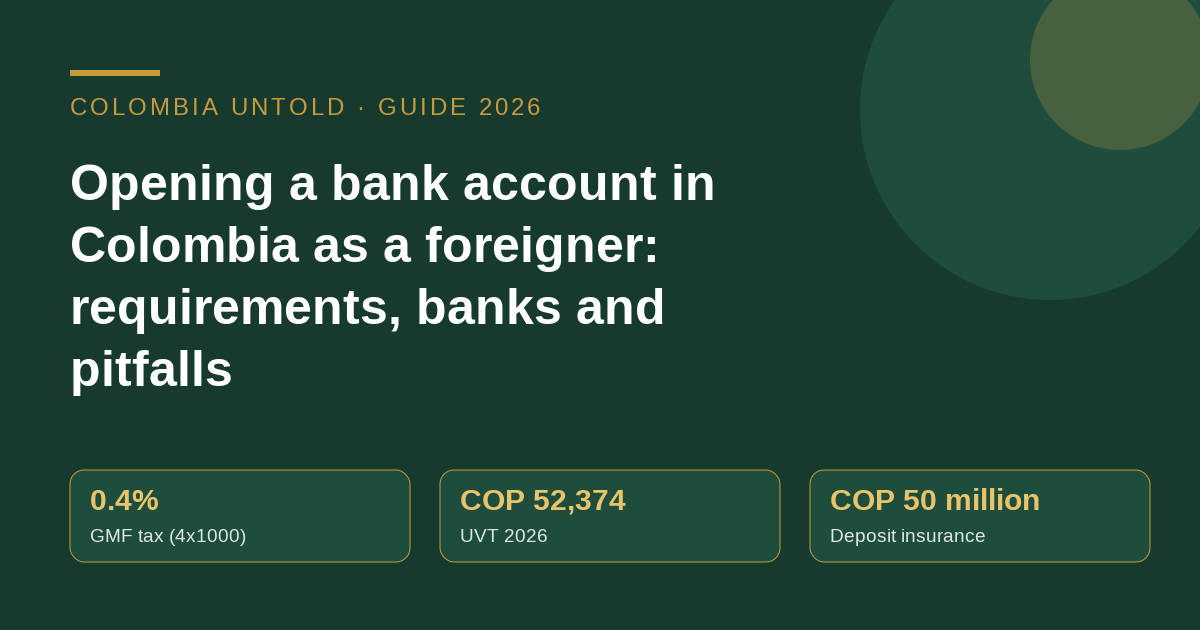
The Financial Transactions Tax equals 0.4% of each withdrawal or movement of money, and the bank deducts it automatically. There is one benefit: each person can mark a single savings account as exempt, up to 350 UVT per month. With a 2026 UVT of COP 52,374, the cap is about COP 18.3 million a month in operations without GMF. The marking is done with the bank by signing a form, and applies in only one institution. It is a useful decision for those moving large sums: choose the account you use most. Details for nomads are in The 4x1000 Tax in Colombia: What It Is and What It Means for You.
Security and protection of your money
Savings accounts at institutions supervised by the Financial Superintendence are covered by Fogafín’s deposit insurance up to COP 50 million per person per institution, covering principal and interest. Beyond that, your security depends on habits: never share the dynamic key or the code sent by message, distrust calls claiming to be from the bank, do not use ATMs in isolated places and activate notifications for every movement. In Dynamic keys and banks and ATMs and safety we explain the practices that prevent most fraud.
Frequent mistakes that delay opening
- Going with documents that do not match: a name spelled differently in the passport and the visa, or a different address in the lease and the RUT, stops the process.
- Arriving with only the visitor stamp: without a visa or cédula, most traditional banks do not open full accounts.
- Not explaining the source of funds: a large initial deposit without support triggers alerts.
- Choosing a bank for proximity rather than for the offer: management fees and digital limits weigh more than location.
- Forgetting to mark the GMF-exempt account: you will pay 0.4% needlessly.
- Handing over low-quality copies: an unreadable document is grounds for return.
- Hiring an intermediary who promises a “guaranteed account”: nobody can guarantee the bank’s decision; distrust advance payments without a contract.
A four-step opening plan
First, put your identity in order: valid passport, visa in good standing and, if you already have it, cédula de extranjería. Second, get the RUT if your situation requires it and a stable proof of address. Third, gather proof of income from abroad, with a simple translation if in another language. Fourth, book an appointment at the branch or start the online application with two parallel options, one traditional and one digital, so you do not depend on a single answer. If your case depends on the visa, a migration adviser such as Colombia Visa Legal can guide you so your migration paperwork is ready before going to the bank.
Savings or current account: which suits you
The savings account pays interest on the balance and is the usual option for individuals; the current account allows cheques and is usually for companies or people with business activity. For an expat’s daily life, savings is enough. See the full contrast in Savings vs checking account.
If you are within your first quarter in the country
During the first months it is normal to combine products: a starter digital account, a wallet for small payments and, when your visa or cédula are ready, a traditional account. The guide Banking and payments in the first quarter proposes a realistic order. Meanwhile, protect your trips and health with insurance: Protege Tu Viaje offers discounts of up to 65%.
Frequently asked questions
Can I open a bank account in Colombia with just a passport?
It depends on the product and the bank. Some wallets and low-amount accounts accept a passport with low limits; full savings accounts at traditional banks usually require a valid visa or cédula de extranjería. If you only have visitor permission, your options are more limited.
Why do they ask for the RUT to open an account?
Because the bank must know your economic activity and tax status, and the RUT certifies it with the DIAN. It is not always mandatory for a basic personal account, but it is frequently requested if you will receive income or carry out an activity.
What is the 4x1000-exempt account and how is it activated?
It is the savings account you mark with your bank so as not to pay the 0.4% GMF up to 350 UVT a month. You can have only one in the whole financial system; it is activated by signing a form at the institution, and the benefit applies to withdrawals and movements up to that cap.
Is my money insured if the bank fails?
Deposits in institutions registered with Fogafín are covered up to COP 50 million per person per institution, including interest. Anything above that limit is not covered, so it may be sensible to spread larger sums across institutions.
Can I receive my foreign salary into a Colombian account?
Yes. You can receive international transfers by SWIFT or remittance services, and the bank may ask for evidence of the source. Compare commissions and exchange rate, and make sure the payment is consistent with the activity you declared when opening the account.
How long does the process take once I hand over the documents?
At digital banks it can be resolved the same day or within a few business days. At traditional banks it usually takes one to two weeks, longer if the file needs additional review because you are a foreign client.
If you want guidance on migration requirements, you can contact Colombia Visa Legal. When a procedure is online, Cancillería recommends doing it directly; professional guidance helps you understand the process, it does not replace the official source.
Key figures and data
| Item | Value | Note |
|---|---|---|
| GMF tax (4x1000) | 0.4% | On withdrawals and transfers; one savings account can be marked exempt up to 350 UVT per month |
| UVT 2026 | COP 52,374 | Basis for tax and banking thresholds; 350 UVT ≈ COP 18.3 million |
| Deposit insurance | COP 50 million | Fogafín cover per person per institution |
| Typical opening time | 1 to 10 business days | Depending on the bank and document type |
Official sources and reliable reading
Related guides
- Checklist when returning to your home country
- Living in Santa Marta: expat guide
- Moving between cities in Colombia
General information based on current rules and practice; it may change. Confirm your case with the official source or an authorized professional. Not legal, tax or medical advice.