Internet contracts in Colombia: fine print, minimum terms, speed, cancellation and complaints for foreigners
Updated: 13 October 2026 · Colombia Untold
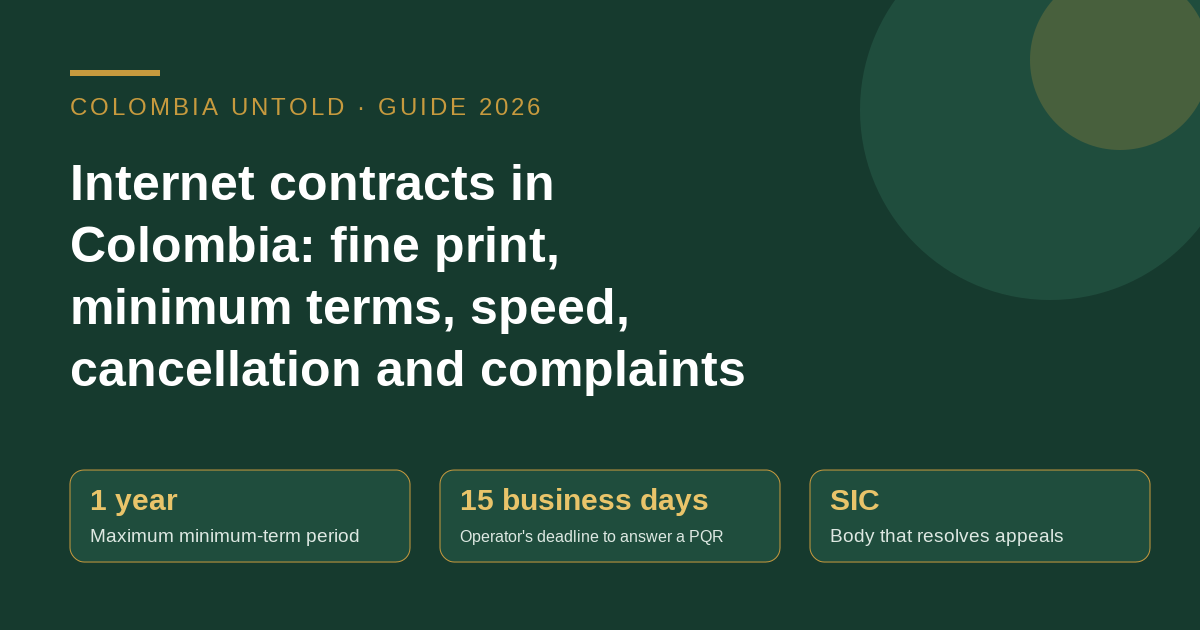
Quick answer: Before signing an internet contract in Colombia, review the minimum-term clause (at most one year and only with a real benefit), the cost of installation and equipment, contracted versus actual speed, rate increases and the cancellation procedure. If the operator does not answer a petition, complaint or appeal in 15 business days, positive administrative silence applies, and the Superintendency of Industry and Commerce handles appeals.
For a foreigner who works remotely, the internet is not just another service: it is the work tool. An installation that takes three weeks, a speed that bears no resemblance to the advertised one or an impossible cancellation can cost clients, income and patience. The Colombian internet market has good fiber coverage in the main cities, but contracts include clauses worth understanding before signing: minimum terms, equipment, installation charges, rate increases and cancellation procedures. This guide explains what the regulation says, what to check in the contract, how to handle procedures as a foreigner and how to complain when the service fails.
Who regulates the service and what your rights are
Law 1341 of 2009 sets the framework for information and communication technologies. The Communications Regulation Commission (CRC) sets the regime for protecting the rights of communications users, contained in Resolution 5111 of 2017 and its amendments, which regulates the contract, billing, minimum terms, petitions, complaints and appeals (PQR) and quality. The Superintendency of Industry and Commerce (SIC) oversees compliance with these rules and resolves users' appeals. The Consumer Statute (Law 1480 of 2011) complements the protection. Among your basic rights are receiving clear and truthful information before contracting, knowing the total price, receiving a copy of the contract, having an understandable invoice and having your claims handled through the channels the operator offers, including a free one.
What to check before signing
Rate and what it includes. Check the monthly amount, whether it includes VAT (19%), the promotional discount and when it ends. Many offers apply a low rate for a few months and then raise it. Ask what the full price will be from the month after the discount. Speed. Distinguish contracted speed (download and upload) from actual speed. For video calls and cloud work, upload speed weighs as much as download. On fiber optic, symmetrical speeds are usual; on other technologies, upload is typically lower. Ask which technology reaches the building. Installation and equipment costs. Ask whether there is an installation charge, whether the router is yours or on loan, what happens to the equipment at termination and whether there are costs for damage or loss. Demand the information in writing. Minimum term. It is the clause by which you commit to keep the service for a period in exchange for a benefit, such as a discount on installation or equipment. Under the CRC regime, it is valid only if the operator grants you a real benefit and it cannot exceed one year. If you cancel earlier, the charge must be proportional to the benefit received and the time remaining, not a fixed penalty. Read the start and end dates carefully. Rate increases. Ask whether there are annual increases and how they are notified. Operators must report changes, and you may terminate the contract if you do not accept them under the legal conditions. Technical support and repair times. Ask about the support line, hours and technical-visit deadlines. If you work from home, this matters as much as speed. Bundled contract. Many offers combine internet, television and telephony. Minimum-term clauses and cancellation charges become more complex; check which services you can cancel separately.
Being a foreigner: requirements and obstacles
To contract fixed internet, the operator usually asks for ID (foreigner ID card or passport), service address and sometimes verification of payment capacity through a credit-bureau check. A newly arrived foreigner with no credit history in Colombia may face a demand for a deposit, a co-signer or prepayment of some months. If the home is in a third party's name, the operator may ask for a copy of the lease or the owner's authorization. The alternative is for the service to be in the owner's name or that of a trusted third party, which is worth documenting in the lease; see Utilities in a foreigner’s name and How to rent an apartment in Colombia as a foreigner: full process, documents and pitfalls. For mobile phones, prepaid plans let you use the service without history, and a Colombian line is indispensable for banks and wallets; see Dynamic keys in Colombian banks: what they are, how to activate them, what to do without a local number and how to avoid fraud. If fixed internet is not viable on arrival, a mobile data plan with hotspot works as backup and temporary solution; see Power cuts and remote work in Colombia: a backup plan for electricity and internet.
Check coverage before contracting
Availability changes by building, sometimes by floor. Ask neighbors which operator works best and have the operator confirm technical feasibility in writing. Some buildings have exclusivity contracts with a single operator. Also check the apartment's network points: the router's location conditions the signal in the workspace. If you need coverage in several rooms, evaluate repeaters or mesh systems. If you will work with important video calls, run a speed and latency test before committing to a long term.
Installation and the first days
Ask for a specific installation date and confirm by message. Check that the technician uses suitable materials and that the connection reaches the place where you will work. Run speed tests at different hours during the first week, by cable and wifi, and keep screenshots. If actual speed is consistently below the contracted one, you have grounds to complain. Keep the contract, installation invoice, visit records and reference numbers of every contact.
Billing: what to look at each month
Check that rates match what was agreed, that discounts are applied, that there are no charges for services you did not request and that the billing period is as expected. If there is a charge you do not recognize, you have the right to complain before the due date without being suspended over the disputed amount. Pay the undisputed amounts to avoid cut-offs. Telecommunications services are billed with VAT, which you will see on the invoice. If you work as a freelancer, keep invoices for your tax records; see Tax residency certificate in Colombia: who is resident, how to request it from the DIAN and what it is for.
How to cancel without surprises
Review the contract to know the end date of the minimum term, the notice period and the valid channels. Request cancellation through a channel that leaves a record (service line with reference number, virtual or in-person office, email) and keep the proof. The operator must accept the request through the same medium through which you contracted. Ask in writing for the exact amount of any early-termination charge and check that it is proportional. Return loaned equipment at the indicated point and ask for a delivery receipt. Check on the next invoice that no later periods have been charged.
Complaining: petitions, complaints and appeals
If you have a problem, the first step is to file a petition, complaint or appeal (PQR) with the operator through its service channels, and obtain a reference number. The operator has 15 business days to respond. If it does not respond in that period, positive administrative silence applies, meaning that what you requested is deemed resolved in your favor, as long as the legal conditions are met. If the answer does not satisfy you, you can file an appeal for reconsideration and, alternatively, an appeal to a higher authority, which the SIC resolves. Present your arguments clearly, attach evidence (invoices, screenshots, contract) and respect deadlines. For improper charges and repeated failures, you can also go to the SIC's consumer protection mechanism. Keep everything in a digital folder.
Mobile services and packages for nomads and remote workers
If you work from different cities, a mobile plan with generous data, a backup SIM with another operator and a portable hotspot provide redundancy. Some coworking spaces offer high-performance connections; see Coworking contracts in Colombia: membership types, clauses, business address and how to negotiate. For power-cut planning, see Power cuts and remote work in Colombia: a backup plan for electricity and internet. For procedures and payments, see Banking and payments in your first 90 days in Colombia: cards, cash, wallets and your first account.
Digital security of the service
Change the router and wifi password when installing, update the firmware, disable remote administration if you do not need it and use a guest network for visitors. For sensitive work, use a reliable VPN and enable two-step authentication on your accounts. Do not share your access data in messages. Operators will not ask for your banking passwords; distrust calls posing as them.
Frequent mistakes
Signing without reading the minimum term. Accepting the promotional offer without knowing the later price. Not asking for feasibility in writing. Not keeping reference numbers. Canceling only by phone without proof. Paying a termination charge without asking for the calculation. Not testing real speed. Leaving the service in the name of someone who later leaves. Confusing download speed with upload speed.
Checklist before signing
Technology (fiber or not) and confirmed feasibility. Contracted download and upload speed. Full price after the discount. Installation and equipment charges. Minimum term, dates and proportional cancellation charge. Rate increases. Support and repair times. Contract holder and required documents. Copy of the contract and the offer. PQR channel and reference number. Before deciding, compare at least three offers in writing, including the full price over twelve months, and choose the one that best balances cost, stability and exit flexibility, not just the one with the most eye-catching introductory discount. A cheaper plan with a long lock-in and slow repairs usually ends up costing more, in money and in lost working time, than a slightly pricier plan with reliable support and a short or no minimum term.
Frequently asked questions
How long can a minimum-term clause last?
Up to one year under the CRC's user protection regime, and only if the operator grants you a real benefit. The early-cancellation charge must be proportional.
Can I contract internet as a foreigner?
Yes. They normally ask for a foreigner ID card or passport and verification of payment capacity. Without credit history you may face a deposit, co-signer or prepayment.
What do I do if speed is lower than contracted?
Run documented tests at different times, file a PQR with a reference number and request correction or a discount. If unresolved, you can appeal to the SIC.
How long does the operator have to answer my complaint?
15 business days. After that period without an answer, positive administrative silence applies if the legal conditions are met.
How do I cancel the service?
Request it through a channel that leaves a record, keep the reference number, return equipment with a receipt and check the next invoice for later charges.
What if the building has only one operator?
Ask about exclusivity conditions before renting. If there is no fiber alternative, consider a mobile data plan as backup.
Key figures and data
| Item | Value | Note |
|---|---|---|
| Maximum minimum-term period | 1 year | CRC user protection regime |
| Operator's deadline to answer a PQR | 15 business days | After that, positive administrative silence applies |
| Body that resolves appeals | SIC | Superintendency of Industry and Commerce |
| VAT on services | 19% | Shown on the invoice |
Official sources and reliable reading
Related guides
- Dance classes in Colombia: salsa, bachata, vallenato and how to build your social network by dancing
- Laundry and dry cleaning for expats
- Banking and payments in your first 90 days in Colombia: cards, cash, wallets and your first account
General information based on current rules and practice; it may change. Confirm your case with the official source or an authorized professional. Not legal, tax or medical advice.