What competitive advantages does Colombia have over other Latin American countries?
By Francisco Viloria · Updated: 13 October 2026
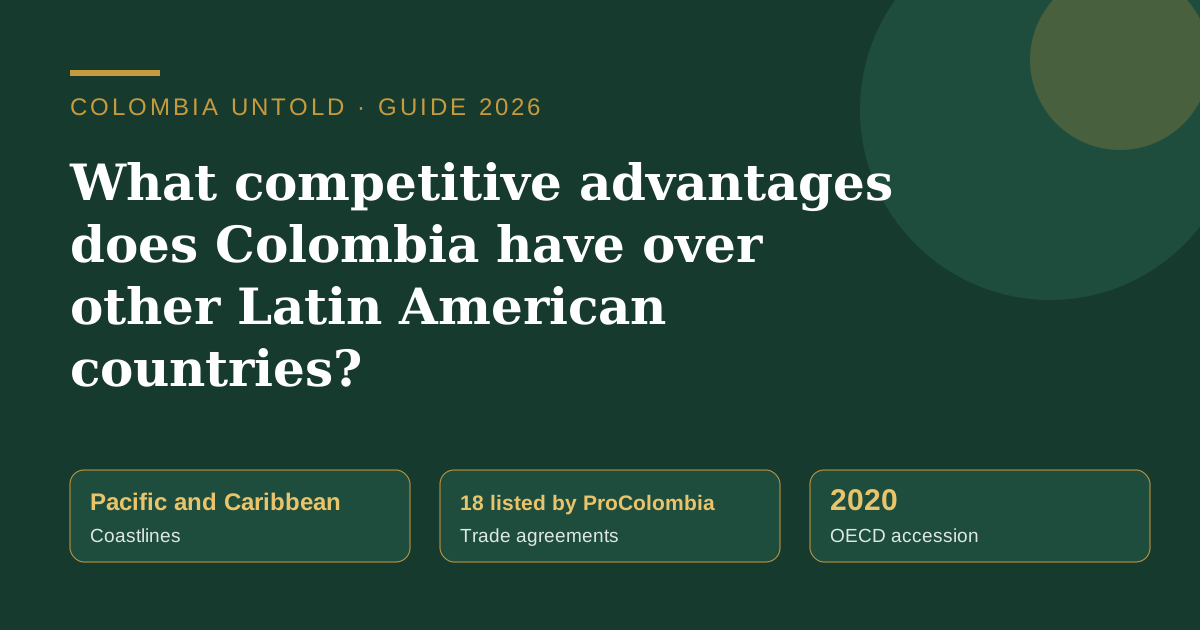
Quick answer: Colombia's competitive advantages are its location in northwestern South America with Pacific and Caribbean (Atlantic) coasts, a large population, growing human talent, a network of trade agreements reaching over 1,500 million consumers, geographic diversity and OECD membership since 2020.
When an investor, entrepreneur or remote professional decides where to settle in Latin America, they compare countries on many factors: stability, costs, talent, connectivity, market and quality of life. Colombia usually appears in that comparison because of a combination of traits that is hard to replicate: its location, its two coastlines, its population, its network of trade agreements, its human capital and its diversity of climates and regions. This guide analyzes those advantages with judgment, without exaggeration, and also points out the limitations to keep in mind. It does not aim to rank Colombia above other countries, because every economy in the region has its own strengths; it aims to help you decide whether these advantages fit your project.
What "competitive advantage" means for a foreigner
A competitive advantage is a trait that makes one place more attractive than another for a specific purpose. For an exporter it may be logistics; for a services company, talent; for a remote professional, the time zone and cost of living; for a real estate investor, demand and regulation. That is why the useful question is not whether Colombia is "better" but better for what. With that idea, we review the most-cited advantages and what evidence supports them.
Strategic location
Colombia lies in northwestern South America, in a position that connects it with Central America, the Caribbean and the rest of the continent. That location, near the Panama Canal and the hemisphere's main air and sea routes, makes direct flights to many cities in the Americas and Europe easier. For companies that want to serve several markets from a central point, proximity to North and Central America is an argument. It is no guarantee of efficiency: the quality of ports, roads and customs procedures weighs as much as geography.
Access to two oceans: Pacific and Caribbean
Colombia is the only South American country with coasts on both the Pacific Ocean and the Caribbean Sea, which opens to the Atlantic. This gives it sea access to Pacific and Atlantic markets. The Pacific connects with Asia through the port of Buenaventura, and the Caribbean with North America and Europe through ports such as Cartagena, Barranquilla and Santa Marta. For foreign trade it is a structural advantage, although infrastructure and overland connections between the Andean and port regions remain a challenge. If your business depends on logistics, evaluate times, costs and road conditions.
Network of trade agreements
ProColombia lists 18 trade agreements that give access to more than 1,500 million consumers, including treaties with the United States, the European Union, Canada, Mexico, South Korea, EFTA, Chile and Israel, plus the Pacific Alliance and the Andean Community. This network is one of the reasons some companies choose to produce or assemble from Colombia. To understand each agreement and what it means in practice, read What are Colombia's main trade agreements? FTAs with the US, European Union, Canada, Mexico, the UK and South Korea.
Human talent
Colombia has a large population, with more than 50 million inhabitants according to DANE projections, and a growing supply of professionals in areas such as services, technology, engineering, health, finance and customer care. Interest in bilingualism and the university offering in cities such as Bogotá, Medellín, Cali and Barranquilla are an asset for global services companies. Talent is concentrated in big cities, and differences in educational level between regions are a reality. If you hire staff, understand the labor rules; read Local employment contract and visa and Payroll as a foreigner.
Time zone and remote work
Colombia is on UTC-5 and does not observe daylight saving time, so its time matches the US East Coast during northern winter and is one hour behind its summer time. For teams working with North America, that alignment is practical. For remote professionals, add the supply of coworking spaces, connectivity in big cities and the digital nomad visa; read Time zones and remote work from Colombia and Digital nomads Colombia 2026.
Geographic and climate diversity
Colombia has coasts, mountain ranges, valleys, Amazon rainforest, plains and altitude zones ranging from tropical heat to moorland cold. That diversity lets one economy produce coffee, flowers, fruit, energy, minerals and services, and lets resident foreigners choose their climate and lifestyle: a high-altitude city, a temperate valley, the coast or the coffee region. It is one of the reasons for expat interest in the country. If you are choosing a city, read Best cities to live in Colombia for expats: comparison.
OECD membership and institutional framework
Colombia has been a member of the Organisation for Economic Co-operation and Development (OECD) since 2020. Accession meant adopting practices and standards in areas such as governance, trade, investment and regulation, and serves as a signal of institutional commitment for some investors. The country also has an independent central bank and a formal foreign investment regime. OECD membership does not remove the challenges, but it is a relevant fact when evaluating the environment. Consult the country profile on the organization's site.
Domestic market and consumption
With a large population and a growing urban middle class, Colombia offers an attractive domestic market for consumer goods and services, health, education, tourism and technology. For someone setting up a company, having a significant local market reduces dependence on exports alone. Competition, informality and purchasing power vary by region and segment, so it is wise to research the market before investing.
Energy, resources and sustainability
The country has an electricity mix with a significant share of renewable sources, in particular hydropower, and potential in solar and wind. It also has natural and mineral resources and great biodiversity. These traits can be an advantage for energy, agribusiness and nature tourism projects, but they also carry climate risks, such as those associated with El Niño, and debates over environmental licensing. Evaluate with specialized advice.
Quality of life and cost for residents
For resident foreigners, the competitive advantage translates into quality of life: cities with services, a moderate climate in several regions, a cost of living that in many cities is lower than in developed economies and established expat communities. Compare your budget with your own data, not averages: read Cost of Living in Medellín 2026: Complete Breakdown and Cost of Living in Bogotá 2026. If you plan to buy or rent housing in Medellín, Medellín Advisors and Premium Propiedades can guide you.
Opportunities by sector
Some sectors are commonly mentioned as opportunities: global services and technology, tourism and health tourism, agribusiness, renewable energy, logistics, real estate and the creative economy. Each has its own dynamics, rules and risks, and none is a sure bet. For business, see Opening a SAS as a foreigner in Colombia, Importing and Exporting from Colombia as a Foreigner and Colombia vs. Panama vs. Mexico: Where to Invest.
The limitations you should consider
An honest evaluation includes the challenges. Road and logistics infrastructure is uneven, and mountainous geography makes transport more expensive. Safety varies by region and risks persist in some areas; read Safety in Colombia: what expats should know in 2026. Labor and business informality is high, the tax system is complex, bureaucracy can be slow and the exchange rate is volatile. Policy and government changes can alter tax and regulatory rules. Keeping these factors in mind avoids decisions based on enthusiasm.
How to compare Colombia with other countries in the region
Define your criteria and assign weight to each: cost, taxes, legal certainty, talent, air connectivity, language, climate, available visas and expat community. Compare with official data and with the experience of residents in each country, and visit before committing. A useful comparison does not look for a universal winner but the best fit for your case. For a comparison with two regional destinations, see Colombia vs. Panama vs. Costa Rica: Best Retirement Destination and Colombia vs. Panama vs. Mexico: Where to Invest.
The immigration dimension
An advantage only counts if you can use it legally. Define the visa that backs your activity, whether investment, work, digital nomad or pensioner. Each category has economic requirements usually expressed in SMMLV, and for 2026 the minimum wage is COP 1,750,905. Read Colombia Visa Types: A Complete Explained Guide and Colombia investor visa 2026. If you need to sort out your status, Colombia Visa Legal and CoVisas can guide you.
How the advantage looks from each profile
An exporter looks at ports, customs and agreements; a services entrepreneur at talent, labor costs and time zone; a remote professional at internet, coworking spaces and cost of living; a retiree at climate, health and visa; a real estate investor at demand, returns and legal certainty. That is why the same feature of Colombia can weigh heavily for one profile and almost nothing for another. Before deciding, write down your three priorities and review what official evidence says about each. If your profile is that of a pensioner, read Is Colombia a good place to retire? Advantages, costs, visa and risks for foreigners.
Which official data to consult
To compare rigorously, rely on official sources and international bodies: DANE for population, employment and inflation; the Banco de la República for rates, exchange rate and foreign investment; the Ministry of Commerce, Industry and Tourism and ProColombia for trade and investment; and the OECD for cross-country comparisons. Verify the date of each data point, because figures change every year, and avoid basing a decision on a single metric or isolated headlines.
Our analysis
Colombia's advantages are real, but they combine, and their value depends on your project. Location and two coastlines matter if your business is logistics or export; talent and time zone, if you serve North America; climate and cost, if you come to live. The limitations, such as infrastructure, bureaucracy and regulatory risk, are equally real. The best decision is usually made with a trial period, verified data and local advice. For exploratory visits and stays, you can quote travel coverage at Protege Tu Viaje.
Frequently asked questions
What are Colombia's main competitive advantages?
Its location in northwestern South America, coasts on the Pacific and the Caribbean, a large population, human talent, a network of trade agreements, climate diversity and OECD membership since 2020.
Is Colombia the only South American country with Pacific and Atlantic coasts?
Yes, it is the only South American country with coasts on both the Pacific Ocean and the Caribbean Sea, which opens to the Atlantic.
Is Colombia better than other Latin American countries for investing?
It depends on your project. Each country has its own strengths; compare logistics, taxes, talent, legal certainty and costs for your case.
What are Colombia's disadvantages?
Uneven infrastructure, bureaucracy, informality, tax complexity, exchange-rate volatility and security risks in some areas.
What time zone is Colombia in?
UTC-5, with no daylight saving time, which aligns it with the US East Coast in winter.
What visa do I need to take advantage of these benefits?
It depends on your activity: investment, work, digital nomad, pension or another. Each category has its own requirements that you should confirm with the Foreign Ministry.
Where is Colombia located?
In northwestern South America, with Caribbean and Pacific coasts, which helps maritime trade.
How large is its economy?
It is one of the region's larger economies. See recent figures from DANE, the Banco de la República and bodies like the IMF and World Bank.
What advantages does its talent offer?
A young, educated population and a growing supply of bilingual professionals, according to official indicators.
What advantage does biodiversity bring?
It is a megadiverse country, driving ecotourism, agribusiness and the green economy.
How does the time zone help remote work?
Colombia uses UTC-5 year-round, with no daylight saving, making coordination with the Americas and Europe easier.
What digital infrastructure is there?
Main cities have good connectivity, though it varies by region.
What advantages does it have over other countries in the region?
It depends on the criterion; climate diversity, market size and trade agreements are often cited.
What drawbacks should I consider?
Regional inequality, safety in some areas and bureaucratic procedures.
What is the cost of living like?
It is often moderate compared with other countries, but varies by city.
Which sectors are growing?
Services, technology, tourism, energy and agribusiness are among the sectors of interest. See ProColombia.
Is Colombia an OECD member?
Yes, it joined in 2020 according to the OECD.
What is the investment climate like?
There is legal protection for foreign investment and trade agreements; regulatory risks exist.
Which cities are business hubs?
Bogotá, Medellín, Cali and Barranquilla are major hubs.
What is the official language?
Spanish. English is useful, especially in corporate and tourist settings.
Is it easy to start a business?
The SAS simplifies company creation, though procedures call for advice.
What is Colombia's population?
About 52 million people, one of the largest in South America.
What is Colombian coffee and why is it famous?
Colombia is one of the world's main producers of mild arabica coffee, with the Coffee Cultural Landscape recognized by UNESCO.
How many national parks does it have?
More than fifty protected areas make up the National Natural Parks system, with jungle, páramo, coast and desert ecosystems.
What advantages does its location offer for trade?
It has Caribbean and Pacific coasts, allowing maritime trade with both oceans, and is close to North America.
What advantages does it offer as a tourism destination?
A variety of landscapes, culture, food, beaches, mountains and jungle in a single country, with growing tourism.
How does the health system compare to other countries?
It has near-universal coverage through insurance, with well-regarded private clinics in the region.
How strong is the startup ecosystem?
Bogotá and Medellín host most of the country's startups and fintechs, with strong regional venture capital presence.
What advantages does it offer for remote work?
A time zone compatible with the Americas, a moderate cost of living, good connectivity in major cities and a digital nomad visa.
Which cities are most attractive for real estate investment?
Medellín, Bogotá, Cartagena and Barranquilla, depending on the city and property type.
Where can I get advice on real estate investment in Medellín?
Medellín Advisors and Premium Propiedades accompany foreign investors in Medellín.
Key figures and data
| Item | Value | Note |
|---|---|---|
| Coastlines | Pacific and Caribbean | Only South American country with coasts on both oceans |
| Trade agreements | 18 listed by ProColombia | Access to more than 1,500 million consumers |
| OECD accession | 2020 | Colombia is a member of the organization |
| Time zone | UTC-5, no daylight saving time | Aligned with the US East Coast in winter |
Official sources and reliable reading
Related guides
- What are Colombia's main trade agreements? FTAs with the US, European Union, Canada, Mexico, the UK and South Korea
- Is Colombia a good place to retire? Advantages, costs, visa and risks for foreigners
- Colombia digital nomad visa: requirements and application guide 2026
General information based on current rules and practice; it may change. Confirm your case with the official source or an authorized professional. Not legal, tax or medical advice.