Basic life insurance for expats in Colombia: how much to insure, beneficiaries, misrepresentation, claims and repatriation
Updated: 13 October 2026 · Colombia Untold
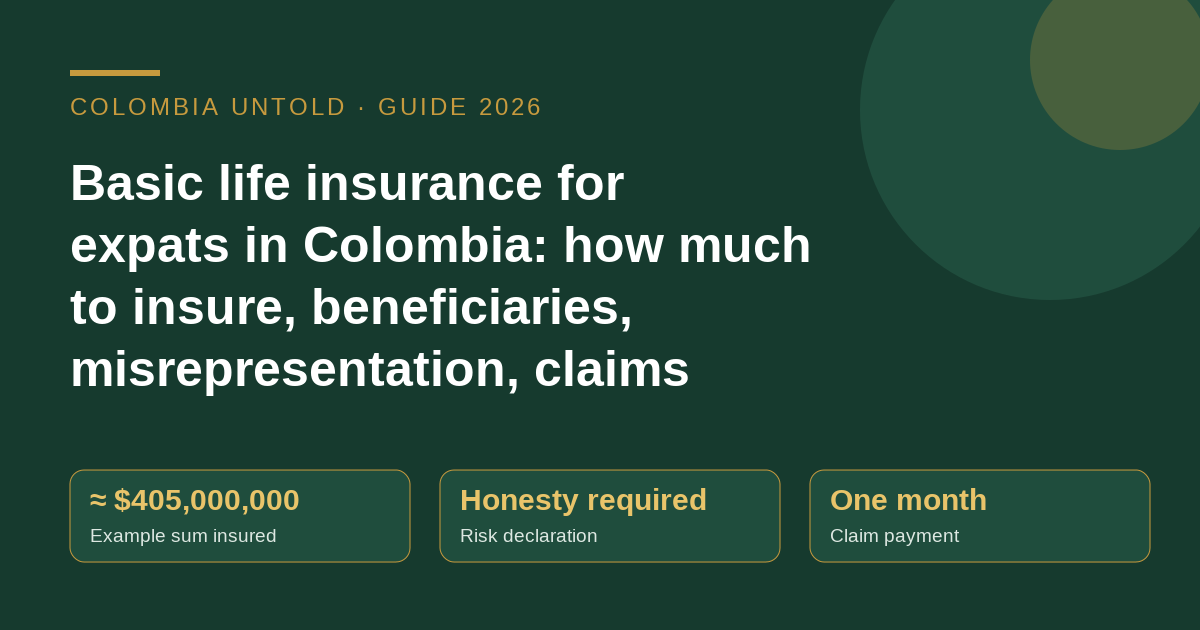
Quick answer: Life insurance pays a sum to your beneficiaries if the insured dies. To decide how much to insure, add up what your dependents would need (expenses × years), debts and final costs, and subtract savings. In this guide's example, a household spending $6,000,000 a month, covering 5 years, with $80,000,000 of debt, $15,000,000 of final costs and $50,000,000 of savings needs ≈ $405,000,000. Declare your health honestly (Commercial Code, art. 1058) and name beneficiaries in writing.
Talking about life insurance is talking about protecting the people who depend on you if you are gone. For an expat the topic has extra layers: beneficiaries may live in another country, a death means procedures in two jurisdictions, repatriation of remains is costly and debts (rent, loan, school) do not wait. This guide explains the basic types of life insurance, how to calculate how much to insure with a method, what you must declare, how to name beneficiaries, how to claim and what mistakes to avoid. The figures in the examples are hypothetical and the rules cited come from the Commercial Code.
What life insurance is and is not
In life insurance, the insurer commits to pay a capital sum to the designated beneficiaries when the insured dies (and, depending on the product, in case of disability or serious illness). It is not savings or an investment, except in mixed products with a savings component. It is a risk transfer: you pay a premium and, if the event occurs, your beneficiaries receive a sum. Term life insurance covers a defined period (for example, 10, 20 years or to a certain age) and is usually the cheapest; whole-life insurance covers the whole life and is more expensive; life insurance with savings or investment combines cover and capital and requires a careful reading of costs and surrender values. For most expats with dependents, term insurance with a well-calculated sum insured is the starting point. There are also debt-linked life policies (for example, one that covers a loan balance) and group life policies that some employers offer. Check whether your employer offers one and what its conditions are: it usually ends when you leave the job. Other related covers, like funeral plans, are explained in Funeral plan for foreigners in Colombia: what it covers, procedures after a death, repatriation, cremation and how to compare, and health protection in Health insurance for expats in Colombia: EPS, prepaid medicine, policies and international cover compared with method and example.
How much to insure: a needs method
The question "how much should I insure?" is answered with a needs calculation. Add three blocks and subtract what you already have. First, income replacement: how much your dependents would need each month to live, multiplied by the number of years you want to cover (until the children finish school, for example). Second, debts: loans, cards, obligations you don't want to leave behind. Third, final costs: funeral, repatriation, legal procedures. Subtract available savings and liquid investments and other insurance you already hold. Example of our own arithmetic with hypothetical figures: monthly household expenses of $6,000,000; years to cover: 5; debts: $80,000,000; final costs: $15,000,000; available savings: $50,000,000. Income replacement: $6,000,000 × 12 × 5 = $360,000,000. Sum: $360,000,000 + $80,000,000 + $15,000,000 = $455,000,000. Minus savings: $455,000,000 − $50,000,000 = $405,000,000. That would be the capital suggested by the method. If the years to cover were 10, income replacement would be $720,000,000 and the capital $765,000,000. The method does not claim precision, but gives you an order of magnitude for comparing quotes. Adjust the values to your case, consider inflation and review the sum insured whenever your life changes: a new child, a debt, a change of country.
What you must declare: the insured's honesty
The insurance contract rests on good faith. Whoever takes it out must honestly declare the facts and circumstances that determine the state of the risk, according to the insurer's questionnaire (Commercial Code, art. 1058). If there is misrepresentation (hiding or misstating relevant facts, such as an illness or a habit like smoking), the contract may be relatively void, meaning the insurer can invoke that nullity and deny payment. That is why you should answer the health questionnaire precisely, even if something seems minor. If in doubt, ask the intermediary how to declare it and keep a copy of the signed questionnaire. A higher premium or a known exclusion is better than cover that can collapse when you claim.
Beneficiaries: how to name them well
The beneficiary is who receives the capital. You can name one or several people with percentages and, if you wish, substitute beneficiaries. Do it in writing on the policy or through the insurer's form, and update it if your life changes (marriage, separation, birth of a child, death of a beneficiary). For foreigners, write the full name as it appears on the passport, document number, relationship, country of residence and contact details; the insurer will have to locate the beneficiary and verify identity, and transcription errors are a cause of delays. If the beneficiary is a minor, ask how payment is administered. If you name no beneficiaries, the capital may go to heirs under the succession regime, with longer procedures. See Notary and powers of attorney for foreigners in Colombia: authentications, apostille, translations, general and special powers, sworn statements and costs for the use of documents and powers of attorney between countries.
Costs and what determines them
The premium depends on age, sex, health, smoking, occupation and the risk sports you practice, the sum insured and the term. The older and the larger the sum, the higher the premium. In term insurance, the premium is usually fixed or rises by bands. Ask for comparable quotes (same sum insured and same term) and compare exclusions too: suicide in the first years, dangerous sports, high-risk activities, travel to certain areas, pre-existing illnesses. Ask whether the insurance covers death from any cause anywhere in the world, or only in Colombia.
If you live in Colombia and your beneficiaries are in another country
Clarify three points with the insurer: whether it pays beneficiaries residing abroad, in what currency and by what means; what documents it will require and whether it needs an apostille or translation; and how long payment takes. Beneficiaries will need the death certificate, the death civil registry, a copy of the deceased's and the beneficiary's ID, and the claim form. See Civil registry for foreigners in Colombia: birth, marriage and death, apostille, translation and children's nationality for registry and apostille procedures. If the death occurs in Colombia, notify your country's embassy or consulate.
Repatriation of remains: a cost that gets forgotten
Moving remains to another country involves health procedures, cremation or embalming, a coffin or urn approved for air transport, and freight. The cost can be significant and the procedures demand speed. Some travel and life insurance policies include repatriation of remains; funeral plans with repatriation cover also exist. Check in your policy whether it is included and up to what amount. If it is not, consider adding the cost of repatriation to final costs in the sum insured calculation. See Funeral plan for foreigners in Colombia: what it covers, procedures after a death, repatriation, cremation and how to compare and Consulates and embassies in Colombia: when to contact them, what services they provide and how to ask for help.
How to claim and what deadlines you have
- Gather documents: claim form, death certificate and civil registry, ID of the insured and beneficiary, the policy and, if the insurer asks, medical records.
- Notify the insurer as soon as possible; the policy may set a notice period.
- The insurer must pay the indemnity within the month following the date the beneficiary shows the right (Commercial Code, art. 1080); if it delays, default interest accrues.
- Actions arising from the insurance contract are time-barred, in the case of the ordinary limitation period, after two years counted from when the interested party knew or should have known the fact giving rise to the action (art. 1081). So claim without delay.
- If the insurer objects to payment, ask for the reason in writing. You can go to the entity's financial consumer ombudsman and then to the Superintendencia Financiera de Colombia, or to the courts with a lawyer.
Life insurance and other covers: how they complement each other
Life insurance does not replace health insurance, disability cover or an emergency fund. If you have no dependents or debts, you may not need a large one; if you do, it is one of the most efficient protections. For short stays, travel insurance with accidental death cover and repatriation may be enough; you can quote with Protege Tu Viaje (Protege Tu Viaje), with discounts of up to 65 % depending on plan and conditions. For long-term residents, term life insurance is complemented by social security; see Social security and pensions for foreigners in Colombia: health, pension, occupational risk, freelancers, treaties and the pension reform to understand what the pension system covers in case of death (survivors). For your budget, Budget for your first 90 days in Colombia: method, template, worked example, buffer and mistakes.
Common mistakes
- Insuring an arbitrary sum without calculating needs.
- Hiding illnesses or habits in the questionnaire.
- Not updating beneficiaries after a life change.
- Not reading exclusions (sports, zones, pre-existing illnesses).
- Forgetting repatriation of remains in the calculation.
- Waiting to claim and missing deadlines.
Frequently asked questions
What is the difference between term and whole-life insurance?
Term covers a defined period and is cheaper; whole life covers the whole life and is more expensive. For many expats with dependents, term is the starting point.
How much should I insure?
Calculate household expenses × years to cover, add debts and final costs, and subtract savings. In this guide's example the result was ≈ $405,000,000 with hypothetical figures.
What happens if I don't declare an illness when taking out the policy?
There may be misrepresentation (Commercial Code, art. 1058) and the insurer could invoke the contract's nullity and deny payment. Always declare honestly.
Can my beneficiaries in another country collect?
In general yes, but confirm with the insurer the currency, payment method and documents (apostille or translation). Name beneficiaries in writing with complete details.
How long does the insurer take to pay?
It must pay within the month following the date the right is shown (Commercial Code, art. 1080). If it delays, default interest accrues.
How long do my beneficiaries have to claim?
The ordinary limitation period is two years from when the interested party knew or should have known the fact (art. 1081). It is best to claim as soon as possible.
If you need a medical plan or travel insurance for your visa or stay, CoVisas Colombia can guide you on plans that meet Resolution 5477. Always compare the coverages in writing.
Key figures and data
| Item | Value | Note |
|---|---|---|
| Example sum insured | ≈ $405,000,000 | Household expenses, debt, final costs and savings; hypothetical figures |
| Risk declaration | Honesty required | Commercial Code, art. 1058: misrepresentation can void the contract |
| Claim payment | One month | From when the right is shown (Commercial Code, art. 1080) |
| Ordinary limitation period | 2 years | From when the interested party knew or should have known (art. 1081) |
Official sources and reliable reading
Related guides
- Mail, packages and mailboxes in Colombia: buying from abroad, customs, VAT, couriers and a US address
- Living in Bogotá: expat guide
- Coworking contracts in Colombia: membership types, clauses, business address and how to negotiate
General information based on current rules and practice; it may change. Confirm your case with the official source or an authorized professional. Not legal, tax or medical advice.